
Switched on – Bruce Brubaker & Max Cooper – Glassforms (InFiné)

What’s the story?

The music of the so-called ‘minimalists’, led by Philip Glass and Steve Reich, has always provided a strong link between classical and electronic music, and has naturally inspired a number of artists positioned at that junction.

Reinterpretations of Glass and Reich have varied considerably though, from those who like to perform the music straight with no added frills to those who have added drum tracks and remixed them beyond almost all recognition. In that sense the music has been an inspiration, but it has on occasion proved difficult to get the balance right.

Pianist Bruce Brubaker and scientist / electronic music producer Max Cooper have teamed up for their own reinterpretation of the music of Philip Glass, approaching it with a view to adding subtle enhancements rather than radically changing its essence. Cooper has developed his own system for musical expression with Alexander Randon, taking live feeds from the piano to drive his own systems.

What’s the music like?

Brubaker performs well-known Glass piano pieces such as Mad Rush, Two Pages and Metamorphosis 2 with great sensitivity, to which Cooper adds the expressive studio touches and atmospherics. That may seem like straightforward solution, but both performers have to be careful to avoid over-egging what Glass has already done.

The pair link the originals with improvised music of their own. This is through a series of five preludes where Brubaker channels the spirit of Glass but brings in external influences from the likes of Liszt and Bach to galvanizing effect.

There are so many notes in the busy keyboard pieces such as Mad Rush that to do too much would not work – but here the judgement of both performers is right on the money. The piano parts are essentially the same, but Cooper cleverly highlights elements of the busy lines with his own spotlit textures, putting shards of white noise on the top of the likes of Mad Rush and opening out the sound with long bass notes, taking us from intimate beginnings to cinematic, big-venue textures. He does this without compromising the solitary world of a piece like Metamorphosis 2, and each one makes an unexpectedly weighty emotional impact.

While the reinterpretations of pieces like Tirol Concerto are excellent, Brubaker and Cooper’s interpretation of Two Pages is outstanding. It is ideally paced, the tracer lights of the keyboard operating over great waves of synthesizer pads, the chords shifting simply but with a devastatingly effective emotional payoff. So far each listen to this particular track has left a tear in the eye!

Does it all work?

Yes. It is immediately clear that Brubaker and Cooper hold the music of Glass in the utmost respect, but also that they know how to bring it forward and point it towards a slightly more club-orientated audience. There are no beats at any point, but the electronic sounds and textures bring them much closer – and Glass’s own rhythmic impetus is enough in any case. Each track is carefully woven and lovingly produced, and sounds great on headphones.

Is it recommended?

Very much so. Glass and Reich have had some excellent remix treatment in the last 25 years or so, but Bruce Brubaker and Max Cooper have really raised the game with this album, which is both wholly complimentary to Glass but offers something new in its own right. It is a really fine  achievement.

Listen

Buy

Listening to Beethoven #13 – Piano Quartet in D major WoO 36/2

Bonn around the year 1790. Artist unknown

Piano Quartet in D major WoO 36/2 for piano, violin, viola and cello (1785, Beethoven aged 14)

Dedication Thought to be Elector Maximilian Friedrich
Duration 20′

Listen

Background and Critical Reception

Having heard a deeply passionate work in the Piano Quartet in E flat major, we move on to distinctly sunnier climes with the Piano Quartet in D major, a slightly shorter work.

When talking about the Piano Quartets, Lewis Lockwood is convinced they are Beethoven’s first sign of greatness. ‘Despite the limitations of these works’, he says, ‘remarkable features crop up everywhere, above all in melodic inventiveness and in the larger layout of individual movements. As a major step forward from the little piano sonatas of 1783, these ensemble works show signs of maturity in the making.’

There are some weaknesses, however, ‘largely in the string writing and in his inability to integrate piano and strings effectively and idiomatically. They stand up not despite their direct indebtedness to Mozart – above all certain Mozart violin sonatas – but precisely because of it. They possess the voice of a beginner of genius who is steeping himself in Mozart’s ways and is trying to imitate them. For Lockwood, ‘they mark the beginning of a relationship to Mozart that remained a steady anchor for Beethoven over the next ten years as he moved into his first artistic maturity.

The D major work was the second of the three quartets when published – but we are sticking with Beethoven’s ordering, in which it appears third.

Thoughts

As with the Electoral Sonata in the same key, Beethoven’s use of D major allows him to create a work with a fully positive outlook – and it has the sort of unison beginning which we will certainly hear with greater conviction in his later output. There is lively interplay between the piano and strings, while the second theme is warm hearted and more legato (smoother). Even here though Beethoven strains at the leash on occasion, threatening to break off into distant keys before arriving at the more ‘accepted’ ones.

The slow movement is attractive but feels a bit long, clocking in at just under 10 minutes when performers used the composer’s prescribed repeats. There is however an intriguing bit near the end, as though Beethoven is considering breaking the rules – and the strings use pizzicato (plucking) for a short while, which changes the colour considerably. The end itself is surprisingly sombre. This only makes the return to D major a sunnier occasion, with a bracing tune to send the audience out on a high. Again this is a Rondo, Beethoven’s chosen vehicle for a finale nicely wrought again.

Recordings used and Spotify links

Christoph Eschenbach (piano), Members of the Amadeus Quartet (Deutsche Grammophon) – tracks 4 to 6:

Anthony Goldstone (piano), Cummings String Trio (Meridian) – tracks 6 to 8:

New Zealand Piano Quartet (Naxos) – tracks 7 to 9:

All three versions of this work are strong, but it is Christoph Eschenbach and the Amadeus Quartet members who bring the greatest energy and drive. Anthony Goldstone and the Cummings String Trio enjoy the sunny disposition of the piece. Good though the New Zealand Piano Quartet version is, the use of repeat and a slower tempo mean the middle movement feels that bit too long.

You can chart the Arcana Beethoven playlist as it grows, with one recommended version of each piece we listen to. Catch up here!

Also written in 1785 Mozart Piano Quartet no.1 in G minor K478

Next up Trio for flute, bassoon and piano in G major WoO 37

Listening to Beethoven #12 – Piano Quartet in E flat major WoO 36/1

Painting with a hillside view of Bonn around the year 1790. Artist unknown

Piano Quartet in E flat major WoO 36/1 for piano, violin, viola and cello (1785, Beethoven aged 14)

Dedication Thought to be Elector Maximilian Friedrich
Duration 23′

Listen

Background and Critical Reception

It is curious to note that this group of three works from 1785 mark Beethoven’s only encounter with the form of the Piano Quartet – piano, violin, viola and cello – and that he would not write any more original works for the combination in his career.

Yet, as we outlined in the C major work heard yesterday, they are important works in the young composer’s development. The E flat major work is the most adventurous, and the one to which Beethoven biographer Jan Swafford devotes most time. “In the massive Adagio assai that begins the Piano Quartet in E flat major, listeners then and later could only be stunned at the subtlety and depth of feeling, call it a certain wistful pathos, coming from a composer of age fourteen”, he writes. “This does not sound like learned rhetoric, like everything he had written before; it sounds like music from the heart. What had he experienced to arrive at such an outpouring? All that can be certain is that he had experienced his model, Mozart’s Violin Sonata in G major, K379 (which you can compare below)

Swafford writes of how “the gestures and the low, close harmonies are Mozart’s, and so is the Mozart tone: languid, seemingly suspended between conflicting emotions, peculiarly shadowed for the major mode.” He then notes how Beethoven ‘pushes every envelope’ – with directions for volume that are fortissimo rather than forte, with harmonic writing that moves to the outlandish key of E flat minor, unheard of in his day, and piano writing notable for its difficulty.

Thoughts

This is indeed remarkably profound music for a fourteen-year old to be writing. To start with a slow movement of such depth of feeling is striking to the listener with its hushed, reverent string chords and expansive rhetoric from the piano. The strings grow into the movement, making some rather beautiful harmonies together.

The second movement is even more remarkable. Not only does Beethoven use a key which was never heard in public – E flat minor – he does so with grit and determination, under the marking Allegro con spirito. The piano drives forward relentlessly, and the strings hang onto its coat tails, as though the composer wants to get somewhere quickly. The obdurate nature of the music continues the whole way through, barely letting up.

After such strife, the third movement eases off the Sturm and drang a little, for a dance-inflected tune that stays lightly on its feet. Even this turns out to be a little deceptive, however, as it is a theme and six variations that bring the strings in from the cold. Beethoven gives the second variation to a sweet triple-time variation led by the violin, while the third is unusually handed to the viola – Beethoven’s ‘second’ instrument. The fifth plunges into the minor key, with stormy reminiscences of the second movement, but then the violin takes control of a march-like finale before the piece ends rather suddenly.

Recordings used and Spotify links

Christoph Eschenbach (piano), Members of the Amadeus Quartet (Deutsche Grammophon) – tracks 1 to 3:

Anthony Goldstone (piano), Cummings String Trio (Meridian) – tracks 4 to 6:

New Zealand Piano Quartet (Naxos) – tracks 4 to 6:

The Amadeus Quartet and Christoph Eschenbach bring all the drama to the second movement, which is driven and just the right side of aggressive. Their variations might be a bit too sweetly flavoured for some, but they never lack in character.

Both the other versions are very good, too – Anthony Goldstone and the Cummings String Trio not quite as darkly shaded but still giving a passionate account, while the New Zealand Piano Quartet are particularly good in the theme and variations, with which they spend more time.

You can chart the Arcana Beethoven playlist as it grows, with one recommended version of each piece we listen to. Catch up here!

Also written in 1785 Haydn Symphonies: nos. 83 in G minor ‘La poule’ & no.85 in B flat major ‘La Reine’

Next up Piano Quartet in D major WoO 36/2

Listening to Beethoven #11 – Piano Quartet in C major WoO 36/3

How Bonn looked around the year 1790. Artist unknown
Piano Quartet in C major WoO 36/3 for piano, violin, viola and cello (1785, Beethoven aged 14)

Dedication Thought to be Elector Maximilian Friedrich
Duration 17′

Listen

Background and Critical Reception

There is a good deal of speculation that Beethoven played and improvised in front of Mozart when he journeyed from Bonn to Vienna in 1786. Reports on what actually happened – and indeed if the two composers met at all – are sketchy. Misha Donat, in his booklet notes to one of the recordings used here, says that ‘if, as we may assume, he (Beethoven) also showed him some of his compositions, they would almost certainly have included a set of three Piano Quartets, completed some two years earlier’.

These first examples of Beethoven chamber music set out in a musical idiom not used until now. This is surely a deliberate move by the 14-year-old composer, given the pressure he would have endured in either the string quartet or piano trio. Haydn and Mozart had made giant steps in those forms; the piano quartet – piano, violin, viola and cello – was untried, and it seems these early works even predate the two masterpieces offered by Mozart later the same year.

When published by Artaria, the works were re-ordered – but our listening reverts to Beethoven’s original plan, beginning with the C major work. When they were published – after Beethoven’s death – Lewis Lockwood notes they ‘so surprised even knowledgeable observers, including Ferdinand Ries, that they doubted Beethoven had written them at all, let alone at age fourteen’.

Beethoven thought highly enough of the first work in C major to recycle some of its themes in his Piano Sonata in F minor Op.2/1. Lockwood notes the work to be ‘clearly modelled on Mozart’s C major Violin Sonata, K296. You can decide for yourself here:

Thoughts

There is an attractive hustle and bustle about the C major Piano Quartet right from the start. Its first theme of the first movement (marked Allegro vivace – fast and lively) is a simple one, drawing the Mozart comparisons with its reliance on the notes of the ‘home’ C major chord. The piano has all the dressing, the strings content to provide accompanying roles as they might in a concert. The second theme is more lyrical but continues the piano’s dominance.

For the second movement we retreat to a slow tempo and close-knit scoring, the strings providing rich harmonic support to the piano’s melody. Soon the sweet tone of the violin takes the lead, bringing tenderness to the central section before all three strings enjoy reacquainting us with the first theme, Beethoven’s scoring nicely balanced at this point.

The third movement finale has a resolute quality. Led by the piano with a bright theme, it busies itself with developing that idea and introducing a fresh second theme, played on the piano over pizzicato (plucked) strings. The theme passes to violin – some of its most attractive music – before ending in a whirl of positivity.

Positive is definitely the word to describe this Piano Quartet, for it is a breezy first outing into chamber music for Beethoven. Even though he appears to be using Mozart as a model, there is more than enough evidence that he is at ease in this form, with an individual voice about to emerge.

Recordings used and Spotify links

Christoph Eschenbach (piano), Members of the Amadeus Quartet (Deutsche Grammophon) – tracks 7 to 9:

Anthony Goldstone (piano), Cummings String Trio (Meridian) – tracks 1 to 3:

New Zealand Piano Quartet (Naxos) – tracks 1 to 3:

Christoph Eschenbach and the Amadeus Quartet fly out of the traps in the first movement. The piano sound is a little ‘clangy’ at times, possibly due to the age of the recording, but this is a performance with plenty of energy.

The Goldstone / Cummings version goes off at quite a lick too. It has a thoughtful and considered slow movement, really nicely performed, while the third movement bustles along.

Finally the New Zealand Piano Quartet give a nicely nuanced performance on Naxos, with the best recording of the three sampled versions. Their interpretation is light on its feet.

You can chart the Arcana Beethoven playlist as it grows, with one recommended version of each piece we listen to. Catch up here!

Also written in 1785 Mozart Piano Concertos nos. 20 & 21

Next up Piano Quartet in E flat major WoO 36/1

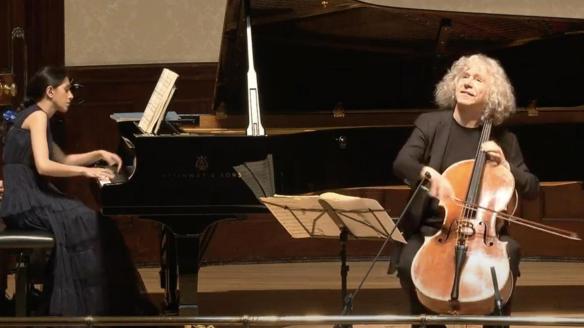
In concert – Steven Isserlis & Mishka Rushdie Momen @ Wigmore Hall

It must have been extremely special for Steven Isserlis to be playing the music of three of his favourite composers at the Wigmore Hall on this day – even more so as the date fell on the birthday of one of them, Robert Schumann.

He is one of the cellist’s greatest musical loves, and the sense persists that Isserlis is still discovering more things that make it so. One of Schumann’s many strengths is the versatility of his music, meaning pieces such as the 3 Romances Op.94, originally written for oboe and piano and given to his wife Clara as a Christmas present in 1849, can easily be performed with violin or, indeed, the cello.

Schumann’s birthday was marked by a performance of unaffected romantic beauty from Isserlis and pianist Mishka Rushdie Momen, very much on an equal footing playing the composer’s first instrument. The pair caught the doleful and slightly inquiring nature of the first romance beautifully, while the surge of feeling in the central music of the second was a strong cumulative wave. The third, its theme given in a darker shade, was briefly introspective in its unison phrases but then more overtly passionate.

Before Schumann came another ‘birthday’ composer. Beethoven’s 250th is not likely to receive quite so much live coverage as it would have done in a year without a pandemic, but what it lacks in quantity it will surely make up for in quality. The Sonata for piano and cello no.1 in F major, the first of a pair published as the composer’s Op.5, is the ideal concert opener. It begins in slight trepidation of what it is about to discover, but then, on establishing what is effectively a new form of writing for the cello and piano together, throws itself headlong into the rapids.

The Allegro that comes after that first sense of discovery was joyous indeed, with lovely dialogue in play between the two protagonists. Isserlis smiled frequently, as though revelling in the combination of favourite music and venue once again, while Momen’s clear phrasing dovetailed neatly with the cello’s, owning some of the really tricky right hand runs with fearless accuracy.

The second movement had a terrific burst of energy, the sun breaking through at every possible opportunity when its catchy theme made several reappearances. The pair also gave a nice air of mystery when Beethoven suddenly departed from ‘home’ and ended up in a number of seemingly unrelated tonal centres, before reassuring us with the warmth of the home key once again.

As he introduced his favourite 20th century cello sonata, there was a sense of Isserlis’ heart almost bursting with the chance to play music live again. He described his discovery of Fauré’s late music as ‘being outside a door but then passing through and wondering why on earth I had been outside’, before the pair played the Cello Sonata no.1 in D minor Op.108, the first of two such works from the Frenchman.

This was a very fine performance indeed, Isserlis and Momen watchful and urgent at the start, its music wracked with uncertainty but nonetheless pushing forward with great conviction. The Andante slow movement began lost in thought, the bell-like toll of the piano matched by Isserlis’ rich legato tone, before reaching heights of passion that the final movement also delivered, the performers now glorying in the major key and Fauré’s bursts of sunshine, the strong resolve of the first movement bringing its ultimate reward.

The pair finished with a profound account of Isserlis’ own transcription of a Bach chorale prelude, Ich ruf’ zu dir, Herr Jesu Christ, in which – as the cellist noted – Bach says it all.