Listening to Beethoven #187 – 15 Variations and fugue on an original theme in E flat major Op.35 ‘Eroica’

Beethoven-eroica

Portrait of Beethoven as a young man by Carl Traugott Riedel and Prometheus Bound by Peter Paul Rubens

15 Variations and fugue on an original theme in E flat major Op.35 ‘Eroica’ for piano (1802, Beethoven aged 31)

Dedication unknown
Duration 25′

Listen

What’s the theme like?

Although this piece is known as the Eroica Variations, the theme is taken from the finale to Beethoven’s music for Die Geschöpfe des Prometheus:

Background and Critical Reception

This substantial set of variations became known as the Eroica Variations because Beethoven used the tune in the finale of his third symphony, the Eroica.

Angela Hewitt describes the set as his most ‘bravura orientated’ variations, going on to illustrate how, before we even hear the main Eroica theme, Beethoven presents a theme in the bass and proceeds to unwind three variations on it. She notes how the theme and its fifteen variations ‘delight us with their compositional and pianistic fancies’.

Harold Truscott, writing in The Beethoven Companion, has some controversial views on Beethoven’s piano writing, branding it ‘on the borderline between difficulty and awkwardness. This is a quality frequently found in Beethoven’s keyboard writing’, he writes, ‘although no one ever mentions it’. He does, however, concede that ‘the Eroica set is a masterpiece for the most part unique in his work’.

Lewis Lockwood labels ‘this great work…the culmination of Beethoven’s early variations sets’. ‘In any case’, he writes, ‘Opus 35 is a milestone in the history of variation. Its introduction dramatically unfolds several elements in order, as if Beethoven, at the keyboard instead of writing in a sketchbook, was sequentially building the thematic material before the very ears of the listener.’

Thoughts

Where the previous set of variations in F major could be described as ‘not your typical set of variations’, this is something else. When you are done listening to the Eroica variations, this is a piece where you are left in no doubt that Beethoven has put his entire heart and soul into writing a piece, and has channelled some extraordinary powers of invention. By the end it is difficult to say exactly how many variations there are, as they seem to fuse into each other.

The introduction is pure drama – and Beethoven’s insistent B flats sound like a knock on the door, as though the theme is waiting to get in. When it does finally arrive the piece is already in full swing, and the mood is already buoyant. The theme and first variation have a spring in their step, the balletic origins laid clear – and as Beethoven gets to work, the dance gets faster.

The second variation is effectively a cadenza, showing off Beethoven’s virtuosity to the full – not just as a performer but as a composer too. His writing is quasi-orchestral, the fourth variation depicting a lively bassoon giving out the variation and strings plucking in the middle ground. Calmer waters are found for the fifth, but soon the textures are full again and the ideas overflowing. The piano writing is remarkably dense and demanding, but thrilling too.

Variation 7, marked Canone all’Ottava, anticipates the fugue but practically stamps on the keyboard at times. What the audience would have made of Beethoven’s bravura and daring is anybody’s guess. Varation 9 picks up a similar theme, where it feels like the B flat has got stuck, while the tenth is like a blast of cold air, disappearing up some odd tonal alleyways. We return to the ballet for Variation 11, the keyboard opens out in the 12th, before the 13th reintroduces the ‘stuck’ B flat in a jarring upper register, in an act both maddening and humorous!

A much-needed respite arrives with Variation 14, where we move to the minor key for a reflective episode. Far from running out of ideas with the ‘final’ variation, Beethoven feels like he has only just got started, and the lead-up to the fugue acquires impressive gravitas. The fugue itself is symphonic, its tune unusually hummable, with a lot of action between the parts.

At the risk of sounding like a cracked record, what a remarkable piece this is. Beethoven’s powers of invention are truly stretched, but the feeling remains that he could have written enough for another half hour of music without flagging. We will see an awful lot more of that invention as his pieces move further and further away from the norm.

Recordings used and Spotify links

Angela Hewitt (Hyperion)
Cécile Ousset
(Eloquence)
Ronald Brautigam
(BIS)
Alfred Brendel
(Philips)
Rudolf Buchbinder
(Teldec)
Glenn Gould
(Sony)

Some very impressive recordings here, not least the newest – a dazzling but extremely musical account from Hewitt, whose musicality always comes before the virtuosity. Emil Gilels is masterly from the commanding first chord and thoughtful theme. Cécile Ousset conveys the scope of the piece immediately, inhabiting the drama of the introduction, and having a lot of fun with the dance variations.

The Spotify playlist below includes all but one of the versions listed above – with the opportunity to hear a clip from Angela Hewitt’s version on the Hyperion website

Also written in 1802 Samuel Wesley Symphony in B flat major

Next up Symphony no.2 in D major Op.36

On record – Weinberg: Complete Violin Sonatas Volume Three (Yuri Kalnits & Michael Csányi-Wills) (Toccata Classics)

weinberg-violin-sonatas

Mieczysław Weinberg
Violin Sonata no.3 Op.37 (1947)
Violin Sonata no.6 Op.136bis (1982)
Solo Violin Sonata no.3 Op.126 (1979)

Yuri Kalnits (violin), Michael Csányi-Wills (piano)

Toccata Classics TOCC00096 [60’36”]

Producers Yuri Kalnits, Michael Csányi-Wills
Engineer Rupert Coulson

Recorded 9-12 July 2016 at St John’s Fulham, London; 7-8 July 2020 at K Studios, London (Solo sonata)

Written by Richard Whitehouse

What’s the story?

After a lengthy hiatus, Toccata Classics duly continues its series devoted to the violin sonatas by Mieczysław Weinberg with this third volume featuring two further sonatas with piano and the last of his solo sonatas – in performances comparable to those on the earlier two volumes.

What’s the music like?

It is a measure of how the Weinberg discography has grown that, in the decade or more since this cycle commenced, all the composer’s violin sonatas have now been recorded on several occasions. Good, then, that Toccata has opted to see it through as the interpretative stance of Yuri Kalnits and Michael Csányi-Wills is a persuasive one – not least for the subtlety of its interplay between violin and piano such as underlines the increasingly and flexibly idiomatic nature of Weinberg’s writing for a medium that remains problematic whatever its popularity.

With the Third Sonata (1947), Weinberg achieved an all-round assurance as is evident from the flexible handling of content within each of these progressively longer movements. Thus, the moderately paced initial Allegro exudes a purposefully provisional feel, fulfilled by the central Andantino with its achingly expressive deployment of Jewish folk elements, before being intensified in the final Allegretto cantabile that moves adeptly between eloquent and energetic ideas prior to a Lento coda which brings the work deftly and movingly full-circle.

Unlike its predecessors the Third Solo Sonata, dedicated to the memory of the composer’s father, unfolds as a continuous span which, though it can be viewed as several interrelated movements, is more akin to variational episodes on the motives heard at the outset. As if to underline this audacity, the writing for violin is the most resourceful and imaginative to be found in in any of these pieces – a heady succession of mood and textures such as reaffirms Weinberg’s technical and creative mastery when confronting apparent restrictions head-on. 

Weinberg abandoned the duo medium in the late 1950s and when the Sixth Sonata emerged, it went unacknowledged until 2007. Yet a work dedicated to the memory of his mother must have held a deeply personal significance. The initial Moderato, where the instruments come together only at the centre and are framed by an anguished prologue for violin then resigned epilogue for piano, speaks of intensely subjective emotion – as do the elegiac central Adagio and a finale which surveys previous material in a more consoling if ultimately fatalistic light.

Does it all work?

Yes, not least given the widely differing concept that underlies each piece (further proof that Weinberg repeated neither himself nor other composers), as well as the undemonstrative yet searching approach of the performers. Others may favour the commanding rhetoric of Linus Roth (Challenge Classics) or the forthright incisiveness of Stefan Kirpal (CPO), but the more understated manner of Kalnits and Csányi-Wills likely brings out the inward intensity of this music more completely. As a cycle for repeated listening, it should prove difficult to surpass.

Is it recommended?

Indeed, abetted by almost perfect instrumental balance and detailed notes by David Fanning. A fourth volume – which, other than the early Three Pieces, might feature the Sonata for Two Violins and Gidon Kremer’s arrangement of the 24 Preludes for cello – is keenly anticipated.

Listen

Buy

You can discover more about this release at the Toccata Classics website, where you can also purchase the recording. You can read more about Yuri Kalnits here, and more about Michael Csányi-Wills here

On record – Villa-Lobos: Choral Transcriptions (São Paulo Symphony Choir / Valentina Peleggi) (Naxos)

villa-lobos

Villa-Lobos transcriptions of:

Bach Prelude and Fugue no.8 in E flat minor / D sharp minor BWV853, Prelude no.14 in F sharp minor BWV883; Fugues – no.1 in C major, BWV846; no.5 in D major, BWV874; no.21 in B flat major, BWV866; no. 22 in B flat minor BWV867
Beethoven Adagio cantabile Op.13/2
Chopin Waltz no.7 in C sharp minor Op.64/2
Massenet Élégie Op.10/5
Mendelssohn Lieder ohne Worte in E major Op.30/3
Rachmaninov Prelude in C sharp minor Op.3/2
Schubert Ständchen D957/3
Schumann Träumerei Op.15/7
Villa-Lobos Bachianas Brasileiras no.9 W449

São Paulo Symphony Choir / Valentina Peleggi

Naxos 8.574286 [58’32”] English and Portuguese translations included

Producer Ulrich Schneider
Engineers Marcio Jesus Torres, Camilla Braga Marciano, Fabio Myiahara

Recorded: 5-10 August 2019 at Sala São Paulo, Brazil

Written by Richard Whitehouse

What’s the story?

Naxos’s coverage of the music of Heitor Villa-Lobos (part of this label’s series The Music of Brazil) continues with a selection of mainly transcriptions from the piano repertoire that the composer undertook during the mid-1930s as part of his extensive educational commitments.

What’s the music like?

Almost all these arrangements emerged in the period 1932-5, when Villa-Lobos took on the challenge of overhauling music education in the public school system of Rio de Janeiro. This involved the creation, virtually from scratch, of a choral pedagogy that he drew from across the spectrum of Baroque, Classical and Romantic music. It is a measure of his prowess that such transformation from mostly piano sources was accomplished with unfailing rigour and an idiomatic quality, so the fame of the originals is almost the only clue to their provenance.

From the soulful strains of among the most mellifluous from Mendelssohn’s Songs without Words, the programme then continues with the Eighth Prelude and Fugue from the first book of Bach’s The Well-Tempered Clavier – the former piece summoning a plangently rhetorical response which finds pertinent contrast with the latter piece’s methodical and intricate build-up to a culmination of sombre eloquence. The arrangement of Dreaming from Schumann’s Scenes from Childhood fully conveys its wistful pathos, as does that of the First Fugue from Bach’s WTC the original’s cool elegance. Similarly, the last of Schubert’s Serenade settings loses little of this song’s plaintiveness, and the Twenty-First Fugue from Bach’s WTC takes on unexpected jauntiness in what proves one of Villa-Lobos’s most inspiriting re-creations.

Chopin’s Waltzes might be considered unsuited to the vocal medium, yet the C sharp minor responds ably to such elaboration, as too the ruminative calm of the Twenty-Second Prelude from Bach’s WTC. Rachmaninov might have thought better of his Prelude in C sharp minor had he encountered this uninhibitedly dramatic realization, with basses providing the baleful anchorage, in contrast to the yearning aura drawn from the Fourteenth Prelude of the second book from Bach’s WTC. Massenet’s Elegy exceeds the original song for bittersweet poise, a foil to the serenity of the Fifth Fugue from Bach’s WTC. The indelible main melody from the Adagio of Beethoven’s Pathétique segues ideally into the Ninth Bachianas Brasileiras, with Villa-Lobos’s choral incarnation rather more atmospheric and evocative than that for strings.

Does it all work?

Almost entirely and due in no small part to the excellence of the São Paulo Symphonic Choir with its Italian conductor Valentina Peleggi. Lasting just under 60 minutes, the selection feels varied yet also cohesive enough to be enjoyed as a continuous programme, while enterprising choirs from both sides of the Atlantic ought to find much here to enrich their existing rosters. Inclusion of Villa-Lobos’s own music at the close is a reminder its technical demands should never be taken for granted, but here too the SPSC rises to the challenge with unstinting verve.

Is it recommended?

It is. The acoustic is just a little reverberant at times yet without detriment to the clarity of the choral writing, with informative annotations from Manoel Corrêa do Lago. Listeners should also investigate a recent Naxos release of Villa-Lobos’s first three violin sonatas (8.574310).

Listen

Buy

You can discover more about this release at the Naxos website, and you can also purchase the recording here. You can read more about conductor Valentina Peleggi here

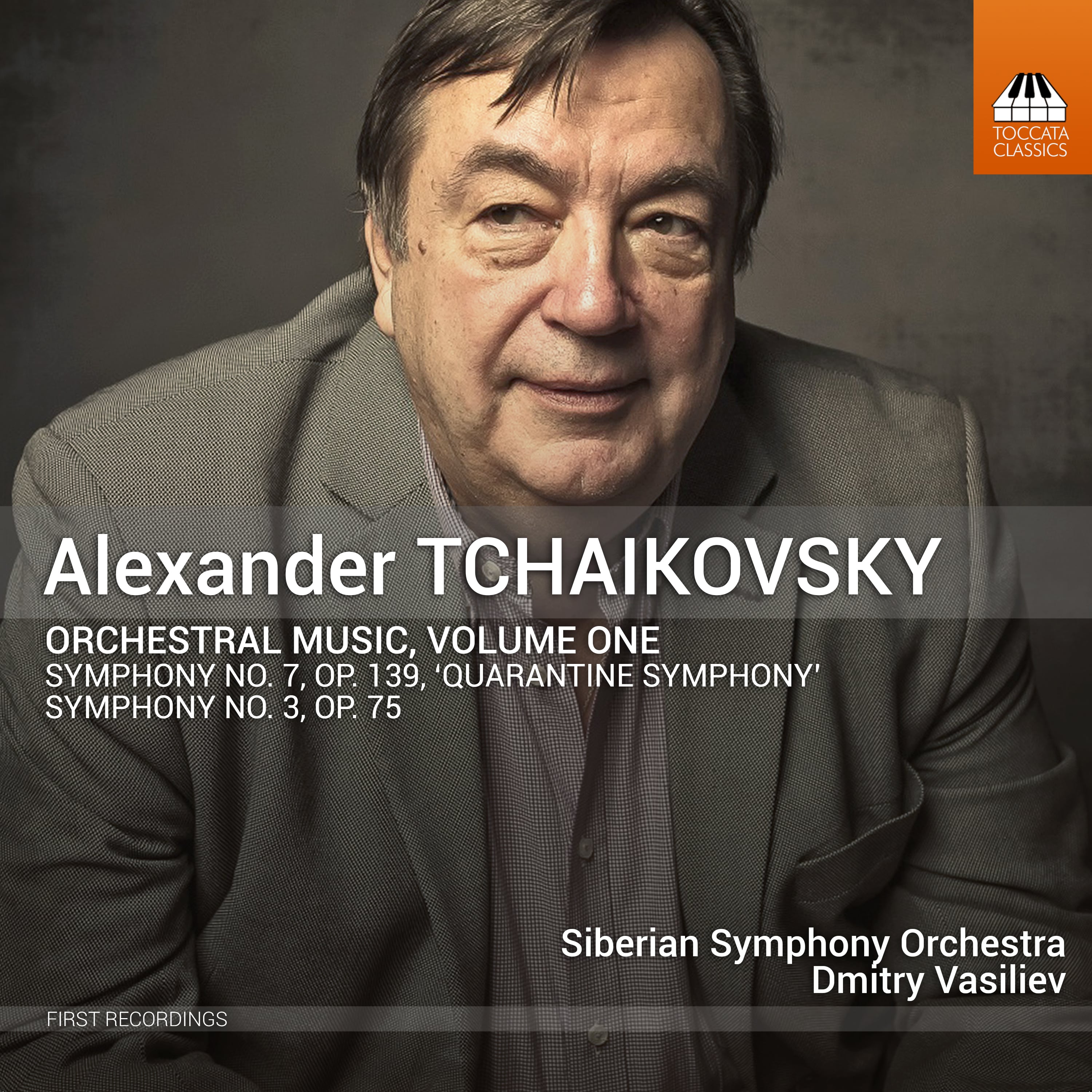
On record – Alexander Tchaikovsky: Orchestral Music Volume One (Siberian Symphony Orchestra / Dmitry Vasiliev) (Toccata Classics)

alexander-tchaikovsky

Alexander Tchaikovsky
Symphony no.3 Op.75 (1995-2002)
Symphony no.7 Op.139 ‘Quarantine Symphony’ (2020)

Siberian Symphony Orchestra / Dmitry Vasiliev

Toccata Classics TOCC0587 [60’12”]

Producer Vadim Dedik
Engineer Adaq Kahn

Recorded in live performances: 19 May 2019 (Symphony no.3), 20 September 2020 (Symphony no.7) at Philharmonic Hall, Omsk

Written by Richard Whitehouse

What’s the story?

Toccata Classics continues to investigate those paths lesser trod with this first instalment of symphonies by Alexander Tchaikovsky, likely the leading composer of the older generation in Russia, whose music is directly and audibly in the lineage of his geographical forebears.

What’s the music like?

Born in Moscow in 1946, Alexander Tchaikovsky is a nephew of composer and pianist Boris – but, in contrast to the latter’s selective output, has built an extensive catalogue featuring 14 operas (in addition to operettas and musicals) and three ballets, alongside numerous concertos and (to date) seven symphonies that frequently evince an illustrative or at least programmatic aspect. This is borne out in music highly evocative in import if without loss of that formal or expressive focus needed to sustain the two, wholly different, abstract arguments pursued here.

With its lengthy gestation and opulent instrumentation, the Third Symphony is a key work in the composer’s output. Its minimalist aspects occasioned more by Nielsen or Prokofiev than any post-war figure, the initial Allegro opens stealthily as its main theme gradually comes to the fore – tension increasing through a series of dissonant outbursts towards a massive climax across the orchestra that subsides into a sombre close. The central Allegro molto is described as ‘‘essentially a sequence of waltzes’’, which indicates its motion but not its stark emotional contrasts and violent denouement. It remains for the final Andante, proceeding without pause, to attempt a reconciliation; its furtive gestures opening-out onto a sustained expression whose restive and volatile content does not pre-empt the inexorability of the waltz music at the close.

Its title referring to the COVID-19 pandemic that occasioned its compact design and smaller forces (strings with percussion and piano), the Seventh Symphony comprises two movements. The first of these alternates between a plaintive Andante and trenchant Allegro molto, which latter gradually comes to the fore in a conclusion of unbridled abandon. Almost twice as long, the Adagio unfolds on the lines of a ‘prelude and fugue’ – the initial section sustaining a rapt eloquence that is intensified after the strings’ airy ascent and the commencement of the fugue in its methodical while deeply felt progress towards a fervent close. It is worth noting that the composer himself contracted the virus soon after completing this work – and which duly led to his missing the premiere in Omsk – but from which he has fortunately made a full recovery.

Does it all work?

For the most part, yes. This is music governed by the impulses as brought it to fruition, such that its underlying logic can be difficult to discern even on repeated hearings, while ensuring that a sense of destination – and arrival thereat – is never absent. The playing of the Siberian Symphony Orchestra is up to the standards of earlier releases for this label, Dmitry Vasiliev bringing a discipline and cumulative momentum to the often lengthy individual movements. There is little evidence of audience ‘presence’ in what are designated as live performances.

Is it recommended?

Indeed. The sound conveys the impact of these symphonies (the Third in particular) with no lack of immediacy, and there are insightful notes by pianist and composer Jonathan Powell. Hopefully more volumes of Alexander Tchaikovsky’s orchestral music will be forthcoming.

Listen

Buy

You can discover more about this release at the Toccata Classics website, where you can also purchase the recording. You can read more about Alexander Tchaikovsky here, and more about conductor Dmitry Vasiliev here

Playlist – K.D.A.P. (Kevin Drew)

It is our great pleasure to bring you a playlist from Broken Social Scene’s Kevin Drew…or K.D.A.P. as he is currently known for his solo activities.

K.D.A.P. (Kevin Draws A Picture) has not long released his Influences album, a fascinating document of his experiences ‘locked down’ in the English countryside. In that time Drew made very creative use of the Endlesss app, and as you will read in an interview with Arcana coming soon, he captured his natural experiences and sights on a form of musical film.

In our interview we also asked Drew for a playlist of the music he has been listening to of late, and he obliged with this:

Have a listen – you will hear music from Daniel Avery & Alessandro Cortini’s collaboration, two impressive works from Gigi Masin and longer form treasures from Laurel Halo, Teebs and Emily A. Sprague. Drew raised himself on a diet of early Warp treasures and Brian Eno, but as you will hear from this selection his musical tastes are considerably broader than you might expect.

Listen, and enjoy – and come back in a few days for the interview!

K.D.A.P.’s new album Influences is out now on Arts & Crafts Productions – and it can be streamed and purchased via Bandcamp below: