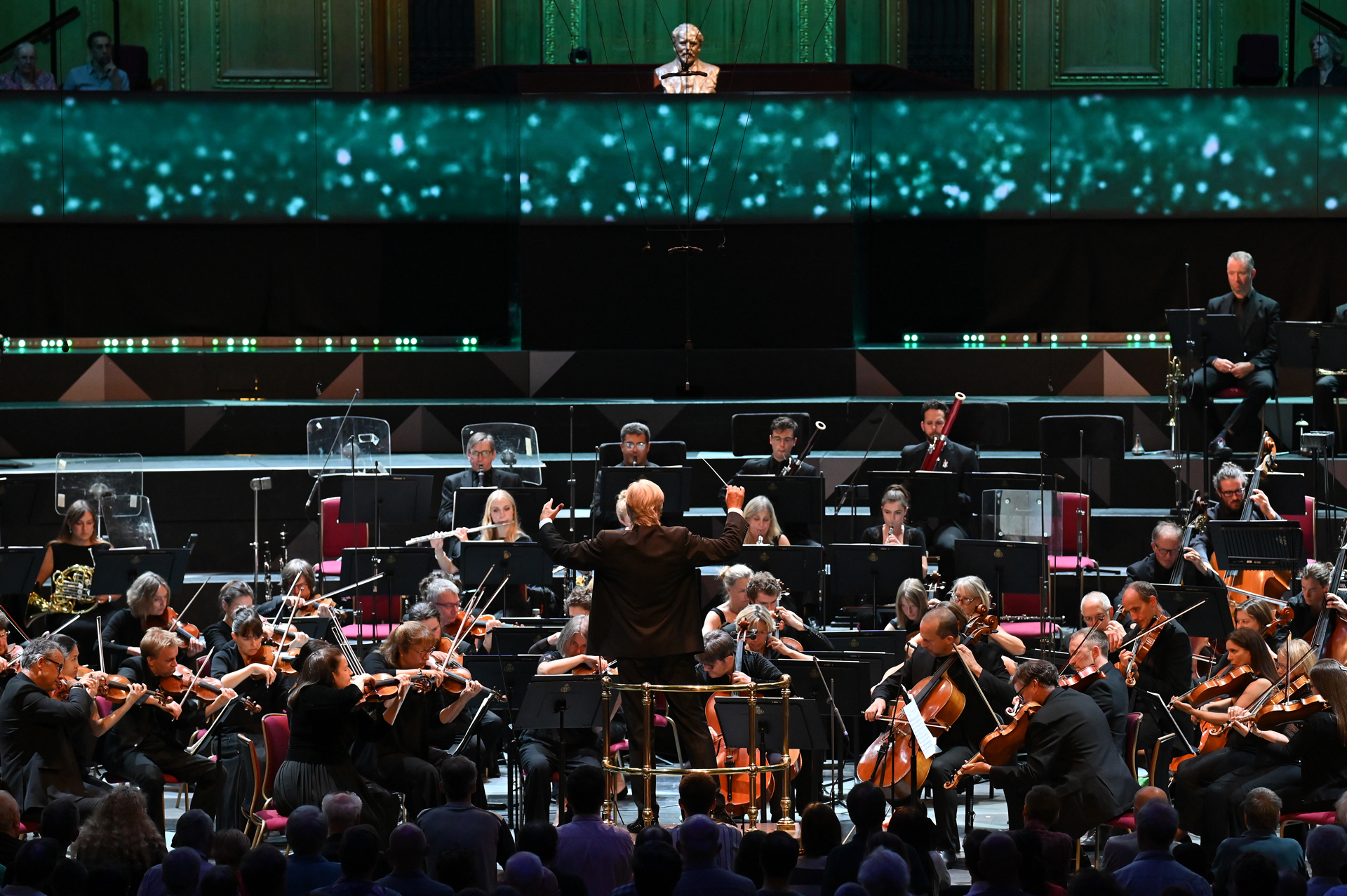
BBC Proms #44 – Soloists, BBC Symphony Chorus & Orchestra / Sakari Oramo: Ethel Smyth ‘Mass’ & Debussy ‘Nocturnes’

Prom 44 – Nardus Williams (soprano), Bethan Langford (mezzo-soprano), Robert Murray (tenor), Božidar Smiljanić (bass), BBC Symphony Chorus, BBC Symphony Orchestra / Sakari Oramo

Debussy Nocturnes (1897-9)
Smyth Mass in D (1891, rev. 1924) [Proms premiere]

Royal Albert Hall, London

Saturday 20 August 2022

Reviewed by Richard Whitehouse Photos (c) Chris Christodoulou

His third Prom this season found Sakari Oramo conducting the BBC Symphony Orchestra in an unlikely yet, in the event, thought provoking double-bill of pieces composed at either end of the same decade and which duly played to the strengths of all those who were taking part.

The music of Ethel Smyth has been a prominent feature of this season and while her Mass in D comes too early in her career to be considered ‘mature’, it does evince many of those traits as defined the operas that followed. Written during a brief flush of adherence to Anglicanism, this is demonstrably a concert rather than liturgical setting (which makes its apparent status as the first Mass heard publicly in England for almost 300 years the more ironic) and, moreover, one of a ‘symphonic’ rather than ‘solemn’ conception despite the audible debt to Beethoven.

Smyth reinforces this aspect by placing the Gloria at the close – thereby making it the finale of a sequence in which the Kyrie, building gradually to a baleful climax before returning to its initial sombreness, becomes an extended introduction to the Credo whose numerous sub-sections facilitate a sonata-form design of no mean formal cohesion and expressive breadth. For their part, the Sanctus, Benedictus and Agnus Dei function as extended slow movement whose (for the most part) emotional restraint enables the soloists to come to the fore – after which, the Gloria takes its place as a finale not least in terms of drawing on previous themes and motifs through to the forceful though never merely bathetic culmination. That Smythe did not essay a symphony given her evident structural command seems the more surprising.

Tonight’s performance was no less assured than that which Oramo gave at the Barbican (and subsequently recorded, albeit with different soloists) three seasons ago. The soloists made the most of their contributions – Nardus Williams bringing a plaintiveness and elegance that was ideally complemented with Bethan Langford’s warmth and understated fervency, and though Robert Murray’s ardency showed signs of strain, he was no less ‘inside’ his part than Božidar Smiljanić, whose solo was more affecting for its burnished eloquence. The BBC Symphony Chorus responded as one to the full-on contrapuntal writing of those main movements, while Richard Pearce ensured the (too?) extensive organ part did not muddy the orchestral textures. Oramo directed with clear enjoyment a work that, for the most part, justified its 62 minutes.

In the first half, Oramo presided over a searching account of Debussy’s Nocturnes – its three movements still sometimes encountered separately but far more effective heard as a complete entity. Not its least impressive aspect was the ease with which these followed on from each other with a cumulative inevitability – the fugitive shading of Nuages (melting cor anglais playing by Helen Vigurs) leading to the half-lit activity of Fêtes, with its darting gestures and a central march-past of vivid understatement, then on to the sensuous allure of Sirènes.

As enticing as the women’s voices of the BBCSC sounded in this closing movement, it was the fervency with which Oramo infused its recalcitrant content such as made it the natural culmination of the sequence – the final bars dying away with a tangible sense of fulfillment.

Click on the artist names for more information on Nardus Williams, Bethan Langford, Robert Murray, Božidar Smiljanić and Sakari Oramo and for more information on the BBC Symphony Orchestra head to their website. For more on composer Dame Ethel Smyth, click here

Switched On – Szun Waves: Earth Patterns (The Leaf Label)

Reviewed by Ben Hogwood

What’s the story?

Earth Patterns is the third album from the creative spirits of Szun Waves – saxophonist Jack Wyllie, keyboard maestro Luke Abbott and percussionist Laurence Pike.

The sessions took place in late 2019, where a succession of ideas germinated through improvisation – and after honing the tracks with James Holden and producer David Pye they have emerged with what is described as ‘the most fully-formed Szun Waves record to date’.

New Hymn To Freedom, their second album, looked up towards the stars – but Earth Patterns is very much of this planet, an organic affair where the music grows from small cells.

What’s the music like?

There is undoubtedly a special chemistry at work in Szun Waves. Each of the protagonists has their own special contribution to make, and there are so many notes produced in Earth Patterns, but somehow the trio and their studio team make room for all of them, crafting an album where each track goes on its own meaningful journey.

The album gets off to quite a chaotic but thrilling start, Exploding Upwards establishing the myriad of colours on offer from the trio, with surges of analogue synthesizers and saxophone alike. New Universe evolves at a gradual pace but ends up in an even more exalted and euphoric state, the saxophone flying high.

As the album progresses so the range of colours broadens, and In The Moon House features shimmering metallic instruments above a drone, with deeply soulful thoughts from the saxophone. Be A Pattern For The World builds its intensity through long notes, the saxophone starting to strain in its upper register.

Final track Atomkerne is poised, the saxophone like a massive, overarching presence, as figures flit back and forwards in the middle ground with a low drone buzzing away underneath. What unites all of these ideas is the sheer strength of feeling behind them. Jack Wyllie plays his saxophone like his life depends on it, with a dizzying range of pitches from soft, low thoughts to soaring high phrases. Luke Abbott marshals the electronics beautifully, ensuring we hear the colours of the analogue synths but that they bubble respectfully when other instruments play, surging to the front when their moment is called. Laurence Pike gives us the icing on the cake with intricate, detailed percussion that can focus on metallic treble-based material one minute, then fulsome lower range instruments the next.

Does it all work?

It does – and hangs together emotionally too, for Earth Patterns is certainly Szun Waves’ most deeply felt album to date.

Is it recommended?

Yes, without hesitation. Anyone following the musical progression of any of these three artists will want to snap this one up without delay – and anyone enjoying the intersection of jazz and electronica should also do the same. A Mercury nomination would not seem to be out of the question for next year, even at this stage!.

Listen

Buy

BBC Proms #42 – Jan Lisiecki, BBC Scottish Symphony Orchestra / Thomas Dausgaard: Nielsen, Beethoven & Sibelius

Prom 42 – Jan Lisiecki (piano), BBC Scottish Symphony Orchestra / Thomas Dausgaard

Sibelius Symphony no.7 in C major Op.105 (1924)
Beethoven Piano Concerto no.4 in G major Op.58 (1804-6)
Nielsen Symphony no.4 FS76 ‘The Inextinguishable’ (1914-16)

Royal Albert Hall, London
Thursday 18 August 2022

Reviewed by Richard Whitehouse Photos (c) Chris Christodoulou

Ending his tenure as Chief Conductor of the BBC Scottish Symphony Orchestra, Thomas Dausgaard directed this programme which once again played to both his and the orchestra’s strengths – in the process underlining just what they have achieved together over the past six seasons.

He might not have scheduled Sibelius quite so assiduously as his one-time predecessor Osmo Vänskä, but Dausgaard is hardly less perceptive in this composer as was proven with his take on the Seventh Symphony. If not a tale of two parts, the first half that resonated more deeply – an introduction shot through with expectancy that preceded a powerful build-up to the first emergence of the trombone theme, and an effortlessly accelerating ‘scherzo’ as made feasible a central climax of rare intensity. From here tension dropped a little over the course of a lucid yet (in this context) over-extended ‘intermezzo’, and if the approach to the final return of the trombone theme had the right inexorability, the strings’ climactic response was a little reined-in emotionally. Nor did the fraught cadence into the home-key have the desired inevitability.

Whether or not the Sibelius should open a concert, Beethoven’s Fourth Piano Concerto made for an ideal continuation. Stepping in at the eleventh hour, Jan Lisiecki is no stranger to this music such that his lightly articulated if rarely insubstantial tone complemented Dausgaard’s incisive but never headlong accompaniment. Just occasionally in the opening movement this jewel-like pianism felt a little self-defeating, though not with a lucid rendering of the (more familiar) cadenza or transition from the Andante into the finale of heart-stopping eloquence. The latter movement had the necessary vigour but also an appealing intimacy, as in the lower strings’ transition towards the final return of the rondo theme or those ruminative woodwind asides before the decisive coda. Chopin’s C minor Nocturne (1838) made for a limpid encore.

Keen to get on with proceedings, Dausgaard launched Nielsen’s Fourth Symphony after the interval before applause had subsided. Often a conductor willing to modify his approach, he might have steered the opening Allegro less forcefully given the textural detail that was lost in the Albert Hall’s ample expanse, but the twofold appearances of the ‘motto’ theme were magisterially rendered – the shocked transition into the intermezzo proving as mesmeric as this latter movement was affecting through its deft combination of winsomeness and pathos.

Equally memorable was Dausgaard’s handling of the slow movement, here exuding fervency without undue histrionics both in the searching string threnodies and the confiding passages either side – the latter of which provided a stealthy transition into the final Allegro. Here the placing of a second timpani set front-left in the arena made stretched the antiphonal contrast a little too obviously, but the music’s overall intent came across unscathed as the ‘motto’ made its climactic final appearance then those closing bars hit the ground as they should – running. Whether or not Dausgaard intended ‘Inextinguishable’ to sum up his music-making with the BBCSSO, or whether anything might be read into his wearing a Covid mask throughout, this concert was a worthy leave-taking. Hopefully he will not be absent from the UK for too long.

Click on the artist names for more information on Jan Lisiecki and Thomas Dausgaard, and for more information on the BBC Scottish Symphony Orchestra head to their website

BBC Proms #41 – Behzod Abduraimov, Elizabeth Watts, Benjamin Appl, BBC Scottish Symphony Orchestra / Thomas Dausgaard: Nielsen ‘Sinfonia espansiva’, Beethoven & Ravel

Prom 41 – Behzod Abduraimov (piano), Elizabeth Watts (soprano), Benjamin Appl (baritone), BBC Scottish Symphony Orchestra / Thomas Dausgaard

Ravel La Valse (1919-20)
Beethoven Piano Concerto no.1 in C major Op.15 (1795, rev. 1800)
Nielsen Symphony no.3 ‘Sinfonia espansiva’ (1910-11)

Royal Albert Hall, London
Wednesday 17 August 2022

Reviewed by Ben Hogwood Photos (c) Mark Allan

There is a changing of the guard in Glasgow. On his way in as chief conductor of the BBC Scottish Symphony Orchestra is the conductor, composer and pianist Ryan Wigglesworth, an exciting and evolving artist. He will replace Thomas Dausgaard, who leaves City Halls after six years and is signing off with two consecutive Proms of symphonies by his Danish compatriot, Carl Nielsen.

We began this concert in Paris, however, with a distinctly chilly account of Ravel’s La Valse. The horrors of the First World War encroach into Ravel’s writing, and were all too audible around the edges in this performance, which was brilliantly played and lucidly controlled. The feather-light strings of the opening bars ensured the dynamic contrasts were extreme, and when the full orchestra cut loose towards the end the effect was both exhilarating and terrifying, the ‘fatal whirring motion’ of Ravel’s inspiration collapsing in the final bars.

Dynamic contrasts were a feature, too, in a fine performance of Beethoven’s Piano Concerto no.1, with soloist Behzod Abduraimov. The Uzbek pianist was the ideal foil for the clarity of the reduced forces of the BBC SSO, giving an affectionate performance notable for its dance-like qualities. There were occasional rhythmic indulgences in the solo party, but these were both tasteful and well-managed, with Dausgaard alive to his flights of fancy. The dialogue with the orchestra was often exquisite, especially when piano and clarinet (Yann Ghiro) linked in the slow movement. Time stood still for an early example of one of Beethoven’s heavenly silences, before the Rondo danced its way into the minds of the audience for the interval. Stylishly played and with some attractive, witty touches, this was an endearing account of high technical quality. Abduraimov’s encore was slightly at odds with the feather-light touches displayed in the Beethoven, being a heavyweight performance of Mercutio from Prokofiev’s Romeo & Juliet transcriptions for piano. There were fireworks and great virtuosity, though the significance of choosing a Ukrainian-born composer should not be overlooked.

Dausgaard returned after the interval to conduct his compatriot’s ‘most Danish’ symphony. David Gutman’s ever-helpful Proms notes revealed that Nielsen’s Sinfonia espansiva was somehow not performed at the Proms until 1990, and even this was its first Royal Albert Hall performance in 23 years. It was a memorable encounter, the high voltage first movement immediately into gear with its repeated notes surging forward, bursting through the dam. The exultant first movement was complemented by the radiance of the second, with wordless vocals from on high in the gallery supplied by soprano Elizabeth Watts and baritone Benjamin Appl. The combination, over hushed strings, enchanted the hall and made the best possible use of its spatial options. Surrounding their contributions were winsome cadenzas from the BBC Scottish woodwind, portraying the great Danish outdoors with crisp outlines.

The third movement built its energy cumulatively, all the while pointing towards the finale, where we heard the Danish ‘ode to joy’ in luxurious tones from assembled strings and horns. This was music of wide-eyed optimism, galvanizing orchestra, audience and conductor alike to an emphatic signing off. With contributions from golden brass and thundering timpani, this performance was truly expansive – and served to emphasise what the Proms audiences have been missing with this symphony all these years!

For more information, click on the names to discover more on the BBC Scottish Symphony Orchestra and their new chief conductor Ryan Wigglesworth

Switched On – Indian Wells: No One Really Listens To Oscillators (Mesh)

Reviewed by Ben Hogwood

What’s the story?

Pietro Iannuzzi’s latest album as Indian Wells may have a humorous title, inspired by a fit of pique while working in the studio, but it contains music of much greater personal meaning.

His concept with the album was to reflect the fact that it is possible to grow up around half-finished buildings that become a part of the landscape without anybody noticing – and that this leads to a distorted reality, that we very quickly become accustomed to.

What’s the music like?

Multilayered and compelling. The distortion Iannuzzi refers to can be felt immediately on the first track, An escalator in a storm (Incomputio Part I), where voices and snatches of sound flit across the picture of what would otherwise have been the serene progress of slow moving musical figures.

Life of JS (Incomputio Part II) has a deeply personal resonance, written about his daughter who was born in early lockdown and found to have Down Syndrome. Research around the condition lead him to the American artist Judith Scott, a self-declared ‘unfinished’ person – and who is the dedicatee of this beautifully cloudy music, with its twists and swirls. Iannuzzi’s daughter also inspired Before Life, the closing track, which starts with a recording of her foetal heartbeat and grows into a really impressive and emotive piece of work, the choice cut on the album.

Elsewhere the music is shot through with movement and positive kinetic energy. Four Walls bubbles and flickers in the half light, while Against Numbers uses its glitchy beats and motifs in a thought provoking way while also cutting loose with white noise.

The title track progresses with a stately poise, the oscillations holding up well! – while Habitat also enjoys wide-ranging squiggles before kicking into a more conventional four to the floor rhythm. Calabrian Woods breaks into this area too, retreating to a warning motto over soft keyboard pads before launching into a full breakout.

Does it all work?

Yes – each track works well in isolation but the album works best when experienced in one setting, with a very satisfying ebb and flow.

Is it recommended?

Yes. Anyone who has enjoyed the music of Max Cooper will surely warm to the music of his labelmate, whose personal experiences bring deeper meaning to this thoughtful but ultimately positive music.

Listen

Buy