
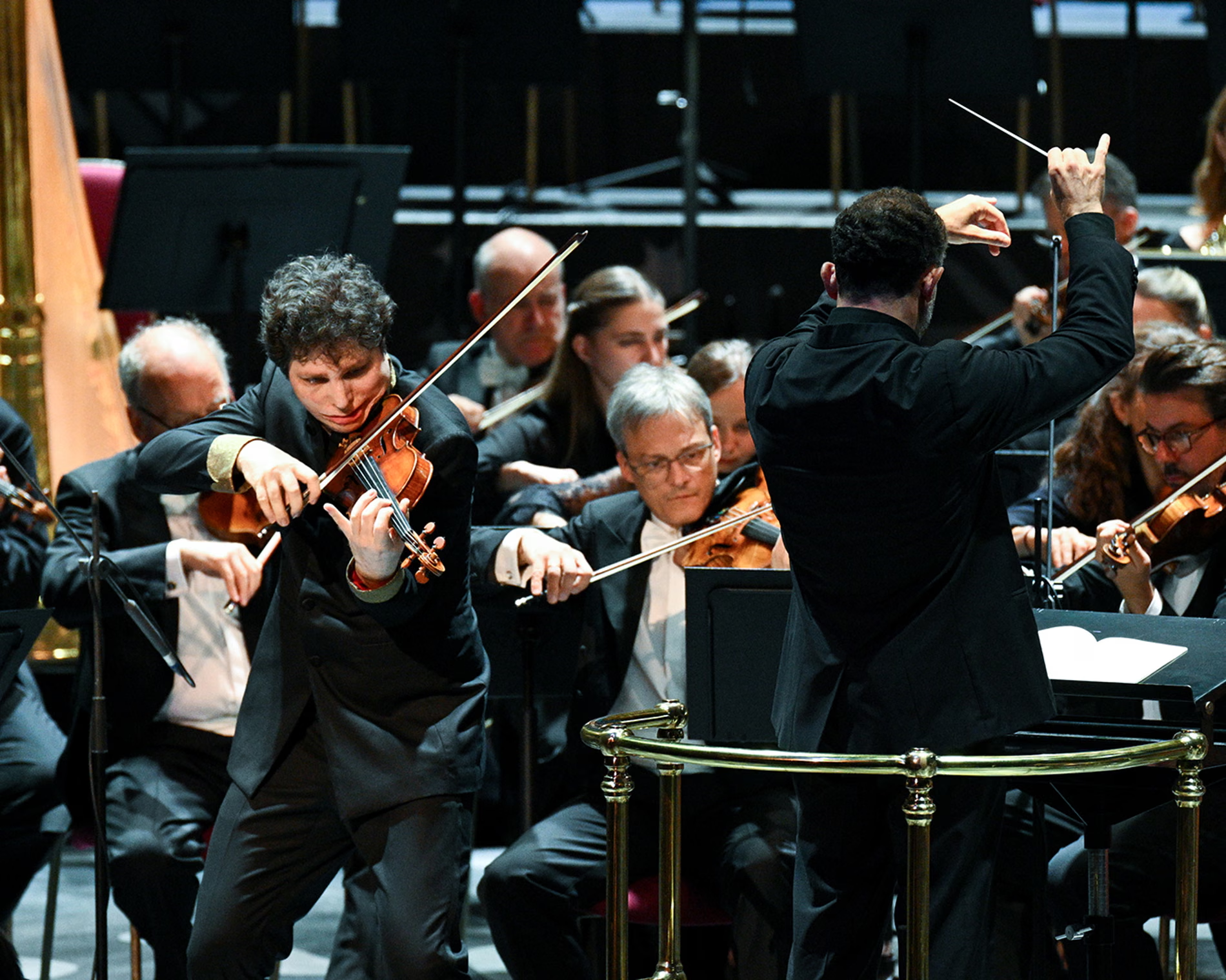
Augustin Hadelich (violin), Berliner Philharmoniker / Kirill Petrenko
Beethoven Violin Concerto in D major Op.61 (1806)
Scriabin Symphony no.3 in C minor, Op.43 ‘Le poème divin’ (1902-04)
Royal Albert Hall, London
Thursday 3 September 2026
Reviewed by Richard Whitehouse Photos (c) BBC / Chris Christodoulou
Their second appearance this season saw Kirill Petrenko and the Berliner Philharmoniker tackling pieces that, written almost a century apart, could hardly have offered greater contrast in terms of their aesthetic and which made the cohesion of tonight’s programme the more impressive.
His fifth visit to the Proms in just a decade found Augustin Hadelich giving a performance of Beethoven’s Violin Concerto full of interest if on occasion neglecting the wood for the trees. Not that, other than momentarily in its development, the opening Allegro hung fire but this most spacious such movement in Beethoven’s output lacked an underlying impetus without which it all too easily loses focus. The (unexpected) highlight was a Kreisler cadenza which renewed respect for its motivic ingenuity then segued into the coda with acute seamlessness.
There was little to fault thereafter. The Larghetto duly emerged as the most eloquent of those variational slow movements that Beethoven favoured at this time, with orchestral playing of fastidious poise then an ideal transition into the final Rondo – the incisiveness of whose main theme threw into relief its genial secondary idea then the plaintiveness of its central episode. It rounded off what was a never less than perceptive reading, and Hadelich returned with his own arrangement of Träumerei from Schumann‘s Kinderszenen as a raptly affecting encore.
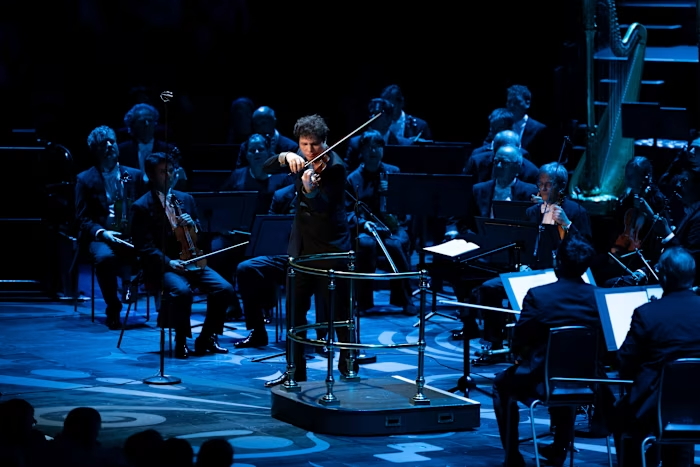
Some 98 years after Beethoven’s most intrinsically abstract symphonic work found Scriabin flexing his extra-musical muscles in the last if most ambitious of his numbered symphonies. Given its UK premiere at these concerts by Sir Henry Wood in 1918 and repeated three years later, The Divine Poem had to wait nine decades for its Proms revival but has now secured its place in the repertoire. Certainly there was no element of ‘special pleading’ in an account as underlined that structural integration between its three (continuous) movements as across the work overall. However overreaching Scriabin’s theosophical aspirations may have been, his musical instinct was such that nothing is left to chance in a design as surveys the ‘tragedy to triumph’ trajectory beloved of late-Romanticism from an arresting and productive vantage.
The defining motto drawn unerringly into its evolution, the opening Luttes made a virtue of its discursive unfolding with a sure balance between its agitated and ethereal themes; building to a resplendent if short-lived climax in its development then methodically retracing its steps. There was no lack of sensuousness in the central Voluptés, offset by an ominous undertow resolved in the final Jeu divin with its capricious trumpet idea and its pointed revisiting of earlier material as made the eventual apotheosis not just inevitable but necessary as a formal and expressive QED. Felicities of phrasing and of texture abounded in an interpretation that demonstrated the rapport of conductor and orchestra, now at the start of their eighth season together, at its most tangible with music on the cusp between Romanticism and Modernism.
As on their earlier visits, there was no encore with Petrenko’s blowing a kiss to the audience his most overt acknowledgement of what seemed a genuine enthusiasm for the piece as heard in this performance. Their next Proms appearance (in 2028?) can only be eagerly anticipated.
You can listen to this Proms concert on BBC Sounds until the end of September 2026.
Published post no.3.007 – Friday 4 September 2026

