
Unknown's avatar

About Arcana

My name is Ben Hogwood, editor of the Arcana music site (arcana.fm)

On Record – Emma Tring, BBC NoW / Martyn Brabbins – John Pickard: Symphonies 2 & 6; Verlaine Songs (BIS)

John Pickard
Symphony no.2 (1985-87)
Symphony no.6 (2021)
Verlaine Songs (2019-20, orch. 2022)

Emma Tring (soprano), BBC National Orchestra of Wales / Martyn Brabbins

BIS 2721 [72’51’’] French text and English translation included

Producer Thore Brinkman Engineers Simon Smith, Mike Cox
Recorded 29-31 March 2023, Hoddinott Hall, Cardiff

Written by Richard Whitehouse

What’s the story?

BIS continues its coverage of John Pickard (b.1963) with a pertinent coupling of his Second and Sixth Symphonies, heard alongside his song-cycle to poems by Verlaine, in what is the most wide-ranging release – whether chronologically or stylistically – to date in this series.

What’s the music like?

It hardly seems 35 years since the Second Symphony blazed forth at its Manchester premiere, so establishing Pickard’s reputation. The composer had earlier studied with Louis Andriessen, to whose confrontational minimalism this piece is indebted in certain particulars – but, unlike other among his contemporaries who were so influenced, Pickard was alive to its symphonic potential. Unfolding over six continuous sections, the work builds via an intensifying process of tension and release to a seismic culmination as marks a seamless, even inevitable return to its start. Those familiar with that pioneering version by Odaline de la Martínez (on YouTube) will find this new one hardly less attentive to the visceral power of what, given its predecessor remains unheard, is a symphonic debut with few equals and one that urgently warrants revival.

Almost 35 years on and the Sixth Symphony offers a very different though no less involving perspective on what this genre might be. The first of its two movements channels a modified sonata design such that an almost whimsical opening has become brutalized well before the despairing close. Its successor refashions the expected continuity from an even more oblique vantage – the music heading eloquently if funereally toward a plangent climax that subsides into a delicate intermezzo, infused with the sound of nature, then on to a final section which recalls earlier ideas in a mood of rapt anticipation. Not that this understatement offers in any sense an easy way out: indeed, the work concludes with its composer poised at a crossroads as much existential as musical, and from where the whole creative process can begin afresh.

Separating two substantial statements of intent, the Verlaine Songs continues Pickard’s recent involvement with poetic texts and, while Paul Verlaine might seem far removed from Edward Thomas or Laurence Binyon, his evocations fanciful while sometimes unnerving – hence Le sqelette with its graphic aural imagery – finds the composer reciprocating in kind. Coming in between scorings with ensemble or violin and piano, this version with orchestra finds Pickard enriching a lineage of French song-cycles from Berlioz, via Ravel and Messiaen, to Dutilleux.

Does it all work?

It does, not least because Pickard is conscious of the need for his music to determine its own course. However dissimilar these symphonies might seem, the sensibility behind them is the same and any stylistic differences more apparent than real. It helps when Martyn Brabbins is a conductor familiar with this idiom as to inspire a committed response by the BBC National Orchestra of Wales, with Emma Tring alive to the manifest subtlety of the vocal writing, and the recordings consistently heard to advantage in the spacious immediacy of Hoddinott Hall.

Is it recommended?

Indeed, in the hope this series will be continued. Both the First and Third Symphonies await recording, as do Partita for strings and large-scale choral work Agamemnon’s Tomb, so that Pickard’s discography has a way to go even without addition of new pieces to his catalogue.

Listen

Buy / Further information

For purchase options and more information on this release, visit the BIS website. Click on the names for more on composer John Pickard, the BBC National Orchestra of Wales, conductor Martyn Brabbins and soprano Emma Tring
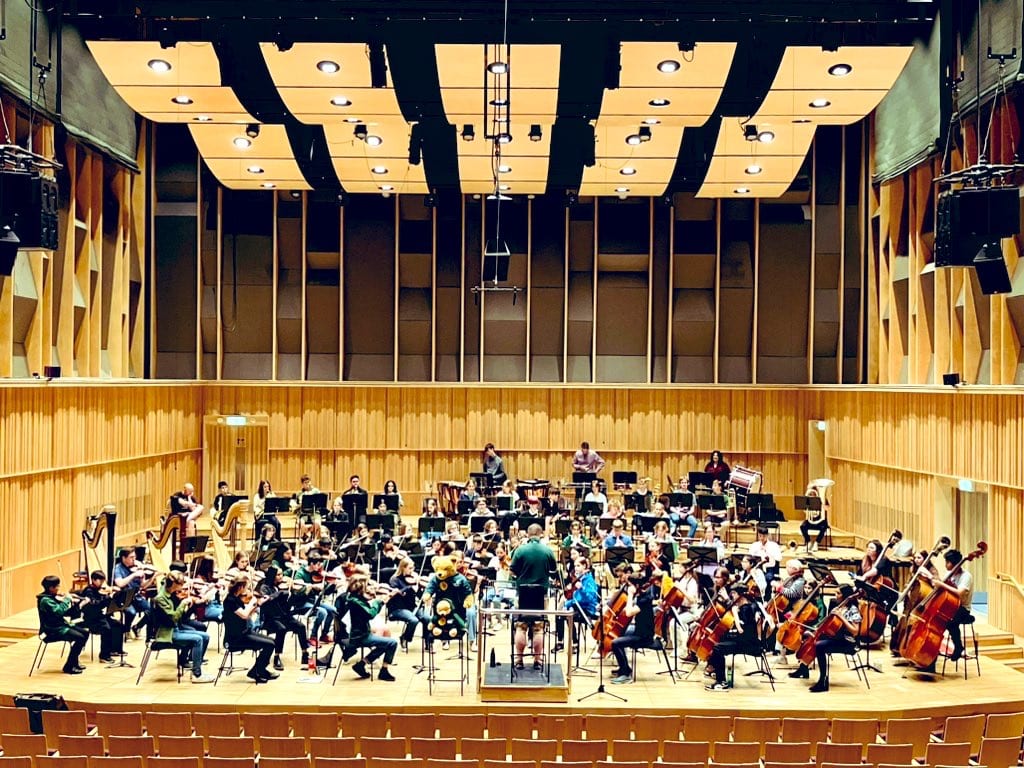

In concert – Fenella Humphreys, ESO Youth Symphony Orchestra / James Topp: Walton, Heathfield & Korngold

Fenella Humphreys (violin, below), ESO Youth Symphony Orchestra / James Topp

Walton Prelude and Fugue ‘The Spitfire’ (1942)
Korngold Violin Concerto in D, Op. 35 (1945)
Heathfield JAZZ HORSE (2024) [World Premiere]
Korngold arr. Russ The Sea Hawk – Suite (1940)
Walton arr. Matheson/ed. Lloyd-Jones Henry V – Suite (1944, arr. 1963)

The Bradshaw Hall, Royal Birmingham Conservatoire, Birmingham
Friday 23 August 2024

Reviewed by Richard Whitehouse

The English Symphony Orchestra’s annual Summer Course reached its climax this evening with a concert by its Youth Symphony Orchestra as ranged across film music from the mid-20th century, and in various guises from straightforward adaptation to wholesale reworking.

Whether or not those films for which he provided music have stood the test of time, Walton’s is a significant contribution to the cinema. As adapted from The First of the Few, his ‘Spitfire’ Prelude and Fugue remains one of his most characteristic such pieces and this performance did full justice to the prelude’s martial tread as to the fugue’s driving impetus, though James Topp was mindful to ensure the pastoral interlude (just before the return of the main theme) yielded an intimacy as underlined the essentially personal nature of this now underrated film.

Whereas Walton’s metier was in wartime or theatrical subjects, that of Korngold centred on Hollywood ‘blockbusters’ which required scores of suitably emotional opulence. Several of these found an equally appropriate home in the Violin Concerto completed at the end of the Second World War, whose formal cohesion prevents any risk of its expressive power losing focus. This was certainly the impression as conveyed by Fenella Humphreys – notably the ardency of her take on the opening Moderato, with a central Romance as ingenious in its trajectory as it was eloquent in content. Nor was there any lack of energy in a final Allegro with repartee between soloist and orchestra at its most engaging and not least in its closing stages, when a resplendent version of the main theme is outflanked by the uproarious coda.

After the interval, a sinisterly attired Finn Heathfield put members of the orchestra through their collective paces with JAZZ HORSE, described as ‘‘a collection of improvisations and performance exercise rooted by the rhythm section’s bass motif (thus F-Ab-Bb-Eb). It duly provided a telling foil to the suite (here arranged by Patrick Russ) from Korngold’s score to The Sea Hawk; a sequence capturing this film’s overall panache as surely as its resourceful writing for percussion and a reminder of a composer who should never be underestimated.

The programme concluded with more Walton and the suite from his score to Henry V – now remembered as a star-vehicle for Laurence Olivier, but which at the time played a necessary role in the British war-effort. Muir Matheson’s adaptation features most of the highlights and, as edited by the late David Lloyd-Jones, takes in more from the Overture in its evoking The Globe Playhouse via Elizabethan stylizations these players audibly relished. The sombreness of The Death of Falstaff and calm ecstasy of Touch Her Soft Lips and Part were rendered with no less insight, while the Charge and Battle placed between them brought a frisson of excitement set in relief by a poetic evocation of the Baïlerò at the close. Building intently to its joyous close, the Agincourt Song provided a rousing end to the suite and to this concert.

Another Summer Course Concert completed – its success not, as Topp indicated, to be taken for granted given the logistical and financial obstacles in bringing 91 musicians to this level of attainment. Hopefully such considerations will not become insurmountable in the future.

For details on the artists, click on the names to read more about Fenella Humphreys, James Topp, the ESO Youth Orchestra and the English Symphony Orchestra – and for more on composer Finn Heathfield

Published post no.2,282 – Monday 26 August 2024

Summer serenades: Mozart’s Eine Kleine Nachtmusik

Sooner or later, Arcana’s Sunday serenade series had to arrive at the most famous one of them all – Mozart‘s Serenade no.13 in G major, known universally as Eine Kleine Nachtmusik.

The work was written for string quintet in 1787, but expands beautifully for string orchestra, as demonstrated in this version from the Wiener Philharmoniker and Karl Böhm. As is so often the case with Mozart, its beauty lies in simplicity, with memorable tunes that are developed with a pure musical instinct:

Published post no.2,281 – Sunday 25 August 2024

Arcana at the Proms – Prom 43: Paul Lewis, CBSO / Kazuki Yamada – Ravel, Mozart, Holmès & Mussorgsky / Wood

Ravel Ma mère l’Oye – suite (1910-11)
Mozart Piano Concerto No. 27 in B flat, K595 (1790-91)
Holmès La Nuit et de l’Amour (1888)
Mussorgsky arr. Wood Pictures at an Exhibition (1874, orch. 1915)

Paul Lewis (piano, above), City of Birmingham Symphony Orchestra / Kazuki Yamada

Royal Albert Hall, London
Thursday 22 August 2024

reviewed by Ben Hogwood Photos (c) Sisi Burn

A colourful Prom from the CBSO this year, reaching a deafening climax with Proms founder Sir Henry Wood’s arrangement of Mussorgsky’s Pictures At An Exhibition. More of that anon, but the orchestra, under principal conductor Kazuki Yamada, began with music by Ravel – whose orchestration of the Mussorgsky we tend to hear.

Mother Goose was cool to the touch but given a winning performance, Ravel’s colours spread across the orchestra as the music came to life. The CBSO strings were elegant and refined, leaving the starry moments to the woodwind, who excelled – particularly the gruff contrabassoon in Conversation of Beauty and the Beast, winningly played by Margaret Cookhorn. The hues of the closing The fairy garden were ideal, too – though Yamada’s decision to bring the music to a near standstill before the final, wondrous tune won’t have been to all tastes, no matter how skilfully it was achieved.

Elegance was the watchword for Paul Lewis’s Mozart, too – a thoughtful and graceful account of the composer’s last piano concerto, published in his final year but thought to have begun three years prior. This is Mozart in relatively subdued form, but still cracking a smile in the attractive first movement. Soloist and orchestra took a little while to align within the Royal Albert Hall acoustic, but once they did the first movement dialogue, complete with Mozart’s own cadenza, was fluent and balletic. The slow movement lullaby was a treat, Lewis with stylish phrasing of the melodies, while the finale enjoyed its lightfooted dance, a theme so simple and yet so memorable; classic Mozart.

Following the interval we heard the brief but romantic La Nuit et de l’Amour by Augusta Holmès, a pupil of César Franck whose music was appearing at the Proms for the first time. It was a charming miniature with a memorable tune, whose presence shone through. It acted as an upbeat to Sir Henry Wood’s arrangement of Mussorgsky’s tour through the gallery, a version predating the celebrated Ravel by seven years.

Unlike the Frenchman, Wood goes for broke on several occasions during Pictures At An Exhibition. His decision to include only the first Promenade, where Mussorgsky describes his observer walking around the exhibition, means the pictures are a little squashed together, but in this performance the dramatic impact was heightened. Gnomus was frankly terrifying, while The Old Castle was headed by a sensitive and touching euphonium solo; Becky Smith projecting beautifully from the gallery.

Wood’s version is brassy on occasion, and the CBSO players excelled – as did the wind and percussion, whose unpredictable interventions had the audience jumping on several occasions! They were a feature of Bydlo, the old carriage rumbling into action with all its bells rattling, the lower strings and brass in deep toil. Nothing quite prepared the throng for the final Great Gate of Kiev, however – not even the sinister outlines of the preceding Baba Yaga. The gate itself came slowly into view, the toll of the nine bells of the Liverpool Philharmonic bells up in the gallery both solemn and unexpectedly chilling. Soon all notions of reserve were brushed aside, however, Wood’s orchestration demanding the nine bells at full volume – delivered in a brilliant peal from the gallery by Graham Johns. However – from the arena at least – they did rather swamp the combined forces of the orchestra and organ, who were barely audible at times.

Excesses like these no doubt helped Emerson Lake and Palmer in their decision to arrange Pictures for rock group in 1971 – and certainly had a positive impact on the Proms audience, who were thrilled by the drama and the sheer volume. So too was Yamada, who had already been dancing on the podium, but as the Gate reached its tremendous conclusion he pivoted to urge the audience into applause, long before the final chord had rung out. How refreshing to see a conductor living in the moment, reading the occasion and the audience, and crowning a memorable Prom with shattering, exhilarating noise.

The playlist below collects the music from this concert, including the only available recording of the arrangement of Pictures At An Exhibition by Sir Henry Wood:

Published post no.2,283 – Saturday 24 August 2024

In concert – Paul Lewis, CBSO / Kazuki Yamada: Ravel, Mozart, Holmès & Mussorgsky / Wood

Paul Lewis (piano, above), City of Birmingham Symphony Orchestra / Kazuki Yamada

Ravel Ma mère l’Oye – suite (1910-11)
Mozart Piano Concerto No. 27 in B flat, K595 (1790-91)
Holmès La Nuit et de l’Amour (1888)
Mussorgsky arr. Wood Pictures at an Exhibition (1874, orch. 1915)

Symphony Hall, Birmingham
Wednesday 21 August 2024

Reviewed by Richard Whitehouse

Although the CBSO has not put on its own Proms season for many years, a concert featuring the programme for its annual Proms appearance has been a regular fixture and this evening’s event proved to be much more than merely a ‘dry run’ for tomorrow’s Royal Albert Hall date.

Despite the timing, this was indeed the suite as orchestrated by Ravel from his Mother Goose piano duets before being expanded into a ballet. It took a while to get going – Pavane of the Sleeping Beauty feeling impassive and Little Tom Thumb enervated, yet Laideronette had the requisite playfulness. Conversations of Beauty and the Beast was ideally poised between whimsy and pathos, before The Enchanted Garden concluded this sequence with an inward rapture made more so thanks to its exquisite contribution from leader EugeneTzikindelean.

Paul Lewis must have played Mozart’s 27th Piano Concerto on innumerable occasions (and several times with the CBSO) but his perspective constantly varies. The opening movement had a spaciousness resulting in an unusually moderate Allegro, albeit never at the expense of a subtly incremental intensity unerringly sustained through to a cadenza of limpid eloquence. Even finer was the Larghetto – dependent, as with much of Mozart’s late music, on what the performer brings to it; here yielding a serenity informed by not a little fatalism. After which the finale provided an ideal complement in its buoyancy and unforced humour, leading into a cadenza (how fortunate Mozart’s own have survived) of pensive understatement, then a coda launched with a guileless interplay of soloist and string that set the seal on this performance.

Opening the second half was Augusta Holmès’s La Nuit et l’Amour – actually, an interlude from Ludus pro Patria, her ‘Ode-Symphonie’ which, even if it might not sustain the present piece’s enfolding passion, should certainly be worth at least a one-off hearing in its entirety.

In Henry Wood’s orchestration, Mussorgsky’s Pictures at an Exhibition proved a highlight of last season. Wood retains only the first appearance of the Promenade but is not unfaithful to the original’s essence. Hence the shock-horror of Gnomus, sombre aura of The Old Castle with its baleful euphonium, playful insistence of The Tuileries or fatalistic tread of Bydlo with its evocative percussion. The whimsical Ballet of the Unhatched Chicks contrasts with the grim realism of Samuel Goldberg and Schmuÿle or the frantic bustle of The Market at Limoges.

Respighi surely took note of this glowering Catacombs with its plangent recollection of the promenade refrain hardly less effective than in Ravel, and while Baba Yaga is unnecessarily curtailed here, its sudden dispersal more than prepares for the crescendo of offstage bells that launches The Great Gate[s] of Kiev. This set the tone for a realization which, if its opulence borders on overkill, could not prevent the CBSO from projecting Wood’s cinematic sonics to the maximum. Those present once again erupted during that echoing resonance at its close.

Quite a way, then, to end an impressive performance and memorable concert. Kazuki Yamada and the orchestra will be doing it all over again tomorrow evening at their Prom, at which this orchestration of the Mussorgsky will be heard in the environs as envisaged by its orchestrator.

The playlist below collects the music from this concert, including the only available recording of the arrangement of Pictures At An Exhibition by Sir Henry Wood:

For details on the 2024-25 season A Season of Joy, head to the City of Birmingham Symphony Orchestra website. Click on the names to read more about pianist Paul Lewis and chief conductor Kazuki Yamada

Published post no.2,279 – Friday 23 August 2024