Unknown's avatar

About Arcana

My name is Ben Hogwood, editor of the Arcana music site (arcana.fm)

On Record – Tim Posner, Berner Symphonieorchester / Katharina Müllner: Bloch, Bruch & Dohnányi (Claves)

Tim Posner (cello), Berner Symphonieorchester / Katharina Müllner

Bloch Schelomo (1917)
Bruch Kol Nidrei Op.47 (1880)
Dohnányi Konzertstück Op.12 (1904)

Claves CD3079 [56’21’’]
Producer & Engineer Johannes Kammann
Recorded September 2023 at Diaconis-Kirche, Bern, Switzerland

Reviewed by Ben Hogwood

What’s the story?

This is the debut concerto album from British cellist Tim Posner, currently principal cellist with the Amsterdam Sinfonietta. He has been awarded the Thierry Scherz prize at the Sommets musicaux de Gstaad, joining a list of illustrious cellists such as Nicolas Altstaedt, Pablo Ferrández and Anastasia Kobekina, as well as viola player Timothy Ridout, with whom he is a member of The Teyber Trio.

The winner of the Thierry Scherz prize gets a recording with Claves as part of their reward, and here Posner. together with conductor Katharina Müllner and the Berner Symphonieorchester have constructed an attractive program of concertante works for cello and orchestra, written in the style of a concerto but in single-movement form.

What’s the music like?

Bloch’s Schelomo is increasingly well-known, a powerful utterance for cello and orchestra in an extended single movement. Subtitling the piece Rhapsodie hébraïque, Bloch wrote the piece in six weeks, modelling it on chosen verses from the book of Ecclesiastes. In his words, the cello takes ‘the incarnation of King Solomon (the book’s author), while the orchestra ‘represents his internal world and his experience of life’. The themes are mostly original but are of Hebrew resonance, one a reproduction of a tune Bloch’s father would often sing.

The Konzertstück for cello and orchestra is not a well-known part of the output of Ernő Dohnányi, but it had personal significance for the composer when he completed it at the age of 26. The composer’s father was a fine amateur cellist, and he must have been at the front of Dohnányi’s mind when he wrote this single-movement work, set out as though it were a single movement concerto.

Bisecting the two larger works is Kol Nidrei, one of the most enduring of works for solo instrument and orchestra by Max Bruch. Completed in 1880, it was dedicated to Robert Hausmann, who premiered Brahms’s Double Concerto with Joseph Joachim seven years later. Kol Nidrei is based on two Hebrew melodies.

Does it all work?

Yes, it does. Posner brings a fresh approach to each of the three works and is extremely sensitive in his balancing with the orchestra and the melodic phrasing he applies.

Schelomo receives a commanding performance, but with room for the orchestra to make its telling contributions, ideally shaped under Katharina Müllner. Posner’s tone is beautiful throughout, and especially secure in the higher register sections, where he takes the part of Solomon with assurance and poise. There is some really nice detail in the smaller sections, where the Bern principal oboe really shines, and the whole mood is one of intense and passionate thought.

Kol Nidrei starts softly, lost in thought, but comes through to a chorale theme displaying emotional strength in depth, a real point of light in the darkness. Müllner’s pacing here is ideal.

The real discovery of the album is the Dohnányi, whose cheery, airy theme sets the tone for free flowing piece that proves contagious in its positivity. Cello and woodwind enjoy frequent dialogue, and the main theme is a joy when it reappears in orchestral guise half way through. The cello part is deceptively virtuosic, but it falls easily under Posner’s hands.

Is it recommended?

Enthusiastically. This is an imaginative album, performed with sensitivity and flair. The trio of pieces are extremely complementary, and Posner’s verve and enthusiasm are infectious. It is to be hoped more recordings will follow from this source, for this is a very fine package all round.

Listen

Buy

You can explore purchase options for this recording on the Presto website

Published post no.2,170 – Monday 6 May 2024
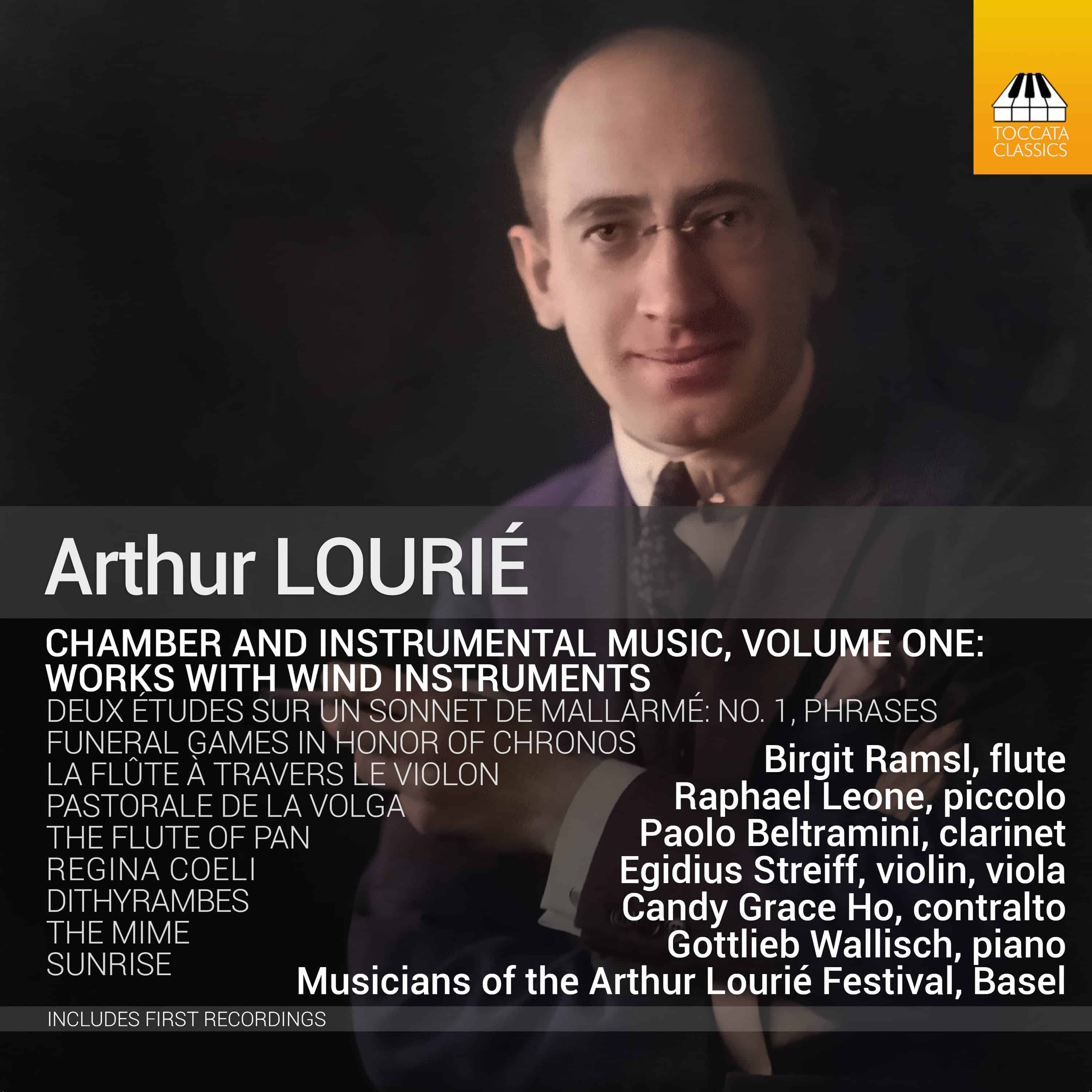
On Record – Arthur Lourié: Chamber and Instrumental Music Vol. 1 (Toccata Classics)

Lourié
Sunrise (1957)a
Pastorale de la Volga (1916)b
Regina Coeli (1924)c
La Flute à travers le Violon (1935)d
Dithyrambes (1938)e
Deux Études sur un sonnet de Mallarmé (1945/62)f
The Mime (1956)g
The Flute of Pan (1957)h
Funeral Games in Honor of Chronos (1964)i

cCandy Grace Ho (contralto) iRaphael Leone (piccolo) adehBirgit Ramsl (flute), gPaolo Beltramini (clarinet), Egidius Streiff, bd(viola/violin) fiGottlieb Wallisch (piano)
Musicians of Arthur Lourié Festival, Basel [iLucie Brotbek Prochásková (alto flute), bcHansjürgen Wäldele (oboe), bNicolas Rihs (bassoon), cSimon Lilly (trumpet), bAgnès Mauri (viola), bMateusz Kamiński (cello), iNicolas Suter (percussion)]

Toccata Classics TOCC0652 [70’05’’]
Producer Mauro Piccinini Engineers Sergio Cossu & Riccardo Botta
Recorded 26 November 2021 (g) and 25 February 2022 (adeh) at Sacro Cuore, Bellinzona; 20/24 February 2022 (bcfi) at Studio 1, Schweizer Radio und Fernsehen, Zurich

Reviewed by Richard Whitehouse

What’s the story?

Toccata Classics adds to the growing recorded representation of Arthur Lourié (1892-1966) with this first volume devoted to chamber and instrumental music, so extending appreciation of not only a culturally significant figure but a strikingly original composer in his own right.

What’s the music like?

Earliest here is Pastorale de la Volga – its pungent scoring for woodwind and strings, with its avowedly constructivist unfolding (what might be termed ‘additive form’), maintained across two continuous movements which do not develop linearly as evolve modularly; these motifs intensifying, as it were, through association and in a manner Stravinsky or Prokofiev drew on intensively around this time. Subsequently isolated in Wiesbaden, Lourié brought modernist and traditional facets into telling accord with his setting Regina Coeli; here, oboe and trumpet play off a vocal line that continues unaware of, or is indifferent to, their contrasting presence.

In essence a sonata ‘malgré-lui’, La Flûte à travers le Violon has its composer utilizing some of the more recondite aspects of Stravinskian neo-classicism – whether in the agile rhythmic displacement of its opening Allegretto, taciturn eloquence of its central Adagio or engaging repartee of the final Presto with its appealingly populist undertones. By contrast, the trilogy for solo flute Dithyrambes offers an avowedly Nietzschean take on the choral odes found in Greek antiquity – the graceful undulations of Le Sacrifice du miel duly complemented by the unfurling lament of Plainte d’Ariane, before the tonal and rhythmic intricacies of the relatively lengthy Labyrinthe make a potent corollary to that fabled if mythical construct.

Phrases, first of two études respectively commenting on and setting a sonnet by Mallarmé, finds this composer at his most unashamedly melodic – though there is nothing reactionary about its plaintive and at times capricious interplay between flute and piano. This is no less true of Mime, a study for clarinet which is dedicated to Charles Chaplin and which it is not unreasonable to think of as a portrait of this actor in his most enduring guise as the Tramp.

The programme had opened with the alluring strains of Sunrise, its (imagined?) evocation of the ‘dawn chorus’ just one of the aspects of this first cousin to pieces by Debussy and Varèse, and to which The Flute of Pan makes for a pointed contrast with its gradually but inexorably mounting activity to a febrile ending. From here to Funeral Games in Honor of Chronos is to encounter Lourié’s penultimate work, his latter preoccupation with ritual heard in a sequence of linked episodes conceptually of the ancient past yet aesthetically of the immediate present.

Does it all work?

Yes, notwithstanding that Lourié is a composer less occupied with any expressive or technical consistency than with imparting a ‘world view’ such as veers freely between past and present. These performances, recorded under the auspices of the Arthur Lourié Festival in Basel, are always attuned to his arresting idiom and have been recorded with the requisite spaciousness.

Is it recommended?

Indeed, and good to hear a follow-up volume from this source is forthcoming. In particular, Lourié’s music for string quartet would be necessary listening for anyone who has heard his epic first such work (recorded by the Asasello Quartett on Genuin GEN22745) in this genre.

Listen & Buy

You can listen to sample tracks and purchase on the Toccata Classics website. Click on the names for more on composer Arthur Lourié

Published post no.2,165 – Wednesday 1 May 2024

In concert – Jeremy Denk, CBSO / Kazuki Yamada: Gershwin, Clyne, Ravel & Mussorgsky / Wood

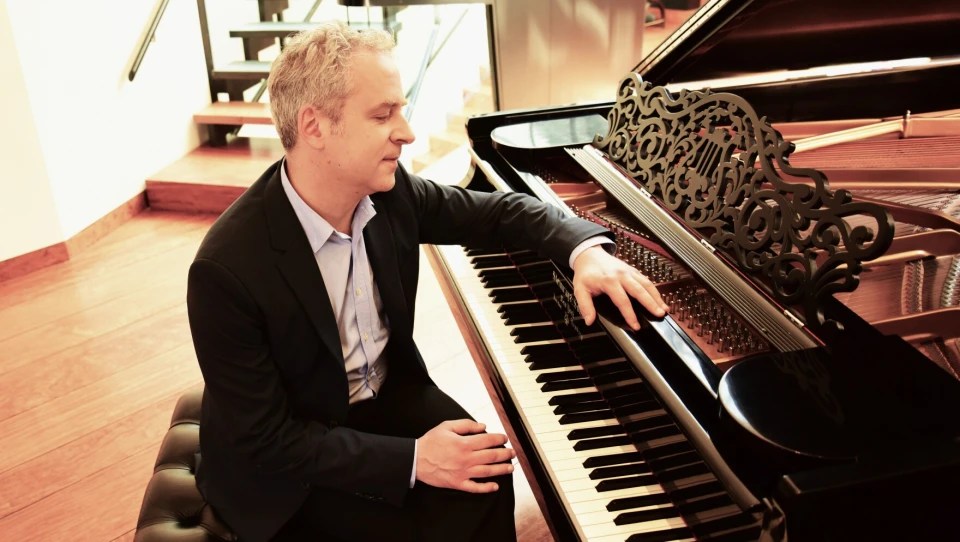
Jeremy Denk (piano, above), City of Birmingham Symphony Orchestra / Kazuki Yamada

Gershwin An American in Paris (1928)
Clyne ATLAS (2023) [CBSO Co-Commission: UK Premiere]
Ravel Pavane pour une infante défunte (1899, orch. 1910)
Mussorgsky orch. Wood Pictures at an Exhibition (1874, orch. 1915)

Symphony Hall, Birmingham
Wednesday 1 May 2024

Reviewed by Richard Whitehouse

This evening’s concert by the City of Birmingham Symphony Orchestra may have taken its overall title from the final work, but ‘pictures’ were everywhere in evidence and not merely those ‘at an exhibition’ – not least with Kazuki Yamada as enthusiastic as ever at the helm.

While it loses out to his Rhapsody in Blue in the popularity stakes, Gershwin’s An American in Paris is surely the most successful of his orchestral pieces for matching its immediacy of imagery to a resourceful structure. Encouraging the CBSO to a bracing response in the outer sections, and with Jason Lewis’s nostalgic trumpet initiating that pathos-laden central phase, Yamada secured a response whose full-on expression was offset by too sectional an approach – the music proceeding in a stop-start fashion rather than unfolding organically as it should.

Over recent years, the New York-based Anna Clyne has emerged among the leading British composers of her generation, with this first UK hearing for her piano concerto ATLAS keenly anticipated. Inspired by the eponymous and epic collection of the artist Gerhard Richter, this likewise falls into four ‘volumes’ rather than movements, which also underlines their relative formal freedom. Certainly, the ingenious interplay between soloist and orchestra is a tough challenge which Jeremy Denk met head-on – whether in the coursing energy then yielding eloquence of the opening Fierce, alluring textural overlaps of Freely, intimate, the lilting nonchalance of Driving or cumulative activity of the final Transparent with its surge to an emphatic close that (as with this work overall) was capricious and allusive in equal measure.

Doubtless motivated by Denk’s coruscating virtuosity, the CBSO gave its collective all in a work which (rightly) appealed to those present – the pianist responding with his deft take on the Heliotrope Rag co-written by Scott Joplin and the tragically short-lived Louis Chauvin.

After the interval, a rare moment of calm – Ravel’s Pavane for a Dead Princess given with a studied if never stolid grace, Elspeth Dutch’s horn and Katherine Thomas’ harp enhancing its appeal. As with Fauré’s Pavane, this is ideal music for opening the second half of a concert.

And so, to Mussorgsky’s Pictures at an Exhibition – heard here in the orchestration by Henry Wood which preceded and was duly superseded by Ravel’s. Wood is more interventionist, not least by reducing the recurrent ‘Promenade’ to a stealthy introduction, but not necessarily less faithful to the piano work’s spirit – hence the scabrous immediacy of Gnomus, sombre aura of The Old Castle (Andrew McDade’s tuba balefully intoning on high above stage-right), or fatalistic tread of Bydlo with its evocative percussion. Respighi was probably taken by this glowering depiction of Catacombs with a ghostly recollection of the promenade hardly less effective, and if Baba Yaga gets summarily curtailed here, the crescendo of bells launching The Great Gate[s] of Kiev set the tone for a treatment whose opulence borders on overkill.

Not that this inhibited the CBSO from projecting Wood’s organ-clad texture to the maximum, to the enthusiasm of an audience that erupted in the lingering resonances at its close. Quite a way to end an impressive performance, and a memorable concert, on a day that saw Yamada become this orchestra’s Music Director and the CBSO launch ‘A Season of Joy’ for 2024/25.

Click on the link to read more on the current CBSO concert season, and also to read about the recently announced 2024/25 programme. Click on the names for more on pianist Jeremy Denk, conductor Kazuki Yamada, and composer Anna Clyne

Published post no.2,168 – Saturday 4 May 2024

In concert – Quatuor Danel: Shostakovich & Weinberg #4 @ Wigmore Hall

Quatuor Danel [Marc Danel & Gilles Millet (violins), Vlad Bogdanas (viola), Yovan Markovitch (cello)]

Weinberg String Quartet no.5 in B flat major Op.27 (1945)
Shostakovich String Quartet no.6 in G major Op.101 (1956)
Weinberg String Quartet no.6 in E minor Op.35 (1946)

Wigmore Hall, London
Monday 29 April 2024

by Richard Whitehouse Photo (c) Marco Borggreve

Quatuor Danel’s ongoing cycle devoted to the string quartets of Shostakovich and Weinberg reached its fourth instalment this evening with a programme in which two of the latter’s most characteristic such pieces framed what is among the most ambivalent of the former’s works.

Composed in the aftermath of the Second World War, Weinberg’s Fifth Quartet emerges as a divertimento in concept but hardly in substance. The opening Melodia underlines this with its brooding theme on violin that intensifies expressively as the movement expands texturally, while the ensuing Humoreska has a dance-like insouciance that takes on ominous overtones as it unfolds. This accrued tension bursts forth in the central Scherzo with its violent motivic and gestural exchanges between the players, then the Improvisation revisits earlier material from an inevitably more troubled perspective. It only remains for the final Serenata to bring closure via its familiar gambit of summing-up the whole from a likely emotional remove, only to take on greater immediacy on the way to a musing close: something ideally conveyed here.

The mid-1950s was a difficult time for Shostakovich, recently widowed and unsure as to his future direction. Dedicated to his second wife, the Sixth Quartet can seem as tentative as this marriage proved short-lived – the genial quality of the opening Allegretto’s themes assuming much more combative guise as the movement evolves, with the Moderato that follows poised uncertainly between scherzo and intermezzo but without committing either way. The second of its composer’s passacaglias in a quartet context, the Lento unfolds as a processional both fatalistic and doubtful before heading into a final Allegretto whose inherent nostalgia exudes a sepia-tinted regret at its core. As previously, the Danel was mindful to vary the expressive intent of that recurrent closing cadence – one whose finality is ultimately borne of resignation.

The last work proved to be a culmination in all senses. Over six decades might have elapsed between its composition and its premiere (by this ensemble), but Weinberg’s Sixth Quartet is one of his finest and a highpoint of quartet-writing in the twentieth century. Although it runs to six movements, there is never risk of diffusiveness or loss of focus – witness the deceptive equability of its initial Allegro, such equivocation decisively countered by the violent Presto whose unbridled energy has barely been dispelled across the brief and recitative-like Allegro.

Despite its fugal mobility, the ensuing Adagio emerges as a slow movement frozen in intent – something the Danel brought out as acutely as it did that bittersweet anxiety of the Moderato which follows. More than in any of Weinberg’s earlier quartets, the final Andante maestoso is a fitting destination – its almost monumental power fashioning elements previously heard into a cumulative structure whose outcome is one of desperation mingled with defiance. Not hard to fathom why the Soviet authorities should have prohibited even a private performance.

Whether or not it has become a ‘signature work’ for the Danel, the sheer emotional input of this reading assuredly took no hostages. Shostakovich’s 1931 arrangement of Katerina’s aria from the third scene of his opera Lady Macbeth of Mtsensk duly made for an eloquent envoi.

You can hear the music from the concert below, in recordings made by Quatuor Danel:

For more information on the next concert in the series, visit the Wigmore Hall website. You can click on the names for more on composer Mieczysław Weinberg and Quatuor Danel themselves.

Published post no.2,167 – Friday 3 May 2024

On Record – Peter Herresthal, Jakob Kullberg, Bergen Philharmonic Orchestra, John Storgårds – Nørgård: Symphony no.8, Three Nocturnal Movements, Lysning (BIS)

Peter Herresthal (violin) and Jakob Kullberg (cello) (Nocturnal Movements), Bergen Philharmonic Orchestra / John Storgårds

Nørgård
Lysning (2006)
Symphony no.8 (2011)
Three Nocturnal Movements (2015)

BIS BIS-2502 [54’20’’]
Producer Hans Kipfer Engineers Matthias Spitzbarth, Håkan Ekman (Nocturnal Movements)
Recorded 29 & 30 August 2019 (Nocturnal Movements), 4 & 5 February 2022 2022 at Grieghallen, Bergen

Reviewed by Richard Whitehouse

What’s the story?

His activities as a composer may effectively have ceased, but Per Nørgård (1932-) remains a defining figure in post-war European music and this latest release from BIS collates three wholly characteristic pieces, including a double concerto which is also his last major work.

What’s the music like?

Playing a little over 25 minutes, the three movements of the Eighth Symphony each pursues its intriguing take on an established form (sonata, ternary then rondo) which emerge with a renewed fluidity and flexibility. The opening movement continually evolves its main ideas   in a gradual if cumulative curve of activity, culminating in the heightened crystallisation of motifs on tuned percussion. The central Adagio emerges across densely luminous waves of sound that recall earlier Nørgårdian practice from an arrestingly new perspective; one whose expression admits an almost confiding intimacy. The finale deftly complements this with its artfully ratcheting percussion and infectious rhythmic gyrations on route to a coda of purest radiance; the fitting close to a symphonic cycle that ranks with the finest of the post-war era.

A crucial factor of Three Nocturnal Movements is its having been a collaboration with cellist Jakob Kullberg and developed from the viola concerto Remembering Child of three decades earlier. The outcome comprises two substantial movements that frame a ‘nocturnal’ cadenza. The opening Allegro finds the solo instruments deeply embedded within an orchestral texture whose clarity enables motivic interconnections to emerge with due precision, underlining the airy momentum which carries this music towards its predictably unexpected close. Whatever its provenance, the central Andante is of a piece with those on either side – its limpid gestures and intonational punning a throwback to this composer’s preoccupations from more than half a century earlier, but now imbued with an aura no less affecting for its valediction. The final (undesignated) movement is the most demonstrative with its frequently percussive outbursts and those abrupt though never jarring changes in course that keep the attentive listener fully attuned to a discourse such as builds incrementally toward its wistfully fulfilled conclusion.

The earliest work here, Lysning makes for an ideal ending. Its title translating as ‘Glade’, this is the last of its composer’s pieces for strings and takes the Nordic miniature as template for a study in discreet yet potent contrasts of sonority and emotion that lingers long in the memory.

Does it all work?

Yes, not least because Peter Herresthal and Jakob Kullberg have premiered earlier concertos by Nørgård for their respective instruments, while John Storgårds had previously recorded the Second, Fourth, Fifth and Sixth Symphonies and gave the premiere of the Eighth of which he is dedicatee. This recording ideally complements that from Sakari Oramo (Dacapo 6.220574), focussing less on its overall symphonic cohesion than on the continual unpredictability of its renewed Classicism, and it is difficult to imagine more persuasive readings of the other works.

Is it recommended?

Very much so, in the hope Storgårds may yet complete his Nørgård cycle with the First, Third and Seventh Symphonies. Sound is up to BIS’s customary standards in clarity or perspective, while Kasper Rofelt’s annotations evince long familiarity with the composer’s unique idiom.

Listen

Buy

You can explore purchase options for this recording at the Presto website. Click on the names for more on the artists – John Storgårds, Peter Herresthal, Jakob Kullberg and the Bergen Philharmonic Orchestra – and for more on the composer Per Nørgård

Published post no.2,166 – Thursday 2 May 2024