Unknown's avatar

About Arcana

My name is Ben Hogwood, editor of the Arcana music site (arcana.fm)

On Record – Roderick Williams, Rupert Marshall-Luck, BBC Concert Orchestra / John Andrews – La Belle Dame (EM Records)

Roderick Williams (baritone) (Holst, O’Neil, Quilter & Scott), Rupert Marshall-Luck (violin, Brian), BBC Concert Orchestra / John Andrews

Brian orch. Marshall-Luck Legend B144 (c1919)
Delius Petite Suite d’Orchestre no.1 RTVI/6 (1889-90)
Holst Ornulf’s Drapa H34 (1898, rev. 1900)
Mackenzie Colomba Op.28 – Prelude (1883)
O’Neill La Belle Dame sans Merci Op.31 (1908)
Quilter orch. anonymous The Faithless Shepherdess Op.12/4 (1908)
Scott The Ballad of Fair Helen of Kirkconnel Op.8 (1900)

EM Records EMRCD085 [61’21’’] English texts included
Producer Neil Varley Engineers Andrew Rushton, Robbie Hayward
Recorded 5-7 January 2023 at Battersea Arts Centre, London

Reviewed by Richard Whitehouse

What’s the story?

EM Records continues its enterprising schedule with this collection of mainly vocal settings from the early twentieth century – heard alongside early orchestral pieces by Mackenzie and Delius, plus a recent orchestration of what is Havergal Brian’s only surviving chamber work.

What’s the music like?

This album’s title is also that of the 1819 poem by John Keats, its tale of ecstasy recollected in despair tangibly conveyed by Norman O’Neill in a setting which surely ranks among his finest concert works before music for theatre productions became his focus. Only marginally less compelling, Cyril Scott’s take on a typically over-elaborate ballad by Walter Scott has a keen sense of atmosphere – not least as rendered by Roderick Williams with an appropriate Lowland burr. Less involving emotionally, Holst’s setting of verse from an early Ibsen play is rather forced in its rhetoric – though the passages of emotional impulsiveness, allied to an acute feeling for orchestral textures, does presage those masterpieces of his maturity. Roger Quilter’s setting of a favourite Elizabethan lyric launches the collection with brusque charm.

Of the orchestral pieces, Delius’s early Première Petite Suite is here heard in full for the first time. Influences are easy to discern – Bizet in its whimsical Marche, Grieg in its winsome Berceuse, Massenet in its vivacious Scherzo then Fauré in its plaintive Duo – but never to the detriment of this music’s appeal, while the final variations on a sternly unison theme with ecclesiastical overtones will keep even seasoned Delians guessing as to its provenance. The likelihood of Alexander Mackenzie’s lyrical drama Colomba being revived is slim, but the Prelude to its first act has an evocative ardency which concludes this album in fine style.

John Andrews has the measure of these contrasting idioms and gets committed playing from the BBC Concert Orchestra. Roderick Williams is on fine form, as is Rupert Marshall-Luck in the Legend by Havergal Brian he himself has orchestrated. Ranging widely in expressive profile, while building considerable fervour during its relatively brief span prior to a calmly eloquent close, it is a stylish adaptation of the violin-and-piano original which has enjoyed increasing exposure this past decade. Marshall-Luck speculates whether Brian intended his own orchestral realization yet, given the composer had evidently written an orchestral piece with this title around 1915, it seems not impossible that the duo version is itself a reduction.

Does it all work?

Yes, in that the whole proves greater than the sum of its parts. Certainly, the works by Scott and O’Neill find these contemporaneous while otherwise very different figures at something near their best, while the Delius makes for an attractive sequence which deserves more than occasional revival. As, too, does the Brian given that comparable shorter concertante pieces by figures such as Saint-Saëns are being taken up by a younger generation of violinists. The spacious sound and extensive annotations are both up to EMR’s customary high standards.

Is it recommended?

Indeed. Hearing the Holst prompts the thought that, with the 150th and 90th anniversaries of his respective birth and death falling this year, now would be the ideal time for revival of his orchestral suite Phantastes – which has seemingly remained unheard since its 1912 premiere.

Listen & Buy

La Belle Dame is due for release on 19 April, but you can hear excerpts and look at purchase options on the EM Records website. For more information on the artists click on the names of conductor John Andrews, baritone Roderick Williams, violinist Rupert Marshall-Luck and the BBC Concert Orchestra

Published post no.2,126 – Saturday 23 March 2024

In concert – Quatuor Danel: Shostakovich & Weinberg #3 @ Wigmore Hall

Quatuor Danel [Marc Danel & Gilles Millet (violins), Vlad Bogdanas (viola), Yovan Markovitch (cello)]

Shostakovich String Quartet no.4 in D major Op.83 (1949)
Weinberg String Quartet no.4 in E flat major Op.20 (1945)
Shostakovich String Quartet no.5 in B flat major Op.92 (1952)

Wigmore Hall, London
Tuesday 19 January 2024

by Richard Whitehouse Photo (c) Marco Borggreve

Having got past its second instalment this time around, the Quatuor Danel’s cycle of string quartets by Shostakovich and Weinberg tonight encountered its most impressive programme thus far; the latter’s Fourth Quartet being framed by the former’s Fourth and Fifth Quartets.

Given its public premiere over four years after completion (it seems likely there were private hearings in the interim), Shostakovich’s Fourth Quartet is one among several of his pieces in which Jewish melody and inflection predominates. The key surely lies in emphasizing these as a structural as much as, if not more than, an emotional facet – as the Danel demonstrated with a take on the preludial Allegretto whose fervour never seemed anecdotal. The ensuing Andantino’s heightened pathos becomes anguished at its climax, while the scherzo is one of those speculative movements whose intimations the Danel projects so convincingly. With its implacable heading to an impulsive culmination then its allusive subsiding into an equivocal half-close, the final Allegretto conveys a tangibly but by no means concretely human drama.

Arguably his first masterpiece in the genre, Weinberg’s Fourth Quartet finds this composer tackling the Beethovenian model head-on – albeit with an opening Allegro whose unhurried manner and burnished textures only takes on greater urgency in its latter stages. The Danel brought this out accordingly, then pointed up the expressive contrast with a scherzo whose driving and ingratiating main themes alternate without hope of resolution. No less potently realized was the interplay between strident rhetoric and halting processional in the ensuing Largo, its unrelieved sombreness tentatively countered by a final Allegro which hints at an affirmative end, only to dismiss such possibility with its desperate closing crescendo. Well- received at its premiere, this quartet should have secured Weinberg’s reputation forthwith.

Other than his Twelfth, the Fifth Quartet is Shostakovich’s finest such achievement – directly preceding his Tenth Symphony with which it shares a comparable formal as well as expressive inclusivity. The Danel launched its opening Allegro with ample resolve, as if to underline the cumulative momentum of an outwardly Classical sonata form whose strenuous development carries over into a heightened reprise, then on to a coda whose pizzicato undertow establishes an emotional distance that connects seamlessly with what follows in this continuous design.

What follows is the most inwardly profound of Shostakovich’s slow movements – its overall remoteness tempered by allusion to his recent works then embargoed, with a passing raptness that might or might not be inherently personal in import. The Danel maintained concentration unerringly here, then headed straight into a finale whose initial geniality duly gives way to an explosive central climax and, in turn, tentative retracing of earlier ideas before a coda whose fatalistic radiance yields the most affecting end to any of its composer’s large-scale statements.

It certainly brought out the best interpretively from the Danel, who still found energy for an encore in the guise of a Capriccio that Weinberg wrote in the wake of his First Symphony in 1943: its amiable if sometimes barbed playfulness an ideal way to conclude a superb recital.

You can hear the music from the concert below, in recordings made by Quatuor Danel:

For more information on the next concert in the series, visit the Wigmore Hall website. You can click on the names for more on composer Mieczysław Weinberg and Quatuor Danel themselves.

Published post no.2,125 – Friday 22 March 2024

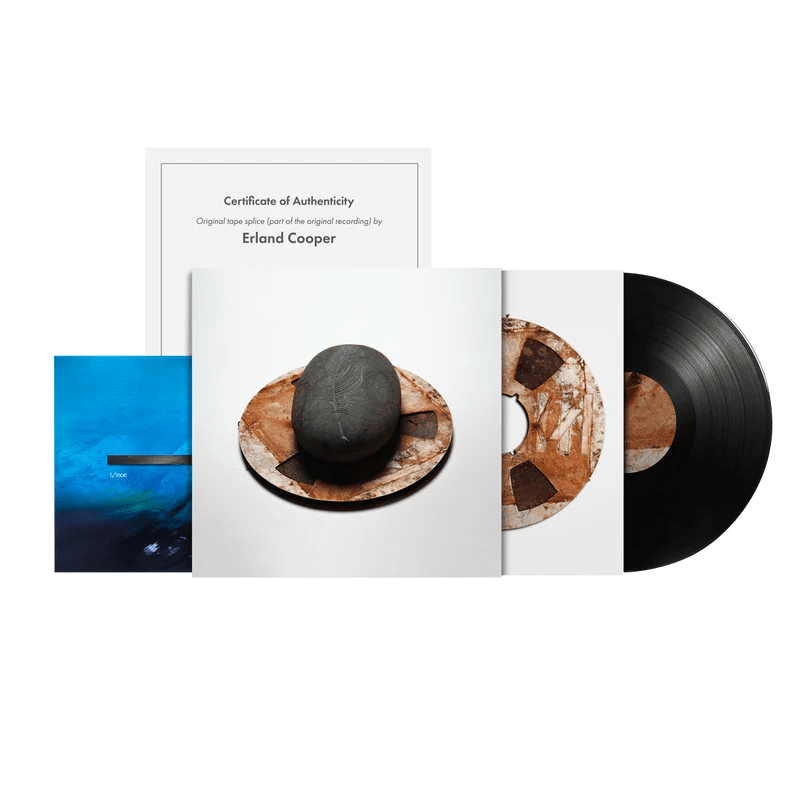
New music – Erland Cooper: Carve the Runes Then Be Content With Silence (Mercury KX)

by Ben Hogwood

The story behind Erland Cooper’s new work Carve The Runes Then Be Content With Silence is by no means an ordinary one – it is a deeply personal document.

On his website, Cooper himself describes the work as “a meditation on value, patience and time, as well as the often disposable nature of music. It seems fitting to me that the tape will slowly return and dry out between Orkney and London, in those safe havens of record shops that bring value to mine and my peers’ work.”

Carve the Runes Then Be Content With Silence will be released on the Autumn equinox, 20th September 2024, following its premiere live at The Barbican in London on 8th June. This first public reveal comes 3 years after the only master tape was planted deep in the soil of the Scottish Highlands and Islands of Orkney and all digital copies were deleted. It will be released exactly as it sounds from the earth. The recording is Cooper’s new three-movement work for solo violin and string ensemble.

After digitisation, the composer will complete the score for live performance as a true collaboration with the natural world. The piece was written to mark the centenary of celebrated Orcadian poet George Mackay Brown, as 2021 marked 100 years since his birth.

Inspired by natural landscapes and ruminating on time, hope, community and patience, the sole recording of the work – on ¼ inch magnetic tape, with the digital files permanently deleted – was planted, to grow and be nurtured or “recomposed” by the earth, before being exhumed and released. A treasure hunt of clues was slowly revealed by the composer every equinox period for fans and his record label alike to search for it if they so wished. In three years, if not found, the composer would return to dig it up himself.

In late 2022, the tape was found on a hunt by Victoria and Dan Rhodes. The album will now be digitised on the spring equinox in a special ceremony captured on film and released, exactly as it sounds from the earth, with nature having collaborated in the compositional process. The final score will then be completed and performed by live musicians at special concerts scheduled across the UK, Europe and America.

You can explore purchase options for the limited edition vinyl release of Carve The Runes Then Be Content With Silence on the Mercury KX website

Published post no.2,124 – Thursday 21 March 2024

New music – Daniel Avery: Wonderland / Running (fabric originals)

by Ben Hogwood

Here is a love letter from Daniel Avery to the fabled Fabric nightclub. The release celebrates 25 years of the club, having been a pivotal space for Avery. Following the 2014 release of his album Drone Logic, he was invited by fabric to stage his own DJ night at the club, and the release of this single marks the return of that night.

Published post no.2,123 – Wednesday 20 March 2024

Switched On – Echaskech: Novacene (VLSI)

by Ben Hogwood

What’s the story?

Echaskech describe their new album as ‘a soundtrack to an imaginary movie based on James Lovelock’s book and theory of the ‘Novacene’. Reflecting the tragedy of the previous epochs’ climate damage and the optimism of a more positive future, the tracks trace the dream-like lives of a group of humans co-existing with cyborg collaborators.

Deep into a distant future, the world has survived a brutal climate breakdown and shifted from an epoch defined by humankind, the Anthropocene, to one defined by hyper intelligent beings – the Novacene.

What’s the music like?

One of the strengths of Echaskech’s music has been their ability to combine floated ambience with earth shattering beats – yet this release sees them leaning heavily towards the former discipline.

It proves an effective move, for Dom Hoare and Andy Gillham have always been expert scene-setters, creating vivid and spacious pictures even before the beats make themselves known, and that is the case here. The key is a slight adjustment in the musical tension, so that the listener is drawn into a more meditative state of mind, but not necessarily relaxed, as there is still enough tension here.

Instead the music tends to reflect the cover, the synths creating deep washes of colour and full harmonies that bring James Lovelock’s concept to life. Walking With Spheres is very descriptive, with sharper outlines against the broad canvas. Conversion Using Sunlight has an ambient backdrop of birdsong, into which the warm synth colours emerge. The duo still use beats, and Garden of Antheia has a steady, dubby tread. The title track presents a bright outlook, reinforced by an atmospheric closing pair.

Does it all work?

It does. Best heard in an uninterrupted sequence, Novacene works as an immersive experience – best heard this way – or if it retreats to the corner of your listening.

Is it recommended?

Very much so. Echaskech have a high quality threshold with their releases, and Novacene shows the best of a ‘less is more’ approach, securing ambient music that still rewards closer listening,

Listen & Buy

Published post no.2,122 – Tuesday 19 March 2024