Unknown's avatar

About Arcana

My name is Ben Hogwood, editor of the Arcana music site (arcana.fm)

On Record – Elena Setién: Moonlit Reveries (Thrill Jockey)

by Ben Hogwood

What’s the story?

Basque artist Elena Setién last released an album two years ago, the understated but incredibly powerful Unfamiliar Minds – a set of songs begun before 2020 but honed during lockdown.

Glenn Kotche, drummer and percussionist with Wilco, was a fan of the album – and when he was touring Spain with the band, he met up with Setién. The two began collaboration, Setién using a series of drum patterns from Kotche’s series A Beat A Week, after which the drummer started sending in more patterns. Setién enjoyed the irony of her music taking on more rhythmic direction. In her words, “funnily enough, I, being a Spanish artist, sought inspiration in the rhythms of a Chicago drummer to reach something with a Latin feel to it. A somehow surrealistic way to get there.”

Another influence at play in the album was that of Bridget St. John, who Setién sought to emulate in a low register vocal delivery. It became the instrument through which the singer / songwriter could express the dreamlike state of the songs, though her own instrumentation – guitars and keyboards – played a large part too.

What’s the music like?

In a word, dreamy. Yet that is not the only story behind Moonlit Reveries, for these songs often have a feverish quality. Setién has a knack of making intense music from minimal means, but when you listen closely her music is suffused with clever effects and details that give the music a semi-conscious appearance.

She holds her vocal with remarkable poise, and it cuts through clearly, but the instrumental accompaniment that she uses is often haunting and frequently shifts the perspectives of the listener. The gentle undulating guitar of Hard Heart laps like water against the resonant vocals, while Losing Control gets a rippling effect from its shimmering electronics and pizzicato violin. Strange is especially enchanting, Setién singing very slightly out of tune over a throbbing guitar line.

Moonlit Reveries itself is particularly vivid, a hypnotic harpsichord dancing on the horizon as Setien coos softly. Mothers is a deeply immersive song, a tribute to Low’s Mimi Parker with minimalist loops and concentrated, layered vocals that end above delicate cymbals.

Does it all work?

It does – and the more you listen to it, the more Moonlit Reveries has to reveal.

Is it recommended?

Enthusiastically. Elena Setién is a compelling artist, and the restraint in her music is deceptive – for this is an album of great intensity, a set of dreams that take place in slightly balmy conditions but leave their listener with vivid and lasting impressions.

Listen and Buy

Published post no.2,094 – Wednesday 21 February 2024

Let’s Dance – Ash Walker & Amp Fiddler: Afronaught (Ron Trent Remix) (Night Time Stories)

by Ben Hogwood

What’s the story?

Ash Walker’s Astronaut slipped under the Arcana radar in 2023, so it’s only right to focus on it as its constituent tracks start to get the remix treatment. The choice of Afronaught is ideal, not just because – as the press release states – it flips the title of the album on its head, but because it contains guest vocals from Amp Fiddler.

Amp – Christian name Joseph – sadly left us just before Christmas 2023 at the age of 65, leaving in his wake a stellar discography of solo vocal and band keyboard contributions (notably with George Clinton and Moodymann).

This is what Walker had to say: ‘Having recently very sadly lost a dear friend, mentor, collaborator and huge inspiration of mine – Amp Fiddler, it was very touching to hear how Ron Trent reinterpreted Amp and I’s track together ‘Afronaught’. Label buddy Ron was able to steer Afronaught in a Chicago style, Acid House inspired direction which compliments Amp’s vocal perfectly, giving the track a new lease of life. Amp was such a pioneer and embodiment of Afrofuturism who never ceased to push boundaries, proving that us as black musicians have the power to defy genre and surpass societal expectations. Amp’s spirit will live on eternally, not only through the music he created in his lifetime but also through all the artists he nurtured and influenced worldwide.”

The press release goes on to say that “Ron Trent’s remix marks just the beginning of this journey, a sonic flare if you will lighting up the way for the projects to come”.

What’s the music like?

It’s difficult to imagine a more appropriate mix to mark Amp Fiddler’s passing. Ron Trent delivers a spatial piece of work full of low-end goodness – mellow keys underpinned by a steady, deep kick drum and surrounded by vocal snippets that are easy on the ear. Amp’s voice appears as though in a vision, while the keys flicker in the middle ground.

Does it all work?

It does. All very easy on the ear!

Is it recommended?

It is – a very classy remix and the ideal tribute to a much-missed musical presence.

For fans of… Moodymann, Charles Webster, Carl Craig, Juan Atkins

Listen & Buy

Published post no.2,093 – Tuesday 20 February 2024

Online Concert – Ensemble Apparat @ Ultraschall 2024

Poppe Zug (2007)
Bailie Night Scenes I & II (2023) [World Premiere]
May Multiplayer Instrument (2023) [World Premiere]
López Brass Quintet (2003-04)

Ensemble Apparat (Mathilde Conley and Rike Huy (trumpets), Samuel Stoll, Morris Kliphuis and Elena Kakaliagou (horns), Weston Olencki and Wojciech Jeliński (trombones), Eliot Duschmann (tuba)] / Max Murray

Radialsystem V, Berlin
Sunday 21 January 2024

by Richard Whitehouse

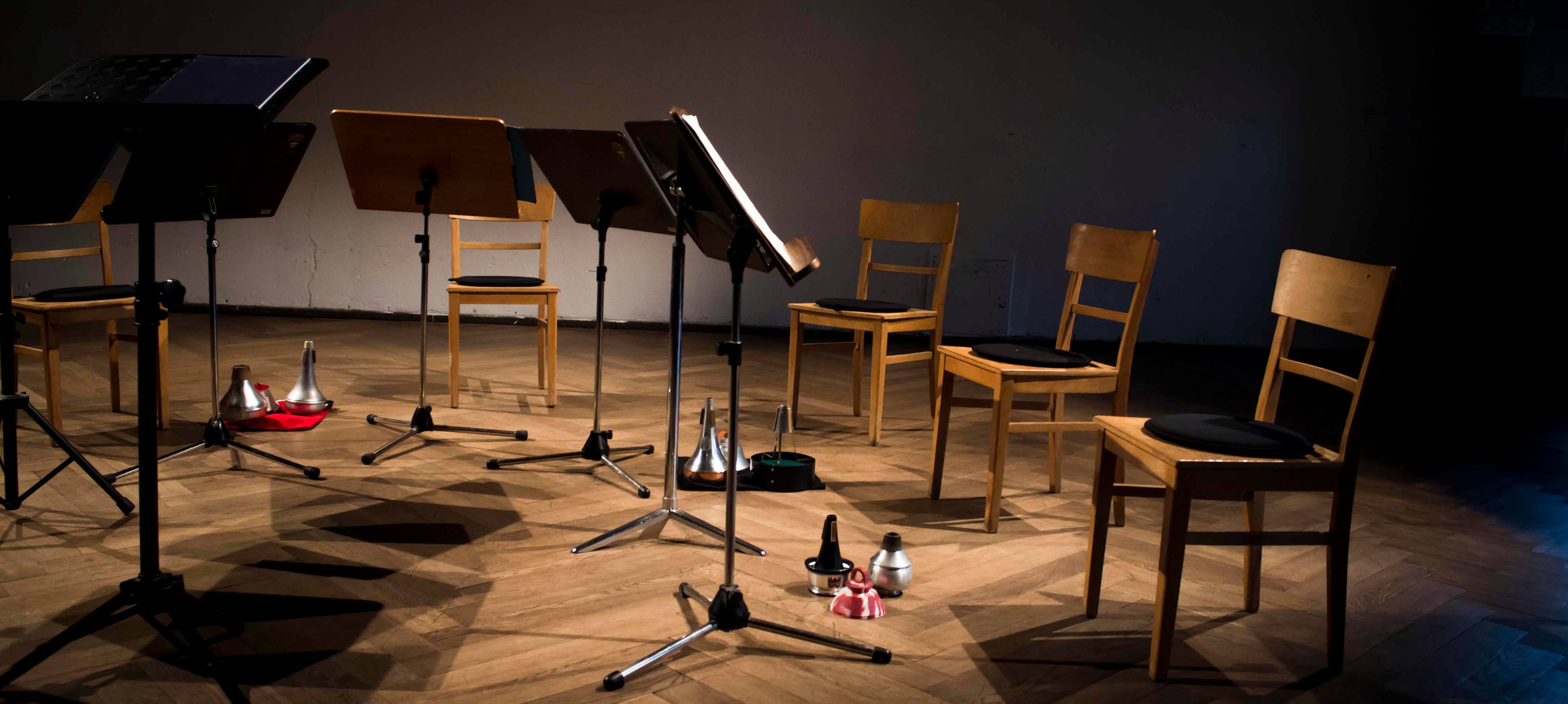
Heading into its second quarter-century, Berlin’s annual Ultraschall festival put together some typically wide-ranging programmes – not least this Sunday afternoon concert, which featured Ensemble Apparat in a sequence of diverse pieces for various ensembles of brass instruments.

Among the leading German composers of his generation, Enno Poppe (1969-) has now built a sizable catalogue – from which Zug, whether it refers primarily to a train or a procession (or the capital of a Swiss canton), continually diverts and intrigues with its interplay for brass septet. Unfolding as three intensifying waves of activity, the music elides between sometimes playful and at other times ominous moods. While the expressive outcome is left in the balance, there can be no doubting the formal cohesion of a work whose technical dexterity never draws undue attention to itself.

Its comparable number of players aside, there could scarcely have been greater contrast than with Night Scenes by Joanna Bailey (1973-). Much of her recent output features audio-visual or installation elements, the present diptych setting its instrumental component in the context of a soundtrack whose incrementally changing ambience likely reflects those places specified. Hence the luminous if distanced activity of Geneva and atmospheric if never claustrophobic confines of Schwarzwald, with these two complementing each other in an evocative totality.

From here to installation pure if not so simple. Visual artist Ragnhild May (1988-) has made a feature of human and mechanical amalgams, with Multiplayer Instrument her most ambitious such project yet by fusing the ensemble into a ‘meta-brass instrument’ whose sonic and even constructional qualities are in a constant state of change. While its overall impact inevitably depends on being seen as well as heard (see the photographs on the Ultraschall website), the stark and even hieratic nature of this undertaking is undeniable even to those ‘just’ listening.

The combining of sound-sources was heard at its most graphic in the Brass Quintet by Jorge E. López (1955-). Here the instrumental music is interpolated with concrète episodes such as evoke respectively the sonic overlap between an alpine crevice and industrial powerplant, the tortuous process of mountain rescue down a vertical cliff-face, then its effortful continuation over a field of scree. In each case, the contextual emergence and resolution of these episodes has been provided by the music for brass out of which they come then into which they return.

That brass writing has all the visceral immediacy associated with this composer, not least in its emphasis on those lower sonorities of Wagner tuba and contrabass tuba. The preludial first section vividly contrasts its contrasting musical-types, while the second is an incisive toccata and the third a plangent threnody, then the fourth section resembles an introduction and fugue in which a lively jig earlier insinuated by trumpet rapidly comes to the fore – dominating the closing stages as it draws all five instruments into a recessional of jocular yet wanton inanity.

Such was the impression made by this performance, superbly rendered by the musicians of Ensemble Apparat under the astute direction of Max Murray. It set the seal on a programme of engrossing music and music-making – these being characteristic of Ultraschall at its best.

You can watch this concert via the Ultraschall website Click on the names to read more about Ensemble Apparat and Max Murray – and for the composers Enno Poppe, Joanna Bailie, Ragnhild May and Jorge E López, whose 65th birthday tribute can be read on Arcana

On Record – William Doyle: Springs Eternal (Tough Love)

by Ben Hogwood

What’s the story?

William Doyle returns to the LP format with this response to the ‘ecstasies and agonies of the 2020s’ . On it, he is assisted by Brian Eno, Alexander Painter and Genevieve Dawson.

What’s the music like?

This time Doyle shows his musical versatility through a collection of intricate art pop songs. Drawing on late 1960s pop and psychedelia for inspiration, he updates them with cultural references for today, a kind of coping mechanism for life in the digital age.

Doyle’s lyrics show an awareness of the changing climate, and as he found nearly all the songs mention water in some way. They are clever and well written, with songs like Relentless Melt that are knowing commentaries on modern life dressed with catchy tunes. The orchestration is bright and suits Doyle’s delicate tones.

Does it all work?

Largely – though on occasion the feeling persists that the music on this album is just a bit too bright eyed and bushy tailed, that darker thoughts below the surface are not fully expressed.

Is it recommended?

It is. Springs Eternal is an optimistic statement proving once again how versatile William Doyle can be.

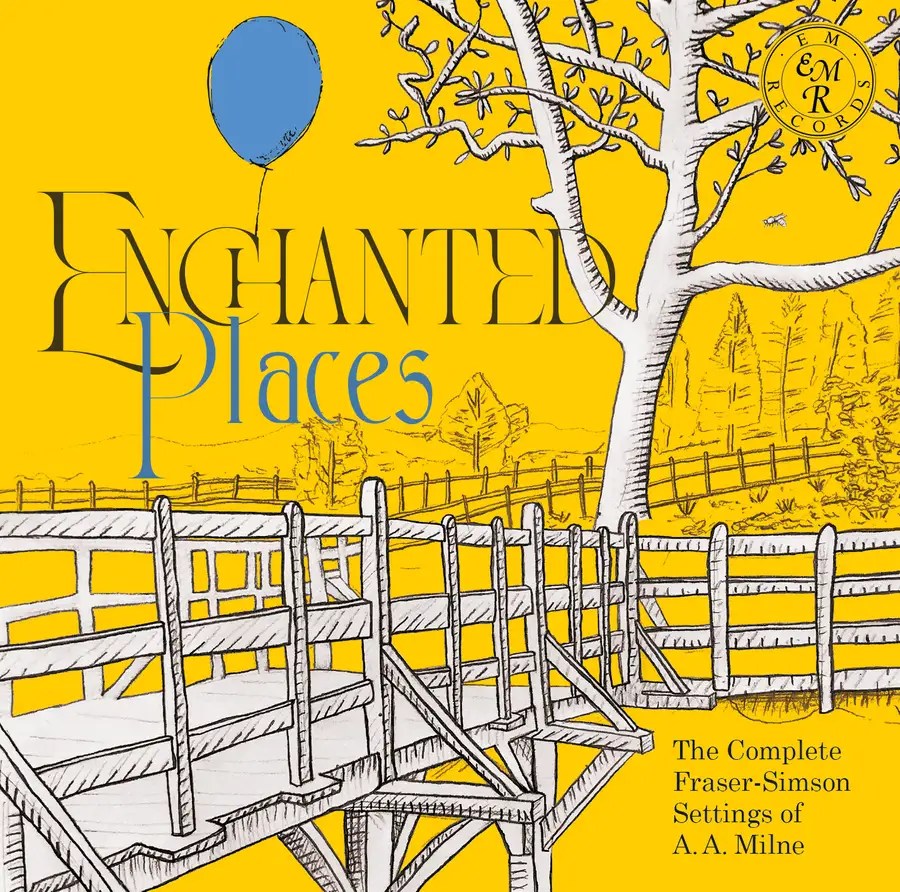
On Record – Enchanted Places: The Complete Fraser-Simson Settings of A. A. Milne (EM Records)

Grant Doyle (baritone) and John Kember (piano) with Brian Sibley (narrator)

EM Records EMRCD082 [two discs, 2h29m17s]
Producers Grant Doyle, John Kember Engineer Nick Taylor
Recorded 2019 and 2020 at Porcupine Studios, Mottingham, London

Reviewed by Richard Whitehouse

What’s the story?

EM Records continues its coverage of lesser-known and neglected English music with this complete traversal of A. A. Milne settings by Harold Fraser-Simson, more than appropriate when this year coincides with the centenary of Milne’s first collection of poems for children.

What’s the music like?

One among a notable generation of ‘light music’ composers, Fraser-Simson (1872-1944) had a brief if successful career with his songs and musicals; his musical comedy The Maid of the Mountains enjoyed one of the biggest West End successes during the latter years of the First World War and is still occasionally revived (the complete score was recorded by Hyperion in 2006). Although Simson’s star waned after the mid-1920s, his settings of Milne’s poems from the collections When Were Very Young (1924) and Now We Are Six (1927) have kept his name alive. Along with Milne’s books of short stories, these centre upon his son Christopher Robin and the latter’s nursery toys – above all, his bear Winnie-the-Pooh. They have held their own, moreover, throughout an era when the Disney franchise has continued to grow exponentially.

The songs themselves were published in six books between 1924 and 1929, alongside Milne’s poems with illustrations by Ernest Shepard which had graced the original collections. Private recordings were made at this time by Cicely Fraser-Simson with her husband as pianist, while Christopher Robin recorded several for HMV in 1927, and they have continued to attract the attention of singers both amateur and professional. Nor have the poems lost their appeal for subsequent generations of composers (Oliver Knussen drawing on a selection of them in his 1970 opus Hums and Songs of Winnie-the-Pooh), but Fraser-Simson’s settings have retained their charm along with a pathos accrued over the intervening decades. The present recording features 10 songs recorded for the first time to make this collection complete in all respects.

Does it all work?

Yes, not least given the quality of these performances. A seasoned exponent of opera, Grant Doyle gets to the heart of these settings – his singing of a warmth and precision that offsets any risk of sentimentality. Nor can his diction be faulted – no potential purchaser is likely to be without Milne’s original books but having them to hand is hardly necessary – while John Kember accompanies with subtlety and discretion. Devotee of all things Pooh, Brian Sibley narrates his handful of texts with due feeling for their unforced and often ingenious scansion.

This might not be the only way to realize these settings (a comparably extensive collection by Volante Opera Productions (Prima Facie) features seven singers), but the consistent and characterful nature of Doyle’s approach is its own justification. Those wishing to sample this release should go to The King’s Breakfast (CD2, tracks 26-29), essentially a cantata in which singer, narrator and pianist are joined by four other musicians to deftly imaginative effect, or evergreens Vespers (1, 39) and Buckingham Palace (2, 3) which emerge newly minted here.

Is it recommended?

Yes. The sound has an ideal combination of clarity and definition, while Sibley’s booklet notes on composer, author and project could hardly be bettered as an informed introduction. Put the Disney treatment aside and enjoy these settings for the winsome humour as initially intended.

Listen

Buy

You can explore purchase options for this album at the EM Records website. For more information on the artists click on the names of Grant Doyle, John Kember and Brian Sibley

Published post no.2,091 – Sunday 18 February 2024