Keith Kenniff releases his third album as Helios on Ghostly International, a label he joined in 2018. Kenniff, though, has been making music under this alias since 2004 – a complement to his other active persona of Goldmund. Kenniff, who also explores poppier climbs with partner Hollie as Mint Julep, is a prolific composer who likes to record at night.
Espera took on its form in this way, using layers of guitar, piano and percussion and concentrating on texture and colour just as much as melody and rhythm.
What’sthemusiclike?
In a word, lush. Espera presents wide open vistas, sunny outlooks, a light wind in the branches, an ebbing tide – all of those ambient things that we look for on holiday, presented in audio form. He presents those textures with subtly catchy hooks and melodies, the sounds warm to the touch and the harmonies easy on the ear.
From the moment Fainted Fog floats in the mood is set, and you can practically feel the sand in your toes as Intertwine takes shape. As well as pure relaxation, Kenniff’s music as Helios does have an emotional dimension, as the excellent later cuts Well Within and Rounds show. The latter has some softly voiced melodic loops linked together rather beautifully.
Meanwhile the likes of Impossible Valleys present a calming meander, outdoors in nature with not a care in the world.
Does it all work?
It does indeed, especially in the sunshine!
Is it recommended?
Yes. There are no surprises here, but that’s because Helios knows exactly what to do to set the mood. The mood here being relaxation and hot weather bliss.
Here’s a calming video for a Saturday morning – the visual accompaniment to new music from Jack Cooper’s project Modern Nature. Enjoy Cascade, the second cut from forthcoming album No Fixed Point In Space on Bella Union next month.
Jack Cooper had this to say about the single: “Cascade is a link between the abstract colours of this record and the rhythms of the last one Island Of Noise. The imagery is an attempt to convey how overwhelming the world can be when you make the time to really observe it. Beautiful, intricate and infinite. I was honoured to be able to sing this round a microphone with the great Julie Tippetts… something I’ll never forget.”
Scenes and monologues; opera in one act by György Kurtág; Libretto by the composer after Samuel Beckett’s Fin de partie
Semi-staged performance; sung in French with English surtitles
Hamm – Fred Olsen (bass), Clov – Morgan Moody (bass-baritone), Nell – Hilary Summers (contralto), Nagg – Leonardo Cortellazzi (tenor), Victoria Newlyn (stage director)
BBC Scottish Symphony Orchestra / Ryan Wigglesworth
Royal Albert Hall, London
Thursday 17th August 2023
Royal Albert Hall, London Friday 11 August 2023
by Richard Whitehouse photos by Sisi Burn / BBC
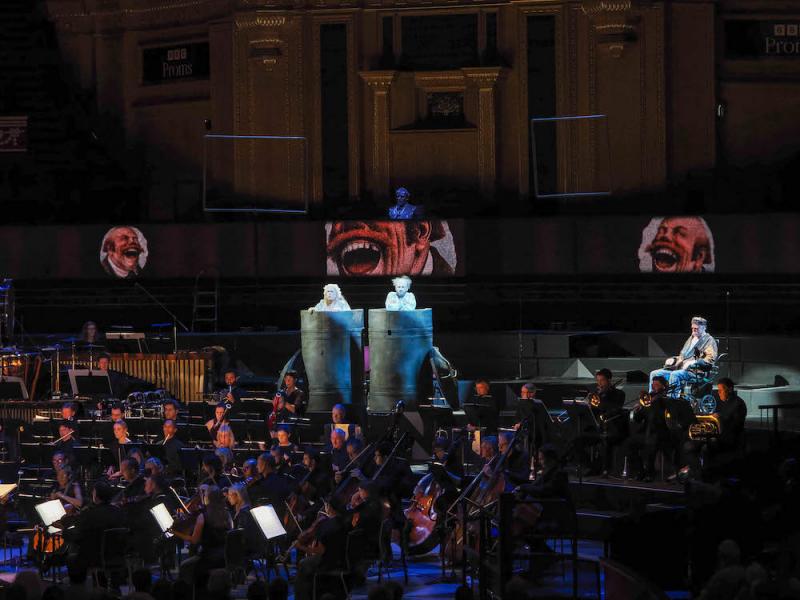
It may have had to wait three years since being postponed from the 2020 season, but tonight’s Prom brought a first hearing in this country for György Kurtág’s opera Endgame after Samuel Beckett and a performance such as, in the event, delivered at least as much as it had promised.
Although seeing Fin de partie on his first visit to Paris in 1957, it took several decades before Kurtág felt able to tackle a full-length opera and only in 2010 was a formal commission made by La Scala – presaging seven years of sustained (and evidently torturous) activity prior to its Milan premiere in November 2018. The subtitle is ‘Scenes and monologues; opera in one act’ and, having set 60% of the original French text, Kurtág still intends to add further scenes but, now in his 98th year, it would not be surprising were this opera to remain in its present form.
Unfolding continuously (and with no interval) across almost two hours, Endgame consists of 14 scenes which hone Beckett’s already sparse drama down to an unremitting focus on its four characters in their undoubted hopelessness and seeming helplessness. Vocally the predominant idiom is a speech-inflected arioso conveying its text with acute clarity against the backdrop of an orchestra which, despite – perhaps because of – its size and diversity, is almost always used sparingly. Stylistically the music invokes those traits familiar from its composer’s work across six decades which are not diluted as rendered in new and unlikely contexts; one notable aspect is the oblique while always audible allusion to those earlier composers who have accompanied Kurtág over his life’s work, and that here emerge as ‘figures’ all but tangible in their presence.
Utilizing three of the four singers from the Milan production, the cast could hardly have been stronger in commitment or insight. His being even more the defining role than with Beckett’s play, Frode Olsen here conveyed the predicament of Hamm with an authority the greater for its restrained vulnerability. He was abetted in this by Morgan Moody, whose Clov was poised between servant and protégé for a portrayal always empathetic however great its exasperation. Leonardo Cortellazzi summoned deftly whimsical humour as Nagg, reconciled to his dustbin-clad fate in contrast to the bittersweet recollections of Nell as taken by Hilary Summers – her eloquence extended by a later Beckett poem in a touching prologue. Victoria Newlyn brought the stark stasis of the drama and expanse of the Albert Hall’s acoustic into persuasive accord.
A versatile and perceptive conductor (and no mean opera composer, witness his ENO drama The Winter’s Tale six years previously), Ryan Wigglesworth duly had the measure of Kurtág’s elusive if inimitable idiom and drew a fastidious response from the BBC Scottish Symphony Orchestra; its playing as attentive to the score’s many subtleties as to its emotional highpoints – not least the closing bars, whose wrenching dissonance speaks of catharsis at least as much as of tragedy. The composer will hopefully have had an opportunity to hear this performance.
One looks forward to an eventual staging of this opera in the UK (following those subsequent productions in Amsterdam and Paris). Whatever else, Endgame is the summative work which Kurtág had to write and as confirmed tonight, the effort in its realization has not been in vain.
There are two new beginnings at work with this release, the first one on the new Odda Recordings label. Odda, founded by Leaf’s label manager and press officer, Thea Hudson-Davies, describes itself as being ‘informed by the musical contours of a long-running NTS Radio show, taking the lesser-walked paths across the fringe terrains of experimental music, percussive electronics and film soundtracks’.
To that end, the choice of Flaer – aka Realf Heygate – is an obvious one. Heygate is an artist, pianist and cellist based in Leicestershire, and this mini album has strong classical connotations in its title. For inspiration the net is cast further afield, however, drawing on environments and field recordings that would fit into 1970s folk horror films,
Heygate started the album during lockdown, restricting himself to four track tape and three acoustic instruments – cello, piano and acoustic guitar.
What’sthemusiclike?
Preludes captures the rarefied atmosphere of early lockdown in the UK, where an eerie quiet fell over the land and familiar sounds such as birdsong and church bells took on heightened significance and intensity.
Hew reflects this in its churchyard recording that quickly segues into gently oscillating piano and guitar, rippling out beautifully to a rocking cello motif. The cello takes the lead for a plaintive but searching melody on The Hill, while the guitar comes forward for Pasture, closely mixed to capture fret movements under the watchful eye of a blackbird.
Forever Never is the first truly heartstopping moment, an eddying piano line dropping away into stillness:
Landlock pits broad cello phrases against complementary guitar, but a low piano note on Magnolia introduces caution, the pastoral scene compromised by swarming treble lines, though these soften appreciably as the track proceeds. The closing Follow sees dense acoustic guitar lines accompanied by the distinctive chirp of house sparrows, before the cello adds richness.
Does it all work?
It does. Close-up listening is recommended, to catch the detail of the field recordings and the softened timbres Heygate often applies to the instruments. The only regret is that the recordings do not exist in longer versions, as there is still plenty of room for musical development in each.
Is it recommended?
It is. An auspicious start for the new label, which looks well set for the long haul. Preludes will put you under a spell for 20 minutes, and though on occasions it might get eerie, Flaer’s environment is a musically nourishing place to be.
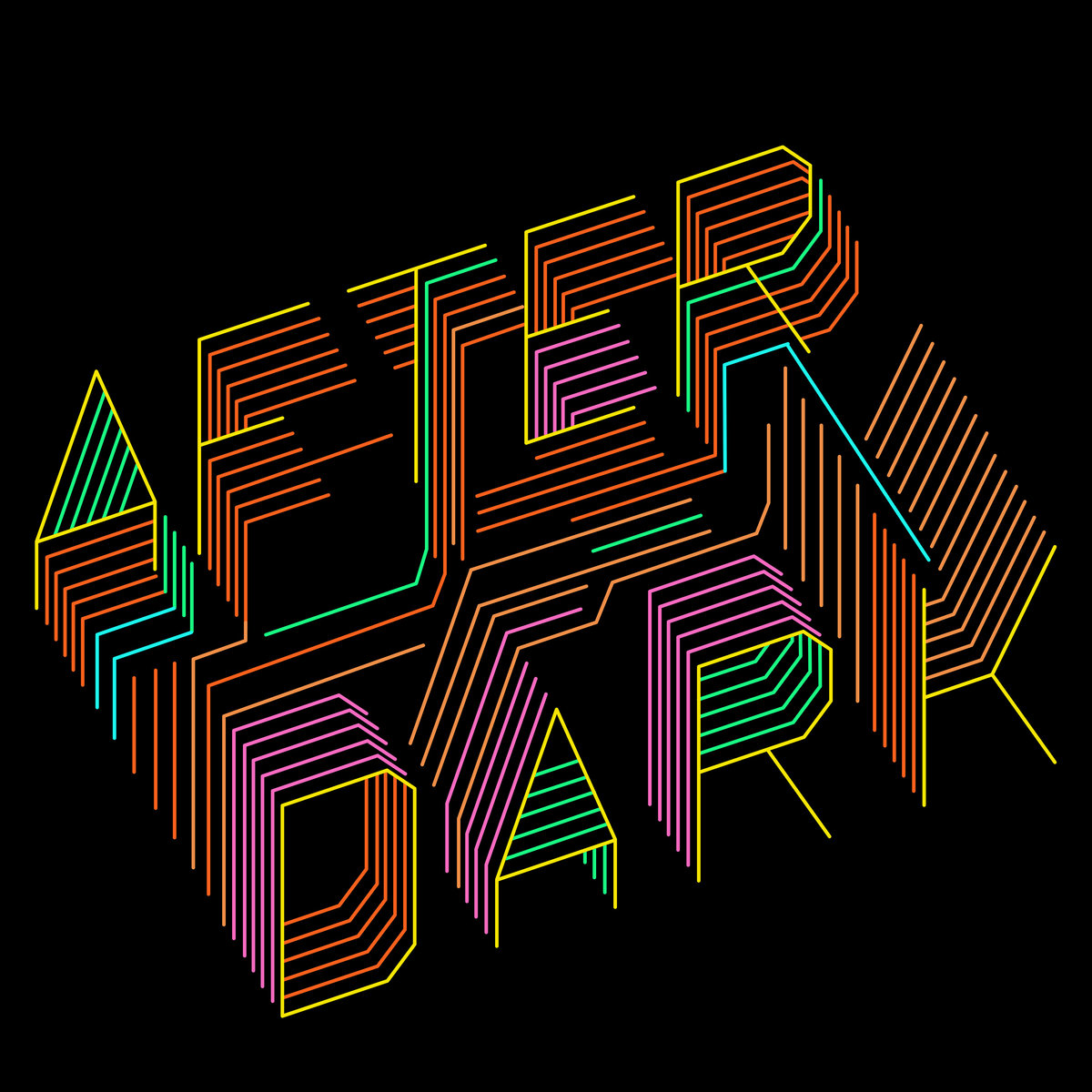
Bill Brewster returns to the decks for a new instalment in his After Dark series for Late Night Tales. Firmly entrenched as dance music royalty, Brewster has an encyclopedic knowledge of house, funk and disco, writing and co-writing a number of books and endlessly fascinating booklet notes. This love transfers effortlessly to his DJ sets and the music itself.
As before he has come up with an inventive selection of tracks old and new, plucking a number of rarities from behind the sofa, always with an eye on the overarching whole. Tracks are either brand new or digitally available for the first time.
Brewster describes his selection as “a basement, a red light and a sound system. Or, as the Beasties once rapped, slow and low, that is the tempo”.
What’sthemusiclike?
Not surprisingly, slow and low – and very smooth with it. Brewster, whose modesty is commendable given all the tunes he knows, has come up with a set that casts its net far and wide musically. It’s a selection where the listener will find plenty to satisfy their curiosity.
Brewster’s own work in the studio shines through, joining Alex Tepper for the Hotel Motel remake of Jeb Loy Nichols’ Don’t Drop Me, the singer professing his love for ‘a little bit of dirt’. Nichols makes an excellent vocalist in this context, though it could be argued that Brewster’s work with Raj Gupta, as Mang Dynasty, is even finer. The pair lend a chunky groove to Khruangbin‘s So We Won’t Forget.
Where Brewster really scores is in the joyful unpredictability of his selections, which turn out to sound great next to each other. A great example begins with the persuasive rhythms of Jana Koubkova’s Nijána, which give way to the Hacienda-tinged vocals of Dan Wainwright and the excellent Come Home.
Island Band‘s Idle Hours is openly joyful, with its choruses of voices and saxophones. Meanwhile Gus Paterson, Fernando and IPG V Hot Toddy all present winsome summer grooves. The former’s Archipelago has a Balearic feel, while IPG’s Open Space explores a classy pool party vibe.
Wrapping things up are a nice bit of electro funk from Rheinzand, the Scorpio Twins remix of Kills And Kisses, and a very smooth, languid groove from Chaz Jankel, Manon Manon.
Does it all work?
It does indeed. The music here is gloriously unhurried, and with each track able to play out there is plenty of space around the notes.
Is it recommended?
Certainly – a great complement to previous releases in the series. Bill Brewster certainly understands what makes a dancefloor tick.