Unknown's avatar

About Arcana

My name is Ben Hogwood, editor of the Arcana music site (arcana.fm)

Arcana at the Opera – Verdi: Le Touvère @ Wexford Festival Opera


Reviewed by Tom Hardwick


If the Wexford Festival is known and acclaimed for its commitment to reviving obscurer corners of the operatic repertoire, how could it also manage to open its 2025 season with one of Giuseppe Verdi’s best-known works? The instant success of Il Trovatore after its première in Rome in 1853 encouraged the financially astute composer to revise it for the lucrative Paris market, which preferred operas in French, before pirate versions of the score could deprive him of rights and royalties.

Verdi transformed Il Trovatore into Le Trouvère, revising the score to take account of the French text, adding a ballet to conform to the format of the Paris Opera (and justify his fee), tweaking the final scene, and overseeing the first performance in February 1857. Le Trouvère enjoyed a long reign in France and its colonies, before falling from favour by the 1930s. Musicological research led by David Lawton has encouraged revivals and the production of a critical edition of Le Trouvère. If Wexford could have its cake and eat it with this very familiar rarity, there’s an eeriness in hearing unanticipated words to very familiar melodies – who would have guessed “di quella pira” rendered down to “bûcher infame” – which remains slightly disconcerting.


Director Ben Barnes brought forward Verdi’s plot, originally set in medieval Spain and encompassing love triangles, civil war, burnings at the stake, and a gipsy’s curse, to the Spanish Civil War. The rebellious troubadour Manrique is now a dashing bicycle-mounted leader of an Anarcho-Syndicalist detachment; the Comte de Luna, his rival for Leonore, is a smartly uniformed Nationalist, albeit one who seems very happy to break into convents (shouldn’t it have been the other way round?). Liam Doona’s single set, with lofty shuttered openings upstage, flexibly suggested bivouacs, cafes and prison cells, as well as the bedroom where Leonore and Manrique finally manage to spend some time before fate and duty tear them apart.

The major difference between Il Trovatore and Le Trouvère is the ballet sequence at the start of Act III. Although rarely performed, the music showcases Verdi’s talent for orchestral writing, and the Wexford Festival Opera Orchestra sparkled under conductor Marcus Bosch. In 1857 the ballet illustrated the colourful life of a gypsy encampment, but it presents a problem for contemporary directors lacking the huge corps de ballet and budget of the Paris Opera. Ben Barnes used newsreel footage of the Spanish Civil War, and three rifle-toting dancers, to turn the ballet into the Comte de Luna’s uneasy dreams, but it remained one of the slacker parts of a production that usually kept the action belting along; in the last act the imprisoned Manrique and the gypsy Azucena (his mother – or is she?) even rose rather squeakily through the floor to avoid a scene change and keep the melodies unfurling.

The Wexford Festival Opera Chorus convinced as revolutionaries, soldiers, monks, and (especially) nuns, but the grand scenes only serve to outline the relationships between the four leads. Kseniia Nikolaieva sang Azucena powerfully but with few consonants, while Giorgi Lomiselli grew into the Comte de Luna and put some depth into one of Verdi’s less engaging baddies. Lydia Grindatto as Leonore showed no signs of the illness that was announced at curtain up, and Eduardo Niave, whose French accent was the best in the cast, was a young and charismatic Manrique. A solid – and sold out – start to the 2025 Festival.

You can watch this production of Le Trouvère below:

Arcana at the Opera – Wexford Festival Opera present Verdi’s Le Trouvère

Stand by for a review of this production, due tomorrow on Arcana (internet permitting, as I’ve just moved house!) – but thanks to Wexford / RTÉ you can enjoy the production online:

On this day – the first performance of Copland’s Symphony no.3

photo courtesy of CBS Television

by Ben Hogwood

Two days ago we noted the first performance of Aaron Copland’s ballet Rodeo in 1942. Now we look at the first performance of his Symphony no.3, which took place on this day in 1946. The Third is Copland’s flagship symphony, an impressive and powerful work that reaches its apex with music that you will no doubt recognise as the Fanfare for the Common Man, written in 1942. Here is a fine performance of the whole work from the New York Philharmonic and Leonard Bernstein, recorded for DG in 1986:

As with Rodeo, Emerson, Lake & Palmer were not far away, and their adaptation of the Fanfare for the Common Man became their biggest hit in 1977:

Published post no.2,691 – Saturday 18 October 2025

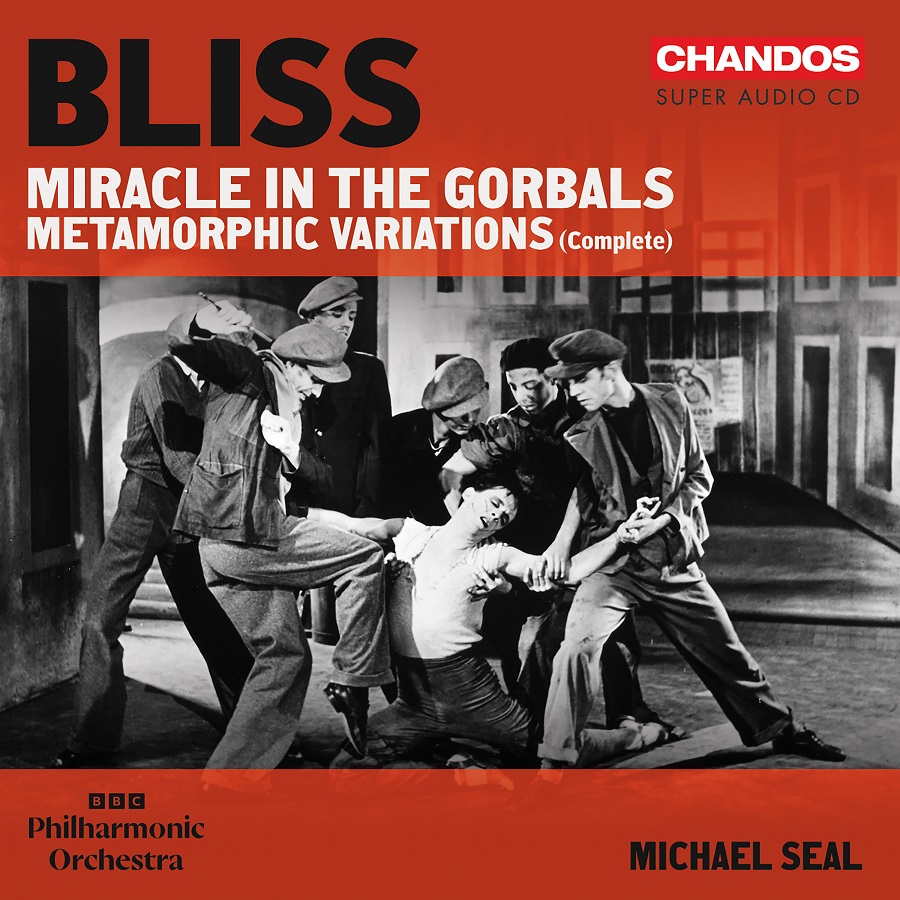
New music – BBC Philharmonic Orchestra / Michael Seal – Bliss: Miracle in the Gorbals; Metamorphic Variations (Chandos)

adapted from the press release by Ben Hogwood

An important new release in the Sir Arthur Bliss anniversary year, from a record company who have done so much to advance the cause of the composer. This is the recording made around a concert in Nottingham in February, where the Metamorphic Variations were appraised by Arcana’s Richard Whitehouse.

Chandos write in their press release: “Perhaps now overshadowed by his earlier ballet Checkmate, Miracle in the Gorbals was a tremendous hit for Bliss and the Sadler’s Wells Ballet company. First performed in 1944, it was repeated in every season through to 1950. Based on a scenario by Michael Benthall (inspired by Jerome K. Jerome and Dostoyevsky), the ballet features the appearance of a Christ-like figure amid Glasgow’s most infamous slum. This mysterious Stranger performs a miracle, reviving the Girl Suicide, who in despair had earlier thrown herself into the Clyde. The locals rejoice, but an Official (Benthall had in mind a priest) is jealous and, after a failed attempt to cast doubt on the virtue of the Stranger via the local Prostitute, has him slashed to death by a razor gang.

Bliss’s score employs a wide range of styles and harmonic language, and also exploits Leitmotifs for the principal characters. Originally titled Variations for Orchestra, Bliss composed the Metamorphic Variations towards the end of his life, during a late surge of creativity. Two of the sixteen movements were dropped before the first performance (given by the LSO and Vernon Handley in 1973) and for some reason were not re-instated at any of the later performances of the work until that given by Michael Seal and the BBC Philharmonic Orchestra in February 2025, the day before they made this recording.

Published post no.2,690 – Friday 17 October 2025

On this day – the first performance of Copland’s Rodeo

photo courtesy of CBS Television

by Ben Hogwood

On this day in 1942, at the Metropolitan Opera House in New York City, the premiere of Aaron Copland’s ballet Rodeo took place. It was a wildly successful event, with no less than 22 curtain calls for a work that was to become one of Copland’s best-loved.

Often the Four Dance Episodes are performed as an extract for orchestra, and these contain two famous scenes in Buckaroo Holiday and the popular Hoe-Down, which you can enjoy below in a brilliant recording from the San Francisco Symphony and Michael Tilson Thomas:

Thirty years after Rodeo’s premiere, progressive rock trio Emerson, Lake & Palmer put their own inimitable stamp on the Hoe-Down, with a virtuosic tour de force that stays faithful to the original but showcases the trio’s daredevil virtuosity, especially in this concert from Milan:

Published post no.2,689 – Thursday 16 October 2025