Unknown's avatar

About Arcana

My name is Ben Hogwood, editor of the Arcana music site (arcana.fm)

Talking Heads: Simon Dobson

simon-dobson

Interview with Alec Snook

Simon Dobson is a man of many disciplines. To date his musical career has found him out front as a conductor and composer, then behind the scenes as an arranger and multi-instrumentalist. On occasion all those disciplines combine, often with the London-based Parallax Orchestra, with whom he has worked on shows for rock and metal bands. The last year has seen a return to solo composition, with his second artist album MDCNL, released by Lo Recordings in May 2021, delivering five substantial musical statements including the single Quiet, Pls. Here he gives Arcana the lowdown…

In the making of your new LP ‘MDCNL’, was your hand forced to change recording styles/techniques due to the on-going pandemic?

Yeah, pretty much everything about the way I work had to change. Until last year I’d mostly worked to commission, one nail biting month to another, but with ensembles not meeting there were no commissions and no conducting work. I’d been looking to move away from that for a while if truth be told and so I got into production.

What is your relationship with electronic music composition as opposed to the more ‘traditional’ orchestral music that you trained in?

Other than loving listening to it and being a huge fan of it, my relationship with it is super new. This was pretty much the first time (other than demoing stuff at home to later be recorded) that I’d produced music electronically…which is pretty weird, actually. Being a composer and a conductor is obviously a bit of a ‘musical control freak’ thing and there’s more control to be had in the production of electronic music and all the infinite variations it contains. I’ve always been a fan of acts like Squarepusher and Aphex Twin though, I feel like all roads were going to lead me here at some point.

Do you feel that instrumental composers have to work harder to create a narrative or tell a story?

Maybe. Telling a story is hard regardless of the forces you’re writing for. I feel like the world of electronic music is just a language with more words or a shelf with more paints, though.

Does taking a more electronic focussed ensemble on the road appeal to you?

For sure. I love the idea of making electronic music live (and I do have some well tekkers plans up my sleeve), but for the moment getting over the panic of being ready to perform again in ANY way (having not played for the longest time in my adult life) is the first thing to tackle.
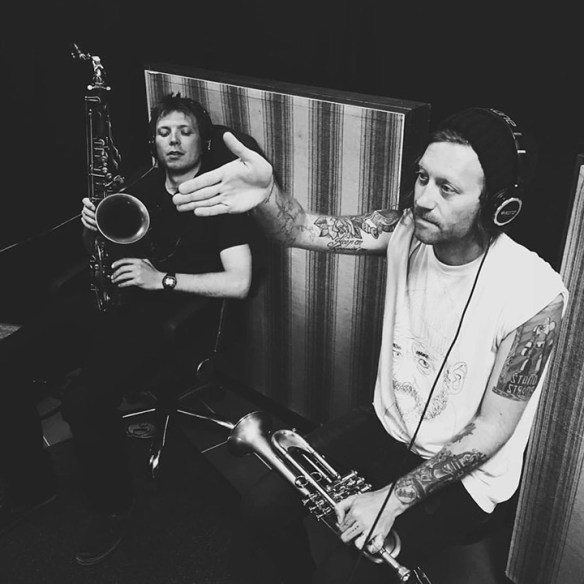
simon-dobson-2

When writing and arranging for guitar bands, what shifts in focus or strategies need to take place?

Big talk. Firstly, I’m always aware that in those work situations whatever I write is always beholden to someone else’s music. It’s only ever there to back it up and enhance it, so sometimes it’s hard to let go of ego and be utterly cool with stuff getting chopped or dissed if it’s “too far out” (it never is). Secondly, I generally only arrange for acts or a style I’m into (for example metal), that way I can throw myself into it and have fun as a composer/arranger.

Do you feel more pressure when collaborating with another band/artist? Or does it give you a freedom to step away from pieces that weren’t initially conceived by you?

If I’m working for an act or an orchestra I’m well into, I’ll obviously want them to think that my work is rad. So, I work hard at that shit for sure, but yeah, if I don’t have that sense of total ownership of a piece of music it is easier to be subjective about it.

What order of priority do you give to your orchestral work; the film scores; and the contemporary music arranging?

Honestly, music is my life so there is no strict priority order. I love the orchestral arranging work because I know I can add sheen and value to someone’s creations (plus metal/orchestra stuff is literally the funnest job ever, and the culmination of how I grew up loving heavy music but being classically trained). Film score stuff is new to me but again a very specific discipline and super fun; and contemporary composition is often solitary and hardcore but utterly fulfilling. I basically throw myself right into anything I do – ‘cos it’s music, and music is rad.

If you could work with one film director on a project, who would it be and why?

Either Werner Herzog or Wes Anderson. I know these two are miles apart, but they always have music that I absolutely love. I love the fun, quirky thing with Wes, I reckon I could give that a good crack, and I love the abstract serenity and epic emptiness of Herzog film scores; I’d love to write some weird soundscapes with a string quartet for whatever mad thing it is he does next.

Which other contemporary bands/artists, past or present, are you finding inspiring at the moment?

Anna Meredith (obvs, as always), Olly Coates, Colin Stetson, Steve Reich, Brian Eno (of course), Radiohead (for ever and ever), Matt Calvert, Mica Levi, Esbjorn Svensson, Tigran Hamasyan, Grace Lightman, LYR... you know, the normal bunch.

What other projects do you have coming up this year, whether studio or live?

I’m currently working on a big orchestral gig with my London based crew, Parallax Orchestra. This is a live gig with a band, but I can’t say anything about it just yet, safe to say I’m currently buried under a mountain of orchestral arranging. I’ve got an interesting contemporary commission on the horizon in collaboration with my mates LYR, and I will also be writing a sax quartet for my friend Andy Scott‘s group Apollo.

Oh, I’m also involved in a long-term project working with a local beekeeping start-up called Pollenize, writing generative music based on real time data sets coming out of beehives in Plymouth where I live. Other than that, who knows, MDCNL2 maybe…

Simon Dobson’s MDCNL is out now on Lo Recordings, while a new remix from Human Pyramids of Quiet, Pls has been released today (30 July 2021). You can hear that in the Soundcloud embed above.
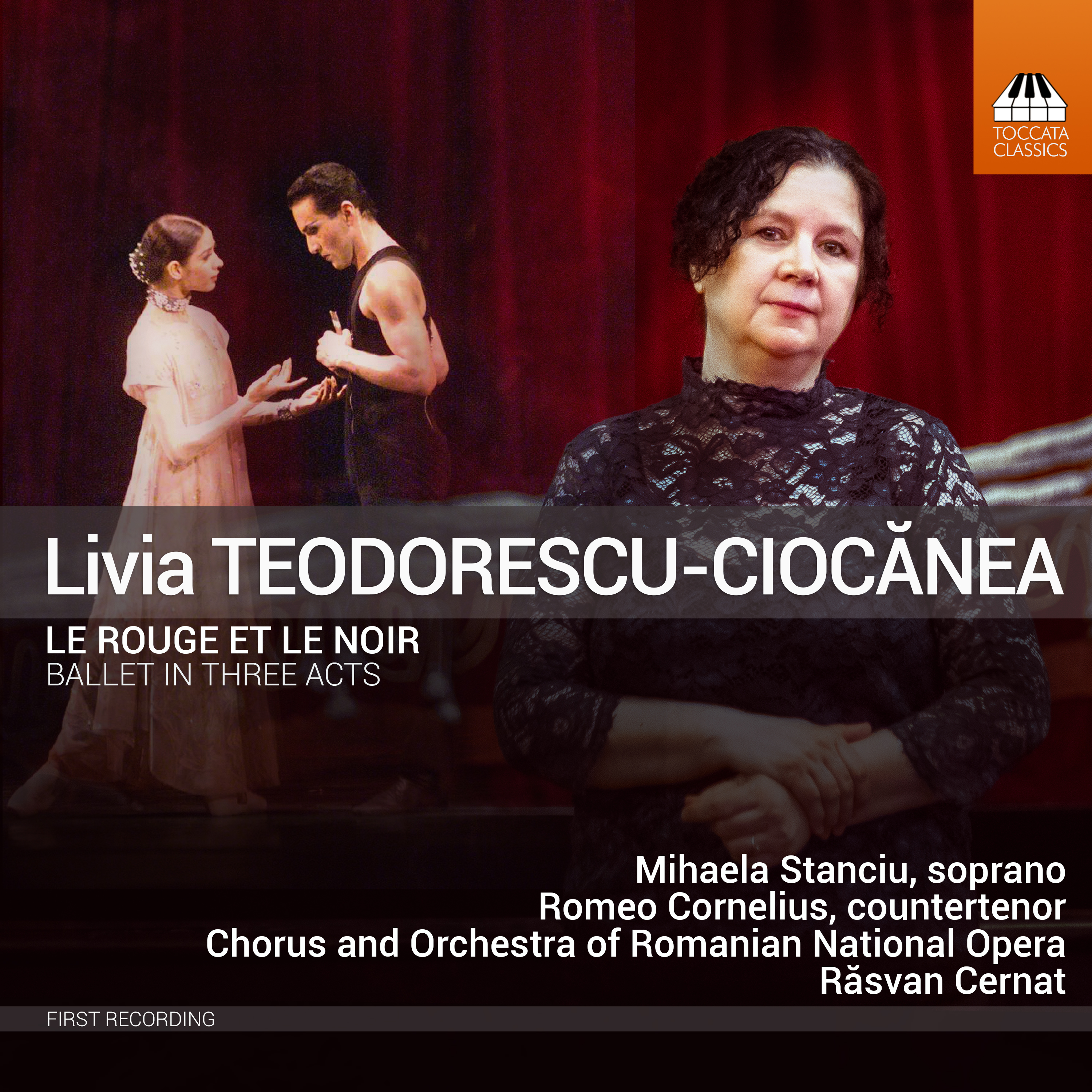
On record – Livia Teodorescu-Ciocănea: Le rouge et le noir (Romanian National Opera / Răsven Cernat) (Toccata Classics)


TOCC_0595

Teodorescu-Ciocănea
Le rouge et le noir (1999-2000)

Mihaela Stanciu (soprano), Romeo Cornelius (countertenor), Chorus and Orchestra of Romanian National Opera / Răsven Cernat

Toccata Classics TOCC0595 [75’25”] Synopsis included

Producers Florentina Herghelegiu, Erika Nemescu
Engineer Alexandru Părlea

Recorded 11-15 June 2000 at studios of Romanian Radio Broadcasting Corporation, Bucharest

Written by Richard Whitehouse

What’s the story?

Toccata Classics here continues its coverage of Livia Teodorescu-Ciocănea (b1959) with the ballet Le rouge et le noir, whose frequently lurid scenario allows her orchestral prowess and range of invention full rein – making for a musical experience cohesive almost despite itself.

What’s the music like?

Alongside a distinguished academic career (her PhD in composition was undertaken at the University of Huddersfield), Teodorescu-Ciocănea has amassed a sizable output that ranges across all the main genres. Her music has been compared to that of Horaţiu Rădulescu and Ştefan Niculescu in its usage of ‘spectral’ elements, but its expressive character is arguably closet to that of Pascal Bentoiu with its pivoting around post-romantic and modernist traits. Appropriate, then, for a ballet score complementing its subject-matter in no uncertain terms.

In her introductory essay, the composer describes Stendhal’s novel upon which this ballet is based as a ‘‘powerful and romantic one’’; which might almost be thought euphemisms for a scenario in which histrionics are emphasized to the point of – and even beyond – overkill. All is revealed in her track-by-track synopsis, but maybe this is a score best tackled – at least on first hearing – minus the distractions of Stendhal’s narrative with its cumbersome symbolism or mostly unsympathetic protagonists; one that culminates in a disingenuously tragic outcome.

Appreciating this ballet ‘in the abstract’ is facilitated, moreover, by the theatrical immediacy of its music. Structured in three acts, framed by a prologue and epilogue, it draws the listener through the story with no inherent longueurs (the ballet initially lasted for around 95 minutes, which Teodorescu-Ciocănea has reduced to its present 75 through withdrawing the numbers ‘‘that seemed to me redundant or transitional’’). Highlights are the second half of Act Two’s first scene – a propulsive passacaglia set in the mayor’s house; the subsequent scene, with its plangent and evocative love-duet set at Vergy; the brief while potent Passion Tango in Act Three’s second scene; and the Epilogue which brings about the denouement with a fervour and a dramatic inexorability that comprehensively transcends the narrative which inspired it.

Does it all work?

For the most part, yes. Listeners might well be advised to tackle the music straight off, rather than study the scenario beforehand. In the (understandable) absence of the visual component, this is a piece best evaluated on its own terms; without the cringing element of melodrama as derived from Stendhal, yet another of those ‘classics’ novels which has rightly been relegated to an academic footnote in history. The present performance surely presents this work to best advantage – vocalists Mihaela Stanciu and Romeo Cornelius eloquent in their contributions, and Răsven Cernat securing a visceral response from the forces of Romanian National Opera. The track-listing gives immediate access to each scene in the three acts, while Joel Crotty’s biographical outline is invaluable given the almost complete absence of material in English.

Is it recommended?

Yes, in the hope Toccata will go on to release examples of Teodorescu-Ciocănea’s orchestral and choral music – not least the oratorio Poppy Fields, her ‘in memoriam’ for those who fell in the First World War and on a scale as was largely ignored by major composers in the UK.

Listen

Buy

You can discover more about this release at the Toccata Classics website, where you can also purchase the recording. To read more about Toccata’s exploration of Teodorescu-Ciocănea’s piano music, click here

Listening to Beethoven #175 – 12 Contredanses WoO 14

accidents-in-quadrille-dancing

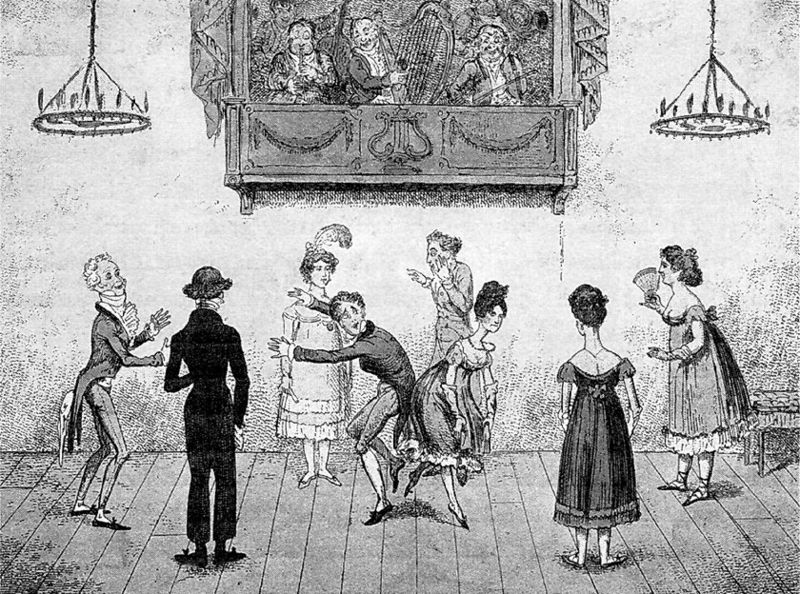
Accidents in Quadrille Dancing (1817 caricature)

12 Contredanses, WoO 14 for orchestra (1791-1802, Beethoven aged 30)

no.1 in C major
no.2 in A major
no.3 in D major (with Trio)
no.4 in B flat major
no.5 in E flat major (with Trio)
no.6 in C major (with Trio)
no.7 in E flat major
no.8 in C major
no.9 in A major
no.10 in C major (with Trio)
no.11 in D major
no.12 in E flat major (with Trio)

Dedication not known
Duration 9′

Listen

Background and Critical Reception

Very little is written about this set of 12 country dances, though they appear to have sat on the back burner for some time, Beethoven having begun them 11 years ahead of publication in 1802.

Daniel Heartz notes a crossing-over of material between these dances and the music for The Creatures of Prometheus, with a reference to ‘the composer’s favourite dance tune’ in no.7, which appears in the ballet as the Finale.

All have attractive, ‘one-off’ themes – but given their brevity there is little to no chance for development of the tunes in a minute or 30-second slot.

Thoughts

The music is bright and simple, and full of melody. There are two ideas in the first dance, which sets the scene with a spring in its step. The second hints at a minor key but has warm-hearted chords in the woodwind. The third is quite brisk, before the fourth moves to B flat major – Beethoven becoming a little more adventurous in this genre with his choice of key.

Beethoven makes a lot of simple themes from the notes of the triad, the fifth dance in E flat major providing a good example of how to construct from simple building blocks. This one is longer, allowing for the clarinet to come forward for a simple second theme. The elegant seventh dance has offbeat woodwind, before the most striking dance, the eighth, with castanets helping let the hair down! There is a similar energy to the ninth, with both gone in a flash – before offbeat emphasis in the eleventh. The final dance is the longest, giving more room for the horns and full orchestra, while lingering on the main theme.

Recordings used

Philharmonia Hungarica / Hans Ludwig Hirsch (Warner Classics)
Berliner Philharmoniker / Lorin Maazel (Deutsche Grammophon)
Academy of St. Martin-in-the-Fields / Sir Neville Marriner (Philips)
Orchestra of St. Luke’s / Michael Tilson Thomas (Sony Classical)

There is quite a coarse sound to the Philharmonia Hungarica violins in the Warner recording, which shows its age a little – but not the full Lorin Maazel version. Sir Neville Marriner conducts a typically light hearted version, as does Michael Tilson Thomas, fusing the short dances together effectively.

You can chart the Arcana Beethoven playlist as it grows, with one recommended version of each piece we listen to. Catch up here!

Also written in 1802 Cambini Wind Quintets nos. 1-3

Next up Man strebt, die Flamme zu verhehlen WoO 120

Listening to Beethoven #174 – Lob auf den Dicken, WoO 100

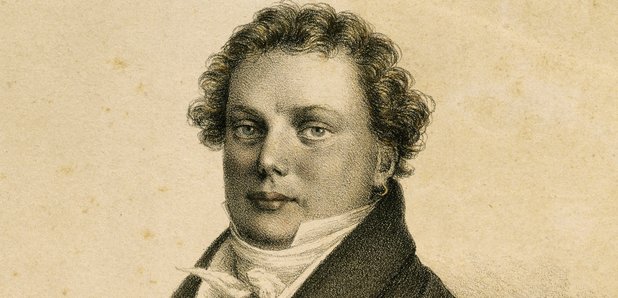
ignaz-schuppanzigh
Violinist Ignaz Schuppanzigh, the subject of this song

Lob auf den Dicken (Schuppanzigh ist ein Lump), WoO 100 for tenor, two basses and choir (1801, Beethoven aged 30)

Dedication Ignaz Schuppanzigh
Text Beethoven
Duration 40″

Listen

Background and Critical Reception

This is the first appearance of a musical joke in Beethoven’s output – and one of the first pieces for unaccompanied choir we have encountered. Many of the jokes are from the composer himself – with Lob auf dem dicken Schuppanzigh (Praise to the fat Schuppanzigh) no exception.

It does exactly what it says on the score, taking the mickey out of one of Beethoven’s few lifelong friends, violinist Ignaz Schuppanzigh. ‘We all agree that you are the biggest donkey’, runs the text, affectionately taunting the man who was to take part in the premieres of all three string quartets dedicated to Count Razumovsky, Schubert’s Rosamunde string quartet and Beethoven’s Ninth Symphony, where he led the orchestra.

It seems Beethoven’s friend was thick skinned in more ways than one.

Thoughts

This is definitely one of those songs where the humour is ‘of its time’ – and it certainly helps to have the text to hand when following it. It would be good to know how Schuppanzigh received Beethoven’s humour, as otherwise it feels rather awkward.

It is a tiny musical postcard, showing off the composer’s humour, while giving a hint that composing was something he did in his sleep and that his confidence was high enough to write like this in public. There will be more jokes and send-ups as time goes on…

Recordings used and Spotify links

Cantus Novus Wien / Thomas Holmes (Naxos)

Kammerchor der Berliner Singakademie / Dietrich Knothe (Brilliant)

A full-throated Berlin version – and a light-hearted new recording on Naxos. Both work well.

Spotify links

A playlist of four different versions of the Op.48 Lieder can be found here:

Also written in 1801 Zelter 12 Lieder am Clavier zu singen Z122

Next up 12 Contredanses, WoO 14

Listening to Beethoven #173 – 7 Variations on ‘Bei Männern, welche Liebe fühlen’ WoO 46

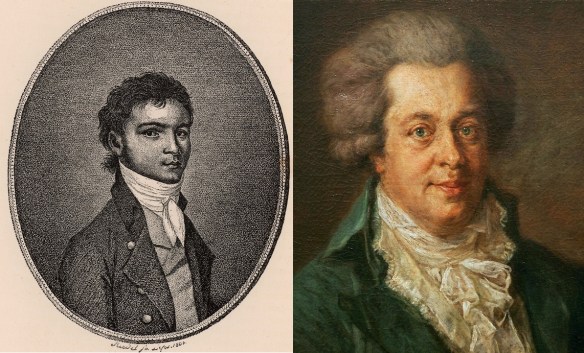
Ludwig van Beethoven and Wolfgang Amadeus Mozart (right, in a portrait by Johann Georg Edlinger)

12 Variations on ‘Ein Mädchen oder Weibchen’ from Mozart’s Die Zauberflöte Op.66 for piano and cello (1796, Beethoven aged 26)

Dedication Count Johann von Brown-Camus
Duration 9′

Listen

What’s the theme like?

The theme is a duet from Act 1 of Mozart‘s opera Die Zauberflöte (The Magic Flute), between the characters Pamino and Papageno, as below. It is an attractive tune in triple time, shared between the piano and cello in its higher register.

Background and Critical Reception

This set of variations is the third and last from Beethoven for piano and cello – and the second to use a theme from Mozart’s Die Zauberflöte. The inspiration is thought to have been two new productions of the opera appearing in Vienna in 1801. Steven Isserlis notes that despite its equal writing for both instruments, the first edition of Beethoven’s new work ‘fails to even mention the cello on its title page: pianistic chauvinism’.

This is all the stranger given the cello’s elevated role in Beethoven’s writing. As Misha Donat observes, writing for Philips’ recording by Heinrich Schiff and Till Fellner, ‘for the first time the two players are treated very much as equals. Their equality is inherent in the theme itself, which is laid out in such a way that the piano takes the part of Pamina, and the cello the answering voice of Papageno.

Isserlis takes the variations ‘depict various aspects of romance – from excited gossip to lofty ardour’. Marc D. Moskovitz and R. Larry Todd, in their wonderful book Beethoven’s Cello, observe how the fourth variation travels through the ‘parallel, though remote and rare, key of E-flat minor’, and Beethoven ‘reaches for the extremes’, the piano in its high register and the cello down low. Then, the three final variations ‘further deconstruct Mozart’s theme’, the last with a coda.

Thoughts

As the authors observe, Beethoven is bringing his ‘duo’ works to an ever more even keel. The theme here is a case in point, piano and cello united in their sharing of melodic material, and some effortless dialogue. Soon Beethoven is working through a busy second variation, before spicing up the melody with some chromatic additions. The questions and answers between the instruments continue, before the striking fourth variation in the minor key – tricky tuning for the cello here!

The two instruments have a lot of fun, finishing each other’s sentences in the fifth variation. Variation 6 is a florid affair, first for piano then cello, before the substantial finale, with the exuberant interplay of its coda – which also goes on a forceful excursion into the minor key. On the music’s return ‘home’ there is a bit more sparkling interplay before the two instruments sign off convincingly.

Recordings used and Spotify links

Adrian Brendel (cello), Alfred Brendel (piano) (Decca)
Mischa Maisky (cello), Martha Argerich (piano) (Deutsche Grammophon)
Miklós Perényi (cello), András Schiff (piano) (ECM)
Steven Isserlis (cello), Robert Levin (fortepiano) (Hyperion)
Nicolas Altstaedt (cello), Alexandre Lonquich (piano) (Alpha)

The Spotify playlist below includes all but one of the versions listed above – with the opportunity to hear a clip from Steven Isserlis and Robert Levin’s version on the Hyperion website

All versions are excellent, with operatic flair in evidence from Perenyi and Maisky. Once again though it is Robert Levin and Steven Isserlis who get to the heart of the piece and the enjoyment it can provide.

Also written in 1801 Woelfl Duo for cello and piano Op.31

Next up Lob auf dem dicken (musical joke) WoO100