Unknown's avatar

About Arcana

My name is Ben Hogwood, editor of the Arcana music site (arcana.fm)

Listening to Beethoven #178 – Sonata for piano and violin no.7 in C minor Op.30/2

op302-koch-glacier

Grindelwald Glacier in the Alps (1823) by Joseph Anton Koch

Sonata no.7 for piano and violin in C minor Op.30/2 (1802, Beethoven aged 31)

1. Allegro con brio
2. Adagio cantabile
3. Scherzo: Allegro
4. Finale: Allegro; Presto

Dedication Tsar Alexander I
Duration 26′

Listen

by Ben Hogwood

Background and Critical Reception

Once again, a group of three instrumental pieces by Beethoven is found to contain a tempestuous piece in C minor, the Op.30 violin sonatas following in the footsteps of Op.1 (piano trios), Op.9 (string trios) and Op.10 (piano sonatas). Gerald Abraham, writing in The Beethoven Companion, says ‘one grows used to finding that the C minor work in a group is the outstanding piece’. He finds the first movement of this work to be ‘one of Beethoven’s grandest first movements to date in any medium’.

Jan Swafford is slightly less affected, declaring the sonata ‘only modestly fiery compared to the storms that that key usually roused in him’. He reserves greatest praise for the slow movement, ‘a touching Adagio cantabile with no lingering hints of the eighteenth-century galant but rather an inward and spiritual atmosphere of wonderful beauty’.

In this piece Beethoven reverts to a four movement structure, with the slow movement second and a scherzo placed third.

Thoughts

Beethoven is certainly a different animal when operating in C minor. Right from the off there is a tension about this piece, and added urgency to the material that follows. As in all his C minor works Beethoven uses silence to intense dramatic effect, the breaks between the notes as important as the notes themselves. There is a big-boned piano part, too, which could dominate due to its sheer weight, even though the violin has an equal share of the melodic material.

The slow movement lies in Beethoven’s familiar ‘slow movement’ key of A flat major, and has a calming introduction to the theme from the piano. The violin follows almost in step, but gradually the dialogue becomes more animated, especially in the central section.

The third movement is playful, a Scherzo choosing C major briefly as its home. The clipped delivery of its theme is shared between the two instruments, and for a while we are in sunnier climes. Yet the closing Allegro takes us back to more serious business, the instruments shadowing each other again before rushing to a close in the coda. Beethoven toys with a lighter ending but at the close he firmly shuts the door with an emphatic gesture.
This is Beethoven’s most dramatic violin sonata so far, the tension bubbling on the surface. Though it may not cut loose in the same way as his other C minor works there is a great deal of inner strength and a keen sense of purpose. Repeated listening only heightens the admiration for a fine piece of work.

Recordings used and Spotify playlist

Midori Seiler (violin), Jos van Immerseel (fortepiano) (Zig Zag Classics)
Yehudi Menuhin (violin), Wilhelm Kempff (Deutsche Grammophon)
Josef Suk (violin), Jan Panenka (piano) (Supraphon)
Alina Ibragimova (violin), Cédric Tiberghien (Wigmore Hall Live)
Tasmin Little (violin), Martin Roscoe (piano) (Chandos)
Frank Peter Zimmermann (violin), Martin Helmchen (BIS)
Paul Barritt (violin), James Lisney (piano) (Woodhouse Editions)
Arthur Grumiaux (violin), Clara Haskil (piano) (Philips)
Augustin Dumay (violin), Maria João Pires (piano) (Deutsche Grammophon)

The drama of this piece is laid at its most bare by Midori Seiler and Jos Van Immerseel, and while some pianists exaggerate the forceful nature of their part, Yehudi Menuhin and Wilhelm Kempff strike the ideal balance. Dumay and Pires offer a very fine digital version too.

The Spotify playlist below does not contain the Barritt / Lisney version, but does also include a highly powered account by Gidon Kremer and Martha Argerich, recorded for Deutsche Grammophon:

You can chart the Arcana Beethoven playlist as it grows, with one recommended version of each piece we listen to. Catch up here!

Also written in 1802 Krommer – Concerto for 2 Clarinets in E flat major Op.35

Next up Sonata no.8 for piano and violin in G major Op.30/3
Listening to Beethoven #177 – Sonata for piano and violin no.6 in A major Op.30/1

op301-koch-monastery

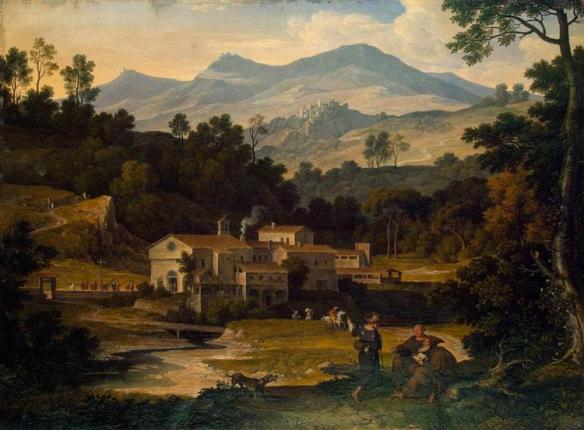
Monastery of San Francesco Di Civitella in the Sabine Mountains (1812) by Joseph Anton Koch

Sonata no.6 for piano and violin in A major Op.30/1 (1802, Beethoven aged 31)

1. Allegro
2. Adagio molto espressivo
3. Allegretto con variazioni

Dedication Tsar Alexander I
Duration 23′

Listen

by Ben Hogwood

Background and Critical Reception

The Op.30 violin sonatas stand at a crossroads in Beethoven’s output, drawing the early works to a close and beginning the more exploratory middle period. There is more evidence for the ‘equalising’ of the instruments, too, the violin on an equal footing with the keyboard instrument, now firmly established a fortepiano.

This set of three works was dedicated to Tsar Alexander I, in the view of Jan Swafford a convenient gesture ‘to a figure famously allied to enlightened ideals…who might also be moved to do something for a composer now and then’.

Commentators tend to gloss over this first work in the set and head for the stormy C minor work, placed second, or the bubbly third work in G major. However Gerald Abraham, writing in The Beethoven Companion, stops to take in the ‘beautiful three-part writing of the opening’ and the ‘violin cantilena of the slow movement’. Bernhard Uske, writing booklet notes for Deutsche Grammophon, exaggerates the violin-piano relationship. ‘The violin’s role is declamatory and evocative, the piano’s is to energize and keep things moving, as the need arises’.

Beethoven’s friend, fellow composer Carl Czerny, found ‘peaceful, tender seriousness’ in the first movement, described the second as ‘almost like a ballad’ and found the theme for the final movement variations ‘more speaking than sentimental’. In using this format Beethoven put aside his original version of the finale, saving it for another violin and piano work – the Kreutzer sonata, completed the following year.

Thoughts

Beethoven may be at a stylistic crossroads, moving on to something more forward-looking, but he certainly has control over his musical destination. This is fluent, attractive music, full of melody and good feeling.

This first of three sonatas does feel a little ‘older’, however – more Mozartian. The piano leads off and both instruments stay close together with elegant lines – though the violin begins to take its chances to sing more obviously. Things take a slightly darker turn in the middle as the music moves towards minor keys, but this proves to be a brief cloud on the horizon as the original material returns.

In the second movement the violin adopts the poise of a singer for a highly expressive solo, Beethoven taking an effective ‘less is more’ approach, lightly textured and relatively carefree.

The theme and variations begin with a simple melody shared by the violin, before a capricious first variation. Often the hands of the piano appear to be operating different instruments, with the left hand in triplets and the right using trills in Variation 3, before perky multiple notes in the fourth variation suggest the composer is exploring more of the violin’s capabilities. The minor key variation repeats into itself before a sprightly coda, Beethoven teasing the listener towards the end as the two instruments spar politely.

Recordings used and Spotify playlist

Midori Seiler (violin), Jos van Immerseel (fortepiano) (Zig Zag Classics)
Yehudi Menuhin (violin), Wilhelm Kempff (Deutsche Grammophon)
Josef Suk (violin), Jan Panenka (piano) (Supraphon)
Alina Ibragimova (violin), Cédric Tiberghien (Wigmore Hall Live)
Tasmin Little (violin), Martin Roscoe (piano) (Chandos)
Frank Peter Zimmermann (violin), Martin Helmchen (BIS)
Paul Barritt (violin), James Lisney (piano) (Woodhouse Editions)
Arthur Grumiaux (violin), Clara Haskil (piano) (Philips)
Augustin Dumay (violin), Maria João Pires (piano) (Deutsche Grammophon)

Dumay and Pires come into their own in the slow movement of this work with a highly expressive performance, even though their tempo choice is on the fast side. As always the period instrument duo of Midori Seiler and Jos van Immerseel are illuminating, while the richer tones of Grumiaux, Suk and Menuhin are complemented by beautifully phrased piano playing from Haskil, Panenka and Kempff respectively. The newest version, from Frank Peter Zimmermann and Martin Helmchen, is among the finest.

The Spotify playlist below does not contain the Barritt / Lisney version, but does also include a highly powered account by Gidon Kremer and Martha Argerich, recorded for Deutsche Grammophon:

You can chart the Arcana Beethoven playlist as it grows, with one recommended version of each piece we listen to. Catch up here!

Also written in 1802 Hummel – Piano Quintet in E flat major Op.87

Next up Sonata no.7 for piano and violin in C minor Op.30/2

Listening to Beethoven #176 – Man strebt, die Flamme zu verhehlen, WoO 120

man-strebt

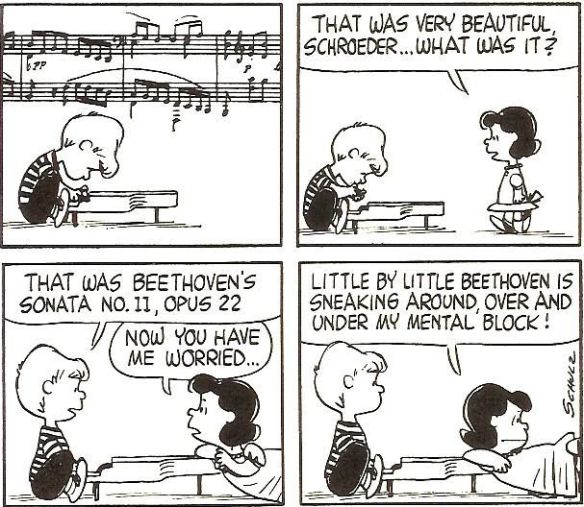
Peanuts comic strip, drawn by Charles M. Schulz (c)PNTS

Man strebt, die Flamme zu verhehlen WoO 120 for voice and piano (1802, Beethoven aged 30)

Dedication Johanna von Weissenthurn
Text Johanna von Weissenthurn
Duration 2′

Listen

Background and Critical Reception

Beethoven dedicated his song Man Strebt, die Flamme zu Verhehlen (One strives to conceal the flame) to Johanna Franul von Weissenthurn, an actress, poet, and playwright active in Vienna beginning in 1789.

Charles Petzold, in his Beethoven 250 series, sets the song in a good deal of context here, revealing a little more about the elusive Frau Weissenthurn in the process.

Thoughts

Given that this song only lasts just over two minutes, it has an unusually elaborate introduction from the piano – maybe part of Beethoven’s portrait-setting?

When the voice enters it sounds preoccupied, and the piano responds again. Translated, the text talks of how ‘a glance says more than a thousand words…a glance will often unbolt the door of passion long concealed. The voice seems to be portraying the glance, the piano more intent on opening the door with its florid right hand.

Recordings used

Natalie Pérez, Jean-Pierre Armengaud (Warner Classics)

Hermann Prey (baritone), Leonard Hokanson (piano) (Capriccio)

Both versions convey the preoccupied feel of this text.

Also written in 1802 Zeller Sammlung kleiner Balladen und Lieder Z123

Next up Sonata for piano and violin no.6 in A major Op.30/1

On record: Stephen Wilkinson – A Celebration of Conductor and Composer (Prima Facie)

stephen-wilkinson

William Byrd Singers, *BBC Northern Singers / Stephen Wilkinson

Dickinson Late Afternoon in November (1975)*

Ellis Sequentia in tempore Natali Sancti (1965)

McCabe Siberia; Visions (both 1983).

Traditional (arr. Wilkinson) Four Choruses from Grass Roots (2003); Betjeman’s Bells (2012)

Wilkinson That Time of Year (1976)

Prima Facie PFCD147 [60’55”] English texts included

Reviewed by Richard Whitehouse

What’s the story?

The always enterprising label Prima Facie releases an album to celebrate the centenary of the conductor and composer Stephen Wilkinson (b1919), whose many decades of work with both the BBC Northern Singers and the William Byrd Choir is appropriately commemorated here.

What’s the music like?

The selection begins with Peter Dickinson’s Late Afternoon in November, a setting of a poem he himself wrote and one whose distanced, often desolate imagery inspires music in which the underlying slowness of pulse and stark emphasis placed on certain words or phrases yields an anguished tone rare in the composer’s output. This performance by the BBC Northern Singers was indeed the world premiere and emphasizes Wilkinson’s assured direction of a demanding piece, the commitment in whose realization hardly something that could be taken for granted.

The remainder is sung by the William Byrd Singers, of whom Wilkinson was the director for almost 40 years. It duly makes the most of Visions, John McCabe‘s elaborate and often eight-part setting of a poem by James Clarence Mangan whose ranging across mellifluous vocalise and visceral chant is conveyed accurately and with not a little sensitivity. If that of the same poet’s Siberia encourages a more direct and (understandably) plangent response, the overall textural variety in this four-part chorus is felicitously judged throughout what is another responsive reading.

For many years a senior producer for BBC Radio in Manchester, David Ellis is also a notable composer, witness his resourceful and often imaginative response to the traditional sequence for Christmas time Sequentia in tempore Natali Sancti. In its astute alternation between full choir and solo voices, it makes for an admirable foil to the straightforward approach adopted by Wilkinson in That Time of Year – a setting of Shakespeare’s Sonnet LXXIII that enfolds its autumnal musings within a sound-world that is monochrome while luminous in character.

The programme is interspersed with Wilkinson’s arrangements of four folksongs taken from his collection Grass Roots – being Welsh, English, Irish and Scottish respectively. Thus, the ruminative As I walked out is followed by the gentle eloquence of Rowing down the Tide, the winsome melancholy of The Lark in the Clear Air, before the steadily accumulating vivacity of The Piper o’ Dundee. Also included here is the charming Betjeman’s Bells, three settings of texts by the Poet Laureate whose music was ingeniously derived from traditional sources.

Does it all work?

As an overall sequence, very much so. While none of these pieces makes use of the extended techniques encountered in much post-war choral music, they are rarely easy technically and the care in preparing these performances (including several world premieres) is evident from every bar. A pity that full recording details have not been included, though the quality of the remastering means that few, if any, allowances need be made for presumed older recordings. The booklet notes place each of these pieces within a meaningful as well as relevant context.

Is it recommended?

Indeed. That Wilkinson is still active as composer, and reader for his daughter’s early-music ensemble Courtiers of Grace, is itself gratifying. This archival release goes much of the way towards explaining why his presence on the English choral scene has been a beneficent one.

For further information on this release, and to purchase, visit the Prima Facie Records website, and for more on Stephen Wilkinson click here

In concert – English Symphony Orchestra / Kenneth Woods: New Notes

3choirs festival

English Symphony Orchestra / Kenneth Woods

Doolittle Woodwings (2018, arr. 2020) [Version premiere]
Elcock
Symphony no.8 Op.37 (2019-20) [World premiere]
Beethoven
Symphony no.7 in A major Op.92 (1811-12)

Town Hall, Kidderminster
Wednesday 28 July 2021 (2pm)

Written by Richard Whitehouse

It may have taken over 15 months, but the English Symphony Orchestra this afternoon gave its first concert with audience, as part of the Three Choirs Festival, in what was essentially an event rescheduled from last year that continued its estimable 21st Century Symphony Project.

The premiere was that of the Eighth Symphony by Steve Elcock (above), born in Chesterfield in 1957 and resident in central France, whose music has only recently come to prominence via releases on the Toccata Classics label fronted by the redoubtable Martin Anderson. Symphonic writing has dominated Elcock’s output this past quarter-century, and if his latest piece has antecedents in a string quartet composed back in the early 1980s, there can be no doubt it continues those processes of organic evolution and integration central to the seven works that came before it.

The present piece reflects the impact of having heard the Sixth Symphony of Allan Pettersson (awaiting its UK premiere after 55 years), but whereas that hour-long epic centres on fateful arrival, Elcock’s 20-minute entity is more about striving towards a destination which remains tantalizingly beyond reach. Various pithy motifs are sounded in the opening pages, the earlier stages pursuing a productive interplay between relative stasis and dynamism as is thrown into relief by the emergence (10 minutes in) of a trumpet melody which crystallizes the course of this piece as it builds inexorably to a powerful climax then subsides into a searching postlude that recedes beyond earshot. Overt resolution may be avoided, yet the sense of cohesion and inevitability audible throughout its course makes for an engrossing and rewarding experience.

That was certainly the impression left by this well prepared and finely realized performance, notable for the way in which Elcock’s idiomatic while demanding string writing was realized with manifest conviction. A 10-strong wind ensemble (along with cello and double-bass) had opened the concert with Emily Doolittle’s Woodwings, the songs and calls of nine Canadian birds rendered over five characterful movements somewhere between Poulenc and Messiaen, with a finale whose relatively freeform structure made for an intriguing and enticing payoff.

After the interval, Beethoven‘s Seventh Symphony received a performance as uninhibited and exhilarating as the piece itself. That all repeats in the first, third and fourth movements is no longer the surprise it might once have been: more startling was Kenneth Woods’s decision – entirely justified – to proceed without a pause into the second movement, so underlining the A-A minor pivot which uncannily anticipates that of Mahler’s Sixth almost a century later. Other highlights were the bracing cross-rhythms of the transition into the first movement’s reprise, the flexible pacing of the scherzo’s trio melody– poised ideally between hymn and dance, then a finale whose coda threatened to breach the confines of Kidderminster’s Town Hall but whose ultimate elation clearly left its mark on the audience’s enthusiastic response.

An impressive return to live performance from the ESO (above) and a harbinger of just what can be expected in its 2021/22 season. Before that comes another in this orchestra’s series of online concerts with a fascinating chamber realization of Bartók’s opera Duke Bluebeard’s Castle.

You can find information on the ESO’s next concert at their website, and more on their latest recording, ‘Fables’, here. For more on the composer Steve Elcock, head to his website – and for the recordings on Toccata Classics, click here