
Unknown's avatar

About Arcana

My name is Ben Hogwood, editor of the Arcana music site (arcana.fm)

Listening to Beethoven #72 – Prelude and Fugue in C major

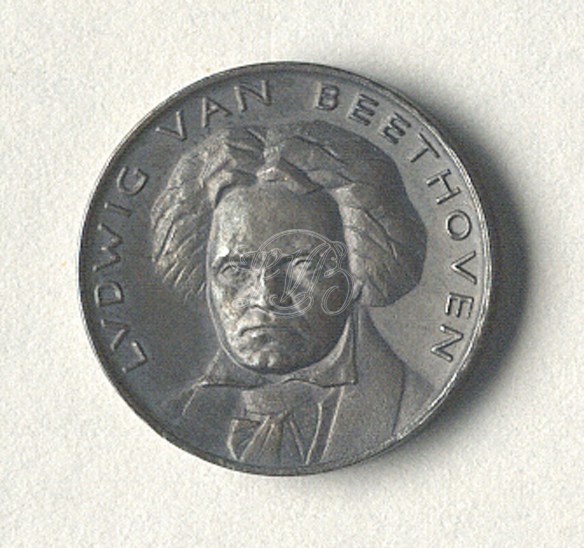
Commemorative medal for Ludwig van Beethoven, 1927 – Silver medal from the Bavarian Main Mint based on a design by Josef Bernhart, Munich, 1927 © Beethoven-Haus Bonn

Prelude and fugue in C major, Hess 31 for string quartet (1794-5, Beethoven aged 24)

Dedication not known
Duration 5′

Listen

Background and Critical Reception

A third Prelude and Fugue from Beethoven’s lessons with Albrechtsberger in Vienna, 1794-5. By way of a reminder, Beethoven was taking lessons from the Austrian composer, whose relatively rigorous approach to working with counterpoint complemented the vocal teaching he was receiving from Salieri.

Beethoven had worked writing fugues in two or more parts, and here is another in four – with a short prelude added to the front.

Thoughts

During his lessons with Albrechtsberger it seems that Beethoven opens up a little more with every piece. This attractive Prelude and Fugue are outgoing from the start, with a very solid ground note on the cello beginning proceedings. After that the Prelude proceeds on its genial way, compact and very approachable. It ends on an open chord (G major)…

…which allows Beethoven to lead straight into the energetic fugu, back in C major. There is a strong pointer here towards one of his true masterpieces of counterpoint, the String Quartet in C major Op.59/3 ‘Razumovsky’, which he would publish in eleven years’ time.

Recordings used

Fine Arts Quartet (Naxos)

Endellion Quartet (Deutsche Grammophon)

Both ensembles give a full-bodied account of this piece, the Fine Arts noticeably louder while the Endellion have a bit more light and shade.

Spotify links

Fine Arts Quartet

Endellion Quartet

You can chart the Arcana Beethoven playlist as it grows, with one recommended version of each piece we listen to. Catch up here!

Also written in 1795 Hyacinth Jadin – 3 Piano Sonatas Op.4

Next up Prelude and Fugue in C major Hess 31

Listening to Beethoven #71 – Prelude and Fugue in F major

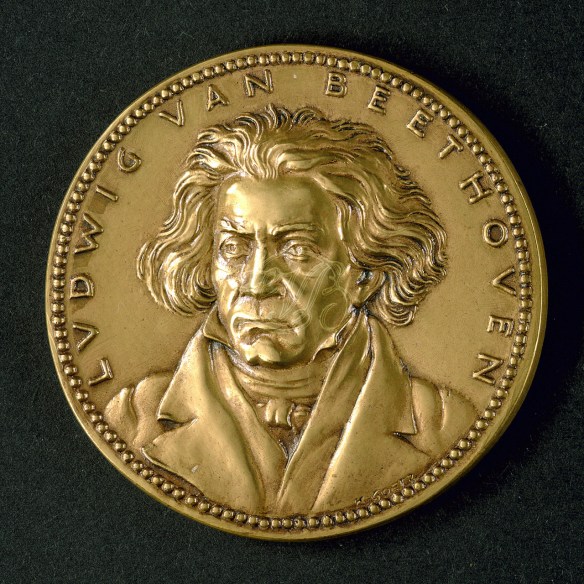
Commemorative medal for Ludwig van Beethoven, 1927 – silver medal based on a design by Karl Goetz © Beethoven-Haus Bonn
Prelude and fugue in F major, Hess 30 for string quartet (1794-5, Beethoven aged 24)

Dedication not known
Duration 6′

Listen

Background and Critical Reception

Here we have more from the pen of Beethoven via the careful scrutiny of Johann Georg Albrechtsberger. This is another more substantial piece suggesting he has reached the required standard of counterpoint writing and that his teacher is now encouraging him to apply it to a bigger scale.

Thoughts

Beethoven must have studied the organ works of J.S. Bach at some point while under Albrechtsberger – at least, that is the natural conclusion of thought while enjoying the busy, breezy prelude to this pair of movements. The music bustles along happily, each of the four instruments interacting closely but with the whole piece in mind.

The fugue is equally upright, Beethoven’s confidence in his part writing clear for all to hear. The main subject is bold and colourful, and dominates proceedings – but there is plenty going on behind the scenes, the accompaniment full of references to the main tune.

Recordings used

Fine Arts Quartet (Naxos)

Endellion Quartet (Deutsche Grammophon)

The Fine Arts Quartet give a clearly voiced account of the Prelude, with plenty of gusto – which they also apply to the Fugue. Their new Naxos recording is brightly lit, more so than the Endellion Quartet, who are a little bit more relaxed at the start of the Prelude, allowing the energy to build over a greater span.

Spotify links

Fine Arts Quartet

Endellion Quartet

You can chart the Arcana Beethoven playlist as it grows, with one recommended version of each piece we listen to. Catch up here!

Also written in 1795 Friedrich Witt – Horn Concerto in E flat major

Next up Prelude and Fugue in C major Hess 31

Listening to Beethoven #70 – Prelude and Fugue in E minor


Commemorative medal for Ludwig van Beethoven, 1927 – bronze medal based on a design by Karl Goetz © Beethoven-Haus Bonn

Prelude and fugue in E minor, Hess 29 for string trio (1794-5, Beethoven aged 24)

Dedication not known
Duration 6′

Listen

Background and Critical Reception

Beethoven’s counterpoint lessons with Albrechtsberger were starting to bear substantial fruit, the composer now producing fugues he considered to be public-facing, rather than the dutiful exercises we have witnessed up until now. This example sees quite a meaty prelude added to the front of a such an exercise to make a relatively substantial piece for string trio.

The excellent Unknown Beethoven resource goes into impressive detail on the unpublished work, recognising that the theme of the fugue itself must be by Beethoven, since ‘it does not occur on the list of themes which Albrechtsberger gave to his pupils’.

Thoughts

Beethoven’s prelude gives a hint of what is to come in the fugue. There may only be three instruments on show but the writing is dense enough to simulate at least four. The trio exchange their ideas but as the prelude moves on so the viola’s longer notes become both prominent and profound.

The fugue has a great deal of nervous energy, a tentative subject floated by the violin but gradually exerting itself with greater authority. Beethoven works his ideas through several chromatic harmonies, with a compact design and some neat trickery between the parts. The pair make an impressive and convincing piece that could easily be used as a concert opener or encore with rarity value.

Recordings used

Lukas Hagen, Rainer Schmidt (violins), Clemens Hagen (cello) (Deutsche Grammophon)

An excellent performance, rich in sound but with impressive clarity too.

Spotify links

Lukas Hagen, Rainer Schmidt, Clemens Hagen

You can chart the Arcana Beethoven playlist as it grows, with one recommended version of each piece we listen to. Catch up here!

Also written in 1795 Hummel – Piano Sonata no.8

Next up Prelude and Fugue in F major Hess 30

Listening to Beethoven #69 – 2 Triple Fugues


Medaille: Wyon, L. C.: Beethoven-Gedenkmünze (Philharmonic Society London, 1870) © Beethoven-Haus Bonn

2 Triple fugues, Hess 244 for four parts (1794-5, Beethoven aged 24)

no.1 in D minor
no.2 in F major

Dedication not known
Duration 5′

Listen

Background and Critical Reception

These two triple fugues were written for four parts, though the exact instrumentation is not known. All three themes of the first piece are by Beethoven, while the second piece is collaborative between the composer and his teacher Albrechtsberger.

Thoughts

Writing a triple fugue means that a good number of musical parts are in play. Beethoven achieves his aim with music of impressive craftsmanship which will surely have satisfied Albrechtsberger.

The result for the listener is more admiration at the process than anything else, for this is clearly music that was not meant to be performed in concert. The first fugue is dutifully played out and a little downbeat as we return to D minor, while the second is more energetic and has a busier theme.

It is fascinating listening to these exercises though – and we will see much later in Beethoven’s life how they bear considerable fruit.

Recordings used

Covington String Quartet [Frank McKinster, Greg Pinney (violins), Luke Wedge (viola), William Hurd (cello)] (Deutsche Grammophon)

The versions for string quartet were arranged by the Dutch musicologist Albert Willem Holsbergen and are given sprightly performances here.

Spotify links

Covington String Quartet

You can chart the Arcana Beethoven playlist as it grows, with one recommended version of each piece we listen to. Catch up here!

Also written in 1795 Hyacinthe Jadin – Three String Quartets Op.1

Next up Prelude and Fugue in E minor Hess 29

In celebration of Bruch

Believe it or not, Beethoven is not the only classical composer to have an anniversary in 2020!

While Arcana are spending a great deal of time examining and enjoying his output, we should definitely spare some moments to appreciate the gifts of Max Bruch, a gifted melodist who died 100 years ago today.

Born in 1838, Bruch is known chiefly for his works for violin and orchestra, in particular the Violin Concerto no.1 completed just before he turned 30. As is so often the case, however, if you look beneath the surface there are many more riches to be found.

Even at the age of 11 he was showing considerable talent in his Septet in E flat major, a work only discovered in 1981. The first violin concerto was followed by a first Symphony of three – attractive works which have just recently been released by Robert Trevino and the Bamberg Symphony Orchestra on the CPO label, reviewed on this site. Full of attractive tunes and outdoorsy textures, they are very enjoyable works.

This is before we get to the works for solo instruments and orchestra, where Bruch is at his most consistently inventive. The imaginative combination of clarinet and viola work well in the Concerto in E minor (1911), while the Concerto for two pianos and orchestra from a year later has added steel from the two keyboard instruments. The shorter pieces for strings and orchestra are more directly moving, headed by the soulful Kol Nidrei for cello and the Romance for violin.

On a larger scale, Bruch’s Scottish Rhapsody, based on themes from James Johnson’s collection of folk songs The Scots Musical Museum, is a wonderful piece, full of positive energy, which leads us to the three violin concertos themselves. The Violin Concerto no.1 is rightly celebrated for its blend of romanticism and technical virtuosity, but the second and third are cut from a very similar cloth, reaching similar heights of expression and daring. A late Serenade for violin and orchestra, published in 1899, is also a fine piece.

Bruch is a figure who often dips beneath the radar in concert programming, and who suffers from over-exposure of his ‘flagship’ piece, but it is worth taking some time around his centenary to appreciate the body of his output. Happily there are some fine records to aid us in that quest!

Bruch’s symphonies can be heard in the most recent recording by Robert Trevino, while the violin concertos have all been recorded by Jack Liebeck and the BBC Scottish Symphony Orchestra under Martyn Brabbins for Hyperion. You can visit their Bruch page to examine these and other attractive chamber pieces from the Nash Ensemble:

This Spotify playlist below celebrates some more highlights from the composer’s output:
https://open.spotify.com/playlist/39bOXUAmlwwHUfot2jZ0sM?si=UsGg2uiYTmu3xeEBD7h3kw