Unknown's avatar

About Arcana

My name is Ben Hogwood, editor of the Arcana music site (arcana.fm)

Listening to Beethoven #16 – Cantata on the death of Emperor Joseph II WoO87


Joseph II (right) with his brother Peter Leopold, then Grand Duke of Tuscany, later Emperor Leopold II Painting by Pompeo Batoni, 1769, Vienna, Kunsthistorisches Museum

Cantata on the death of Emperor Joseph II WoO87 for soloists, choir and orchestra (1790, Beethoven aged 19)

Dedication Emperor Joseph II
Duration 41′

Background and Critical Reception

Emperor Joseph II reformed Vienna in his decade in power, but in that time between 1780 and 1790 Bonn was very much under his dominion. Beethoven had visited Vienna briefly, but had to return to Bonn early due to his mother’s fatal illness. However because Joseph II’s brother was Maximilian Franz, Elector of Cologne, Beethoven was closer than many through his musical links.

On the Emperor’s death Beethoven was commissioned to set a text by Severin Anton Averdonk in commemoration, yet the resulting cantata was never to be performed in his lifetime. A planned performance in 1791 did not take place, seemingly due to the complexity of the music and the time (two and a half weeks) available to write and rehearse it. That Beethoven finished it was impressive enough, but once the moment had passed it would have been difficult to secure further performances.

The works remained unknown until the 1880s – when we have, as Lockwood describes, ‘an astonished letter of praise from Brahms, who said of the Joseph cantata, “It is Beethoven through and through”. He was later impressed by its “noble pathos…its feeling and imagination, the intensity, perhaps violent in its expression”.

Jan Swafford suggests Beethoven would not have been too disappointed at this, and points to several unusual qualities about the piece. It is a funeral cantata that ‘does not mention God until the third number, and then only in passing; only toward the end does it give lip service to paradise and immortality. In this cantata death is nothing but tragic, and Joseph’s main immortality is his legacy on earth, not his bliss in heaven.

Beethoven writers are united in their view of the Cantata’s important. Lewis Lockwood sees both this cantata and its successor, the Cantata for the Accession of Leopold II, as ‘the capstones of the Bonn years’. Swafford notes how Beethoven pulls out all the stops in his efforts to impress. ‘If he pulled too many, that is a sign of his youth, but already the expression is powerful, the handling of the orchestra effective and expressive the voice unmistakably his own. As a sign of that dynamism, he mined ideas from this cantata again and again in later years’.

The Joseph cantata anticipates important elements in Leonore of 1805, the first version of Beethoven’s opera Fidelio. While discussing this, Swafford praises how ‘he could also resurrect a beautifully sculpted melody that perfectly fitted both cantata and opera’.

Thoughts

This is a very different Beethoven. His response to setting the solemn text proclaiming Joseph’s death is so profound it is tempting to assume he is channeling his own experiences of bereavement into the score.

We hear Beethoven’s first orchestral ventures in the very solemn opening pages, a hushed introduction that calls to mind the desolation of Haydn’s representation of chaos from his oratorio The Creation. The chorus gives an equally weighty account of grief, reacting as it is to the text proclaiming and repeating ‘Joseph the great is dead’. In response to this sombre beginning Beethoven writes music of impressive heft for the soprano, then the bass voice sings triumphantly of Joseph’s triumph in ‘defeating the monster’. The orchestra gets caught up in the excitement, while the pacing of solo vocal flourishes (recitatives) and general momentum feels slightly in thrall to Handel.

The soprano brings warmth with an aria Da stiegen die Menschen an’s Licht (Then mankind climbed into the light), which is a thoughtful and ultimately radiant aria with choral backing. Another soprano aria, Hier schlummert seinen stillen Frieden (Here slumbers in his quiet peace the great sufferer), feels like the emotional centre of the piece, a really substantial slow movement that leads up to a restatement of the opening choral passages. Here the tragedy of death takes root once again, the desolation complete – and all in Beethoven’s now-familiar ‘tragic’ key of C minor.

The Cantata on the death of Emperor Joseph II feels like the most substantial Beethoven piece to date by some distance, and the most openly emotional too. With it Beethoven joins his idols Haydn and Mozart in the ability to write for large forces without ever appearing daunted by the prospect. Ultimately it feels like a fitting memorial to his mother, whether that was intended or not.

Performances

Charlotte Margiono (soprano), Veronica Verebely (soprano), William Shimell (bass), Ulrike Helzel (contralto), Clemens Bieber (tenor), Chorus and Orchester der Deutschen Oper Berlin / Christian Thielemann (DG)
Janice Watson (soprano), Jean Rigby (contralto), John Mark Ainsley (tenor), José Van Dam (bass), Corydon Singers and Orchestra / Matthew Best (Hyperion)
Juha Kotilainen (bass), Reetta Haavisto (soprano), Chorus Cathedralis Aboensis, Turku Philharmonic Orchestra / Leif Segerstam (Naxos)

Recordings of the cantata were thin on the ground until 1996, when Matthew Best and the Corydon Singers and Orchestra made a landmark release for Hyperion. Best’s use of a harpsichord in the ‘continuo’ role dates the piece, heightening its progression from the music of Gluck, Haydn and Mozart. He does much to inhabit the drama and is helped by excellent soloists, soprano Janice Watson hitting superlative heights and José van Dam giving a sonorous contribution as bass. The chorus are also excellent.

Christian Thielemann followed soon after for DG’s complete Beethoven edition of 1997, and his account is used on their big box this year. It is superbly paced and appropriately weighty, a little sleek in places but really getting to the tragic nub of the work. He achieves a hushed intensity from the start, and never lets up – with Charlotte Margiono imperious as soprano soloist.

A recent version from Leif Segerstram for Naxos offers stiff competition, a dramatic interpretation with excellent soloists in Reetta Haavisto and Juha Kotilainen.

Spotify links

Christian Thielemann

Leif Segerstam

You can chart the Arcana Beethoven playlist as it grows, with one recommended version of each piece we listen to. Catch up here!

Also written in 1789 Haydn String Quartets Op.64 nos.1-3

Next up Elegie auf den Tod eines Pudels (Elegy on the death of a poodle)

Listening to Beethoven #15 – 2 Preludes through all the major keys


Portrait statue of Beethoven along the balustrade. Library of Congress Thomas Jefferson Building, Washington, D.C. (photo: Carol Highsmith)

2 Preludes in C major Op.39 (through all the major keys) for keyboard (1789, Beethoven aged 18)

Dedication not known
Duration 9′

Listen

Background and Critical Reception

As Jan Swafford notes, Beethoven’s mid to late teens were spent perfecting his art as a pianist, and so his attention was fully focused on performance at the expense of composing. In this period he was playing Mozart piano concertos in Bonn, as well as playing viola in the court orchestra.

There were a few exceptions however, notably this intriguing pair of preludes, published later in his life as Op.39. There is very little written about the pieces but Barry Cooper, writing in the Decca / DG complete Beethoven notes, says how they ‘attempt to outdo Bach’s famous sets of preludes in every key, by modulating rapidly through every major key within the space of about 100 bars’. Keith Anderson, writing for Naxos’ release from Jenő Jandó, notes how the first prelude proceeds ‘through all the major sharp keys, making use of a repeated formula’, then makes its way ‘back, through the flat keys, to its original starting point of C major’. The second prelude, he notes, does this with greater economy.

Thoughts

The first prelude has a distinctive theme but it never settles, always moving on to the next chord. The piece feels more fluid when heard played on the organ. There is some restless experimentation and some quite jaunty moves, with Beethoven using daring harmonies to move through the keys at speed. Some of those harmonies feel bound for future compositions.

Ultimately though the two pieces feel like an attempt to emulate Bach in the shortest amount of time possible. An affectionate tribute, perhaps, but you can almost hear the boxes being ticked in the composer’s mind as he negotiates each key. Because of that it is hard to love either piece, but you can’t fail to be impressed by their execution – and perhaps in proving he could do it, Beethoven showed himself a bit more of what he was capable of!

The second prelude feels more comfortable, and its movements are more subtle until it comes to a distinctly clunky false stop on A flat before the end – which would I’m sure be deliberate. Having done this, Beethoven shows how easy it is for him to resolve into the ‘home’ key, back in C major.

Recordings used

Jenő Jandó (Naxos); Simon Preston (DG)

Jenő Jandó plays both preludes really nicely, with a line in clarity that makes it easy to follow Beethoven’s workings. However Simon Preston’s version for organ is more effective, as he uses some lovely registration choices – especially in the low but very sonorous chord at the end of the first prelude.

Spotify links

Jenő Jandó

Simon Preston

You can chart the Arcana Beethoven playlist as it grows, with one recommended version of each piece we listen to. Catch up here!

Also written in 1789 Mozart Clarinet Quintet in A major K581

Next up Cantata on the Death of Emperor Joseph II

Listening to Beethoven #14 – Trio for flute, bassoon & piano WoO37

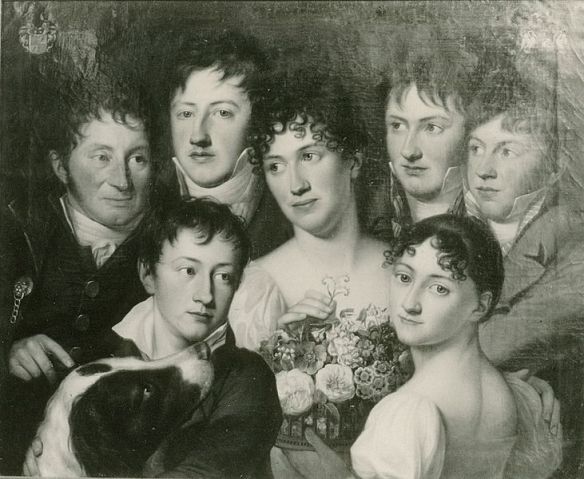
Maria Anna Wilhelmine von and zu Westerholt-Gysenberg with her family and her husband Freiherr Friedrich Clemens von Elversfeldt, called from Beverförde zu Werries painted by Johann Christoph Rincklake

Trio for flute, bassoon and piano WoO 37 (c1786, Beethoven aged 15)

Dedication The family of Count Friedrich Ludolf Anton von Westerholt-Gysenberg
Duration 26′

Listen

Background and Critical Reception

An unusual combination of instruments for Beethoven’s first published chamber music composition. This is entirely due to the aristocratic Westerholt-Gysenberg family of Bonn, for whom the piece was written – with a father who played the bassoon, whose children played the flute (son) and piano (daughter). The pianist, known Maria Anna Wilhelmine, was a pupil of Beethoven’s. On the words of John Suchet, Beethoven ‘fell in love with such a passion…that Romberg was telling tales of his friend’s unrequited love forty years later’.

For a while the authenticity of this Trio was in question, due to the teenage composer’s handwriting, but that notion was put to bed in the 1970s and the piece took its place in the canon as Beethoven’s first known chamber music trio.

The trio is a substantial piece, lasting 27 minutes, and it falls into three movements. The first is in G major and the second is an Adagio in G minor, leading directly into a set of theme and variations which comprise the finale. Writing in a booklet note for an early Deutsche Grammophon release, Anthony Burton describes a first movement ‘which, for all the triteness of some of its episodes of scales and arpeggios, anticipates the mature Beethoven in its breadth and range’. The finale is ‘an early example of Beethoven’s lifelong fondness for variations. Here, the form allowed him to achieve what was clearly his intention throughout the work: to provide all three players with fair shares both of the melodic material and of virtuoso passagework’.

Thoughts

On first listen this piece brought to mind some of C.P.E. Bach‘s more imaginative chamber music combinations, but also the attractive trios written by Haydn for flute, cello and piano. The style of this piece leans a bit more to the former than the latter, though the musical language does still feel quite ‘safe’ in the first movement, a reflection perhaps of its destination for domestic music making.

The piano does still dominate but there is the feeling that Beethoven is beginning to level the instruments more and give them more equal contributions. The start of the second movement sees a shadow pass over the surface of the work, and the music sounds more vulnerable, the bassoon suddenly plaintive.

On first impression another set of theme and variations was not going to raise the pulse rate too much but I was wrong. Although the theme initially feels quite regal and relatively simple, that does of course give it the ideal profile for Beethoven to work some magic with it – and he does with a wide range of profiles. The ubiquitous minor-key variation (fourth of seven) is effective, and the work ends in a sunlit mood with a restatement of the main theme.

Recordings used and Spotify links

Karlheinz Zoeller (flute), Klaus Thunemann (bassoon), Aloys Kontarsky (piano) (Deutsche Grammophon) – tracks 40 to 42:

Les Vents FrançaisEmmanuel Pahud (flute), Gilbert Audin (bassoon), Éric Le Sage (piano) (Warner Classics) – tracks 5 to 7

Both versions are excellent, but the more recent release from Les Vents Français has the greater freshness in its recording, not to mention an excellent performance. The version led by pianist Aloys Kontarsky for DG is brightly voiced, with a pronounced holding back before the main tune comes back in both the first and third movements. Slightly exaggerated but undoubtedly stylish!

You can chart the Arcana Beethoven playlist as it grows, with one recommended version of each piece we listen to. Catch up here!

Also written in 1786 Mozart Symphony no.38 in D major K504 ‘Prague’

Next up 2 Preludes in all the major keys, Op.39

On Record – Hats Off Gentlemen It’s Adequate – Nostalgia for Infinity (Glass Castle)

reviewed by Richard Whitehouse

Four decades or more since its heyday and progressive (prog) rock continues to be at the thin end of the wedge when it comes to critical respect (if hardly public acclaim), which is unfair to music featuring as much stylistic variation and aesthetic nuance as any comparable genre.

Formed around a decade ago, Hats Off Gentleman It’s Adequate is in essence the joint project of Malcolm Galloway and Mark Gatland – who, between them, have put together a catalogue fairly permeated by imagery of dystopian futures and human catastrophe. Such is evident on this fourth album, Nostalgia For Infinity duly taking its cue from the novels of astrophysicist Alastair Reynolds in which the very notion of scientific ‘progress’ is poised, now more than ever, on a knife-edge between the enhancement of civilization and its wholescale destruction.

Something to bear in mind when traversing a lengthy and impeccably realized album that, if it springs few genuine surprises, is rarely less than appealing in its seriousness and eloquence. While most of these 12 tracks might inhabit a sound-world of resonant synths and mid-tempo rumination – tracks such as Arc, a heady evocation of the triumphs and ultimate tragedy of HMS Ark Royal; Inhibitors, with its imaginatively treated flute from Kathryn Thomas; and Sixth Extinction, in its driving impetus, absorb the mind as surely as they arouse the senses.

Warmly recorded but not lacking in impact, with a booklet that explains the aim behind each track and includes lyrics of those with vocals, Nostalgia For Infinity testifies to the dedication of those who created it and a reminder that progressive need not be at the expense of integrity.

Stream

Buy

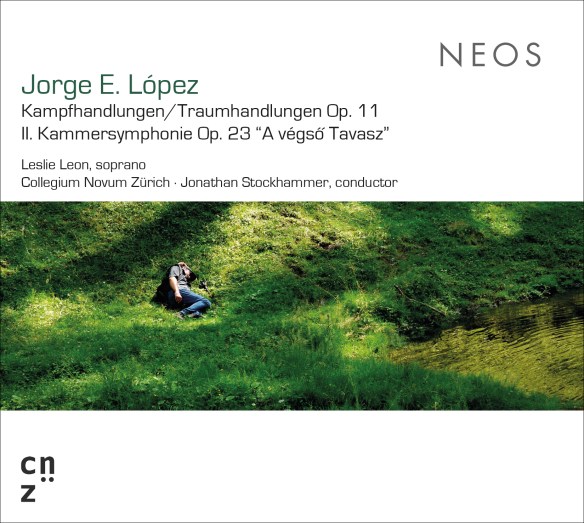
On record – Jorge E. López: Kampfhandlungen/Traumhandlungen & Kammersymphonie II (NEOS Music)

López
Kampfhandlungen/Traumhandlungen Op.11 (1995, rev. 1998)
Chamber Symphony no.2 Op.23, ‘A végsö Tavasz’ (2009-11)*

*Leslie Leon (soprano); Collegium Novum Zürich / Jonathan Stockhammer

NEOS 11912 [74’43”]

Producer Wulf Weinmann
Engineers Leandro Gianini, *Ueli Würth

Recorded 12 April 2018, TOnhalle Maag, *11-15 February 2019 at Radiostudio, Zurich

Written by Richard Whitehouse

What’s the story?

The always enterprising NEOS label releases a second disc devoted to the music of Jorge E. López (b1955) – a composer who has pointedly reassessed that dislocated juncture between late Romanticism and early Modernism, with little concern for any eventual accommodation.

What’s the music like?

Little heard (if at all) in the UK, López was born in Havana then spent his formative years in New York and Chicago, latterly moving to Austria and residing in Vienna since 2008. Largely self-taught as a composer, he was unknown until Michael Gielen championed his Landscape with Martyrdom (Intercord – hopefully to appear as part of SWR Music’s Gielen Edition), as singular an Op. 1 as any in musical history. Since then he has gradually built up a catalogue of 30 predominantly large-scale works, with increasing emphasis on the symphonic genre.

López has frequently spoken of the importance to his thinking of Surrealism, albeit not as an aesthetic but rather a method of musical construction as intuitive as it is flexible. This is made plain in Kampfhandlungen/Traumhandlungen – a visceral workout for large ensemble which emerges in stages from those elemental, Xenakis-like beginnings toward a more individuated discourse with prominent roles for cor anglais and bass trumpet; the whole piece adhering to that ‘Scenes of Combat/Tissue of Dreams’ interplay as posited by its title. Despite an aura of primal metamorphosis as might recall Birtwistle, López’s expressive range is informed more by evocation of human activity in the way his music proceeds in an often erratic while always fascinating trajectory; one whose denouement is the more conclusive for its unexpectedness.

Hardly the first composer to have embraced symphonic writing belatedly, López has focussed increasingly on the genre (he is currently completing his Fifth). The first two are for chamber forces, the Second taking its subtitle – which translates as The Final Spring – from the late 19th-century Hungarian poet Endre Ady. Should this bring to mind an exercise in ruminative introspection, the music confirms otherwise – its 52 minutes unfolding over five movements that consist of a compressed sonata design, further skewed by cadenzas for piano and horn; a sizeable and disruptive scherzo at length waylaid by (surreal) intimation of children’s songs; a halting and edgy intermezzo periodically arraigned by percussive fusillades; another scherzo that rapidly assumes a Mahlerian façade, where the soprano functions as a constituent of the ensemble in that her singing makes phonetic rather than semantic sense; then a finale whose martial undertow affords recollections of earlier movements (notably the first) as it heads to a conclusion of an inevitability which, not for the first time with López, arises out of nothing.

Does it all work?

It does, once one accepts López is not so much breaking the rules of formal and expressive continuity as refashioning them according to his needs; something Jonathan Stockhammer conveys in gratifying measure through these assured readings by Collegium Novum Zürich.

Is it recommended?

Very much so. The sound could hardly be improved on for clarity or perspective, and there is an informative overview by Jens Schubbe with a more subjective appreciation by Láng Zsolt. NEOS will hopefully be issuing further releases by this fascinating and absorbing composer.

Listen

Buy

You can listen to clips from the recording and buy this release at the Presto website

Read

You can read more about this release on the NEOS website, while for more information on Jorge E. López head to the Musica Austria website