Unknown's avatar

About Arcana

My name is Ben Hogwood, editor of the Arcana music site (arcana.fm)

Britten Sinfonia at Lunch – Katie Bray sings Freya Waley-Cohen’s Spell Book @ Wigmore Hall

Katie Bray (mezzo-soprano), Britten Sinfonia Soloists [Jacqueline Shave, Miranda Dale (violins), Clare Finnimore (viola), Caroline Dearnley (cello), Joy Farrall (clarinet), John Lenehan (piano)]

Leclair Trio Sonata in D major Op.2/8 (1728)
Mahler arr. Waley-Cohen Rückert-Lieder (1901-2, arr. 2019)
Lutosławski Bukoliki (1952 arr. 1962)
Waley-Cohen Spell Book (2019)

Wigmore Hall, London
Wednesday 22 January 2020

Photo credits Patrick Allen (Freya Waley-Cohen); Tim Dunk (Katie Bray)

Review by Ben Hogwood

The previews for this concert were intriguing. As well as a performance of a new arrangement of Mahler’s Ruckert-Lieder, we were to be treated to Spell Book, the world premiere tour of a new dramatic work by Freya Waley-Cohen.

Inspired by the composer’s encounter with Rebecca Tamás’ collection of poems WITCH, the song cycle was written for and performed by mezzo-soprano Katie Bray, singing with an ensemble of string quartet, clarinet and piano. In terms of forces used this gave the work a similar profile to Schoenberg’s famous melodrama Pierrot Lunaire. The music fulfilled Waley-Cohen’s wish that it would place us under a spell, as the book had clearly done for the composer. She brought it to life with music of luminosity and captivating drama.
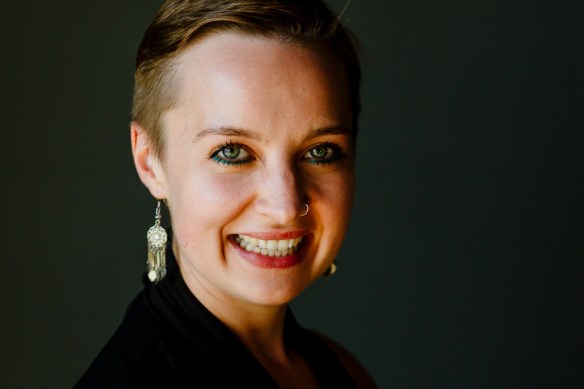
She was helped considerably by Bray (above), who held the attention effortlessly with a commanding performance. The first and most substantial song, spell for Lilith, found her word emphasis in the observation that Lilith is ‘such a bad girl’ setting the expressive tone. The music swept up to impressive heights, Bray’s voice stopping the listener in their tracks while simultaneously nailing the acoustic of the hall.

Waley-Cohen’s response to the text was often vivid, the instruments either offering weighty support to the words or dropping away under their feet. The observation that ‘Lilith, you have a great body’ received appropriately slinky contours, while the contrast of suspension and movement towards the end led to a delirious postlude from John Lenehan’s piano.

The following two songs were more compact but retained Lilith’s intensity. spell for sex had a soft, alluring vocalise that was also remote, while the spell for logic was much more active, pockets of instrumental music bumping into the vocal line but never overwhelming it. The open-ended challenge to the audience was effective, as was the relatively sudden finish, concluding a mysterious and strangely euphoric piece. The spell had indeed been cast.

Spell Book was complemented by Waley-Cohen’s arrangement of Mahler’s Rückert Lieder. In this regard she was bravely nailing her colours to the mast alongside the intimidating figure of Schoenberg, whose arrangement of the composer’s Lieder eines fahrenden gesellen (Songs of a Wayfarer) for chamber ensemble around 100 years ago is still occasionally performed. The ensemble here, replicating that for Spell Book, was cut from similar cloth.

This performance was a qualified success, part of the fault for that lying with the listener and a long-held familiarity with the piano and orchestral versions of Rückert-Lieder. There were however some imaginative qualities here, particularly the technique of doubling instruments at a distance of two octaves. John Lenehan‘s high piano right hand therefore acquired a ghostly shadow in the form of Caroline Dearnley‘s low cello, and this technique was used to create an enchanting, wispy half-light.

It also suited Bray’s range and performance, and while her interpretation felt like it may still be in progress – again the problem of over-familiarity rearing its head – she grew into the songs as they unfolded. The famous Um mitternacht was an inevitable highlight, while the clarinet lines in Blicke mir nicht in die Lieder! (Do not look into my songs!) were beautifully rendered by Joy Farrall. The final song, the rapt Ich bin der Welt abhanden gekommen (I am lost to the world) was beautifully controlled if not quite reaching peak intensity.

Prior to the song cycles we heard the Trio Sonata in D major from Jean-Marie Leclair. It made a nice change to hear this music on modern instruments, the program illustrating how the Trio Sonata was in fact a predecessor of the Piano Trio. Jackie Shave, Caroline Dearnley and John Lenehan clearly enjoyed their time with this piece, and Leclair’s elevation of the cello to much more than mere accompaniment found the two string players engaged in rewarding dialogue.

In between the song collections Dearnley teamed up with viola player Clare Finnimore for Lutoslawski’s six Bukoliki, delectable folk-inspired miniatures originally conceived for piano but subsequently arranged by the composer. Lasting little more than a minute, each one was beautifully formed and strongly expressive, the string players enjoying the melodic ornaments and the rustic sweeps of the bow. The addition of subtle discords created a haunting quality to some of this music, pointing the way to Lutoslawski’s sonic innovations to come.

The Britten Sinfonia’s At Lunch series continues to impress with its imaginative programming and opportunities for contemporary composers. Both aims were realised here in a richly rewarding concert.

Further reading and listening

To discover more about Freya Waley-Cohen, you can visit her website here or listen to her music on Soundcloud here. Meanwhile the Spotify link below offers a chance to hear her Permutations, as played by her sister, violinist Tamsin.


Talking Heads: Sheku Kanneh-Mason

Interviewed by Ben Hogwood
Picture courtesy of Decca Classics

Sheku Kanneh-Mason is a rare commodity. In the midst of dazzling publicity, he is helping open doors for classical music by his very approachable demeanour and an approach to album-making that brings it into closer contact with other forms. On the evidence of this interview he is refreshingly grounded and intently focussed on his first love, which of course is music.

While some have expressed concern that the cellist might be overworked early in his career, our discussions around second album Elgar confirm him to be relaxed and deeply satisfied with the newest addition to his discography.

His debut album Inspirations, released this time in 2019, presented the Shostakovich Cello Concerto no.1, the piece he played to win the final of the BBC Young Musician of the Year in 2016. Kanneh-Mason coupled it with diverse pieces from Pablo Casals, Offenbach, Leonard Cohen and Bob Marley. This time however his main focus is the work of a much older man, the Cello Concerto in E minor of Sir Edward Elgar.

The recording of this much-loved corner of the cello repertoire was made with conductor Sir Simon Rattle and the London Symphony Orchestra. It has an intensity which belies Kanneh-Mason’s tender years, offering new viewpoints into what will be familiar music to a lot of people. Again the context into which Sheku puts the Elgar on his album is intriguing, of which more later. But where did he first hear the music of Elgar – and was it the piece he has just recorded?

“It would have been the concerto, definitely”, he recalls. “I listened to it a lot when I was younger, and I grew up with the famous Jacqueline du Pré version. While we were working on it I listened to a lot of different recordings of the piece, it’s such a special work. Other recordings I really love are the most recent Steven Isserlis recording, Truls Mørk with Simon Rattle, and the famous one from Beatrice Harrison with Elgar himself conducting. There is a huge range of ways in which people approach the piece, and what strikes me about the piece is that everyone reacts in a different way.”

The second movement (a Scherzo) finds Kanneh-Mason and Rattle scooting along with a particularly quick choice of tempo, and the cellist clearly relishes the fast bow strokes required. “It’s a fun piece to play, and you get swept up in it but you have to work on getting a lightness of touch with the repeated notes.”

Elgar’s concerto may be the main piece on the album but there are a variety of shorter pieces imaginatively included by Kanneh-Mason. One composer in particular we may be hearing from again is the Swiss-born American Ernest Bloch, born to Jewish parents. Two of his shorter pieces are included here. “I love his music”, says Sheku. “For Grade 8 I did the Prayer for cello and piano, which is a piece I knew to play young. It’s music I really love, and there’s also the piece for cello and orchestra, Schelomo, which I hope to record in the future. You can feel some of the pain in the harmonies he uses.”

More obscure still is a piece for cello ensemble, Hymnus, by the German composer Julius Klengel. “It’s an amazing piece”, he says. “He was a cellist as well, so I think that’s how he ended up writing for 12 instruments. Every week at the Royal Academy of Music we had a cello ensemble, and that’s how we got to know it. There’s a nice link there, as there is for all the pieces on the album. It’s very inspiring being around really young hardworking musicians and all of us being based in one place.”

How does Kanneh-Mason balance his studies with days like today, where he has a whole day of promotional interviews to navigate? “I just have to be very organised with my time, which is a good thing for us anyway. I never feel that I have too much on.”
He is particularly gushing when talk turns to his work with Sir Simon Rattle, and the bond they share in the interpretation of the Elgar. “Definitely. I think what I love about working with someone is the freedom to do what I want but knowing that they can do everything as well. It’s the spirit of true collaboration I think”.

The theme of collaborating runs through both albums, and Kanneh-Mason identifies with this original approach. “It’s nice to have a link and a reason for putting them together, like creating a concert program. It’s great to record a masterpiece and a big piece, and put it with smaller pieces that have an equal range of colour and harmony, and perhaps more subtleties.”

For Elgar he was helped by Simon Parkin, with sensitive arrangements for cello and orchestra of Elgar’s Nimrod, from the Enigma Variations, and the Romance originally written for bassoon and orchestra. To that he adds Frank Bridge’s Spring Song, the folksongs Blow The Wind Southerly and Scarborough Fair, and Fauré’s profound Elégie.

“He’s an amazingly skilled arranger”, says Sheku of Parkin, “and he keeps the heart of the pieces while making the most of the instruments. I love mixing the arrangements that complement the pieces of music in their original form, and it’s great to record them in respect of friends and teachers, which makes it more personal. I’m always excited and open to lots of new things and working with new people. I’ve had some amazing experiences with these recordings, and you can hopefully hear the enjoyment from them.”

As you might expect given his album programming, Sheku’s ‘out of hours’ musical tastes are varied. “I listen to a mixture of classical, jazz, reggae, and different kinds of folk music”, he says. “Growing up with music all around me has been really inspiring, and it has kept me grounded and motivated. Now I live with students, and the people below me are also musicians.”

Thinking back to his BBC Young Musician of the Year triumph brings Kanneh-Mason onto a subject close to his heart, musical education. “I think we should have as many young people in music as possible. The Young Musician of the Year is great as it shows people playing to the highest standard. When I did it I found watching people three or four years older than me was really inspiring, and it ultimately gives people the opportunity to do many more things.”

He also notes the importance of after care. “Afterwards there was so much attention, but the BBC really looked after me. It was important to have the right people around me and to be working with the right people. A competition is only good if what comes after is good.”

With time running out, we conclude by discussing his favourite musicians of the moment. “I love Steven Isserlis”, he says. “He’s my favourite cellist to watch…and I also love listening to the violinist Daniel Lozakovich. Martha Argerich is also someone I find really inspiring, I love watching her play the piano.”

This blend of youth and maturity, established and new, is perhaps the most inspiring thing about Sheku Kanneh-Mason’s success. His approach is very inclusive, and his next ventures will be very interesting to chart and appraise. With Elgar reaching the heights of number eight in the album charts so far, the musical world is very open to him right now.

Sheku Kanneh-Mason’s Elgar album is out now on Decca Classics – it can be purchased here, via Apple Music, or streamed below via Spotify:

Wigmore Mondays – Jerusalem Quartet play Haydn & Bartók

Jerusalem Quartet [Alexander Pavlovsky, Sergei Bresler (violins), Ori Kam (viola), Kyril Zlotnikov (cello)]

Wigmore Hall, Monday 20 January 2020 (lunchtime)

You can listen to this concert on the BBC Sounds app here (opens in a new window)

Review and guide by Ben Hogwood
Photo of Jerusalem Quartet Felix Broede

The subtitle for this concert on the BBC Sounds website is ‘Quartet Masters’ – which is spot on when you consider the contributions both Haydn and Bartók made to this intimate form of chamber music. The string quartet – two violins, viola and cello – has presented composers with both challenge and inspiration over its 250-year existence, and even as I type this there is no sign of the form dying out.

A big part of the credit should go to Haydn, whose quartets are often used at the beginning of a program such as this. Sometimes that means the consistent quality of his work is overlooked, but there was no doubt of that happening in this performance from the Jerusalem Quartet.

Theirs was a red blooded performance, with a glossy texture to the luxurious string sound, aided by plenty of vibrato on the string. Such an approach would not have worked in the composer’s earlier quartets, but was more appropriate here for one of the six published in 1799 as the composer’s Op.76, his most mature statements yet as a quartet composer.

The ‘Fifths’ is so named because of the melodic interval Haydn uses between the two notes at the very start (2:10 on the BBC Sounds link) This motif becomes an integral part of the quartet, and as the first movement progresses it can be frequently heard. The Jerusalem Quartet’s bold performance gains more charm in the second movement (9:25), a light and relatively gentle dance. Alexander Pavlovsky’s intonation went a little awry here but not for long.

In the third movement, a darkly coloured Minuet (15:18), the quartet impress greatly, divided in two as the two violins’ melody is shadowed by the grainy tones of viola player Ori Kam and cellist Kyril Zlotnikov in impressive unison. The clouds part for a central Trio section with a rustic feel (16:44) before the obdurate theme returns (18:16) The fourth movement, initially quite furtive (19:10), blossoms into an affirmative finish.

Bartók had already confirmed his outright mastery of the string quartet form by the time he reached his Third Quartet of 1927, and the Fourth, completed a year later, achieves if anything a greater level of innovation in sound, together with strong melodic content and the use of connecting ideas between the five movements.

Bartók was obsessed with symmetrical forms, and the dimensions of the Fourth feel wholly right. Its five movements have two intensely concentrated pieces at their outer edge. Movements two and four are Scherzos – which implies they should be witty but the second is ghostly and the fourth otherworldly. The third movement is one of the composer’s classic evocations of the night, with pictorial references to insects and birds as well as dislocated elements of Hungarian folk music.

This performance was right on the money. From the start of the first movement (26:27) the tension is palpable, with a driven approach emphasising Bartók’s dissonant writing but also his melodic invention. The resolution in a pure C major is all the more telling because of it. The second movement (33:10) is marked to be played with all four players using mutes (‘con sordino’) and the ghostly entrails that result chill to the bone – in this case even on a cold January day. The four players shade their contributions exquisitely, preparing us for the central third movement (36:22), a great example of Bartók’s ‘night music’.

The emotional centre of the quartet, this is where time almost stops, and the Jerusalem Quartet captured this feeling immediately with their long, held chords and the songful lines from Kyril Zlotnikov’s cello and Alexander Pavlovsky’s violin. These held a profile close to folk melodies, the other three instruments standing watchfully by.

The fourth movement (42:50) broke us out of these nocturnal dreams, using pizzicato only (each of the four instruments required to pluck rather than use the bow) The folk-like ‘snaps’ against the board of the instrument were very effective, especially on the cello, but so was the thrumming of the violins and viola, which had an enchanting quality.

Finally the fifth movement (46:20) brings a lasting resolution, though it starts with great cut and thrust, using music of dissonance. Later a light-hearted diversion into more folk-based material breaks out, after which we head for a wholly convincing ending, summing up the whole performance perfectly.

A very fine concert, this, which was capped by an encore of the third movement (Minuet) from Mozart’s String Quartet in D minor K421 (54:24). Not only did this piece share the same key of the ‘Fifths’ quartet, it is one of a set of six quartets dedicated to Haydn, so brought the concert full circle with music of both grit and charm, rather like that of its dedicatee.

Repertoire

This concert contained the following music (with timings on the BBC Sounds broadcast in brackets):

Haydn String Quartet in D minor Op.76/5 ‘Fifths’ (1797-8) (2:10)
Bartók String Quartet no.4 (1928) (26:27)

Further listening & viewing

You can watch the Jerusalem Quartet play Bartók’s String Quartet no.4 in a live concert here:

The Jerusalem Quartet have recorded both the works played in this concert, which can be heard on the playlist link below:

Bartók’s cycle of six string quartets is one of his very greatest achievements, and you can track the development of his style by listening through chronologically. The later quartets in particular give the most reward to repeated listening, for even 100 or so years on these works are not easy to grasp straight away! The cycle from the Emerson String Quartet remains one of their best recordings:

Haydn is the father of the string quartet, and his Op.76 set – again six quartets – represents the pinnacle of his compositions for the relatively new sound world of two violins, viola and cello. These are good natured works but have considerable depth too, as this recording by the Hungarian Takács String Quartet proves:

Mozart’s six quartets dedicate to Haydn are among his finest chamber works. This recording from the Hagen Quartett includes a particularly fine account of the D minor work from which the Jerusalem Quartet took their encore:

Live review – Soloists, CBSO Chorus & Orchestra / Mirga Gražinytė-Tyla: Mahler Symphony no.8

Erin Wall (soprano, Magna Peccatrix), Natalya Romaniw (soprano, Una poenitentium), Katja Stuber (soprano, Mater Gloriosa), Karen Cargill mezzo-soprano, Mulier Samaritana), Alice Coote (mezzo-soprano, Maria Aegyptiaca), A. J. Glueckert (tenor, Doctor Marianus), Roland Wood (baritone, Pater Ecstaticus), Morris Robinson (bass, Pater Profundus), CBSO Chorus, CBSO Youth Chorus, CBSO Children’s Chorus, University of Birmingham Voices, Baltimore Choral Arts Society, City of Birmingham Symphony Orchestra / Mirga Gražinytė-Tyla

Symphony Hall, Birmingham
Saturday 18 January 2020

Mahler Symphony no.8 in E flat major ‘Symphony of a Thousand’ (1906)

Written by Richard Whitehouse

The run-up to the City of Birmingham Symphony Orchestra‘s centenary features several major choral works – none more so than the Eighth Symphony by which Mahler essayed his grandest and most-inclusive musical conception, at a pivotal juncture in the evolution of Western culture.

If more frequent performances these past few decades have made this piece less of an event than it once was, there was no lack of occasion in tonight’s rendering. Mirga Gražinytė-Tyla launched the setting of Veni, creator spiritus with an impulsiveness as held good throughout this first part. There were passing intonational flaws among the soloists, along with moments of awkward coordination between choruses and orchestra, but these were as little next to the eloquent ensemble at Qui diceris Paraclitus, the spectral interlude prior to Informa nostri corporis, the vast and cumulative fugal edifice at Accende lumen sensibus, or the ecstatic outpouring from Gloria sit Patri Domino; sustained here with an unerringly judged rhetoric as ensured that this music hit the ground running right through to its heady closing cadence.

Perhaps for this reason MG-T chose not to make a substantial pause before the setting of the final scene of Goethe’s Faust that forms the second part, enabling the accumulated intensity to carry over into this latter’s lengthy orchestral prelude with its mingled anxiety and pathos.

From its starkly evocative beginnings, Mahler’s singular take on the ultimate Enlightenment text can feel at best discursive, so it was a tribute to the conductor’s sense of overall cohesion that what can easily sprawl rarely, if ever, lost focus as the path to redemption is outlined in philosophical and, above all, musical terms. Highpoints included a notably ominous response in the Choir and Echo, a powerfully sustained solo from Morris Robinson then an equally soulful one from A. J. Glueckert, appealingly deft singing from the combined children’s and youth choirs (no hint of coyness or schmaltz here), then the exquisitely dovetailed interplay of Erin Wall, Karen Cargill and Alice Coote – during which their subtly contrasted timbres were heard to advantage against an orchestral backdrop of the greatest delicacy and poise.

Next to these, Roland Wood’s solo lacked fervour and that by Natalya Romaniw sounded a touch ill at ease, though Katja Stuber had all the rapture necessary for her brief offstage solo while Glueckert surged through his second solo on route to an orchestral interlude in which the rippling interplay of woodwind and keyboards was limpidly rendered. Even more telling was MG-T’s handling of their gradual evanescence, from where the final Chorus Mysticus emerges. Always a distinctive moment, it proved especially memorable for the way in which the massed voices unfolded their intensifying expressive curve towards those seismic closing bars – here afforded maximum impact through the conductor’s refusal to linger unnecessarily when the off-stage brass enters to bring the whole work grandly and majestically full circle.

Such reservations as there were will likely be remedied in tomorrow’s performance, yet while MG-T will doubtlessly uncover further depths and nuances in the future, it is hard to imagine she will deliver a reading of greater conviction or purposefulness than that heard this evening.

The reviewed performance is being repeated today, Sunday 19th January. Further information can be found at the CBSO website

On record – Craven Faults: Erratics & Unconformities (The Leaf Label)

Written by Ben Hogwood

What’s the story?

How refreshing to find an artist that keeps their self-promotion to a minimum. That said, it would be good to know more about Craven Faults at some point! The elusive biography on his record label site describes his moniker as ‘half-remembered journeys across post-industrial Yorkshire’.

In fact Craven Faults has been a thing for a while, with his well-received Lowfold Works EPs containing electronic music that shows off an ambitious grasp of musical structure. He is capable of stretching out his approach to minimal music into tracks of 20 minutes or more, using the barest of elements like Philip Glass does but building them up with oscillating synthesizers and drones.

Erratics & Unconformities is his first LP.

What’s the music like?

The Yorkshire reference is helpful, for as first track Vacca Wall establishes its shimmering content it feels like a look across the brooding landscape of the North Yorkshire Moors – but gradually opens out like the wings of a darkly shaded butterfly. This is music supported by a constant bass line, which tolls out like a deep bell, and a percussion track that never extends beyond a single kick drum, if at all.

The instruction from The Leaf Label to ‘put a 17-minute window in your diary and watch the video for Vacca Wall is worth following. In their words, ‘the rest of your inbox can wait, you need slowly unravelling analogue synthesizer arpeggios right now’:

With the mood set for the album, the next five tracks spread across nearly an hour, revealing different but often darker shades. The shorter Deipkier has a kick drum too, while Cupola Smelt Mill has sharper definition to the synthesizers and a bassline off the beat. Picking up the more industrial theme, Slack Sley & Temple is even darker, its brooding outlines giving the impression of a machine. This is the biggest track on the album, an expansive number of austere beauty.

Hangingstones regains some of the mood of the opening, while Signal Post has a more soothing drone at its base.

Does it all work?

Yes. Craven Faults has a distinctive style, and repeated listening brings out the rhythmic invention in his music, which is greater than you might at first think. It explains why he doesn’t need anything more than a kick drum.

Ultimately this album works best as a single unit in which to immerse yourself, drawing the listener in with its textures and spatial effects.

Is it recommended?

Yes, because there is some very fine music here – though it does come with the health warning that its dark nature is not necessarily ideal for the oppressively cloudy January days where it barely gets light!

Stream

Buy