Opera in two acts (four scenes)
Music by Hector Berlioz
Libretto by Léon de Wailly, Auguste Barbier and Alfred de Vigny
Semi-staged performance, sung in French with English surtitles
Benvenuto Cellini – Michael Spyres (tenor)
Teresa – Sophia Burgos (soprano)
Fieramosca – Lionel Lhote (baritone)
Ascanio – Adèle Charvet (mezzo-soprano)
Giacomo Balducci – Maurizio Muraro (bass)
Pope Clement VII – Tareq Nazmi (bass)
Pompeo – Alex Ashworth (bass)
Innkeeper – Peter Davoren (tenor)
Francesco – Vincent Delhoume (tenor)
Bernardino – Ashley Riches (bass-baritone)
Perseus – Duncan Meadows (actor)
Stage director Noa Naamat
Lighting designer Rick Fisher
Costume designer Sarah Denise Cordery
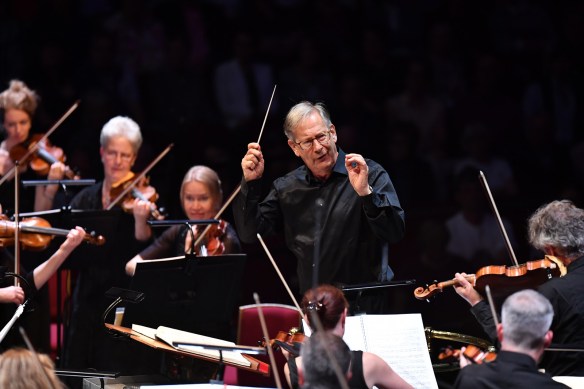
Monteverdi Choir, Orchestra Révolutionnaire et Romantique / Sir John Eliot Gardiner (above)
Royal Albert Hall, Monday 2 September 2019
Reviewed by Richard Whitehouse
Photo credits Chris Christodoulou
The Proms has witnessed some memorable (and innovative) Berlioz performances – with this evening’s account of Benevento Cellini, itself the culmination of Sir John Eliot Gardiner‘s Berlioz project leading up to the 150th anniversary of the composer’s death, an undoubted highpoint.
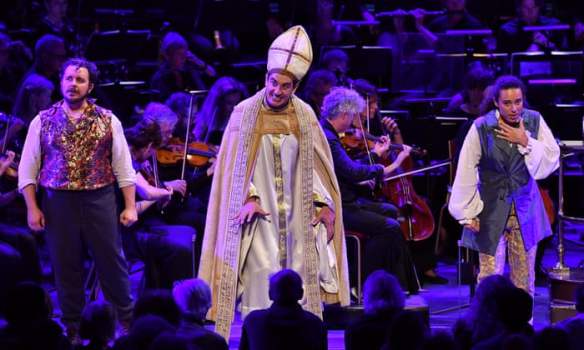
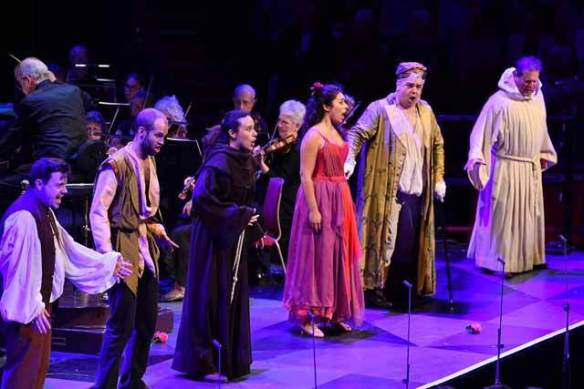
Not a little of its success was the effectiveness of this ‘staged concert performance’ – directed by Noa Naamat so as to make resourceful use of the Royal Albert Hall platform (who would have thought that singers hiding behind – antiphonally divided – second violins made so deft a theatrical conceit?), with unfussy costumes from Sarah Denise Cordery in keeping with the late-Renaissance setting and lighting from Rick Fisher as vividly expanded on the latter-day Proms procedure of illuminating the stage area. A presentation serving the opera admirably.
At least as significant was Gardiner’s pragmatism over just how much of the opera to include. Even at its Paris premiere in 1838, what was heard of Benvenuto Cellini was already distinct from what Berlioz had written; an issue further complicated by versions presented at Weimar during 1852-6. Taking the Urtext published in the New Berlioz Edition, Gardiner has arrived at a compromise which encompasses all the music one would reasonably hope to hear while vindicating this opera as an overall dramatic concept. Recklessly ambitious in its technical demands as it may have been, Cellini was always practicable as a dramatic undertaking and – akin to Prokofiev’s War and Peace a century later – giving a convincing shape to this excess of material is at least half the battle in ensuring its theatrical as well as its musical success.
Not the least of those technical demands is on the singers, and this cast did not disappoint. As Cellini, Michael Spyres (above) evinced all the necessary panache without buckling under some stentorian vocal requirements. He was ideally complemented by Sophia Burgos as a pert yet never too coquettish Teresa; her naivety thrown into relief by the machinations of her suitor Fieramosca, given with suitably hollow bravado by Lionel Lhote, and cynicism of her father Balducci – tellingly rendered by Maurizio Muraro. Adele Charvet made for an appealing and sympathetic Ascanio, with Alex Ashworth exuding appropriate pomposity as Pompeo. Peter Davoren’s cameo as the unctuous Innkeeper was matched by that of Tareq Nazmi as the self-aggrandizing Pope. The Monteverdi Choir brought off its crucial contributions with aplomb.
Inevitably it is the orchestra which so often steals the limelight in a work by Berlioz, and the Orchestre Revolutionnaire et Romantique accordingly rose to the challenge. Of course, any performance of this music on ‘authentic’ instruments must contend with his assertions that the development of instrument-making and instrumental practice (notably within Germanic territories) was a necessary one. That said, he may have been reconciled to those limitations had his work been rendered with such timbral brilliance and intonational accuracy as here.
In building an ensemble of such consistency Gardiner takes especial credit, the more so as his performance demonstrably channelled its authentic credentials towards the spontaneous and creative reassessment of a masterpiece now receiving its due – even if many decades too late.
Kit Downes has very generously granted Arcana half an hour of his holiday time. In it we will discuss his upcoming performance at Snape Maltings as part of the Festival of New weekend, and while we cover that the discussion moves across East Anglia to Norwich, where it transpires both of us were born.
Our current locations, however, could scarcely be farther apart. I am perched awkwardly in a sunlit Soho café, Kit is “marooned on the Isle of Arran. It’s so windy and rainy here but it’s a really special place too.” Is he doing anything musical? “No, that would give a sense of purpose to the holiday! It’s a really relaxing time for me with family at the moment.”
The Snape performance will give listeners a chance to hear material behind his new work Dreamlife of Debris, in the company of Lucy Railton (cello), Seb Rochford (drums) and Tom Challenger (saxophone). The album, his second for the revered ECM label, brings him into contact with much of the music of his youth, growing up as a chorister and organist in East Anglia. “When I was pretty young I sang in the choir at Norwich Cathedral, which would have been there about 25 years ago”, he recounts. “I played with the then organist Katherine Dienes, who was a great improviser. I badgered my mum to get me organ lessons with her, and played on the fantastic four-manual organ at the cathedral. She showed me how to improvise. It was more about learning the different strands of orchestration, texture and sound than working on a particular piece, and looking at how church organists are able to improvise between functions of the church service, where they often have to build on a particular hymn tune to fill time. Through that I learned jazz on the piano, because my mum saw the link between the two. I went to music school in Watford until I was 22, when I started my jazz career.”
The current project began in sessions with saxophonist Challenger. “I was looking for a new project and a new setting”, says Downes, “and I was interested in the music of some of the ‘duration’ composers, like Morton Feldman, and minimalists like Steve Reich. I wanted to get back to instruments where you hold a note for more than one second, and so I returned to the organ. Tom and I did a residency at Huddersfield University, and I enjoyed working back at the organ for three days. I wasn’t playing repertoire like Buxtehude or Reger, although I love that music, but it was about getting jazz that I love on to the organ, in a holistic way – sharing influences in what I play.”
The pair continued working together. “We did one project at Snape Maltings before the recording project where the Vyamanikal album came from. That then led into the solo album for ECM that I did, Obsidian. That was recorded on smaller organs from the area as well as the much larger Henry Willis instrument at the Union Chapel in Islington.”
His new album broadens the spectrum a little. “More recently I have been making a new album for ECM, using some organ and piano but with some guests too. Seven or eight years ago, I made a reconnection with the area, which I had wanted to do since I left for boarding school at 15 years of age. It was great to see the flat landscape and big sky where I grew up, and nice to revisit that part of the world. If you are brought up with the East Anglian landscape that means you are brought up with trees growing sideways! I love Scotland for that reason too, and where we are at the moment. Snape also offers that beautiful connection with Benjamin Britten, and what he did there is very inspiring.”
The move to East Anglia was not initially deliberate. “Without the commission we wouldn’t have run so far. Snape Maltings have been instrumental in developing the sound and approach to the album.”
Having given an overview of his more recent work, Downes considers the impact Aldeburgh’s most famous resident had on his musical development. “We used to sing loads of Britten at Norwich Cathedral. We sang the Missa Brevis, and I remember productions of works like Noye’s Fludde, and loads of the choral works at the Norfolk & Norwich Festival. We would also work with contemporary composers on commissions for the choir. It was a huge learning curve for me with the pretty modern stuff we used to sing, like Arvo Pärt and John Tavener. It was especially noticeable in a service as right after their music you would sing some Palestrina, and jump back hundreds of years in the process. That would be a big deal in a concert, but not in a church service, where they often sit together. The musical aesthetics can connect but the text connects as well.”
Downes agrees that, perhaps like Britten, the textures and sounds of his music offer a link with nature and the outdoors. “I love it myself, so I guess it will come out somehow! I love walking, and being outdoors generally. Our work for the new album involved travelling around rural parts of East Anglia and being outdoors, so I captured lots of field recordings outside the churches where we were recording the organs. We would take things like farming mechanisms and sounds that were important to the location, and put them into the music. If a bell went off we wouldn’t work around it, we’d keep it in. We would be mastering in full so it was never exactly what happened but similar to what Werner Herzog does. You can exaggerate things that feel more truthful, if that makes sense!”
The press release for Dreamlife Of Debris describes the field recordings as ‘deteriorated’. “I think that was already done by our sample rate conversion!”, he jokes. “I was very influenced by William Basinski, who on his Disintegration Loops would leave orchestral loops on a tape machine that would warp and turn into nothing. Some of the recordings were made on cassette recorders. What the ‘deteriorated’ description really talks about is the feeling of everything we were capturing being in a state of slow decline, in an emotional way too. In that part of the world there are those things that have been left to fall apart slightly. With the organs they are historical instruments, and in some examples the community instrument. The whole way the organ is paid for is congregational, through raising money in the community, and it’s very symbolic when that starts fading away”.
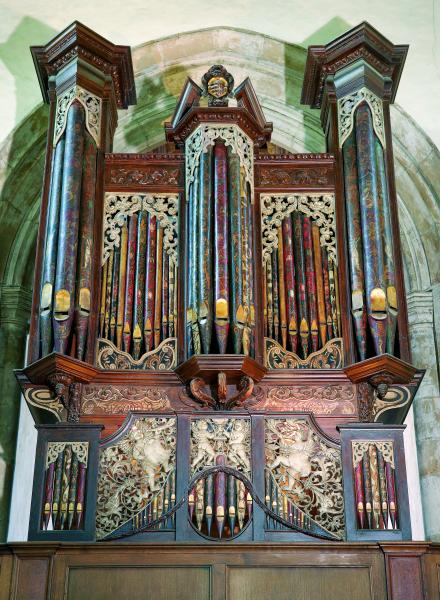
One particular instrument drew Downes’ eye. “We played the old Thomas Thamar organ in Framlingham (above). In Germany and Italy you get old and very impressive instruments, and the one in Framlingham is a real rarity as it still has the original pipework. It originates from London, and they moved it up there about 100 years later. It is a really important and special instrument. The whole process was in sharp relief to that of a one-manual harmonium that we also used, which was falling to bits. It made what we were doing as much of an album as a social study. The way these instruments are built is so important to how they sound, the circumstances under which they came to be.”
Downes has strong connections in the organ restoration community. “I’ve got a friend in America who is an organ builder, and he has the depth of knowledge for the tuning, the reconditioning, removing old things and bringing them back to life. Some builders put modern aspects on to old instruments, which would not preserve the older features. Norman & Beard were the company make that we tended to end up playing, and they were based in Norwich which is very appropriate! The construction and restoration involves so many people over so many years.”
Kit’s rediscovery of this part of his musical heritage is a relatively recent thing. “I listened to the American and European jazz improvisers for a long time. One thing about returning to the organ that I noticed most though was that it feels separate from contemporary classical music. It feels like an open canvas to have a go with.”
The title, Dreamlife of Debris, has a clear precedent. “It comes from the W.G. Sebald book The Rings Of Saturn”, he explains, “which is all about a walking tour he took around Suffolk. He came over to work at the University of East Anglia in Norwich, and The Rings of Saturn is about a walking tour of the area, parts of which we went to for field recordings. Everything reminds him of a tangent that takes him back in time, linking tangential parts of history or philosophy with the location. He takes in things like the silk trade, weaving silk through his narrative. I found it inspiring to create a work in that way, capturing where your mind is wandering and making a composite, putting the things together. That’s how I made the record, with lots of improvisation in different times and places but trusting that the record itself would be coherent.”
The title revealed itself to Downes relatively quickly. “Dreamlife of Debris is a quote from the film Patience After Sebald, which is a discussion piece on that book. It’s the idea that projecting thoughts and feelings onto inanimate objects gives them a kind of extended life. It felt appropriate. The people that I chose to play with me on the album were Lucy Railton, a cellist based in Berlin, Seb Rochford playing drums, and of course Tom Challenger. On the album we also have Ingebjørg Loe Bjørnstad, an electric guitarist from Norway, though he won’t be playing at Snape.”
What can the audience at Snape expect in the Festival of New concert? “I’m going to play piano rather than organ”, he says. “Some of the live stuff is using the ensemble as if it’s an organ. An organ is essentially music of reed, woodwind and strings, so I felt I had enough colours to emulate the sound.
Downes has also been exploring folk music in a major project with Aidan O’Rourke, fiddle player with the Scottish band Lau. Between them they have released two instalments of the 365 project. “That’s been the other big thing”, says Downes modestly. “I ended up recording 200 tunes with Aidan in all! It was a lovely exercise in just the sheer volume of arranging. Aidan would write a melody and I would arrange it, and we basically did that 200 times. I drew on the treatment of folk tunes from people like Britten, Vaughan Williams and Delius, and on techniques used by Ravel and Debussy too. With that music every decision should come from inside the melody rather than on top of it, and it was a really nice exercise.
Festival of New, described as ‘a whirlwind two days of freshly devised music and sound, exploring some of the most exciting work being made in the UK’, takes place on Friday 6 and Saturday 7 September at the Snape Maltings. Performers include urban poet Reload, cellist Maja Bugge and pianist Sarah Nicolls highlighting environmental issues in an inventive set, and Shama Rahman, who will perform with pianist Anya Yermakova ‘the seeds of a sitar concerto informed by neuroscience’.
Kit Downes and friends will perform on Saturday 7 September at 5pm in the Snape Maltings Concert Hall. For more details on the weekend click here. For more information on Kit Downes you can visit his website or his ECM page.
Check back with Arcana soon, as we are intending to host a podcast from Kit with some of his favourite music for organ. In the meantime some of his work can be heard on Spotify below:
For the latest in Arcana’s Ask The Audience series Roisin Brophy (above) gives her thoughts on the BBC Symphony Orchestra and their Prom of English music under Sir Andrew Davis.
Prom 53: Stacey Tappan (soprano) Dame Sarah Connolly (mezzo-soprano), Anthony Gregory (tenor), BBC Symphony Chorus, BBC Symphony Orchestra / Sir Andrew Davis
Vaughan Williams Fantasia on a Theme of Thomas Tallis (1910) Hugh Wood Scenes from Comus (1965) Elgar The Music Makers Op.69 (1912)
Royal Albert Hall, Thursday 29 August 2019
You can listen to this Prom on the BBC iPlayer here
ARCANA: Roisin, how would you describe your musical upbringing?
I am from a very heavily Irish catholic family. I grew up on a lot of Irish folk music, and my mum is quite a hippy at heart. My god parents are also hippies at heart, and so I grew up with a lot of Cat Stevens and Joni Mitchell. My mum’s got really good taste in music, so I grew up always loving Led Zeppelin and they continue to be my favourite band.
My dad is quite a musical person, he plays guitar and sings, and therefore I think I was very influenced into doing folk music as a child, and also being a catholic and going to catholic school, and going to church – where I heard choral music. I sang in a choir for our local church, and I stopped when I was about 15 or 16.
I got into drum and bass completely by accident. I don’t even listen to drum and bass! I know a lot of it but because I happen to work in it. I was just picked up by a dubstep producer years ago, and got into drum and bass from that. Folk is my most natural style of music, although I don’t write it professionally.
Could you name three musical acts you love, and why you love them?
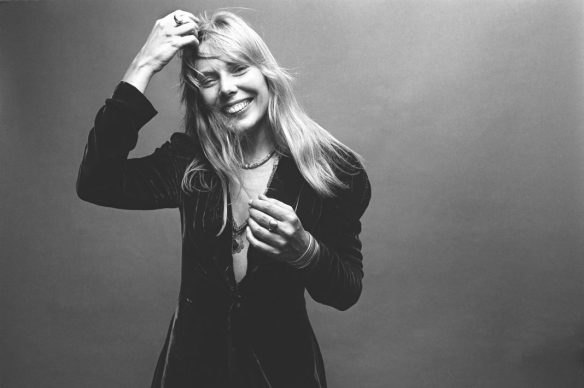
Joni Mitchell (above) – (a) because I grew up on her music, (b) because I think her vocal range and songwriting ability is unreachable by anybody else.
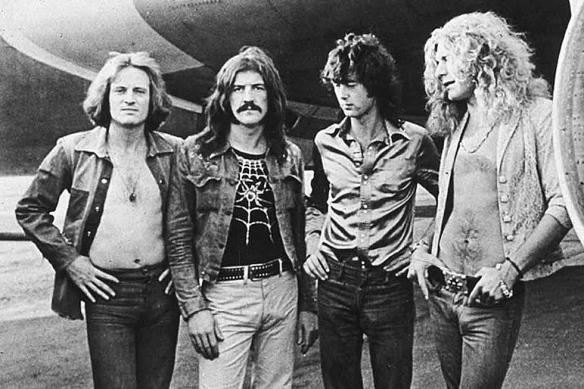
Led Zeppelin (above) Again the vocal range and the guitar and drum skills, for me, and their heavy influence from blues music, which you can really hear going into pop music.
My third would have to be Dolly Parton (above), because she’s a sassy lady, her songs are insanely catchy and again her voice is like no other.
What has been your experience of classical music so far?
I’ve always studied music, and did GCSE and ‘A’ level before studying popular music at university. I’ve always been around people that have been involved in classical music but not been involved personally, as I have always been on the popular or folk side of things. Going to Goldsmiths, which is very renowned for being a classical music education system, I had a lot of friends that were classical musicians and opera singers.
I’ve always loved classical music, and studying it you learn what you like and what you don’t like. I still listen to it most days, it’s more of a morning thing for me. I like piano-based stuff. Vladimir’s Blues by Max Richter is a good example.
How did you rate your first Proms experience?
I absolutely loved it, and I’m actually a bit blown away by how much I did love it. The second half was definitely a lot more emotive than the first, but I think that was because of how the piece (Elgar’s The Music Makers) moved. The crescendos were incredibly moving and the sound in general was such a massive sound with the choir, females on one side and male on the other, a huge orchestra and the percussion in the second piece.
I think it made me appreciate that it was not a piece of classical music I would necessarily listen to on headphones, but now that I’ve seen it live and understand the musicianship behind it, I would very much want to listen to it again as a recording.
What did you think of the Vaughan Williams?
I have a feeling I recognised it. I felt it was light, soft, warming, and dreamy. It was nice to listen to live and I have never seen classical music to that standard live before, so when that piece first opened and the string players were playing it together, how crisp and clear and on point it was! It almost sounded like it was recorded, it was so perfect.
What did you think of the Hugh Wood?
It definitely told the story and was creepy at times. It felt like it was for that purpose, and the emotions that it conveyed was exactly what it was meant to do. It was eerie and scary, and seeing the singers battle against the orchestra with no microphones was pretty amazing. I loved it.
But the Elgar was the one you love the most?
Yes, for sure. It was just a lot more emotive and there was more behind it. The sheer size of it you could tell not only how much went into the writing of it, but I can’t even begin to imagine what it must be like to write for that many musicians and to think about that many parts working together, and for it to come out that perfect. Add to that the hard work and musicianship and understanding the commands of the music itself was amazing.
What did you like about the Proms?
The venue is amazing, a beautiful place to be, and it’s worth a visit on its own regardless of whether there is a concert or not. Going to see classical music you’ve never seen or heard before, for me it opened my ears to listening to classical music I would never necessarily listen to at the moment. Now I’ve seen these pieces live I could now appreciate listening to a recording.
What might you improve about the experience?
I don’t want to change it, because it was as it’s supposed to be. I think because I’m used to going to watch music that requires amplification, seeing music that doesn’t require amplification that is never going to be as loud so you have to wear earplugs as it’s so bloody loud, so maybe I would change the loudness of the sound. But it has a meaning, and that’s the whole point.
Would you go again?
Yes, definitely.
Verdict: SUCCESS
You can listen to the Elgar piece The Music Makers below in this recent release from Dame Sarah Connolly and the BBC Symphony Chorus & Orchestra with Sir Andrew Davis:
For this listener at least, it has taken a while for the Proms At…Cadogan Hall theme to catch on this season. However the BBC’s traversal of 800 years of musical history has turned out to be both original and interesting, touching on areas of music not often heard or given top billing. By grouping these two anniversary composers together a cogent and thought provoking program was the result; a concert subdued in delivery but high on musical and emotional substance.
Both Polish composers featured are not thought of as front rank examples of their country’s classical music tradition, but on this evidence both should be brought forward. There are past reasons for that relative neglect, in the relative unavailability of Weinberg’s music to western ears, and the effective suppression of his and Grażyna Bacewicz’s music, but as classical music looks to remove boundaries and stereotypes, these are exactly the type of musical figures that should benefit from such a move.
We heard Weinberg first, and the seventh of his impressive output of seventeen string quartets (from 2:47 on the broadcast link above). It is perhaps the one that sails closest to the style of his friend and protector Shostakovich, especially in the second movement where it quotes from his String Quartet no.3. As the Adagio first movement (2:47 on the broadcast) shows, the two composers have much in common in mood if not execution. Weinberg’s bittersweet lyricism is to the fore here, the radiance of pure C major at the very beginning reminiscent of Shostakovich’s own first string quartet in the same key from 20 years later.
As the music progresses however there are more troubled offshoots and episodes, the players digging deeper and the music lost in thought. Weinberg does still keep his audience in mind of the brighter sound of the opening material, which returns at 8:18.
The second movement (marked Allegretto, 9:24) has shadowy outlines from the cello, the music again wary but prone to quick and nimble outbursts from second violin (the excellent Arkadiusz Kubica) – very much in the vein of a Shostakovich scherzo, but with less bite to its execution.
The third and final movement (15:24), a substantial set of 23 variations on a theme, feels like the emotional crux of the work, and was performed as such here by the Silesians. Passionate solos from first violinist Szymon Krzeszowiec and viola player Łukasz Syrnicki (an extended dialogue from 24:20) took place in the Adagio sections, and were complemented by some really concentrated and increasingly fraught quartet episodes in the Allegro, the melodies compressed and tense. In keeping with the movement’s arch structure this tension built towards the viola solo, which marked the passionate final section and a resolution in C major. The feeling was that of a battle won, but at a cost.
Bacewicz contributed two piano quintets to her sizeable chamber music output, and both are works of originality and style. While many piano-led works such as these go for volume and bluster in the keyboard part there is more poise and reserve here, the piano and strings complementing each other on an equal footing.
There is a light touch to the music too, especially in the dance music of the second movement. Before then the first movement (initially marked Moderato by the composer) sets a relatively austere scene, though the string glints at the edges. A faster central section hints at a dance and certainly gains more energy before falling back to the slower approach, albeit with more depth this time, certainly as performed here.
The second movement (marked Presto, 37:47) takes the Polish oberek dance as its inspiration, the forthright piano melody supported by lilting, syncopated strings before summoning itself for a dramatic finish. The slow movement (Grave, 42:09) is every bit as powerful, though here the steps are very slow and steady to a stern, full-bodied climax.
The finale (48:35) had great purpose and originality of texture, the quartet busying their musical arguments against an increasingly outspoken piano part. A set of quick fire exchanges and bustling figures among the strings were harnessed for a full bodied closing statement.
Both pieces were superbly played in this concert, the commitment of the Silesian String Quartet beyond contention – as was also the case for pianist Wojciech Świtała. If the music itself was a little straight faced, it was a timely reminder that only 80 years ago (to the week) the Second World War had begun. The music therefore served as a warning for lessons that appear not to have been heeded!
Listen
The music in this concert can be heard on Spotify below:
The Silesian String Quartet have also recorded a good deal of Weinberg’s chamber output. Here is a disc of the composer’s String Quartets nos. 9 & 10:
They have also recorded all seven string quartets by Bacewicz, in an award winning double album for Chandos which you can hear below:
House And Land are from North Carolina, and Across The Field is their second album. The duo – guitarist and instrumentalist Sarah LouiseHenson and fiddle / banjo player Sally Anne Morgan – present traditional folk music recast into today’s world.
What’s the music like?
Deceptive. If you listen to the first minute or two of Across The Field it is easy to underestimate the emotions House And Land are capable of conveying, but by the time you get to the rippling guitar of Rainbow Mid Life’s Willows you will have fallen hook, line and sinker for the duo’s fresh faced vocals and imaginative instrumental responses.
That song in particular hits the sweetest spot of emotion, with Morgan’s double-stopped fiddle the perfect foil to Henson’s vocal and 12-string acoustic guitar. It is a rich tapestry of colours, but these orchestrations never get in the way of the song’s message.
The heart of their music is Appalachia, the duo creating their landscape with delicate shades and colours, but some of their music draws from across the Atlantic. Blacksmith shows the duo’s homage to the great Shirley Collins, a close harmony duet over a drone which is then dressed with glockenspiel. There follows a powerful instrumental track Carolina Lady, from past Madison resident Dillard Chandler, which features earthy guitar and Morgan’s fiddle rising through the textures as it takes on an improvised air.
Collins is again the source for the final Ca The Yowes, and here Henson’s alto recorder sets the evocative scene, while Morgan’s banjo shadows the vocals. It is a haunting yet curiously uplifting coda to the album.
Does it all work?
Across The Field is a powerful and deeply personal piece of work. It may be that the voices are on occasion too shrill for headphone listeners, but that’s more a question of the listener acquainting themselves with the tones than the singers needing to compromise. The songs themselves retain their traditional heart but updated for today are very emotive and winningly sung. The inventive and constantly rewarding instrumentation is a treat, always responsive to the substance of each song.
Is it recommended?
Yes, and I speak as very much an occasional listener to folk music. Across The Field inhabits a rarefied space few albums are able to reach.


 Inevitably it is the orchestra which so often steals the limelight in a work by Berlioz, and the Orchestre Revolutionnaire et Romantique accordingly rose to the challenge. Of course, any performance of this music on ‘authentic’ instruments must contend with his assertions that the development of instrument-making and instrumental practice (notably within Germanic territories) was a necessary one. That said, he may have been reconciled to those limitations had his work been rendered with such timbral brilliance and intonational accuracy as here.