
Unknown's avatar

About Arcana

My name is Ben Hogwood, editor of the Arcana music site (arcana.fm)

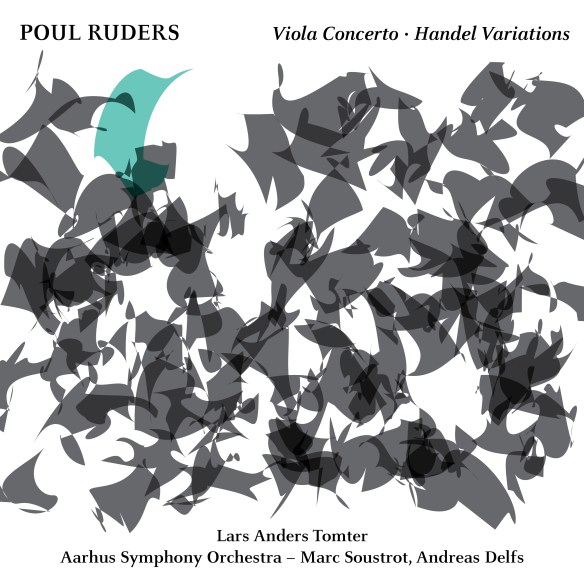
On record: Lars Anders Tomter, Aarhus Symphony Orchestra – Poul Ruders: Viola Concerto & Handel Variations (Dacapo)

Ruders Viola Concerto; Handel Variations

Lars Anders Tomter (viola); Aarhus Symphony Orchestra / Marc Soustrot (Viola Concerto), Andreas Delfs (Handel Variations)

Ruders
Viola Concerto
Handel Variations

Dacapo 8.226149 [65’53”]
Producers Preben Iwan, John Frandsen
Engineers Preben Iwan, Henrik Winther Hansen
Recorded 
December 11/12 2015 (Viola Concerto) and March 18-20 2017 (Handel Variations) at Symphonic Hall, Musikhuset, Aarhus

Reviewed by Richard Whitehouse

What’s the story?

Two sizable orchestral works from Poul Ruders (b1949), long among the most prolific of contemporary composers. In their very different ways they attest to a continuing musical evolution as inclusive as it is unpredictable, while never less than fascinating.

What’s the music like?

Not previously recorded, the Viola Concerto was composed during 1993-4 and premiered at the 1994 Proms. Although the lukewarm reception was ostensibly because of Yuri Bashmet’s less than committed rendering of the solo part (an early indication of his increasingly cavalier attitude in live performance), Ruders harboured doubts as to the success of the work itself and opted for a thorough revision in 2013. This involved scaling back the central movement, so it now forms an intensifying interlude between a first movement which unfolds as a continuous polyphonic texture, then a finale that elaborates on earlier material before coming full-circle in a pensive yet by no means tranquil coda. The favourable impression this piece now makes is also owing to Lars Anders Tomter’s assured handling of a solo part the more testing for its understated character, notably the cadenzas that alter the course of the latter two movements.

By contrast, the Handel Variations is Ruders at his most sardonic and even demonic. Written in 2009 to mark the 75th anniversary of the Aarhus Symphony Orchestra, this substantial 39-minute piece takes its cue from the Bourrée of Handel’s Water Music Suite no.1. The composer relates he had initially intended to write 74 variations on this briefest and most unassuming of themes (one for each year that Handel had lived), but the process of putting it ‘through the wringer’ proved so involving it took 90 variations before this had been played out. The result is among the most quixotic of Ruders’ latter-day works, as it runs the gamut of expressive possibilities while securing continuity by the follow-through of these variations. They also seem to merge into cohesive sub-groups, on their way to a climactic sequence whose affirmation is undercut by the lengthy final sequence which forms a conclusion of decidedly deadpan humour. Such fatalism is itself offset by the always inventive virtuosity of what might plausibly be heard as a large-scale ‘concerto for orchestra’.

Does it all work?

Almost certainly. If momentary doubts persist as to the overall focus of the Viola Concerto, these will likely prove illusory now that this piece has received the sympathetic rendering it needed, while the Handel Variations gives us the essence of an always arresting composer.

Is it recommended?

Indeed. The playing of the Aarhus Symphony Orchestra is well attuned to the very different emotional compass of both pieces and is idiomatically directed by conductors of whom it would be good to hear more in the UK. Stephen Johnson provides the informative if occasionally glib booklet notes.

You can read more about this release at the Dacapo website, while for more on Ruders himself, visit his website here

Wigmore Mondays: Hille Perl & Lee Santana – Dreams and Dances of the Sun King

Hille Perl (viola da gamba), Lee Santana (theorbo, above)

Louis Couperin (c1626-1661) Prélude in D minor (1:54-3:08)
Jean de Sainte-Colombe (1658-c1701) Les Couplets (3:10-8:50)
Marin Marais (1656-1728) Suite du troisième livre de pieces de viole – Allemande, Courante, Sarabande & Gigue (10:23-14:18)
Antoine Forqueray (1672-1745) Le Leclair from Pieces de viole (15:57-22:38)
Marin Marais Le Badinage; Le Labyrinthe (from 4ème livre des pieces de viole) (24:32-38:06)
Robert de Visée (1655-c1732) Prélude; Les Sylvains de Mr Couperin; Muzette (all for solo theorbo) (39:16-47:33)
Marin Marais Les folies d’Espagne from Deusième livre de pieces de voile (49:34-59:18)

Wigmore Hall, London; Monday 30 April 2018

You can listen to the BBC Radio 3 broadcast by clicking here

Written by Ben Hogwood

It is not often we have the chance to enjoy a concert of music for the combination of viola da gamba and theorbo, but the Wigmore Hall and BBC Radio 3 gave us that privilege with the vastly experienced team of Hille Perl and Lee Santana.

Perl plays a seven-string instrument, and if you’re not familiar with the viola da gamba it is essentially an early cello, but without a spike – so you have to grip it between the knees when playing to stop it from slipping. With seven strings this instrument has a wide range, and thanks to a carefully chosen programme we were able to appreciate its very different qualities at each end of its range.

In support was Lee Santana, using two different theorbos. When watching a player like this in action there is always a worry that the instrument’s long neck will take out the other occupants of the concert platform, but thankfully this did not occur! The timbre of a theorbo is very appealing, a kind of more mellow early version of the guitar, and both instruments had a lovely subtle resonance from the Wigmore Hall acoustic to help them.

Their program was based around the reign of the 17th century Sun King, Louis XIV of France, who loved to have music played for him during mealtimes and in his court. Some of the music here could easily accompany a meal, though some was pleasingly energetic and clearly written for a more vigorous form of dancing.

Perl began with a florid Prélude for solo viola da gamba from Louis Couperin (1:54 on the broadcast link), showing off the wide melodic range of the instrument, with wonderful resonance on the lowest note – an open ‘A’ string – and a broad, slightly mellow treble. Then Santana joined almost imperceptibly, in the same key, for Les Couplets, with the unmistakable lilt of a triple time dance – before a more improvisatory section over a set harmonic pattern, building to an impressive and vigorous finish.

The Marais, a collection of movements from a much bigger suite, began with an expansive Allemande (10:23), a slow dance form of German origin, then a graceful French Sarabande (12:10), with more vibrato applied by Perl. 13:28 a brisk Gigue.

The Forqueray piece (15:57), a tribute to the composer Leclair, made some formidable demands met head on by Perl’s virtuosity, again running like a form of chaconne (using a set pattern of chords). Listen from 20:16 to Perl’s rapid passagework, the bow flitting across the strings.

Le Badinage (from 24:32 repeats quite a sombre figure to hypnotic effect, crossing the strings on both viola da gamba and theorbo – and here the mellow tone of Perl’s instrument was ideal, despite an explosive interlude or two. Following this, Le Labyrinthe (28:26) felt more ceremonial, before heading into the higher register, and then stretching out into a much more substantial set of variations over a set chord progression. Once again, brilliantly played with plenty of room in terms of keeping a natural rhythm.

We then heard three pieces for solo theorbo by Robert de Visée, beginning with the free-spirited Prélude (39:16). The graceful Les Sylvains de Mr Couperin followed, then a Muzette (44:08).

Finally we heard a hugely impressive performance of the 32 variations making up Les folies d’Espagne (from 49:34), bringing both instruments together and utilising the practice of double stopping (more than one string on the viola da gamba played simultaneously). It was a stylish tour de force!

Further listening

You can listen to almost all of the music played in this concert on the Spotify playlist below, which includes recordings already made by Hille Perl:

City AM: Music While You Work

If you live in London, hopefully you have picked up a copy of City AM this morning. If you have, and read the Office Politics section, you’ll have seen my piece about the benefits of listening to classical music while you work.

I really wanted to share those with you here, so please find below links to a playlist on Spotify that will hopefully float your boat!

If you want some specific advice on music to listen to, or want to share an opinion, please get in touch! Send me an e-mail or get in touch over Twitter

Wigmore Mondays: Javier Perianes plays Chopin, Debussy & Falla

Javier Perianes (piano, above)

Chopin Prelude in C Op.28/1 (1839) (1:44-2:25 on the broadcast link below)
Debussy Danseuses de Delphes (Préludes Book 1) (1909) (2:30-5:45)
Chopin Berceuse (1843-4) (5:50-10:38)
Debussy Clair de lune (Suite Bergamasque) (1890) (10:39-15:44)
Debussy Les sons et les parfums tournent dans l’air du soir (Préludes, Book 1) (1910) (15:57-19:36)
Chopin Ballade No 4 (1842-3) (19:44-30:51)
Debussy La puerta del vino (Préludes Book 2) (1913) (32:47-36:15); La sérénade interrompue (Préludes Book 1) (1910) (36:18-39:02)
Falla Fantasia baetica (1919) 39:05-51:16

Wigmore Hall, London; Monday 9 April 2018

You can listen to the BBC Radio 3 broadcast by clicking here

Written by Ben Hogwood

The Debussy centenary has brought out some imaginative programmes from performers, and the inspiration for this BBC Radio 3 Lunchtime Concert from the Wigmore Hall lay in one of Javier Perianes‘ earlier recital discs. He played much of the music in an unbroken stream, giving a lovely continuity to the music making while linking the composers too.

Debussy loved Chopin, describing him as ‘the greatest of us all, for through the piano alone he discovered everything’. Comparing the first published preludes by the composers was intriguing, the urgency of the Chopin (1:44 on the broadcast link above) countered by the sultry, easily paced Danseuses de Delphes (2:30). Chopin’s Berceuse (5:50) and the famous Clair de Lune from Debussy’s Suite Bergamasque (10:39) share the same key of D flat major, and here the join between the two was exquisitely close. In the Berceuse the boat, having initially started out on a millpond, ran into some pretty gusty weather, while the dance of the moonlight on the water in the Debussy was allowed to take its time to ripple.

The following Les sons et les parfums tournent dans l’air du soir (15:57) was deeply atmospheric, shot through with mystery – but then Perianes turned to a powerful and very fluid account of the Ballade no.4, (19:44) passionately played and emphatically signing off the concert’s first sequence.

The second sequence was more noticeably modern, its musical language shifting forwards. La puerta del vino (32:47) crackled with tension, an insistent Habanera rhythm becoming the lynchpin for a rich vein of improvisatory work up top, while the humour of La sérénade interrompue (36:18) was brilliantly caught, with its stop-start gait and Spanish flair.

The latter quality was fully in evidence for an assertive and exciting Fantasia baetica (39:05), Manuel de Falla‘s biggest work for solo piano. This was packed with big dance crossrhythms, powerful musical statements and substantial added note harmonies. There were some very striking moments such as the big, bell-like melody from 49:13, which seems to be an attempt on the part of the piano to imitate the guitar, and Perianes swept all before him to an all-encompassing finish.

For the encore Perianes turned our glances sideways to another of Debussy’s close if less likely influences, the composer Edvard Grieg, whose piano music is still massively underrated. The Notturno (52:21) chosen by today’s pianist was beautifully judged and vividly pictorial.

Further listening

You can listen to the music played in this concert on the Spotify playlist below:

Arcana at the opera: Coraline @ Barbican Theatre

Mark-Anthony Turnage Coraline

Opera in Two Acts – Music by Mark-Anthony Turnage; Libretto by Rory Mullarkey, after the novella by Neil Gaiman; Sung in English (no surtitles)

Barbican Theatre, London

Thursday 29th March, 2018

Review by Richard Whitehouse

Coraline – Mary Bevan (soprano); Mother/Other Mother – Kitty Whatley (mezzo-soprano); Father/Other Father – Alexander Robin Baker (baritone); Miss Spink/First Ghost Child – Gillian Keith (soprano); Miss Forcible – Francis McCafferty (mezzo-soprano); Mr Bobo/Second Ghost Child – Harry Nicoll (tenor); Third Ghost Child – Dominic Sedgewick (baritone)

Aletta Collins, designer; Giles Cadle, set designer; Gabrielle Dalton, costume designer; Matt Haskins, lighting designer

Britten Sinfonia / Sian Edwards

Barbican Theatre, London
Thursday 29th March 2018

From the streetwise allegory of Greek, through the traumas of war in The Silver Tassie and tawdry decadence of Anna Nicole: Mark-Anthony Turnage has always been unequivocal in his choice of topics for dramatic treatment, and Coraline ultimately proves no exception.

Its libretto is expertly derived by Rory Mullarky from a novella by fashionable author Neil Gaiman, but what really makes this opera succeed as a theatrical concept is the equilibrium secured between those real and imaginary worlds being traversed by the eponymous heroine in terms of their narrative symmetry and of musical evolution. In these respects, the piece is something of a breakthrough for Turnage – enhanced with an undemonstrative effectiveness of staging which makes up for in scenic integration what it might lack in visual immediacy.

Utilizing the ostensibly inflexible space of Barbican Theatre, Aletta Collins has fashioned a production which underlines the scenario’s uneasy pivoting between fairy-tale and allegory; enabling both characters and settings to appear unexceptionally human while indicative of something ‘beyond’. Her achieving this has been abetted by the engaging and never unduly tricksy designs of Giles Cadle, functional yet never utilitarian costumes by Gabrielle Dalton and effective while unfussy lighting from Matt Haskins. It might be argued the Other House into which Coraline ventures is insufficiently distinct (eye-buttons aside!) from the real one, but such visual consistency serves to unify dramatic action across and between acts; and so ensure an equivocation between environs as points up the underlying moral more explicitly.

These visual qualities are complemented by vocal ones. It might not call for virtuoso singing per se, but Coraline does require tightness of ensemble such as the present cast has in spades. Mary Bevan makes a sympathetic though never cutesy impression in the title-role, gaining in expressive conviction as the drama unfolds, while Kitty Whatley arguably steals the show in her assumption of the mothers. That of the fathers may be more simply drawn, but Alexander Robin Baker is likable and engaging; no less than Harry Nicoll as hapless inventor Mr Bobo. Gillian Keith and Francis McCafferty complement each other ideally as faded thespians Miss Spink and Miss Forcible; the former giving a whimsical cameo as the First Ghost Child, with her companions represented in equally touching fashion by Nicoll and Dominic Sedgewick.

Concerning Turnage’s music, it might easily be dismissed as effective in underpinning stage-action while lacking the memorability and individuality of his best scores. That said, there are numerous stylistic traits consistently in evidence – not least the pungent rhythmic unisons and harmonic astringency such as this composer has made his own. It helps that the score is given with such audible conviction by Britten Sinfonia, increasingly familiar in the opera-pit, and is conducted by Sian Edwards with an appropriate amalgam of incisiveness and dramatic focus.

Whatever else, Coraline secured an evidently appreciative response from adults and children alike, for whom this drama’s more traditional aspects seemed not to inhibit their enjoyment. Not a mesmeric or revelatory night at the opera, perhaps, but an enjoyable and appealing one.

Further performances of Coraline take place at the Barbican Theatre on April 3, 4, 5 & 7 at 7pm and April 7 at 2pm. For more details visit the Barbican and Royal Opera House websites