Unknown's avatar

About Arcana

My name is Ben Hogwood, editor of the Arcana music site (arcana.fm)

In concert – BBC Scottish Symphony Orchestra: Koechlin’s Seven Stars Symphony

ilan-volkov-2Kari Kriiku (clarinet), BBC Scottish Symphony Orchestra / Ilan Volkov, live from City Halls, Glasgow, Thursday 14 January 2016

Written by Ben Hogwood

What’s the music?

Dukas – L’apprenti sorcier (1896-7) (11 minutes)

Unsuk Chin – Clarinet Concerto (2014) (24 minutes)

Koechlin – Seven Stars Symphony (1933) (46 minutes)

Broadcast link (open in a new window):

http://www.bbc.co.uk/programmes/b06v2667

About the music

koechlin

Anyone who has seen the BBC Scottish Symphony Orchestra in Glasgow knows how valuable they are to the community, not just in Glasgow but Scotland too. City Halls, the impressive building that has been their home for the last ten years, is the perfect venue for them. In that time they have explored an impressive range of repertoire with principal conductor Ilan Volkov, who has become a versatile conductor capable of turning his hand to any music from the last five centuries.

A typically inventive program here includes a rare performance of the Seven Stars Symphony by Charles Koechlin (above). Long before the likes of Heat magazine fuelled celebrity culture, Koechlin was a star-struck fan in awe of the Hollywood actors and actresses of the day, especially Lilian Harvey, subject of the second movement, who became his muse. Volkov includes this piece as an example of 1930s that is not often heard, with most programmers opting for the ubiquitous works of the period by Schoenberg, Shostakovich and early-period Stravinsky.

Before that we hear a classical music favourite, Dukas‘ L’apprenti sorcier (The Sorcerer’s Apprentice), surely one of the biggest influences on Walt Disney – appearing in the Fantasia film. This is followed by the Clarinet Concerto from Unsuk Chin, the South Korean composer’s sixth work in a form that suits her style.

What should I listen out for?

Dukas L’apprenti Sorcier (The Sorcerer’s Apprentice)

2:06 – an enchanted introduction, the clarinet spelling out what the profile of the main theme will sound like. The spell has been cast. The orchestral colouring is vivid but then the music stops – awaiting the bassoon’s big moment at 4:26 with the tune we all know and love. The orchestra develop and play around with this until we hear it again in full technicolour at 6:00.

Throughout the piece has a macabre element and this comes to the fore at 9:07 where we hear the creaking sound of the contrabassoon right at its lower end. Gradually the tune comes out again and the full orchestra play it at …with glittering touches applied to the top end with woodwind and piccolo.

Then the door seemingly slams shut, and at 12:10 we hear the enchanted music of the start again – before a sudden end at 13:00.

Unsuk Chin – Clarinet Concerto

16:30 – we hear the clarinet straight away, with its sonorous low end sounding almost like a bird – a swan maybe, ducking and diving over the orchestra like a bird with a big bill. The influence of Messiaen is clear in some of this writing.The brass are prominent with rich accompaniment, and then the strings are heard, shimmering in accompaniment to the clarinet’s playful notes. There uis a build-up and then the orchestra scatter at 22’53”, and the music is much more agitated. Then at 24’20” the music takes a thoughtful angle, the clarinet with

26:07 – the second movement begins with the clarinet playing multiphonics – as in two notes at once – which is a very difficult skill for the clarinettist! He does so very quietly and alone, and is gradually joined by members of the orchestra. The sound is akin to bottles in the wind, and is quite spooky. Then from 29’18” the clarinet returns to the top of the picture, but with some incredibly difficult passagework exploiting its whole range.

The music subsides but then gradually builds again – before the quiet multiphonics make a brief reappearance.

35:26 – the whirring of the percussion inspires the clarinet to a playful approach. Chin uses much more of the orchestra this time, and we hear the bass end in its fullest voice yet. The two forces then play off each other, the clarinet with short squeaks and pips to the end.

Koechlin – Seven Stars Symphony

You can listen to a BBC feature on the Seven Stars Symphony here

1:04:40 Douglas Fairbanks, Sr. – Immediately we get a taste of Koechlin’s rich orchestral palette through exotic solos for clarinet and violin. A rich harmonic backdrop creates a sultry atmosphere, while also suggesting a night time portrait. Flutes, clarinets, bassoon and oboe are all prominent over soft strings, painting pictures in the manner of an early detective soundtrack – far ahead of its time, given this piece was written in 1933!

1:11:43 – Lilian Harvey – a brief but affectionate portrait of Koechlin’s muse / obsession, assigned initially to the oboe but with high violins taking much of the melodic material.

1:14:27 – Greta Garbo – now we hear the weird but wonderful tones of the electronic ondes martenot, a similar instrument to the theremin. It begins the portrait of Greta Garbo with a highly chromatic melody, and Koechlin is to use the orchestra sparingly, creating an exotic atmosphere.

1:18:42 – Clara Bow Et La Joyeuse California – a lively dance led by high violins, countered by a wary sequence. Koechlin uses a wide range of orchestral colour in this movement. At 1:23:08 we hear a saxophone solo before the orchestral gathers for a big, exaggerated Hollywood finish.

1:25:31 – Marlene Dietrich – a soft clarinet solo cuts to an affectionate passage accompanied by softly rippling piano and harp. This slow movement is richly scored, and takes the profile of a declaration of love, settled by an affectionate viola solo at the end.

1:30:55 – Emil Jannings – more exotic scoring from Koechlin at the start of this movement, as the strings come surging through, before a quieter but no less atmospheric passage of play from the woodwind. The portrait ends with a warm string sound.

1:35:15 – Charlie Chaplin – Koechlin’s final portrait is also the most substantial, and could stand as a piece on its own. A luxurious violin solo is then interrupted by a lively sequence suggesting one of Chaplin’s fast moving black and white films – very expressive! Chaplin then becomes furtive, seemingly peering round corners in a slow section. Again Koechlin uses the whole orchestra in a rich variety of colours and moods, right from double basses and piano at the lower end to sparkling woodwind and brass at the top.

Even the harpsichord makes an appearance at 1:44:37. After this the orchestra begin to suggest a slow Habanera dance – but after hinting at a fast section indulges in a serene passage led by the strings – before a softly voiced march takes the music off into the distance – from which point sumptuous strings lead us home to a grand finish.

In concert – London Symphony Orchestra & Sir Simon Rattle: Dutilleux centenary

sibelius-5Leonidas Kavakos (violin), Julia Bullock (soprano), London Symphony Orchestra / Sir Simon Rattle, live from The Barbican Hall, Wednesday 13 January 2016

Written by Ben Hogwood

What’s the music?

Ravel – Le Tombeau de Couperin (1914-17) (18 minutes)

Dutilleux – Violin Concerto, L’arbre des songes (The tree of dreams) (1983-85) (25 minutes)

Delage – Quatre poèmes hindous (1912) (11 minutes)

Dutilleux – Métaboles (1965)

Ravel – Daphnis et Chloé, Suite no.2 (1912) (17 minutes)

Broadcast link (open in a new window):

http://www.bbc.co.uk/programmes/b06v2663

About the music

henri-dutilleux

If you are in any way intimated by newer classical music, Henri Dutilleux (above) is an excellent place to start. ‘One of the most aurally sensual programmes you could ever go through’ is how Sir Simon Rattle describes this concert of orchestral works. Doubtless that statement was made with Ravel’s Daphnis et Chloé in mind, and also the music of Henri Dutilleux, the centenary of whose birth falls on 22 January 2016.

Dutilleux continues in a line of French orchestral masters whose music is every bit about the overall sound as it is about the melodies and harmonies within. His mastery of orchestral colour owes a lot to Ravel’s influence, and that of Debussy too – as you will hear in the Violin Concerto L’arbre des songes (The tree of dreams) and the virtuoso piece for orchestra Métaboles.

The ‘sensual’ description does not apply so readily to Le tombeau de Couperin. The opening Ravel piece is an elegiac suite paying tribute both to his friends who died in World War I and the past generation of French ‘Baroque’ composers, who – Couperin among them – lived and excelled in the 18th century.

Also included are the Quatre poems hindous of Maurice Delage, written just a year after the French composer travelled to India. Delage writes for a much reduced ensemble of just ten instruments to accompany a soprano in four brief but exquisitely realised text responses.

What should I listen out for?

Ravel Le Tombeau de Couperin

3:23 – an attractive and slightly reflective Prélude where not a note is wasted. Ravel’s writing for the wind instruments is particularly beautiful, the oboe taking much of the lilting tune.

6:54 – the Forlane­, a dance where Ravel sounds like he’s written the wrong notes – but in fact has written tunes spiced with harmonies that are surprisingly catchy. Again the orchestration is exquisite, whether in the held string chords behind the woodwind tune or the little points of percussion and harp that provide punctuation. There are four more sections that include equally likeable tunes, with the main tune coming back between each one – structured carefully as a French Baroque composer would.

13:01 – the softly scored Menuet, a dance that has its bright colourings but is sorrowful at its heart. It turns darker in its quiet, minor key Trio (14:57), where a shiver of cold where the spectre of the War can clearly be felt. This builds to an anguished climax before the Menuet, now a brighter and more relaxed presence, returns.

18:14 – there is a sense of purpose about the Rigaudon, a brisk dance where Ravel is getting on with things again, in the face of the Menuet’s sorrow. It is a fun quickstep, pausing briefly for a slower middle section with oboe (19:31) before the main material returns, broken off quickly and emphatically at the end.

Dutilleux – Violin Concerto, L’arbre des songes (The tree of dreams)

28:28 – the violin begins this work on its lowest note, and after a thoughtful beginning becomes animated. The orchestral backdrop is beautifully crafted and carefully shaded. The colours are strongly suggestive of a forest, as is the humid atmosphere.

At 30:59 we hear the cimbalom for the first time as part of the orchestral texture. From 33:00 the tempo is faster, and then from 34:44 there is an upward surge to two bell strokes, which bring in the first interlude – and some agitated thoughts from the violin around 36:30. Now the music is energetic, the violin trading musical thoughts with the woodwind, and often using multiple stopping (playing more than one string at once).

Then, with the mute on, the violin disappears into the distance after 39:00. The cimbalom can be heard again – the second interlude – and then the music becomes nocturnal, and it feels as though we are at the heart of both the forest and the work.

From 41:21 we hear the oboe d’amore, part of an important duet, the two instruments close together while the strings and percussion observe from a distance. The colours here, particularly when strings join around 44:00, are especially beautiful. After a bigger passage with full orchestra, the high strings dazzle at 46:05.

Then at 46:37 the violin can be heard tuning – but this is part of the third interlude, Dutilleux not wanting to relax the intensity of the piece. Sure enough the transition to the final section is seamless, the bells prominent again – and an energetic last movement gets into full swing. Then, as the violins hold a high note, a solemn section of chords is heard, bringing in a coda.

At 52:14 a scratchy sound from the violin and cimbalom, then a big, percussive statement from the orchestra brings the piece to an emphatic end.

Delage – Quatre poems Hindous

Texts https://fr.wikipedia.org/wiki/Quatre_po%C3%A8mes_hindous

1:21:33 – Madras – a sultry flute sets the forest scene before the soprano comes in half a minute later. The music has sensual twists and turns, aided by the flute and cor anglais.

1:24:08 – Lahore – the keen ear of the composer for new sounds can be clearly felt here, the cello pizzicato and accompaniment seemingly from another world as they depict the ‘lone tree in the north’. This song – the most substantial of the four – ends with an exotic vocalise from the singer (music but no words).

1:29:03 – Bénarès – the cor anglais is prominent in the accompaniment here, and light percussive effects from the harp and strings vividly set the scene. The coming of Buddha on earth is announced by the excited singer.

1:30:39 – Jeypur – the flute is prominent in setting the scene, before the questioning vocal takes over. The instrumentation is relatively rich but again the flute has the final say.

Dutilleux – Métaboles

Rattle describes this as the most perfect ‘bonzai’ concerto for orchestra. There are four movements, and each shows the different parts of the orchestra one by one, bringing them together at the end.

1:40:08 – sometimes with a contemporary composer you can tell just from the first chord what they are about. Métaboles is one such example, with a chord of extraordinary colours starting the first section, a fluid tour de force for the wind players. At around 1:43:30 the strings are much more in evidence, a velvety texture used. A high cello solo emerges from the mist.

1:46:38 – a lower clarinet starts off a new section where the music is quicker and lighter, aided by string plucking and carefully placed percussion.

Then with the full orchestra Dutilleux builds up a huge wall of sound to the finish. The audience reaction suggests this piece is well on the way to becoming one of the most popular in recent times.

Ravel – Daphnis et Chloé, Suite no.2

This is a shorter suite from the ballet, which lasts around an hour.

1:59:28 – surely one of the most wonderful evocations of dawn in all music. Ravel’s wonderfully mysterious tableau starts by murmuring in the lower reaches of the sky until, with calls from flute and oboe, the sun reveals its glorious light at 2:00:26. The rest of the movement continues with a sense of wonder at the new day until a massive climax at 2:04:06, the metallic glint at the very top of the sound courtesy of the triangle.

Wigmore Mondays – Pavel Kolesnikov plays Debussy

pavel-kolesnikov

Pavel Kolesnikov (piano) plays Debussy’s first book of Préludes

Wigmore Hall, London

Monday, 11 January 2016

written by Ben Hogwood

Audio (open in a new window)

http://www.bbc.co.uk/programmes/b06tx85v

Available until 10 February

What’s the music?

Debussy (1862-1918): Préludes, Book 1 (1909-1910); L’isle joyeuse (1904)

Spotify

Pavel Kolesnikov has not yet recorded any of this repertoire, but a reproduction of his program using available versions can be accessed below, for listeners who cannot hear the BBC broadcast:

About the music

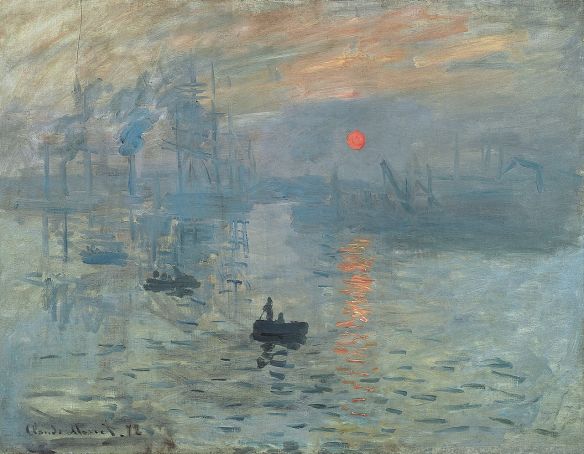
Debussy wrote 24 Préludes for piano, collected in two books but did not approach them in the same way as Chopin, who wrote one in each key. Instead he looked for character pieces, and the first book of Préludes are a fine example of what is often called the composer’s ‘impressionist’ style. By that we mean Debussy would often shade his music in a form that matches the paintings of artists such as Monet and Renoir, leaving them less defined.

impression-sunrise

Impression: Sunrise by Claude Monet (1872)

Perhaps because he wanted the listener to form their own pictures in their mind’s eye, Debussy left the title of each Prélude until the end of the piece – and even then was not at all conclusive in his naming. La cathédrale engloutie (The submerged cathedral), Ce qu’a vu le vent d’ouest (What the West Wind has seen), Danseuses de Delphes (Dancers of Delphi) – all are subject matters that need an active imagination to complete the picture.

L’isle joyeuse is a little more defined but not much, being a homage to Jersey, where Debussy holidayed with his new love in the summer of 1904.

These pieces make great technical demands on the pianist but also allow freedom of interpretation, both for player and listener.

Performance verdict

Having already established a reputation as a Debussy interpreter in his Wigmore Hall debut in 2014, BBC New Generation artist Pavel Kolesnikov returned to dazzle with more of the composer’s music.

Yet his approach was not obviously virtuosic, and he often took sensitive liberties with his tempo choices in the Préludes, drawing out the slow pieces especially effectively. These approaches were shown to be completely valid, setting an atmosphere of quiet intensity where I found myself subconsciously leaning forward on several occasions, literally hanging on Kolesnikov’s next note.

Les collines d’Anacapri (The Hills of Anacapri) was especially convincing, as was a totally unhurried Des pas sur la neige (Footsteps in the Snow). La danze de Puck was brilliantly done, an irresistible glint in the jester’s eye, while the stumbling rhythm of Minstrels was expertly controlled. Kolesnikov opened up the detail of Debussy’s inner part writing but never at the expense of his overall impression of each piece, and in L’isle joyeuse this led to painstakingly produced trills, part of an incredibly secure performance that still created a vivid picture of the island.

Full marks to the pianist, too, for overcoming the considerable distraction of latecomers arriving directly in his eye line after a poised account of Danseuses de Delphes. All that was required was a pertinent pause, and he was back in the zone.

What should I listen out for?

1:35 – Danseuses de Delphes (Dancers of Delphi) – immediately a sultry atmosphere is cast, the slow moving music rather mysterious but at the same time oddly enchanting. The block chords create an essence of calm.

There is then a pause while the latecomers are admitted…before…

5:41 – Voiles (Veils) – if anything the heady atmosphere is heightened by this deeply intimate impression, with suggestively chromatic lines in the right hand over a sustained held note in the left. The boundaries are blurred here, the ‘impressionism’ all too evident.

9:31 – Le vent dans la plaine (The Wind in the Plain) – a blustery outlook is set by the left hand oscillations, though this piece proves just as elusive as the wind. Debussy once again uses melodies in a ‘pentatonic’ form (if you played C-Eb-F-G-Bb ascending on the piano those are the notes of the pentatonic scale). Sudden gusts of wind threaten to knock the music off course but it stays true to form, just.

11:47 – Les sons et les parfums tournent dans l’air du soir (The sounds and fragrances swirl through the evening air) This is an enchanted piece, and indeed is heavily perfumed, as though at the end of a very hot summer’s day. The sustain on the piano means notes can blur together in the listeners’ mind, but there is still a distinct four note theme heard at the start. Kolesnikov really draws out the tension at the end of this piece.

16:20 – Les collines d’Anacapri (The Hills of Anacapri) After a short, nervy start this piece bursts from its cover, with melodies exchanged between the top and bottom of the piano, with sustained but energetic chords in the middle. Then the music gradually ascends to a thrilling end which seems to be in mid-air, with a massive set of five notes high up on the piano at 19:09.

19:21 – Des pas sur la neige (Footsteps in the Snow) Debussy paints some incredibly vivid images on the piano, and the depiction of snow here is cold in the extreme! The quiet dynamic aids this, and the very slow tempo, though the melody does have a forlorn nature, as though in memorial or loss.

24:36 – Ce qu’a vu le vent d’ouest (What the West Wind has seen) – again Debussy mobilises the piano to portray the unpredictable gusts of the West Wind, through suddenly loud figures in the right hand and rumblings in the bass. Soon we hear crashing octaves high in the right hand, then a rush of notes, leading to a snappy end at 28:21.

28:23 – La fille aux cheveux de lin (The Girl with the Flaxen Hair) – one of Debussy’s best-loved pieces, this charming portrait uses the pentatonic scale as a basis for its melody (see above) – which sounds rather folk-like in nature. It is an affectionate picture.

30:38 – La sérénade interrompue (Interrupted Serenade) – from simplicity it’s back to a stop-start affair, as though Debussy were portraying the wind again. The whole piece seems to have a short attention span, moving through its thoughts very quickly as though on edge, but ends quietly.

33:13 – La cathédrale engloutie (The Submerged Cathedral) – one of the most famous Préludes, and certainly one of the most mysterious, with blurred imagery in the sustained left hand notes of the piano and a clear melody in the right hand. It is based on an ancient Breton myth in which a cathedral, submerged underwater off the coast of the Island of Ys, rises up from the sea on clear mornings when the water is transparent. Debussy catches the shimmering water as well as the ghostly outlines of the building – and there are suggestions of plainchant too. Eventually a massive toll of bells is reached (35:38) There is some magical quiet playing when this music reappears at 38:26.

39:49 – La danse de Puck (Puck’s Dance) – pure impudence in this piece of music, darting about elusively and never sitting still anywhere. There are some cheeky melodies but also some brief and profound asides.

42:31 – Minstrels – another stop start piece, but one where the melody is very clearly defined. It is as though the performers are slightly drunk and moving from side to side! After several runs at getting a long-lasting theme, the piece ends crisply and emphatically at 44:52.

45:34 – L’isle joyeuse – this character piece starts with extended trills in the right hand, creating a watery atmosphere but also one with latent energy. By 47:26 the open-air mood has been set and we hear another distinctive melody at 47:32. From 49:44 the music takes on the character of a march, becoming faster and louder until a final joyous theme at 50:15. The piece ends on the lowest end of the piano at 50:56.

Encore

52:08 For an encore Pavel Kolesnikov goes back two centuries to give Debussy’s compatriot – and one of his greatest influences – Jean-Philippe Rameau. The piece in question is L’Egyptienne, from the Nouvelles suites de pièces de clavecin (New Suites of Harpsichord Pieces) Suite in G major.

Further listening

A natural next port of call for listening is the second book of the Préludes, for they follow on naturally from the first. On this album the French pianist Pierre-Laurent Aimard plays both books:

Review – James Ehnes and Andrew Armstrong play Bartók at the Wigmore Hall

bela-bartok

Arcana begins its coverage of Béla Bartók (above) for 2016 with Richard Whitehouse reviewing a concert of the composer’s works for violin and piano, part of the Chamber Music series taking place at Wigmore Hall this year.

Wigmore Hall, Sunday 10 January 2016

Bartók: Rhapsody No.2 (1928); Solo Violin Sonata (1944), Sonatina (1925) (arr. Gertler); Violin Sonata No.1 (1921)

ehnes-armstrongJames Ehnes and Andrew Armstrong © BBC

Bartók’s chamber music with violin fits neatly into two recitals, James Ehnes returning to Wigmore Hall tonight for the second of these. He and pianist Andrew Armstrong began with the Second Rhapsody, in which they found persuasive accommodation between the music’s folk-derived essence; its combative alternation of mood and pacing, or its notably subtle thematic interplay: these aspects being governed by the player, Zoltán Székely, for which it was written and which here complemented each other perfectly in aim and intent.

While it has never been short of advocates since Yehudi Menuhin blazed a trail, the Sonata for Solo Violin is still undervalued in the context of Bartók’s later output. In part this is through its idiosyncratic handling of procedures deriving from the Baroque in general and Bach in particular. This can be observed in the first movement’s interweaving of chaconne and sonata elements, the second movement’s opening-out of its initial fugue to incorporate disparate processes, then the interplay of dynamism and reflection in the closing Presto. Such qualities were brought out in an interpretation audibly acknowledging this work as a harbinger of music to come, though the absence of quarter-tones in the finale underplayed the movement’s astringency.

The second half began with a transcription of the Sonatina by Endre Gertler, resulting in a brief yet perfectly poised piece whose three movements emerge with marginally greater presence than in the piano original, while not any the less characteristic of its composer.

The two violin sonatas (written for Jelly d’Arányi, though neither was in fact premiered by her) are significant in marking off decisive periods within their composer’s output. The First Sonata, its three movements cast on an imposing and even heroic scale, brings to a head those expressionist tendencies of the previous decade yet, for all its leanings towards atonality, is centred on chromatic and whole-tone harmonies. Ehnes had the measure of the fractured design of the opening Allegro appassionato, the stark thematic elements pulled apart rather than being brought together over its course, and found anxious introspection in the Adagio – not least the funereal overtones of its central section. The final Allegro tempered its headlong rush with lyrical asides, re-establishing a sense of tonal ‘destination’ prior to the brutally decisive coda. Armstrong tackled the cruelly exacting piano part with notable lack of inhibition and matched Ehnes’ headlong tempo for the finale through to those coruscating climactic bars.

A fine showing for a work which has only latterly come into its own in terms of performance. Ehnes and Armstrong returned for the Romanian Folk Dances (1926), Székely’s transcription of which stays relatively close to the piano original without sacrificing the slightest degree of virtuosity or panache. That would describe this evening overall, confirming Bartók as master of his craft and a reminder of his stature in the context of earlier twentieth century music: a stature that is happily being accorded its due at the Wigmore this season.

You can listen to the works in this concert on the Spotify playlist below, using versions by Yehudo Menuhin where possible:

What’s coming up on Arcana in 2016?

satie

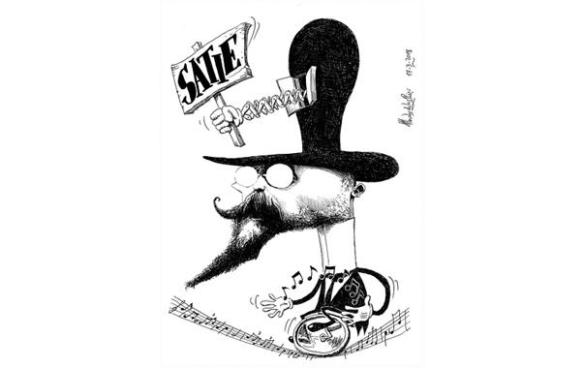
Caricature du Maître d’Arcueil, Erik Satie

A question. What do Janet Jackson, Steve Hackett, Gary Numan and Cesar dog food have in common?

I’ll let you ponder the answer while setting out what Arcana has planned for some of 2016! We’ve already wished you a happy new year but having survived the first week back this is a great chance to let you know what we have planned for the year ahead.

We plan to make much more of the links between classical and pop music this year – so you can expect further episodes of The Borrowers (which already includes Manfred Mann, Plan B, Village People and Greg Lake), interviews with artists who like to work in both areas of music, and reviews of albums that appeal to both sides.

These will include the forthcoming James Holden and Luke Abbott album, a homage to Terry Riley – and we might even delve into the daunting prospect of Rick Wakeman and Alice Cooper celebrating the 40th anniversary of Pink Floyd’s Wish You Were Here, with large orchestra in tow! There is so much variety and depth in this area to explore. We also hope to hear from the artists themselves, whether electronic, prog, jazz or ‘other’.

shining

Arcana will also be training the spotlight on two composers who have been a big influence on pop music, albeit in very different ways. 2016 is the 150th anniversary of the birth of Erik Satie, and we will explore his influence on pop music from several directions. A good contrast to Satie’s music can be found in the work of Hungarian composer Béla Bartók – famously used by Stanley Kubrick in part of The Shining (above). Arcana aims to show the breadth of his writing, as well as illustrating how rock music can be said to trace back through his work. Kicking off, Richard Whitehouse will be covering James Ehnes and Andrew Armstrong playing Bartók in a concert from the Wigmore Hall tonight.

All that and the usual concert and new recording reviews…showing there is an awful lot to enjoy musically this year. Please do stick around for the ride! And the answer to the question? They’ve all used the music of Erik Satie! We’ll tell you how in due course…but for now we will leave you with his most popular piece: