Unknown's avatar

About Arcana

My name is Ben Hogwood, editor of the Arcana music site (arcana.fm)

Under the surface – Lalo Piano Trios played by the Leonore Piano Trio (Hyperion)

lalo-piano-trios

Composer: Édouard Lalo (1823-1892)

Nationality: French

What did he write? Lalo’s best-loved work is the Symphonie espagnole for violin and orchestra, but he actually wrote a fair amount of attractive orchestral music, such as a Symphony in G minor, a Cello Concerto and several other works for violin and orchestra that include a Violin Concerto and the Rapsodie norvegienne.

What are the works on this new recording? Lalo’s music is not too common these days, still less the chamber music. However there are three works for piano trio (the combination of violin, cello and piano) that have all been recorded for Hyperion by the Leonore Piano Trio. Nos.1 & 2 were written when the composer was in his mid to late twenties, while no.3 is a much later work, completed in 1880.

What is the music like? In a word, passionate. French music expert Roger Nichols draws attention to the influence of Schumann and Mendelssohn in the excellent booklet note, but Lalo really does feel like he wears his heart on his sleeve more than those composers do. Big, bold statements such as that from the cello in the fourth movement of the Piano Trio no.1 are straight from the heart, and the Leonore Trio convey the composer’s strong feelings throughout these excellent performances.

The first trio has a heroic feel, the music unashamedly romantic but often making its mark through memorable tunes. Lalo can on occasion be cheeky, and he does this especially in the Scherzo movements of each trio. The one in the last trio is a stormy affair, so powerful in fact that the composer orchestrated it four years later. The Leonore players do not hold back, powering forward in this turbulent but thrilling music, by far the loudest on the disc.

What’s the verdict? Brilliantly played, this disc makes an excellent case for a neglected part of Lalo’s output that finds the composer on very passionate form. With memorable melodies and rich, occasionally indulgent slow movements, this is invigorating music with a soft heart.

Give this a try if you like… Schumann, Mendelssohn, Franck

Listen

You can listen to excerpts from the disc at the Hyperion website

Meanwhile you can hear the Scherzo, the orchestrated movement from the Piano Trio no.3, as part of this excellent disc by Yan Pascal Tortelier and the BBC Philharmonic Orchestra, which contains some of Lalo’s most attractive works for violin and orchestra:

Under the surface – Mendelssohn Preludes and Fugues played by Howard Shelley (Hyperion)

mendelssohn-shelley

Composer: Felix Mendelssohn (1809-1847)

Nationality: German

What did he write? Schumann regarded Mendelssohn as the ‘Mozart of the nineteenth century’, as he was an uncommonly gifted child prodigy. A pianist as well as a composer, Mendelssohn is nonetheless better known for his orchestral and choral works. His five symphonies are best represented by the Scottish, the Italian and the Reformation (nos.3-5 respectively), while his most famous choral work – and one often performed by amateur choral groups – is the story of the Old Testament prophet Elijah.

The composer’s impressive body of chamber music is now better appreciated, headed by two Piano Trios and six published String Quartets.

What are the works on this new recording? Mendelssohn’s work for solo piano is often regarded as a set of attractive miniatures. This is doubtless due to the popularity of the Lieder ohne Worte (Songs Without Words), published in sets of six throughout the composer’s career. They are around three minutes each in length and carry attractive music and titles such as Venetian Gondola Song. On this recording, part four of a complete series of Mendelssohn piano music, Howard Shelley gives us the fifth book, a complement to the main work itself – the set of six Preludes and Fugues.

Mendelssohn was almost single-handedly responsible for the revival of Bach’s music in the nineteenth century, resurrecting the composer in a performance of the St Matthew Passion in Berlin in 1829, when Mendelssohn was still only 20. In the Preludes and Fugues he was paying a more obvious musical homage, using a form Bach had perfected for the keyboard.

What is the music like? When a composer writes a fugue it can sound as though they are showing off academically rather than communicating emotionally, but Mendelssohn brings to these works a strong sense of purpose and poise. His instinctive writing for the piano means the notes effectively play themselves, but they are not easy to play – which is where Howard Shelley comes in! Under his fingers the fugues really jump off the page when moving at pace, and the preludes each have strong personality.

Complementing them with Book 5 of the more romantic Songs without Words is a good move, and Shelley takes up the role of poet in the fanfare of the third piece or the lyrical Spring Song. Finally he adds the Andante cantabile e Presto agitato, an unpublished work of two halves, the first soft-hearted and the second bright and energetic.

What’s the verdict? This brilliantly played and recorded disc shows just how accomplished Mendelssohn’s writing for piano became, and with Howard Shelley completely mastering the technical demands the listener can appreciate the emotion of the music. The Preludes and Fugues are inspiring for their resilience, the Songs without Words for their poetic charm.

Give this a try if you like… Schubert, Chopin, J.S.Bach.

Listen

You can listen to excerpts from the disc at the Hyperion website

Meanwhile you can hear more of the composer’s Songs without Words on Spotify, in a complete set made by Daniel Barenboim:

Wigmore Mondays – Benjamin Appl & Graham Johnson

benjamin-appl-graham-johnson

Benjamin Appl (baritone) and Graham Johnson (piano) perform settings of the poetry of Joseph von Eichendorff

Wigmore Hall, London

Monday, 4 January 2016

Audio (open in a new window)

http://www.bbc.co.uk/programmes/b06tkp3w

Available until 3 February

What’s the music?

Schumann (1810-1856): Frühlingsfahrt Op.45/2 (1840); Der Einsiedler Op.83/3 (1850; Der frohe Wandersmann Op.77/1 (1840)

Mendelssohn (1809-1847): Pagenlied (1832); Nachtlied Op.71/6 (1847); Wanderlied Op.57/6 (1841)

Brahms (1833-1897): In der Fremde Op.3/5; Mondnacht; Parole Op.7/2; Anklänge Op.7/3 (all 1852-1853)

Pfitzner (1869-1949): In Danzig Op.22/1 (1907); Der Gärtner Op.9/1 (1888-9); Zum Abschied meiner Tochter Op.10/3 (1901)

Wolf (1860-1903): Nachruf (1880); Das Ständchen; Der Musikant; Der Scholar; Der Freund (all 1888)

Spotify

Benjamin Appl has not yet recorded any of this repertoire, but a reproduction of his program using available versions can be accessed below, for listeners who cannot hear the BBC broadcast. Where possible I have used recordings made by Appl’s mentor, Dietrich Fischer-Dieskau:

About the music

Joseph_Eichendorff

Joseph von Eichendorff (picture used courtesy of Wikipedia)

With around 5,000 song settings of Joseph von Eichendorff’s poetry from the 19th century alone – with thanks to BBC Radio 3 announcer Sara Mohr-Pietsch for the info! – Benjamin Appl and Graham Johnson had no trouble making up a concert of 18 ‘lieder’ for the first Wigmore Hall lunchtime concert of the year.

Their choice gives an intriguing insight into different approaches to the poet. Broadly speaking, Schumann ranges from love-laden to thoughtful and a little morose (though his selection comprises three prayers), Mendelssohn is either forthright or reflective in his three songs; the youthful Brahms is surprisingly relaxed, while Pfitzner emerges as an inventive painter. Perhaps the most striking examples here come from Hugo Wolf, who wanted to focus on the ‘comparatively unknown humourously and robustly sensual side’ of von Eichendorff’s poetry.

Performance verdict

A slightly downbeat return for the WIgmore Hall in 2016, but a concert that was beautifully performed. The pairing of an incredibly experienced pair of hands in Graham Johnson and a singer starting out on his artistic voyage in Benjamin Appl was a good match and yielded many rewards.

Several songs left lasting impressions from the program, among them two from Brahms, with Appl’s control throughout Mondnacht and the picture painting from Johnson in Parole especially notable.

It was good to hear some rarely-sung lieder of Hans Pfitzner, whose use of the piano’s lowest end brought a wholly new texture to In Danzig, while the Wolf selection reminded us how original he could be in his song settings, the piano cast in a prominent role of scene setting, one that Johnson relished and used to his great advantage.

What should I listen out for?

Schumann

2:06 – Frühlingsfahrt (A spring journey) – the initial optimism of this march is quite bracing, but it soon subsides as the poet thinks of old age.

5:31 – Der Einsiedler (The hermit) – quite a sad song, solemn and lost in thought. Again old age is a preoccupation, the piano supporting the vocal melody as a walking stick might support the physical frame.

9:02 – Der frohe Wandersmann (The happy wanderer) – a much more positive, open-air march that talks of streams ‘rushing down the mountains’ and larks that ‘soar heavenwards’. More spring than winter!

Mendelssohn

11:03 – Pagenlied (Page’s song) – a tentative detached figure in the piano part adds to the tension of this song, which is relatively subdued and distracted.

13:11 – Nachtlied (Night song) – there is a withdrawn feel to this song also, until the Nightingale is encouraged to sing out at 14:39.

16:12 – Wanderlied (Song of travel) – a typically busy piano part from Mendelssohn gives the impression of rapid movement, the traveller set on his way with the minimum of fuss – and happily so!

Brahms

20:49 – In der Fremde (In a foreign land) – a rather downcast setting in a minor key, the poet in reflective mood. The piano hints at a major key near the end but such thoughts are quickly forgotten.

22:12 – Mondnacht (Moonlight) – dappled piano lines suggest moonlight in the branches, and there is a more romantic mood, with yearning vocal lines.

25:03 – Parole (Password) – again Brahms thinks privately, using vivid picture painting from the piano that depicts the huntsman through distant calls but also the ‘one last shot’ (26:44), where Johnson adds extra emphasis.

28:02 – Anklänge (Echoes) – a short but evocative song of two halves, the first depicting a lonely house in a forest, the second greeting the maiden inside.

Pfitzner

30:07 – In Danzig – the mood changes dramatically in this darkly coloured song exploiting the lower range of both piano and singer. The mysterious and faintly menacing mood is aided by elusive harmonic movements.

34:38 – Der Gärtner (The Gardener)­ – this song is more conventional in its language, looking back to Schumann and Brahms. The mood is positive and quite dreamy, but reaches a very impressive climax at the end with the words ‘Viel schöne, hohe Fraue, Grüss ich dich tausendmal’ (‘I, lovely gracious lady, greet you a thousand times’)

38:08 – Zum Abschied meiner Tochter (Farewell to my daughter) – a positive farewell, and an expansive setting that reaches another impressive climax at 40:07.

Wolf

42:58 – Nachruf (In memoriam) – the piano imitates the lute in this song as Appl sings a gentle lament

47:06 Das Ständchen (The serenade) – a watery piano introduces an adventurous setting that contains the tune of a serenade but some unconventional dissonances between voice and piano. There is a great deal of sadness in this song.

50:27 – Der Musikant (The minstrel) – the choice of music over marriage is made here by the singer! As if to emphasise his decision there is a rather lovely piano introduction that proves to be the bedrock of the song.

52:14 – Der Scholar (The scholar) – there are a number of examples of picture painting in the piano part for this song, depicting the ‘little birds’ and the rain that ‘rattles on the leaves’. Again the singer extols the virtues of making music but occasionally with a few too many wines! (53:40)

54:55 – Der Freund (The friend) – The joy of friendship is celebrated here, though not without travelling through a storm or two (55:30) where the crushing piano and loud voice descend into brief turmoil before emerging triumphant.

Encore (not heard on the broadcast)

Verschwiegene Liebe (Silent Love) The twinkling piano introduction was followed here by a sensitive and grateful rendition from Appl.

Further listening

As a complement to the concert, how about a recital based on poems by Heinrich Heine? Anothre great influence on 19th century vocal music, Heine’s music was set by a number of composers – and here the great tenor Christoph Prégardien and fortepianist Andreas Staier look at songs by Schubert, Schumann and Mendelssohn:

New Year Feature – The Sound of Silence

sound-of-silence

First of all, happy new year! I hope 2016 is good for you, and that Arcana can at least play some part in bringing you some musical treats and writing that you will hopefully enjoy.

It may seem an odd thing for a music site to talk about, but I’m going to kick off the New Year by promoting the virtue of silence.

Silence is good on so many levels. It allows the full formation of thoughts, provides a necessary break from the frenetic activity of day-to-day life, and – for me at least – it cleanses the mind over a holiday period such as Christmas, after which the joy of music can be appreciated more than ever. Not that I made an active bid for freedom from music this time around, but stepping away from it for a bit was incredibly useful.

Pop songwriters and classical composers have used silence to their advantage on many occasions. One use of silence I often think of is incredibly minute but works an absolute treat, where King Crimson go for the jugular half way through 21st Century Schizoid Man:

Perhaps the most famous classical example is John Cage in the sound-free 4’33” – which, depending on your view, is a work of genius or flawed publicity stunt. I would definitely tend towards the former, because if you ‘listen’ to 4’33” (after the pretty loud introduction!) each performance is different – because all manner of tiny micro-sounds make themselves known in your environment:

The use of silence goes much further back of course. Can you imagine the works of Beethoven without the use of silence? How on earth would the start of the Fifth Symphony sound without it…

…or the beginning of the second Razumovsky string quartet?

…or, taking a fantastic example from the last century, the very end of Sibelius’ Symphony no.5?

All show just how powerful silence can be when used strategically. Yet if experienced over longer periods of time it takes on an even more special significance.

A New Year’s Day walk brought this home to me in vivid form. After hearing the radio for the first hour or so of the day – and inevitably U2’s New Year’s Day was included in this! – it was out for a walk where we were staying in Faversham, Kent.

Our walk, designed to cure the hangover from the previous night’s celebrations, took us out beyond the town and heading for the reeds and marshland close to a remote place called Oare, and its haunted pub The Shipright Arms.

Here all that could be heard were calls from what turned out to be little egrets, the wind in the reeds, and something quite astonishing in the whirring of a swan’s wings as it took off on the adjacent lake.

little-egret

Little Egret (c) Ben Hogwood

Yet the wonderful truth was that if you stood and listened, most of what you could hear was…nothing. It was a cleansing experience, and one that has set me up to enjoy what 2016 has to offer musically. We at Arcana hope you choose to enjoy it with us…and share your moments of music and  silence with us…and that you have a Happy New Year!

Ben Hogwood – editor, Arcana.fm

On record: Leif Segerstam conducts Sibelius – Works for the stage (Naxos)

leif_segerstam

Leif Segerstam, conductor of an intriguing series of Sibelius works for the stage on Naxos, where he directs the Turku Philharmonic Orchestra.

In recognition of 150 years since the birth of Finland’s greatest composer, Jean Sibelius, his countryman Leif Segerstam has been illuminating his music for the stage. In a year where the composer’s seven symphonies have been ubiquitous in orchestral concerts, it is really gratifying to have these new versions of relatively rare works made available – even more so since they are given here in complete rather than abridged versions.

What’s the music like?

Sibelius is a fascinating composer in this field, and is able to set a scene with little to no preparation. His economical treatment of melodies can come across as brusque, but he is never less than interesting and writes music that is occasionally puzzling but frequently moving.

segerstam-pelleas

Listeners will more than likely know the first number of Pelléas et Mélisande, At The Castle Gate, for the grand way it has provided the soundtrack to the BBC TV programme The Sky At Night.

Yet there is much else to discover in this music. Segerstam may not be as high powered as some conductors in his interpretation but the music is still deeply felt from the Turku Philharmonic strings, while there is a nice reedy woodwind sound.

The Adagio from Act 1 is notable for the sharp woodwind intervention and coarse strings, providing a chilling outlook, while there are some lovely colours in the opening to Act 3, where the influence of Tchaikovksy still evident.

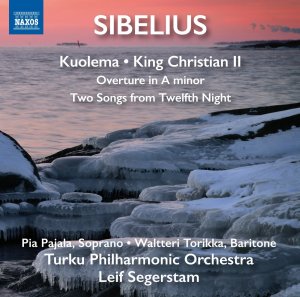
segerstam-kuolema

One of the numbers for Kuolema (Death) is one of the composer’s most popular encore pieces. Valse triste, as we know it, begins six scenes of music for a drama by Sibelius’ brother in law Arvid Järnefelt. Segerstam takes it slowly, but is poised and graceful throughout, as he is in the brooding Scene with Cranes, another Sibelius favourite.

Then he is joined by the fulsome baritone of Waltteri Torikka, who gives Paavali’s Song a convincing presence, while Pia Pajala is clear and crisp in Elsa’s Song. The last scene is strangely chilling, with the fateful tolling of bells.

The seven numbers Sibelius composed for the relatively early King Christian II, a Scandinavian historical play by his friend Adolf Paul, begin with a majestic Elegy, conclude with a tempestuous Ballade and include a substantial central Nocturne that proves surprisingly lively for the night time, building to a really impressive climax that reminds us how much sway Tchaikovsky holds over Sibelius’ early output. The whole score is beautifully performed, Segerstam clearly holding great affection for the romantic score.

segerstam-belshazzar

It was satisfying to see Sibelius’s music for Belshazzar’s Feast making a comeback at the BBC Proms this year, and in Segerstam’s hands we enjoy a colourful opening procession and a penetrating flute solo in the Nocturno. Pia Pajala deserves special credit for a fulsome soprano solo in The Song of the Jewish Girl.

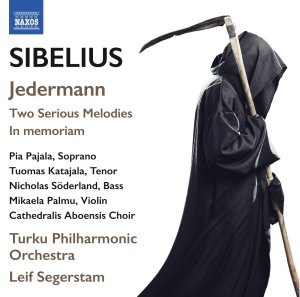
The two discs where the corners of Sibelius’s output are really deeply explored are those devoted to music for Jedermann (Everyman) and Scaramouche.

segerstam-jedermann

The former carries a chilling picture of a sabre-wielding Death on the cover and it is certainly very dark to start with, with some strikingly beautiful writing for strings that Segerstam is keen to bring out, especially when heard in a solo capacity in the Largo. There is more choral music in this score, sung with commendable spirit by the Cathedralis Aboensis Choir, and there is a memorable main tune that makes regular reappearances throughout. The sonorities become appreciably sweeter when the organ gets mixed in for the second part of the Adagio, but this is music that never really settles, and in the section marked ‘Con grande dolore’ there are some disarming sweeps from the strings.

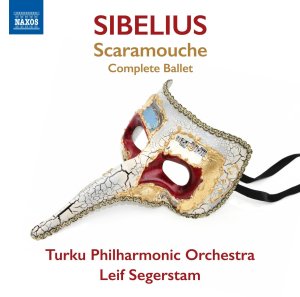
segerstam-scaramouche

Scaramouche caused Sibelius a lot of problems in its composition, causing him to break a telephone on one occasion, but it still has some striking qualities. The bolero in Act 1 is a very curious stop-start dance where what sounds like a bandoneon is used, while in Scene 6 of Act 2 (again untitled) there is extreme uncertainty, both here and in the start of the successive number in the harmonies and wind colouring. Scene 9 conjures up a favourite Sibelius tactic, the bouncing of bows on the strings. So while a bitty score, Scaramouche still generates a good amount of interest and mystery.

segerstam-swanwhite

 Swanwhite is quite an elusive piece but once again is revealed to have a mixture of charm and mystery. The former quality can be found in the third number of Act 2, where there is a poised and rather lovely dialogue between flute and strings, but by contrast the fifth number wears a stern expression, especially through its clarinet part. There are however some moments of pure serenity in Swanwhite, and while at times its music seems to have a short attention span it nonetheless leaves a lasting impression.

The Lizard, far from a makeweight, is a fascinating piece that shows all the composer’s hallmarks in their early stages – though when hearing the music it sounds a lot later than its publication number, Op.8, might suggest. The sweeping violas, the cold and often eerie unison string lines, and the shivers from tremolo strings around 17 minutes in – all are hallmarks of the mature composer and mark him out as an orchestral colourist of the highest quality.

One of the appealing qualities of Segerstam’s discs is the programming, as alongside the stage works he takes the opportunity to include rarely-heard items such as two songs from Twelfth Night, the Overture in A minor, and many more. These help put the Sibelius output in context, and while they might not be classed as masterpieces the works do still contain moments of inspiration and originality. While the Overture in E major may be an obvious early work, Scene de Ballet gets out the castanets to good effect, before finishing in typically abrupt manner. There is a glint in the eye of the waltz Musik zu einer Szene, and a graceful Valse lyrique. The Overture in A minor could only be by Sibelius, and offsets its stern brass with increasingly active strings before suddenly cutting to a brighter, energetic outlook. The Cortège is a piece of grand ceremony though still has its subtleties, while the Processional is a solemn piece. Meanwhile the short Menuetto has Sibelius’ own stamp on it, richly coloured and quite grounded, before once again stopping suddenly.

These are then extremely valuable additions to the Sibelius discography, and are highly recommended to those looking to progress beyond the ubiquitous symphonies. Though the symphonies make one of the twentieth century’s finest collections in the form, Sibelius was a much deeper composer than that – and in these recordings Segerstam proves that beyond doubt.

Does it all work?

Frequently. These are fascinating pieces, though listeners are advised to read the booklet notes either during or before hearing so that Sibelius’ acute scene setting can be fully appreciated.

Is it recommended?

Yes – especially to those who have gotten to know Sibelius through his symphonies. The stage works reveal the composer in a different light, and provide a substantial complement. They also show his remarkable powers of musical concentration and orchestral colouring.

Listen on Spotify

Pelleas https://open.spotify.com/album/2Hd0S5a6jiOzDziBVJ3uNR
Kuolema https://open.spotify.com/album/5NfQh1uva2xxerW8yNbqlr