Unknown's avatar

About Arcana

My name is Ben Hogwood, editor of the Arcana music site (arcana.fm)

On record: Stephen Hough plays Scriabin & Janáček: Sonatas & Poems

stephen-hough

Two of the giants of the piano from the twentieth century lock horns in Stephen Hough’s newest release for Hyperion – which actually brings together recordings made in 2011 and 2013. Scriabin and Janáček complement each other as they both explore rich variants of tonal writing – and in Scriabin’s case, leave tonality altogether.

What’s the music like?

Alexander Scriabin has an output almost entirely based around the piano, which became his primary means of expression. Within that, Scriabin seems to have loved the black keys and in particular F sharp, around which many of his works are centred. The Piano Sonata no.4 and Piano Sonata no.5 both reside in that key, although both make frequent and increasingly exotic bids for freedom, part of the mystical style the composer was working towards.

In Vers la Flamme (Towards the Flame) he reaches his goal, making a complete break with tonality in music that seems to be flying through the air – apt, really, as Scriabin believed in the concept of levitation. Here he conveys it in musical form.

By contrast the piano music of Leoš Janáček has a remote but incredibly intense form of intimacy that can at times be truly disconcerting. The music of Book I of On an Overgrown Path is fraught with anxiety but also has astonishing power, and it has eerie premonitions of death – the fate tragically befalling the composer’s daughter Olga, who lost her life to typhoid in 1903.

The Piano Sonata ‘1.X.1905, From the street’ has an equally tragic genesis, and would have been lost completely had the pianist Ludmila Tucková not copied two of its movements before Janáček lobbed them into the Vltava river. The date is that of the death of Frantisek Pavlík, a Moravian carpenter killed by Austrian forces for his support of a Czech-speaking university.

Does it all work?

Yes. Stephen Hough gets right inside the worlds of these two differing but complementary composers. He gives a frankly astonishing account of Scriabin’s Piano Sonata no.5, notable for its total technical command. This can also be applied to Vers la Flamme, where the fiendish trills reveal a work right on the edge.

Meanwhile the Janáček works thrive on the same levels of clarity, and the vivid picture painting in a piece such as The barn owl has not flown away!, from On an Overgrown Path Book I, lingers long in the memory. Meanwhile the latent anger in the Sonata is undimmed.

Is it recommended?

Without reservation. Stephen Hough is a superb pianist and musician, and plays these works with a command and clarity beyond the reach of most pianists.

Listen

You can get a preview of each track from this disc on the Hyperion website

On record: Mariss Jansons conducts Tchaikovsky: Pique Dame

pique-dame

Although Eugene Onegin may be a more popular opera, Pique Dame is arguably Tchaikovsky’s most accomplished and dramatic achievement in the form.

Here it is presented in a new live recording from BR Klassik, with Misha Didyk playing the role of lovelorn gambler Herman, Tatiana Serjan as his intended Lisa and Larissa Diadkova as the Countess. The Bavarian State Opera Choir and Bavarian Radio Symphony Orchestra are the massed forces.

What’s the music like?

The music shows just how spontaneous the composition of this opera was, Tchaikovsky finishing the entire work in six weeks with the help of a libretto from his brother Modest. In addition the plot and its execution become more dramatic as they progress, leading to the white hot intensity of the final act.

By this time Tchaikovsky’s music has darkened, moving on from a style that benefits from classical influences to one that bares its truly Russian soul. The darker colours that infuse orchestral works such as the Symphony no.5 are fully in evidence, and the writing for voices is at times sumptuous but also of a searing intensity.

Does it all work?

Emphatically, yes. This is a superb live performance from Jansons and his forces that is truly electric in the third act. Misha Didyk of Herman has admirable stamina in a demanding role that calls for him to sing in a wide range throughout, and his voice penetrates every scene in which he is present.

While Tatiana Serjan is also superb as Lisa, the chilling revelation of the ‘secret cards’ from the ghost of the Countess (Larissa Diadkova) lingers long in the memory, by which time Jansons has taken a fearsome grip on the opera.

Support from the chorus and orchestra is exemplary, the offstage choir towards the end of the scene in Herman’s quarter of the barracks a particularly magical moment.

Is it recommended?

Yes. Even to someone who does not listen to a great deal of opera on record, this particular Pique Dame is a wholly compelling experience.

Listen on Spotify

If you do not have Spotify you can listen to clips from the recording on the Presto website. If you do have Spotify however, the opera can be heard here:

Under the surface – Bruckner: String Quintet and Quartet (Linn)

bruckner-fitzwilliam

Fitzwilliam String Quartet, James Boyd (viola)

Composer: Anton Bruckner (1824-1896)

Nationality: Austrian

What did he write? Bruckner’s reputation is almost entirely built on his nine symphonies and three Masses, which form the bulk of his regularly performed repertoire. However there are also a number of exquisite motets for unaccompanied choir.

What are the works on this new recording? Bruckner wrote very little chamber music, but the two works recorded here are by far the most substantial. The String Quintet is an ambitious, substantial piece that could easily be imagined for string orchestra, while the recently discovered String Quartet represents another sizeable contribution to the form.

What is the music like? The Bruckner of the symphonies is only occasionally glimpsed here, for this is music to fill drawing rooms rather than cathedrals. The quintet especially fulfils its purpose with intimacy and depth of emotion, especially in the slow movement, where the Fitzwilliam Quartet and James Boyd really go up a level.

The outer movements are a little less successful, in this recording at least, for the textures are a little congested. However the String Quartet in C minor of 1862, discovered in 1950, justifies its case for a more permanent place in the quartet repertoire, as it is a substantial and memorable work. The third movement Scherzo has a distinctive theme while the outer movements are resilient and very well done here.

As a bonus, the Fitzwilliam and Boyd include an alternative version of the Intermezzo for the String Quintet, given a polished and elegant performance here.

What’s the verdict? This new Fitzwilliam Quartet disc makes a compelling case for the recently discovered work, but is not always on the money in the Quintet itself. The Intermezzo could have a little more humour in its theme, while the outer movements sound a little grainy in the recording.

Give this a try if you like… Brahms, Mendelssohn or Schubert

Listen

You can listen to excerpts from this new disc on the Linn Records website

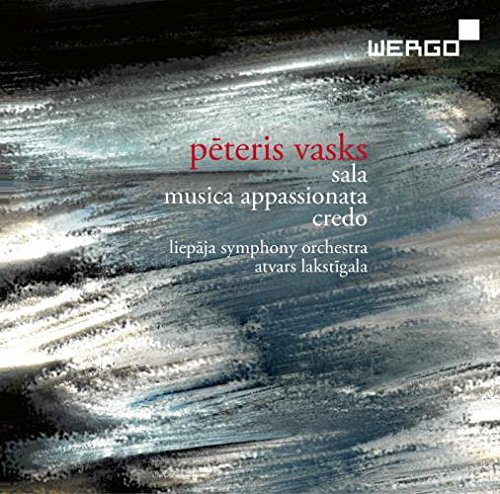
On record: Vasks: Orchestral Works (Wergo)

vasks

“I consider empathy for the sufferings of the world to be my works’ point of departure”. This quotation from the Latvian composer Pēteris Vasks sums up his approach to his music, making a specific reference to the horrors endured by the Latvian people in the wake of the Second World War.

It also infuses the orchestral music on this disc, played by the Liepāja Symphony Orchestra conducted by Atvars Lakstīgala.

What’s the music like?

These three orchestral pieces are certainly borne from Vasks’ statement, to the extent that his music incorporates both the suffering and paranoid trepidation of Shostakovich and the national pride of Sibelius. Crucially there is room for his own style too, and as Sala begins there are beautiful solos for clarinet and flute. That said it is the one assigned to the cor anglais that really sets the mood of contemplation, being the most substantial and leaves a lasting impact.

The show of strength from the strings to open Musica appassionata illustrates just why Vasks’ music has achieved its popularity, for his prowess in orchestration is immediately clear, as well as a capacity for instantly setting a scene and generating emotion.

Perhaps not surprisingly the spiritual aspects of Vasks’ writing are at their most concentrated in the Credo, which harnesses a massive battery of percussion at its climax points. This is relatively slow moving music but at these points the amount of energy unleashed is truly impressive, and would work especially well in the concert hall. Here it is very well played by Latvian forces.

Does it all work?

Largely, yes. For those who want a route into tonal contemporary music, Vasks is a good way to start, for he writes in a direct manner that makes an immediate if not wholly lasting impact. These orchestral works capture the deep feeling of pieces by Shostakovich and Sibelius, as mentioned above, if not quite containing the memorable melodies those composers were capable of writing.

Is it recommended?

Yes. For the age in which we live, Vasks captures the mood of appreciating strength and beauty in the face of adversity and atrocity.

Listen on Spotify

You can hear this disc on Spotify here:

On record: James Taylor – The Rochester Mass (Cherry Red)

james-taylor

Ever felt the need for a ‘funk mass’? Well James Taylor has, and this year The Rochester Mass received its premiere at the Queen Elizabeth Hall in April, before a performance in the cathedral of its home city in June. It was the South Bank who commissioned the work, which James wrote in memory of his late father Clive. The recording features choristers from Rochester Cathedral, as well as the fulsome organ.

What’s the music like?

Rather curiously, Taylor opts to present the mass in reverse order, so we begin with the jerky motif of the Sanctus, working through the Agnus Dei (complete with flute cadenza) to the Benedictus, Gloria and finally the Kyrie.

There is more than a passing reference to Leonard Bernstein’s setting of the Mass, a much bigger work but one that also operates with a policy of musical freedom. James Taylor doesn’t let his music go in quite the same way Bernstein did, preferring to opt for a little more ecclesiastical control. This means he is not self-indulgent in the way so many of these adaptations can be (remember Rick Wakeman’s The Gospels?!) but that he still pushes a boundary or two.

Part two of the Sanctus shows that Taylor can achieve a really grand sound with choir and organ – there is an impressive climax – and the response is a kind of joyous wig-out that sounds a lot better than it reads on paper.

Does it all work?

More or less. It is quite difficult to work out what gives this piece a special connection with Rochester, other than the performers being from the Kent town – and it is not quite clear why Taylor felt the need to reverse the order of the movements. But these are perhaps over-fussy points, because the music itself is meaningful and direct, and achieves the difficult balance of bringing funk into more classical structures without losing its identity. It also has the obvious emotion generated by the passing of Taylor’s father.

On occasion the music can sound forced – the Agnus Dei Duet being a good example – but that is balanced by music of fresh spontaneity, such as the unexpectedly gorgeous Flute Cadenza linking Parts One and Two of the Agnus Dei. In the closing Kyrie you get the feeling Taylor has mastered the unusual blend of cathedral choir and funk group. A unique sound indeed!

Is it recommended?

Yes, if you want to hear something different – and if you want to hear a creative way of taking on one of music’s most traditional forms.

Listen

The Rochester Mass can be heard on Spotify here: