Unknown's avatar

About Arcana

My name is Ben Hogwood, editor of the Arcana music site (arcana.fm)

On record: Alessandro Scarlatti – Con eco d’amore

scarlatti-watts

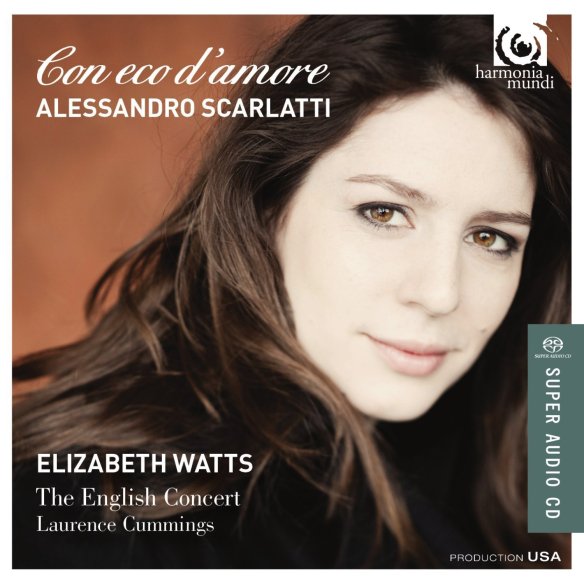
The extremely promising young soprano Elizabeth Watts delivers a stunning disc of arias from operas and cantatas by Alessandro Scarlatti, in the company of The English Concert and Laurence Cummings. The disc is released by Harmonia Mundi

What’s the music like?

Elizabeth Watts and Laurence Cummings deliver a well-chosen selection of arias here, representing the many and varied moods the Italian baroque composer Alessandro Scarlatti can conjure up in his vocal works.

We move from the high energy bout between soprano and trumpet, Se geloso è il mio core, to the dreamy Mentr’io godo in dolce oblio, in arias tending to last between three and five minutes. Scarlatti is a very expressive composer, responding to the words with music that taxes his performers.

Does it all work?

Without question. The levels of musicianship here are uncommonly high, and that’s before we even get to talking about Elizabeth Watts. Trumpeter Mark Bennett is outstanding in his role as the soprano’s opponent in Se geloso è il mio core, the sort of work in which composers of Scarlatti’s day specialised. Violinist Huw Daniel is then exceptionally good in his role as soloist in the cadenzas of Esci omai.

Yet it is nonetheless Watts who steals the show, because she can go from the high register bravura of Figlio! Tiranno! O Dio! to the withdrawn, sensitive singing of Nacque, col Gran Messia and the sparing use of vibrato for the opening strains of Ombre opache, a lament from the cantata Correa Nel Seno Amato, which contains arguably the most powerful music here.

The real technical showstopper is D’Amor l’accesa face, from the serenata Venere, Amore e Ragione, where Cupid warns against showing too much desire. Watts’ performance suggests the opposite is in fact the case!

Cummings and The English Concert are very fine image painters, and their dramatic orchestral response in the recitativo from Erminia, Qui, dove al germogliar, is illustrative of the power they have at their disposal – and Cummings secures from them particularly careful attention to detail on the volume of their contributions.

Is it recommended?

Unreservedly. With performances of great enthusiasm and technical command, you will find few if any discs of the Baroque era to better this one in 2015.

Listen on Spotify

You can hear Con eco d’amore on Spotify here:
Under the surface – Parry: English Lyrics

parry

Composer: Sir Charles Hubert Hastings Parry (1848-1918)

Nationality: English

What did he write? One composition springs to mind when you think of Parry – for the hymn Jerusalem is heard at many a national occasion. Beyond the Last Night of the Proms his choral anthems are also revered, with I Was Glad and Blest Pair of Sirens two of the most popular. Beyond that there are five symphonies and a number of orchestral and chamber works.

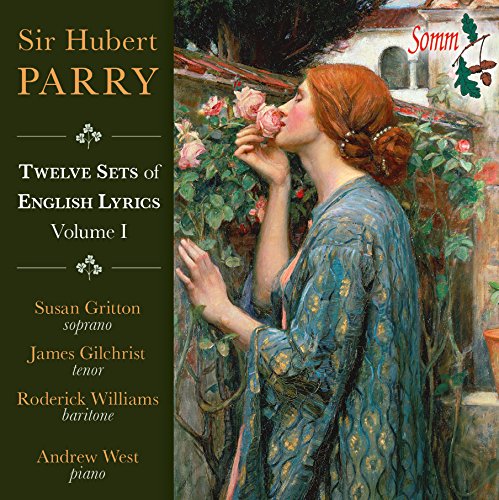
What are the works on this new recording? Although his choral works are often heard, Parry’s songs are a relatively rare breed. Promisingly, this is billed as volume one of the English Lyrics, a massive collection in twelve volumes that the composer wrote between around 1885 and 1920. The 31 songs on this new recording include 26 from the English Lyrics but finish with five settings of Shakespeare.

What is the music like? The disc takes in many moods, and although it flits around the different volumes of English Lyrics it is very well structured in this collection. Parry’s setting of Shelley’s Good Night is an early high point, Susan Gritton slightly husky in her description of nocturnal, and this is followed by the refrain ‘Soft shall be his pillow’ in Sir Walter Scott’s Where shall the lover rest, Gritton controlling the vibrato on her top ‘G’ with impressive precision.

There are some very popular texts in these Parry settings, and Roderick Williams handles O Mistress Mine and Take, O take those lips away with unfussy poise. On the other hand there are tiny trifles such as Julia, where the baritone introduces a touch of mischief. Meanwhile Gilchrist is especially effective in the anonymous text Weep you no more, a lovely piece of consolation. Andrew West is a sensitive picture painter alongside the three singers, introducing When icicles hang by the wall with chilly detachment and accompanying Williams in On a time the amorous Silvy with an instinctive sense of when to push on and when to hang back.

What’s the verdict? Somm have put together an enterprising release that unites some of the best English singers around, with pianist Andrew West joined by Susan Gritton (soprano), James Gilchrist (tenor) and Roderick Williams (baritone). It is a nice and effective contrast to move between the male and female voices, and it helps that the words are sung so clearly.

Give this a try if you like… Brahms, Schumann or Vaughan Williams songs

Listen

You can listen to Good night, sung by Susan Gritton, here

On record: Purcell – Twelve Sonatas of Three Parts (Vivat)

purcell

The King’s Consort play Purcell’s collection of twelve sonatas published in 1683. In the words of the Vivat label website, they ‘combine French elegance, Italian vigour and delicious English melancholy with harmonic daring, extraordinary contrapuntal technique, ravishing dissonances and unique melodic ingenuity’. Clearly Purcell was anticipating a united Europe!

What’s the music like?

Purcell is one of the most obviously expressive composers of the Baroque period, and even his instrumental music has strong vocal qualities. His music here also experiences relatively rapid mood swings, the individual movements of the sonatas capable of switching quickly from grave, browbeaten music to melodies that are full of the joys of spring.

There are dances too, such as the one a minute or so into Sonata no.8, or the enjoyable repeated-note motif that closes out the first movement of Sonata no.2.

When the English melancholy does make itself known the results are rather special, such as the sumptuous beginning to Sonata no.6, where the strings make a sweet sound. By complete contrast the start of Sonata no.4 is relatively stark, bringing Purcell’s daring discords to the surface – before moving into a resolute faster section.

Does it all work?

Yes. There is some beautifully poised playing on this collection, as the staged entries in Sonata no.8 confirm. Violinists Cecilia Bernardini and Huw Daniel are blessed with beautiful, penetrating tones, and the continuo section – bass viol, theorbo and organ or harpsichord – alternates its colours sensitively and effectively, a prime example being the wonderful organ sound half way through the first movement of Sonata no.3. The fugue halfway the first movement of Sonata no.12 sums things up very nicely.

Is it recommended?

Yes. Purcell’s vocal music tends to get the headlines but this disc shows just how imaginative and effective his writing for instruments could be.

Listen

You can get a preview of each track from this disc on the Vivat website

Under the surface – Kuula Orchestral Music

kuula

Composer: Toivo Kuula (1883-1918)

Nationality: Finnish

What did he write? Kuula is not well known outside of Finland, but in his home country his reputation rests largely on his vocal music, the record company Ondine describing him as ‘a colourful and passionate portrayer of Finnish nature and people’. His catalogue includes numerous works for male choir.

What are the works on this new recording? For this disc of some of his orchestral music, Leif Segerstam has chosen the most popular works in the two South Ostrobothnian Suites­ – the Finnish region where Kuula lived. They led to him being dubbed as a successor to Sibelius. Complementing these are the Festive March and the Prelude and Fugue. All the works date from the last decade of the composer’s short life.

What is the music like? Much of it is attractive, if a little undemanding. The Prelude and Fugue feels as though it is trying a little too hard to impress, but the Festive March is a natural and spontaneous composition that sounds like Brahms on holiday.

Perhaps because they describe the Finnish country, the South Ostrobothnian Suites are the most colourful music here. The first suite is especially notable for the graceful, silvery Folk Song, where the strings taking the lead, while there is a surprisingly rustic feel to the Devil’s Dance. Meanwhile in the second suite a clean orchestral picture emerges for The Bride Arrives, while Kuula shows a gift for picture painting in the evocative woodwind calls towards the end of Rain in the forest. Perhaps the most memorable picture painting occurs in the gamelan figuration of Will-o-the-wisp, the last number in the second suite – which is beautifully played by the Turku Philharmonic Orchestra and their conductor Leif Segerstam.

What’s the verdict? If you like classical music to be slightly in the background then this is ideal, music that doesn’t make too many demands on the listener but is nonetheless rewarding when painting a picture of Finland. It is true the attractive cover draws you in, but on many occasions here there is music to match.

Give this a try if you like… Dvořák, Grieg or lighter Brahms

Spotify Playlist

You can listen to excerpts from the disc at the Presto website (be sure to click on the ‘Listen’ tab)

Meanwhile you can hear the composer’s complete songs for male voice choir on Spotify here:

On record: Poulenc – Works for piano and orchestra

Featured recording: Poulenc – Works for piano and orchestra (Chandos)
poulenc-lortie

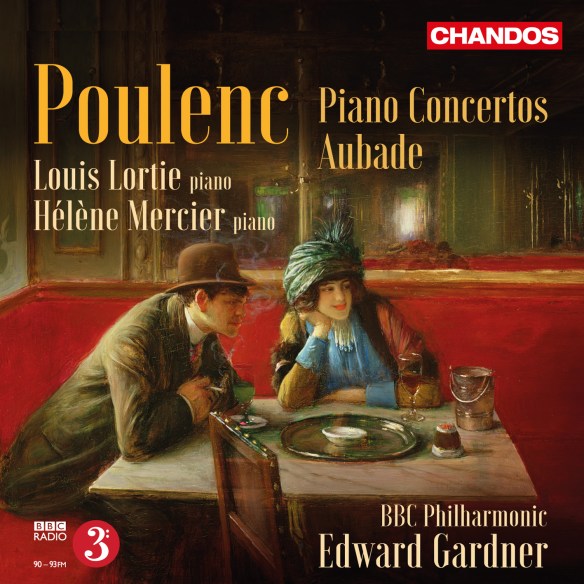
Louis Lortie, a French-Canadian pianist, teams up with conductor Ed Gardner and the BBC Philharmonic Orchestra for a disc presenting Poulenc’s complete music for piano and orchestra, as well as some of his works for two pianos. Here he is joined by regular duet partner Hélène Mercier.

What’s the music like?

Poulenc is well-loved among 20th century composers, often for his gift of writing bittersweet melodies that make the listener smile – such as the oboe theme that dominates the Rondeau section of the Aubade for piano and orchestra, the second work on this disc.

Poulenc is a cheeky composer, thumbing his nose behind your back in a sense, and as with most French composers the imaginative and colourful orchestrations bring the music to life. Every so often Poulenc throws in a turn of musical phrase that makes the listener smile, with an exaggerated gesture here or a knowing chord progression there.

This new collection from Chandos brings together an impressive range of writing. The Piano Concerto is perhaps not as popular as it might be, for it often sparkles in this performance, and that label certainly applies to the entertaining and multi-faceted Aubade from 1929. This work, Roger Nichols informs us in his authoritative booklet note, was written in one of the composer’s depressive bouts, and it tells the story of how the huntress Diana is driven to suicide by her own ‘love that the gods forbid’.

The brief works for two pianos included here are greatly affecting – the doleful Élégie and the free-spirited L’Embarquement pour Cythère especially – while the concise Sonata packs an energetic punch. When writing for two pianos and orchestra in the Concerto Poulenc must have had great fun, for this is full of frolics – but with the customary cautionary notes just beneath the surface.

Does it all work?

Yes. This collection is consistently entertaining, played with great enthusiasm and affection and recorded in such a way that the light and shade of the composer’s writing is fully revealed.

The Aubade is at times po-faced but has an almost ever present glint in the eye, as though it can’t resist cracking a joke amongst the downward thoughts. In the double concerto, Mercier and Lortie enjoy sparkling and spiky exchanges between pianos and orchestra, and in the finale there is what sounds like a clockwork mechanism towards the end.

The tender second movement of the Sonata for two pianos is beautifully done, before the finale scurries away.

Is it recommended?

Yes. Poulenc is a charmer on record, and can be enjoyably brash too. The performers here do him proud.

Listen on Spotify

This particular recording is not on the streaming service, but samples from each track can be heard here