Unknown's avatar

About Arcana

My name is Ben Hogwood, editor of the Arcana music site (arcana.fm)

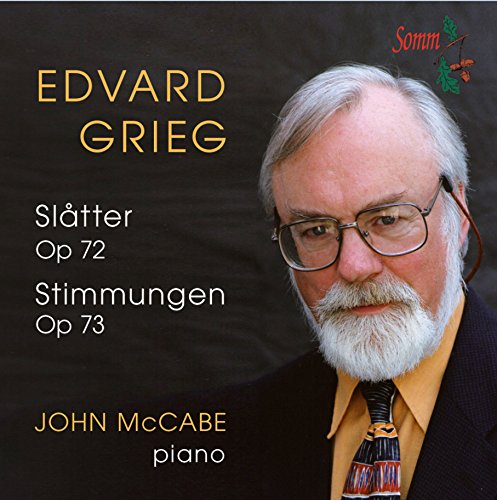
Under the surface – Grieg Piano Music played by John McCabe

grieg

Composer: Edvard Grieg (1843-1907)

Nationality: Norwegian

What did he write? Two of Grieg’s works are among the most popular in classical music. These are the early Piano Concerto and the music for Ibsen’s play Peer Gynt, containing such treasures as Morning and In The Hall of the Mountain King.

What are the works on this new recording? In this new issue of remastered recordings originally made for RCA in 1978, the recently deceased pianist John McCabe plays two late collections of the composer’s music for solo piano – the Slåtter (Norwegian Peasant Dances) and a collection of short pieces published as Stimmungen (Moods) in 1905.

What is the music like? Grieg writes delightfully for the piano, and these pieces show a complete mastery of the three-minute format. In the case of the Slåtter (Norwegian Peasant Dances) he effectively turns transcriber, arranging original folk material for piano but in such a way that it sounds like it was originally written for the instrument.

It is tuneful music, and in both collections the composer’s gift for melodic setting is clear. Often his melodies are played out over drones in the left hand of the piano, giving the music a rustic feel.

McCabe finds the exquisite tension in the first piece, Resignation, while by contrast the second, Scherzo-Impromptu, is an amicable dance, and Tune from the Fairy Hill, the fourth of the Slåtter, is a dance for the outdoors. In the Hommage à Chopin, a technically demanding Studie from the Stimmungen, McCabe is wholly equal to the task.

Grieg’s music may be charming but if often demonstrates a chilling undercurrent, which can clearly be heard in The Mountaineer’s Song and Night Ride from Stimmungen. McCabe communicates this with a real frisson.

What’s the verdict? This music feels intensely personal, and although it is the work of a composer in his sixties there is still a resolutely youthful side to it, and McCabe brings out the balance between the two.

Give this a try if you like… Sibelius piano music, Chopin or Mendelssohn

Spotify Playlist

Firstly you can listen to Resignation, the first piece of the Slåtter, here

A playlist of lesser-known Grieg is available on Spotify below, including the mature Violin Sonata no.3, the two Elegiac Melodies, Bergliot for baritone and orchestra and finally the Lyric Suite, comprising orchestrations of some of his piano pieces. The final March blows away the cobwebs!

The Borrowers Christmas Special – Greg Lake: I Believe in Father Christmas


What tune does it use?

The Sleigh Ride (or Troika from Prokofiev‘s score for the 1934 film Lieutenant Kijé.

How does it work?

Lake lifts the entire melody and uses it at the end of the first verse, from 0’43”:

Then after the second verse the tune appears once more :

Finally after the third verse we hear it again, by which time the song has built through a crescendo with a sizable orchestra and chorus:


Here is the original:


and here it is when the tune really gets going:


What else is new?

Prokofiev is a popular composer for lovers of pop music, and it is quite possible you hear his music more often than you realise. His Dance of the Knights from Romeo and Juliet, for instance, has been used as the theme for the BBC show The Apprentice since it started in 2005:


Greg Lake, of course, is no stranger to arranging or manipulating classical music. Here is arguably his most famous piece of work in that area, the rocking out of Copland’s Fanfare for the Common Man as part of Emerson, Lake & Palmer:

Calin Huma – ‘Carpatica’ Symphony World Premiere

philharmonic-orchestra-london

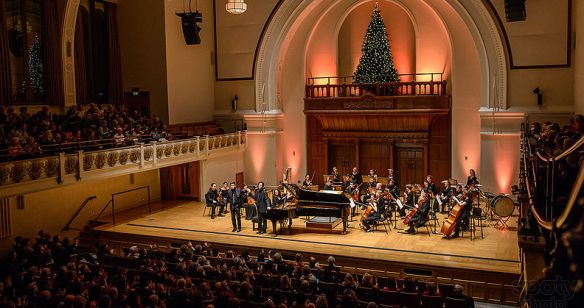
Richard Whitehouse on the London premiere of a new work from Romanian composer Calin Huma from the Philharmonic Chamber Orchestra of London under Christopher Petrie, with Leslie Howard joining them for Rachmaninov’s Second Piano Concerto

Cadogan Hall, London on Thursday 17 December

Rachmaninov: Piano Concerto no.2 (1901)

Enescu: Romanian Rhapsody no.2 (1901)

Calin Huma: Symphony, ‘Carpatica’ (London premiere) (2015)

Leslie Howard (piano), Philharmonic Chamber Orchestra of London / Christopher Petrie

The Philharmonic Chamber Orchestra of London has demonstrably established itself on the London calendar over its two years of existence, with tonight’s programme surely the most enterprising yet. Leslie Howard was on hand for Rachmaninov’s Second Piano Concerto – and a reading which, while offering little in the way of a fresh perspective, was for the most part finely articulated and well-coordinated. The opening Moderato was a touch stolid in its earlier stages, though the second theme was raptly conveyed on its return, then the central Adagio had pathos and, in its scherzo section, deftness to spare. The twin themes of the final Allegro were pointedly contrasted, the PCO nimbly negotiating the fugato at its centre, and the return of the ‘big tune’ capping the whole in a generous yet not over-bearing peroration.

Music by Romanian composers followed in the second half, which began with the welcome revival of Enescu’s Second Romanian Rhapsody. While its predecessor has latterly regained much of its former popularity, this piece is heard but seldom – its melodic eloquence at one with its largely ruminative persona. Christopher Petrie assuredly had its measure – whether in the soulful expression of its initial pages (Enescu’s deployment of traditional melodies at its most alluring), cumulative build-up to its fervent central climax, then the gradual ebbing away of emotion towards its close; a sense of place fleetingly if tangibly evoked. Hopefully this orchestra will go on to perform other works by Enescu – not least the First Orchestral Suite, whose mesmerising unison ‘Prelude’ would doubtless be relished by the PCO strings.

For now, listeners were treated to the London premiere (and only the second performance)   of the ‘Carpatica’ Symphony by Calin Huma (b 1965), the Romanian entrepreneur who has been based in Hampshire these past two decades. Huma has professed himself an avowed neo-Romantic in terms of aesthetic, and the present piece looks back beyond Enescu to the Romantic nationalism of Eduard Caudella (1841-1924) while evincing the melodic directness of more recent figures as Nicolae Kirculescu (1903-85), whose Moment Muzical (or at least its main theme) was well known to Romanian listeners in the 1960s and ‘70s. Huma’s work shared something of its unabashed nostalgia, yet whether the three movements of this half-hour piece amounted to anything which approaches a cohesive conception is open to doubt.

That it failed to do so was hardly the fault of the PCO, whose strings played with lustre, or of Petrie – who directed with sure conviction of where this rhapsodic music ought to be headed. Not that this prevented the lengthy first movement from losing focus before its final climax, while its successor – more a slow intermezzo than a slow movement – would have benefitted from a more flowing tempo. The finale brought a welcome degree of energy, its main theme capping the whole with a decisiveness in which the ends came closest to justifying the means.

A section from Petrie’s own Fantasia on Christmas Carols made for a winsome and appealing encore. More Romanian music from this source would be most welcome: the 90th birthday of Pascal Bentoiu, doyen of post-war composers, in April 2017 provides just such an opportunity.

You can listen to more music from the Philharmonic Chamber Orchestra of London on their website

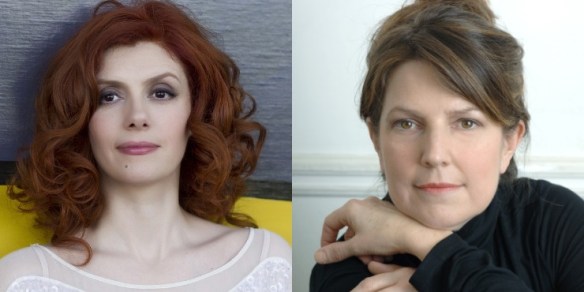
Patricia Petibon and Susan Manoff at the Wigmore Hall – La Belle Excentrique

petibon-manoff

Patricia Petibon (soprano) and Susan Manoff (piano) – La Belle Excentrique, Wigmore Hall, Wednesday 16 December 2015

Review by Ben Hogwood

It isn’t often you see a rubber chicken as part of a song recital, and I would wager one has not been seen on the Wigmore Hall stage for quite some time. If ever! But this wasn’t just any song recital, this was a concert where soprano Patricia Petibon and pianist Susan Manoff asked questions of their audience, expanding the format but making them laugh and cry in the process.

The concert, a memorable Wigmore debut for Petibon, reminded us how regimented and serious some song recitals can be. Not a criticism you understand, for sometimes it is only right and proper to sit and listen to a singer and pianist making music of raw emotion. It can be one of the very best live experiences in classical music. But this was so very different, Petibon and Manoff marrying humourous music with songs of deep emotion, punctuated with well-chosen piano pieces.

La Belle Excentrique was the title given to the recital, which fell neatly into two parts. Part one began with understated beauty, the crystalline music of one of Reynaldo Hahn’s finest songs A Chloris a daring way to start, especially when sung so quietly. Yet gradually it became clear Petibon was here to have some fun, the actions at the end of the third Hahn song Quand je fus pris au pavillon a notice of intent. Soon the soprano was barking (Manuel Rosenthal’s Fido, Fido) and then Manoff donned a trunk for the same composer’s story of L’éléphant du Jardin des Plantes, both brilliantly done. Hats were donned for songs by Satie and Poulenc, while charm and heart-rending emotion took hold in two wonderful songs by Fauré.

The second half also moved between extremes. France, Spain and the Swiss Alps dovetailed beautifully for songs of powerful impact from lesser-known composers such as Henri Collet and Fernando Obradors, as well as underrated song composers Joaquín Turina and Joseph Canteloube, whose Chants d’Auvergne have fallen out of fashion in the last few decades. Petibon’s performance of La delaïssádo (The forsaken girl) proved this to be an oversight, matched by exceptional playing from Manoff who effortlessly deconstructed the orchestral parts. Then we moved back to farce, and an exaggerated performance of Leonard Bernstein’s song cycle La Bonne Cuisine. For this, Petibon and Manoff went the whole hog by dressing up as chefs and using props relating to the food they were describing. It was hilarious! The recital ended with a no holds barred performance of Lara’s popular song Granada, before two encores – the popular French song Parlez-moi d’amour and a short excerpt, The Cat, from Ravel’s opera L’enfant et les sortileges.

These two performers were a breath of fresh air on the Wigmore Hall stage, heightening our appreciation for 20th century song while questioning the conventional format of the song recital. The strongest possible recommendation I can give lies in the fact I have since purchased two of Petibon’s albums on Deutsche Grammophon, La Belle Excentrique and Melancolia (see Spotify below!) – and would wholeheartedly recommend and Susan Banoff as a concert experience to completely blow away the cobwebs.

Wigmore Mondays – Rachel Podger, Marcin Świątkiewicz and David Miller – Biber Mystery Sonatas

Rachel_Podger_photo
Photo (c) Jonas Sacks

Rachel Podger (violin), Marcin Świątkiewicz (harpsichord, organ), David Miller (theorbo) – Wigmore Hall, London, live on BBC Radio 3, 14 December 2015

Listening link (open in a new window):

http://www.bbc.co.uk/programmes/b06rwh78

on the iPlayer until 6 January 2016

Spotify

In case you cannot hear the broadcast, here is a Spotify playlist of some of the music in this concert. Rachel Podger has in fact recorded this music but it is not currently available for streaming – so here is a version led by violinist Andrew Manze:

If you particularly want to hear Rachel in action – along with excerpts from some of her other recordings for Channel Classics – this page on her website provides more audio

What’s the music?

Biber: Mystery Sonatas (c1674):

Sonata No. 1 in D minor ‘The Annunciation’ (6 minutes)

Sonata No. 3 in B minor ‘The Nativity’ (7 minutes)

Sonata No. 9 in A minor ‘Jesus Carries the Cross’ (8 minutes)

Sonata No. 10 in G minor ‘The Crucifixion’ (9 minutes)

Sonata No. 11 in G major ‘The Resurrection’ (9 minutes)

Passacaglia in G minor (8 minutes)

What about the music?

If you don’t know much about the music of Biber yet like what you have heard from the 17th century then you really are in for a treat.

Performance verdict

The programming of the Wigmore Hall’s Monday lunchtime series often gets deserved plaudits, but to have this set of sonatas on the last of the concerts before the Christmas break was an inspired choice. In Rachel Podger the sonatas have their ideal vehicle, for she is a charismatic performer who clearly just loves playing the violin. In Marcin Świątkiewicz and David Miller she had the ideal support, the two very sensitive with the levels of their accompaniment, supplying light and shade but also subtle virtuosity. Świątkiewicz moved effortlessly between a small organ and the harpsichord, mindful of the colour he was making with each, and when he held the long notes on the organ as a descriptive aid (for instance giving an idea of the echo in Jesus’ tomb) the purity of tone was striking. Miller was a very tasteful presence on theorbo, this fascinating instrument always great to watch live but making a lovely mellow sound too.

Yet most eyes were on Podger, who played this music on four different violins with really impressive command not just of the notes and their intonation, but also of the characterisation. We lived the story in a very profound way, the abject despair of the crucifixion and burial only too obvious – but in the same way the portrayal of the resurrection, where minor key darkness gives way to major key light – was a radiant moment, the wide open sound a joy to behold.

From there it was on to the solo Passacaglia, and here it was as though Podger was on her own in the room, completely lost in the four note sequence that obsessively repeats – but finding all the variations in tone colour, attack, vibrato and rhythm that make this music consistently interesting. In this way she capped a very fine concert.

What should I listen out for?

First of all make sure you listen to the Radio 3 announcement from the beginning, and Rachel’s own introduction at 9:57 – they make the ideal preface to the music you hear, and the four instruments she uses to play it. As for Biber’s music:

No.1 The Annunciation (violin normally tuned)

The first of the suites is based on the following bible verse: Luke 1: 26-33 In Nazareth, the angel Gabriel riding on a cloud tells the Virgin Mary she is to have a child.

2:02 – a long low note from the chamber organ starts the Praeludium of this suite, where the violin becomes increasingly animated. Soon this leads into an aria allegro (4:13), where after a quick introduction from the organ the violin takes the lead in a gentle dance. But soon the dance becomes more energetic as the violin spins out variations on the melody. Then the organ holds a long note (6:49) over which the violin ducks and dives – and where the theorbo is more audible. Here it is as though the prophecy is being made.

No.3 The Nativity

Luke 2: 6-20 Surrounded by farm animals, Mary shows Jesus to two shepherds. The angel presides.

14:05 – a solemn though reverent beginning to this sonata, where the harpsichord can be heard elaborating in the background. Then from 15:43 the chamber organ and theorbo can be heard in a mellow accompaniment to the relatively shrill violin. At 17:31 the triple time Courante begins, thought to be set in this way to convey the rocking movements of Jesus’ cradle. At 19:09 the music slows considerably, the organ now an extremely slow accompanist – and another thoughtful, reverent passage brings the Nativity vision to a close.

No 9 Jesus Carries the Cross

Luke 23: 26-32 Jesus falls and Simon the Cyrenian is forced to help by a Roman with a stick while a daughter of Jerusalem ululates.

22:59 – this is a much more obviously grief-stricken piece, a sonata of mourning depicting a woman wailing with grief. The slow introduction depicts this from the outset, and from 24:28 the music becomes twisted. Then the mood softens, the soft strumming of the theorbo again evident against the cool sound of the organ – before Podger again speeds up, dominating the exchanges. Finally an organ improvisation brings in something of a coda 29:30.

No 10 The Crucifixion

Luke 23: 33-46 Jesus dies before three female onlookers.

32:21 – a real tour de force of word painting here, as Biber conjures up visions of Christ’s crucifixion. He does this through the hammering of nails into the coffin (e.g.33:07 in the Praeludium from violin and harpsichord), and then, after a dance based aria and some lively variations, through a violent earthquake, with all three instruments generating stunning power (40:14). The theorbo offers pointed support too, and is especially audible at 36:56.

No 11 The Resurrection

Luke 24: 1-12 Jesus bursts from the sepulchre, the cross now on his flag, surprising the guard and his cowering accomplice.

43:24 – the violin has a very unusual tuning for this sonata, creating a ‘cross’ – wholly appropriate given the subject matter! It is here that the music becomes free of the shackles of the minor key. First there is a slow introduction, where the sonorous octaves on the organ represent the echoes of the tomb. Then there is a quotation of the plainsong hymn Surrexit Christus hodie (46:05) from the organ, and a series of variations on this theme. The closing Adagio (from 50:46) is soft and rather beautiful, with the violin double stopping (playing more than one note at once). The theorbo is also more prominent here.

Passacaglia (violin normally tuned)

A guardian angel guides a child by the hand.

54:13 – the Passacaglia is an extraordinary bit of writing for solo violin, based on a sequence of just four notes the violin plays at the beginning. A sequence of 64 variations on this unfolds, becoming ever more intense as it progresses (from 58:15 for instance) until a rapt finish at 1:02:30.

Further listening

Biber could be regarded as being a slightly earlier example of the Baroque period. Fast forward just a couple of decades and you have quite a lot of music that has either become associated with Christmas or is Christmas-themed – so this disc of seasonal concertos by The English Concert and Trevor Pinnock is a wholly appropriate next port of call: