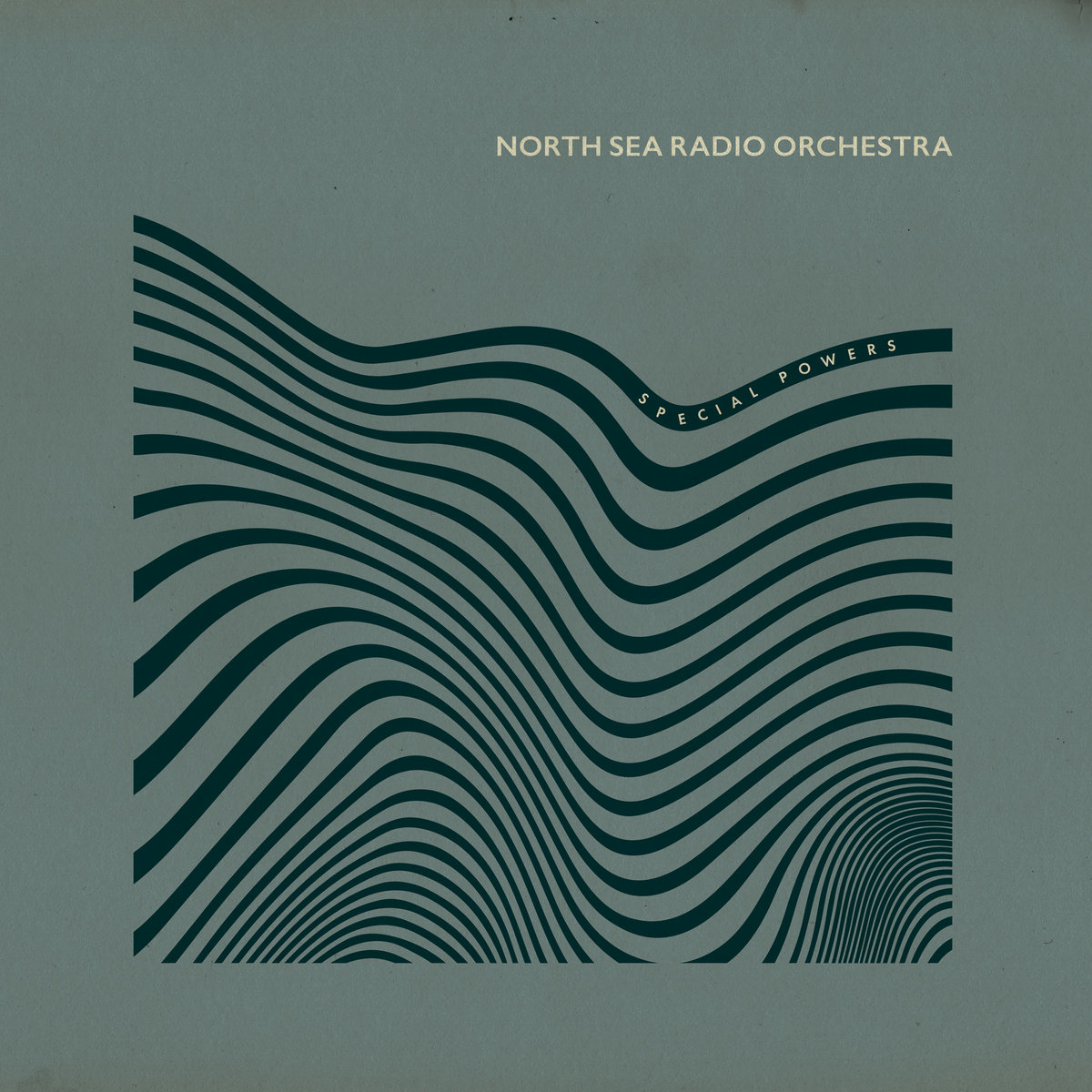
The North Sea Radio Orchestra have announced a new album, Special Powers, to be released on Believer’s Roast on 30 May 2025. This is prefaced by a new single, All Alice Lake, described as “Craig’s attempt at a country waltz (perhaps the most ‘straight-ahead’ song he’s ever written), with string countermelodies and Chantelle’s voice to the fore.”
Summarising their career to date, the press release tells the story of how, “Way back in 2002 North Sea Radio Orchestra (NSRO) began rehearsing and performing in old churches, secreted away in the heart of the City Of London. At first their audience had to explore the lost alleys and lanes of old Londinium to hear their sounds. NSRO then moved out into the world at large; performing in venues diverse – from churches to clubs to Freakzone sessions to festivals, opera houses, libraries etc etc. NSRO are very much a part of the ‘Cardiacs Family’ of bands and musicians; having personal and stylistic ties (harmonically and melodically) to Cardiacs and the music of the late Tim Smith generally; other bands in the ‘scene’ include Gong (and Kavus Torabi), Lost Crowns, William D Drake, Spratleys, Crayola Lectern etc.”
Special Powers is their fifth studio album and as ever, all material is written and produced by band leader Craig Fortnam.
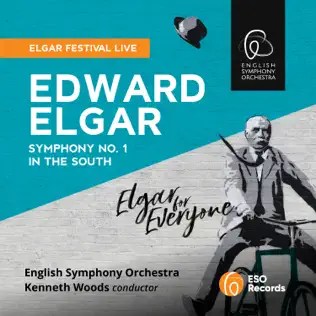
Elgar Symphony no.1 in A flat major Op.55 (1907-08) In the South (Alassio) Op.50 (1903-04)
English Symphony Orchestra / Kenneth Woods
ESO Records ESO2501 (80’10″] Producer and Engineer Tim Burton
Live performances at Worcester Cathedral on 4 June 2022 (In The South) and 3 June 2023 (Symphony)
Reviewed by Richard Whitehouse
What’s the story?
There could hardly been a more fitting release to launch the English Symphony Orchestra’s own label than these performances drawn from past editions of the Elgar Festival, with both of them a reminder of the ESO’s formidable prowess over the range of symphonic writing.
What are the performances like?
The First Symphony may not have the usual number of strings to complement its triple wind, but due to the resonance of Worcester Cathedral this is not evident as regards internal balance. Not least in an opening movement whose motto-theme is never indulgent, setting the tone for an Allegro where expressive variety goes hand in hand with formal focus. Especially fine is a hushed transition into the reprise, then a coda that distils the equivocal mood as this subsides into ruminative calm. Woods is mindful to invest scherzo and trio with consistency of pulse, so if the former feels reined in on return, the latter has an ideal poise and wistfulness. Nor is the transition other than indicative of the Adagio’s profundity, Woods negotiating its soulful main theme and wistful episodes with unerring rightness through to the ineffable closing bars.
If the finale has any marginal falling-off of inspiration, it is not apparent here. Sombre if shot through with expectancy, its introduction launches an Allegro whose alternating incisiveness and suavity holds good over an impulsive development, then a transformation of the codetta whose pathos intensifies for an apotheosis where the motto-theme carries all before it. Not that the closing pages are bombastic or grandiloquent in import – rather, they set the seal on a work whose affirmation is made the greater for its having been so purposefully attained.
As for In the South, the main issue is in setting a tempo flexible enough to accommodate this concert overture’s extended sonata design without it becoming episodic. Here a surging main theme, its speculative transition and suave second theme emerge seamlessly – the underlying tension carried into a development whose impulsiveness is maintained across the intervening first episode. Amply evoking the grandeur of ‘empires past’, this is astutely handled such that its implacability eschews bathos. If the second ‘canto populare’ episode is just a little reticent, its expressive raptness – and Carl Hill’s eloquent playing of its indelible viola melody – more than compensates. Nor is there any loss of continuity during the reprise, Woods’s building of momentum near the start of the coda ensuring an irresistible yet never overbearing peroration.
Does it all work?
Almost always. ESO concerts at the Elgar Festival have yielded numerous performances of note, with In the South among the finest yet in vindicating a work that can all too easily fall victim to its seeming indulgencies. Nor is that of the First Symphony far behind in revealing the formal intricacy and expressive variety of music as personal as is any of this composer’s major works. Anyone who may have harboured doubts about either piece is likely to be won over, confirming an empathy as augers well for the Second Symphony at this year’s festival.
Is it recommended?
Absolutely. These readings are far more than mementos of their concerts, this being ‘Volume 1’ suggests that further performances from the Elgar Festival will be made available. Note too the first instalment of a Sibelius cycle is downloadable as the second release on ESO Records.
This is the third album from the duo of Anna Phoebe and Aisling Brouwer, who have recently bolstered their reputation in soundtrack scores for Savage Waters and The Buccaneers.
They describe their first album since 2021 as “peeling back all the layers we cloak ourselves in until there is nothing left but the source, and discovering the strength that resides there. We wanted this album to feel raw, honest, and intuitive. There are themes of resilience, determination, grit, and an optimism in forever chasing the dawn after dark. It’s the bursting of bubbles and realising how much lighter everything feels without them.”
The single-word track titles are clues to the directness of expression the pair use, and on occasion the pair are complemented by vocalist Imogen Williams.
What’s the music like?
There is a freshness to AVAWAVES that is immediately felt on headphones, which indicates their wish to peel back the layers is an immediate success. The listener is led into wide open spaces, set down and allowed to enjoy the fresh musical air, free of any pretence or expectation.
The title track is purely and deeply felt, Phoebe’s violin played without vibrato and supported by calming piano – and it sets the tone for a purity running throughout the album. Mood secures a range of colours through its imaginative scoring. The violin uses pizzicato, double stopping and subtle inflections to the phrasing, while the doleful piano line is complemented by fuzzy electronics and a solid, quick moving beat. It is, as the pair say, the soundtrack to an imaginary film of the listener’s choosing.
Escape and Raindrop have strong Celtic flavours, the former given a winsome violin line and the latter soft vocals and a free spirit. Crush is synth-based and quite trancey, while Rumour brings the piano forward, its textures mottled and weather-beaten. Sleep Tight is a consoling song, the only one on the album, and is beautifully sung.
Does it all work?
It does. The music builds up in layers but never gets too much – or too cheesy. When used, the beats are especially good, as in the evocative Nightdrive.
Is it recommended?
It is. Heartbeat is an appropriate title for the album, as AVAWAVES make music from the heart, notable for the purity of its expression. Emotional and evocative, it is a rather wonderful listen.
For fans of… Erland Cooper, Ólafur Arnalds, Hauschka, Max Richter
This week we learned the very sad news of the death of talented cellist David Watkin, at the age of 60. Watkin had to stop playing cello 11 years ago due to scleroderma, but as this moving tribute from fellow Scottish Chamber Orchestra cellist Su-a Lee shows, he was a much-loved character whose influence continued to be an overwhelmingly positive one.
I had the good fortune to witness David in action for the Scottish Chamber Orchestra, and his charismatic playing – with good humour clear to see – left a lasting mark. I am sure that in addition to the Scottish Chamber Orchestra the members of The Academy of Ancient Music, The King’s Consort and the Orchestre Révolutionnaire Et Romantique – to name just three ensembles Watkin played with – would concur.
Watkin made relatively few commercial recordings, but it is very much a case of quality over quantity. His collection of VivaldiCello Sonatas for Hyperion is proof of that:
Even more deserving of praise is his cycle of BachCello Suites, made for Resonus and carrying remarkable poise and personality, which these two excerpts illustrate:
BUNKR’s third album Antenne, released nearly a year ago, was based on the radio station of the same name “devoid of any human voice to provide us with clues. No big ups for the SW9 crew, no ads for the turbo-sound rave with safe security. The 97.9 FM frequency was vibrant with all manner of cosmic, unending playlists of widescreen techno, breakbeats, ambient washes and occasional forays into obscure German synth music”. The producer – aka James Dean – brought it to life with expressive, moody soundscapes painting a series of atmospheric pictures. Each was ripe for a remix – and VLSI present here a series of interpretations of a number of tracks from the album, each one built from the lost audio files and recordings of Antenne broadcasts.
What’s the music like?
Consistently absorbing. There is a lot of busy beat making going on here, with the emphasis tending to be on the rhythm section over melodic input. However there was already plenty of that in the original BUNKR material, so the combination works really well.
Warrington Runcorn New Town Development Plan kicks things off with a busy mix of Oriam Speedway, beats chattering down the airwaves above a longer, drawn out line that gives plenty of space.
There is a similar urgency to the Mattr remix of the same track, while the beats get even more prominence from Polyop, and the clattering set of percussion used in the remake of I Feel Eye See. Faex Optim’s take on this track is a widescreen winner, backed with a heavy break, while Alphabox gives a nice, dreamy contrast towards the end of Aquatakt.
Echaskech save some of the best moments until last, their studied and rather majestic account of Nectar Rushes bringing cool ambience and space.
Does it all work?
It does – the only regret being there aren’t a couple more remixes to enjoy. Yet this is a really strong package that gives a great variety of beatmaking.
Is it recommended?
It is. The remix album really should be employed more, for it is a great way of seeing how producers work and getting another view of their process. This group is an example of just how effective the process can be.
For fans of… Echaskech, Fluke, Ulrich Schnauss, Leftfield, Hybrid




 Arcana.fm