There is a strong feeling around Utopia that this is the record Gwenno has been leading towards in her previous three solo albums.
As if to emphasise the fact she has recorded much of the album in English, a departure from the Cornish and Welsh songs she has been writing to date – as though she needs to communicate her message and feelings more immediately and with greater bandwith.
She regards her first three albums as ‘childhood records’, while Utopia is set to capture ‘a time of self-determination and experimentation’.
What’s the music like?
In a subtle way, Gwenno’s music on Utopia is deeply expressive. As always, her winsome voice is a big draw, but here the sense is that she is going emotionally deeper. War is a great example, a darker song with a lower vocal that leaves a lasting effect. 73, too, gets more emotional, while St Ives New School feels like a meditation on motherhood, with a coda of real substance.
Dancing On Volcanoes is a great pop single, while Ghost Of You is beautifully song. The Devil may be serious and relatively dark in lyrical content but again it has a dreamy side. Y Gath, a collaboration with Cate Le Bon and H. Hawkline, feels multilayered, a song to return to for full discovery. Finally Hireth is a spectral beauty, its cascading guitars complementing another excellent vocal.
Does it all work?
It does – the more personal side reaping rewards in longer songs that are as expressive as they are colourful.
Is it recommended?
It is, enthusiastically. Gwenno writes great pop songs, for sure, and has the voice to communicate them well, but intensive listening ensures the compositions are bound together, both in message and music. Gwenno’s best album yet.
For fans of… Cocteau Twins, Cate Le Bon, Gruff Rhys, Wolf Alice
Oxford producer Sebastian Reynolds follows up his September 2023 debut album, Canary, with this set of reworks bringing together source material from collaborations with his previous bands, namely Flights Of Helios and The Epstein.
The collaborative album also welcomes Irish artists Bróna McVittie, Rezo and The Mining Co. as well as West Country group Will Lawton & The Alchemists and New York duo Kritters. The album complements his atmospheric writing with Neon Dance, and his self-termed “athletics themed bangers”, produced with Dubwiser and darqwud.
What’s the music like?
The heat haze of summer courses through Reynolds’ music. He is a gifted and versatile writer, bringing a wide range of beats and textures to make an album that runs fluently.
The songwriting is on point, too – IYSCM especially, a reimagining of If You Could See Me, where breathy vocal interjections are complemented by guitarist Myles Cochran. The destination here is unmistakably poolside, with a lovely Balearic disco feel.
The warmth is a feature of the album, which unwinds with a reworking of Dubwiser’s The Jackal), a loping broken beat number with UNKLE leanings (Molotov, with Rezo), and the breezy Fossils Of The Mind, a collaboration with Will Lawton & The Alchemists. Also making its mark is the attractive indie-baggy hybrid Broken, with Bróna McVittie, and One Year To Go, a Michael Patrick Gallagher co-write with more than a hint of Andrew Weatherall. Finally Make This Our Drone removes the beats but turns everything up to 11, a richly coloured wall of sound.
Does it all work?
It does – and if anything some of the reworks later in the album could be longer, for good vibes abound in their rich melodic content.
Is it recommended?
Enthusiastically. The carefree mood created by New Beginnings is perfect for summer listening, a blissful set of sounds that cover a surprisingly large number of bases. Sebastian Reynolds is a talented producer and songwriter, who deserves to expand his audience considerably with this welcome dose of musical warmth.
For fans of… UNKLE, Ian Brown, Andrew Weatherall, Gorillaz
Augustin Hadelich (violin), BBC Symphony Orchestra / Sakari Oramo
Stravinsky Le chant du rossignol (1914/17) Mendelssohn Violin Concerto in E minor, Op. 64 (1838-44) Anthony Davis Tales (Tails) of the Signifying Monkey (1997) [European premiere] Richard Strauss Till Eulenspiegels lustige Streiche, Op. 28 (1894-5)
Royal Albert Hall, London Thursday 24 July 2025
Reviewed by Richard Whitehouse Photos (c) BBC / Mark Allan
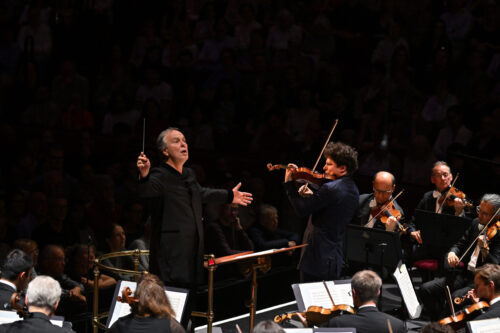
Now in his second decade as chief conductor of the BBC Symphony Orchestra, Sakari Oramo can be relied on for innovative Proms programmes; tonight’s framing a staple of the concerto repertoire and an unfamiliar orchestral work with influential symphonic poems. In the case of The Song of the Nightingale, Stravinsky recycled sections from the latter two acts of his opera Le Rossignol into an illustrative sequence no less successful when heard in abstract terms. As exhilarating as are those earlier stages with their depiction of the bustling Chinese court, it is what follows – arrival of the mechanical nightingale, illness of the emperor then return of the real nightingale to restore his health – that proves most memorable. Above all, that plaintive song of the fisherman – heard on solo trumpet and rendered with due pathos by Niall Keatley.
Oramo has worked with Augustin Hadelich on numerous occasions and this evening’s account of Mendelssohn’s Violin Concerto confirmed their rapport right from the outset. Not its least attraction was the deftness of orchestral response in music as wears its Romanticism with the lightest of touches, with Hadelich’s handling of the first movement’s central cadenza no less assured than Oramo’s ushering in of its reprise. The slow movement had no lack of eloquence, nor the finale of that genial humour wholly typical of its era as it headed toward its engaging close. Hadelich responded to the (rightly) enthusiastic applause with his own arrangement of Por una Cabeza – originally a song penned by Carlos Gardel and Alfredo Le Pera, and which has latterly become a favourite addition to film-scores whenever a tango element is called for.
Although he is best known for his operas, notably X: The Life and Times of Malcolm X which has enjoyed several revivals since its Philadelphia premiere four decades ago, Anthony Davis has written numerous concertos and orchestral works with Tales of the Signifying Monkey the final part of a triptych that can be played together or separately. Inspired by an African fable about how the monkey uses its innate guile to keep lions and other predatory animals at bay, this proceeds as a stealthily cumulative entity in which elements of jazz and even swing, are prominent within the stylistic mix. An aura of anticipation, frequently with an ominous tinge, is always apparent and if the outcome is at all anti-climactic, it could well another take on the maxim of travelling in hope. Certainly, the BBCSO seemed to enjoy making its acquaintance.
Usually encountered at the beginning of a concert, Richard Strauss’s Till Eulenspiegel’s Merry Pranks is no less effective (and perhaps even more so) when heard at the close. So it proved tonight with a performance which, while eschewing the uproarious humour often instilled into these increasingly scatological events, was always adept in its conveying of the music’s capricious demeanour. Composed in the wake of his ill-received first opera Guntram, the present work was a ready incentive for that orchestral virtuosity which was Strauss’s metier – above all, its climactic confrontation between its protagonist and the judiciary that results in the former’s execution. The real Till likely survived to old age, only to expire during the Black Death, but his fictional self is doubtless more appealing when characterized so judiciously as it was here.
You can listen back to this Prom concert on BBC Sounds until Sunday 12 October.
Rameau Les Indes galantes – suite (1735) Saint-Saëns Piano Concerto no.5 in F major Op.103 ‘Egyptian’ (1896) Capperauld Bruckner’s Skull (2024) Beethoven Symphony no.5 in C minor Op.67 (1807-08)
Royal Albert Hall, London Friday 25 July 2025
Reviewed by Ben Hogwood Photos (c) BBC / Mark Allan
This colourful program marking the Scottish Chamber Orchestra’s BBC Proms visit began with music written nearly 300 years ago. Rameau’s characterful ballet score Les Indes galantes looks introduce French sophistication to the culture of exotic destinations overseas. After an elegant Entrée there were boisterous dance encounters in the Rigaudons, with the extremities of loud and quiet, and a colourful Chaconne to finish. The SCO were on fine form, their affectionate performance complemented with tasteful harpsichord contributions from Jan Waterfield. Percussionists Louise Lewis Goodwin and Iain Sandilands were joined by conductor Maxim Emelyanychev himself, wielding a side drum in the Danse du grand calumet de paix (below). Unfortunately the Royal Albert Hall acoustics ensured the beat of his instrument was slightly ahead of his colleagues, but it matter little, adding to the outdoor feel of a performance that left the audience wreathed in smiles.
Saint-Saëns wrote his Piano Concerto no.5 in F major in Luxor, Egypt, where temperatures were surely similar to those on a summer night in the Royal Albert Hall! Taking us back to north Africa was pianist Alexandre Kantorow, with a dazzling account showcasing his virtuosity but also his musical acumen. The picture painting in the rhapsodic second movement was vivid, the quiet playing exquisite, while the orchestra provided the heat haze to the decorative homespun themes. Here Kantorow provided the overtones, evoking North African piped instruments. The concerto’s outer movements were a little more strait-laced in their musical language, but soloist and orchestra had fun here too, Saint-Saëns’ push-pull figurations lapped up and delivered with aplomb. For his well-chosen encore, Kantorow held the audience in the palm of his hand for a delicate arrangement of the composer’s most famous aria, Mon coeur s’ouvre à ta voix, by none other than Nina Simone.
After the interval, the SCO first violins began Jay Capperauld’s Bruckner’s Skull with a line akin to that from Bernard Herrmann’s score to Hitchcock’s Psycho. There was something kind of ‘Eeew’ about the newly orchestrated version of this piece, less a homage to Bruckner than an account of his morbid fascination with death. Bruckner is alleged to have held the skulls of both Beethoven and Schubert after their exhumations, and Capperauld reflected these events in a score quoting from both composers, subjecting the music to ghostly twists and turns. This was in effect a musical exhumation, laced with dark humour and a touch of madness. With Bruckner’s own death mask staring out of the Proms programme, the piece wore a haunted expression throughout, a ghoulish but enduring tale.
There were ghostly outlines, too, in Beethoven’s Symphony no.5 in C minor, notably at the memorable transition between scherzo and finale that marked the high point of this performance. This was a fine account indeed, launched before the audience were fully settled back in their seats but on the front foot from then on. The lean interpretation, such as chamber orchestras can bring to this work, was heightened by a relative absence of vibrato in the strings. Some of the heft of Beethoven’s climaxes was missed, particularly in such a large venue, but the four double basses ensured the lower end of the frequency spectrum was amply covered.
With fine woodwind solos, springy timpani and tightly focussed strings, the rhythmic insights were strong. The slow movement did not linger, and was less affectionate as a result, but Kenneth Henderson and Anna Drysdale took an assertive lead on their natural horns in the scherzo. Then the magical moment, Emelyanychev drawing the orchestra back to a barely audible pianissimo, the launch pad from which the finale sprang forward. Now the music wore a resolute smile, its struggle ultimately won.
You can listen back to this Prom concert on BBC Sounds until Sunday 12 October.
Sarah Aristidou (soprano), Jérôme Comte (clarinet), Lucas Ounissi (trombone), Yann Brécy (IRCAM electronics), Sylvain Cadars (IRCAM sound diffusion), Ensemble Intercontemporain / Pierre Bleuse
Berio Sequenza V (1966) Boulez Dialogue de l’ombre double (1982-5) Berio Recital I (for Cathy) (1972)
Royal Albert Hall, London Wednesday 23 July 2025 (10.15pm)
Reviewed by Richard Whitehouse Photos (c) BBC / Chris Christodoulou
It is a salutary thought that events such as this evening’s later concert were once a ubiquitous feature at the Proms, and it required an anniversary such as the centenaries of both composers heard here to make it possible once again. Not that any of those present would have objected.
The jury might still be out on the precise nature of Luciano Berio’s achievement, but not on the intrinsic value of those works as Sequenza V. One of 14 such pieces that emerged across 44 years, it is arguably the most compact and communicative – not least for its pronounced degree of theatricality. His attire more readily evoked Harpo Marx than Grock the clown, but Lucas Ounissi (above) was fully alive to this music’s extended trombone technique serving a routine humorous though pathos-laden – his exclaimed ‘Why?’ defining the performance as a whole.
Although he eschewed such theatrics, Pierre Boulez was rarely averse to the extra-musical. Inspired by a scene in Paul Claudel’s play Le soulier de satin and the offshoot of work on his major 1980s project Répons, Dialogue de l’ombre double is typical of Boulez’s later thinking with its interplay of live and pre-recorded elements so that the musicians become engaged in a performance with themselves. Here the music proceeds as a continuum between Strophes and Transitions – clarinettist Jérôme Comte as tangible by his presence during the former as he was intangible by his absence during the latter, with all the contrast in perception that this implies. The presence of lighting proved as effective as it was immediate – not least in those framing sections of Sigle initial and Sigle final which act as processional then recessional.
Next to such expressive concreteness, Berio’s Recital I (for Cathy) could feel beholden to its era, but this music-theatre for the composer’s former wife and ongoing collaborator touches on salient aspects of existence as surely as those of performance. As with the more familiar Sinfonia (also revived this season), the plethora of quotations of and allusions to other music – ranging over three centuries from Monteverdi to Berio himself – is absorbed (if not always integrated) into an extended monologue during which the singer evolves from touchy prima-donna to solitary protagonist whose search for meaning in her artistic endeavour has become (and maybe always had been?) elusive. It has to be said that previous Proms hearings, at the Roundhouse then Kensington Town Hall, were better suited to this piece’s relative intimacy than the expanse of the Royal Albert Hall; moreover, for all the eloquence of her assumption, Sarah Aristidou (above) was not wholly suited to a role which requires a singer-actor in the lineage of Cathy Berberian to convey the intensifying emotional meltdown played out during its course.
What could hardly be denied was the alacrity of the instrumental response; the musicians of Ensemble Intercontemporain never less than committed under assured guidance from Pierre Bleuse, who has clearly galvanized this organization in the two seasons since he became its artistic director. Hopefully they will be invited back to the Proms at the earliest opportunity, and not just on the basis of commemorating those composers whose centenaries underscore their significance to a post-war musical culture whose passing has not made less relevant.
You can listen back to this Prom concert on BBC Sounds until Sunday 12 October.