
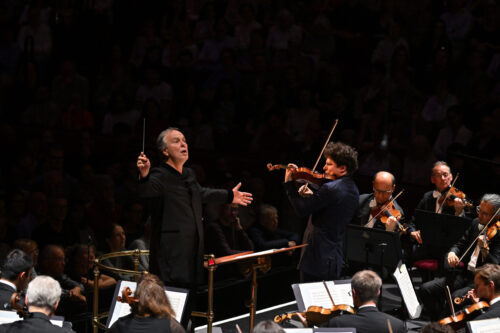
In concert – Augustin Hadelich, BBC SO / Sakari Oramo @ BBC Proms: Stravinsky, Mendelssohn, Anthony Davis & Richard Strauss

Augustin Hadelich (violin), BBC Symphony Orchestra / Sakari Oramo

Stravinsky Le chant du rossignol (1914/17)
Mendelssohn Violin Concerto in E minor, Op. 64 (1838-44)
Anthony Davis Tales (Tails) of the Signifying Monkey (1997) [European premiere]
Richard Strauss Till Eulenspiegels lustige Streiche, Op. 28 (1894-5)

Royal Albert Hall, London
Thursday 24 July 2025

Reviewed by Richard Whitehouse Photos (c) BBC / Mark Allan

Now in his second decade as chief conductor of the BBC Symphony Orchestra, Sakari Oramo can be relied on for innovative Proms programmes; tonight’s framing a staple of the concerto repertoire and an unfamiliar orchestral work with influential symphonic poems. In the case of The Song of the Nightingale, Stravinsky recycled sections from the latter two acts of his opera Le Rossignol into an illustrative sequence no less successful when heard in abstract terms. As exhilarating as are those earlier stages with their depiction of the bustling Chinese court, it is what follows – arrival of the mechanical nightingale, illness of the emperor then return of the real nightingale to restore his health – that proves most memorable. Above all, that plaintive song of the fisherman – heard on solo trumpet and rendered with due pathos by Niall Keatley.

Oramo has worked with Augustin Hadelich on numerous occasions and this evening’s account of Mendelssohn’s Violin Concerto confirmed their rapport right from the outset. Not its least attraction was the deftness of orchestral response in music as wears its Romanticism with the lightest of touches, with Hadelich’s handling of the first movement’s central cadenza no less assured than Oramo’s ushering in of its reprise. The slow movement had no lack of eloquence, nor the finale of that genial humour wholly typical of its era as it headed toward its engaging close. Hadelich responded to the (rightly) enthusiastic applause with his own arrangement of Por una Cabeza – originally a song penned by Carlos Gardel and Alfredo Le Pera, and which has latterly become a favourite addition to film-scores whenever a tango element is called for.

Although he is best known for his operas, notably X: The Life and Times of Malcolm X which has enjoyed several revivals since its Philadelphia premiere four decades ago, Anthony Davis has written numerous concertos and orchestral works with Tales of the Signifying Monkey the final part of a triptych that can be played together or separately. Inspired by an African fable about how the monkey uses its innate guile to keep lions and other predatory animals at bay, this proceeds as a stealthily cumulative entity in which elements of jazz and even swing, are prominent within the stylistic mix. An aura of anticipation, frequently with an ominous tinge, is always apparent and if the outcome is at all anti-climactic, it could well another take on the maxim of travelling in hope. Certainly, the BBCSO seemed to enjoy making its acquaintance.

Usually encountered at the beginning of a concert, Richard Strauss’s Till Eulenspiegel’s Merry Pranks is no less effective (and perhaps even more so) when heard at the close. So it proved tonight with a performance which, while eschewing the uproarious humour often instilled into these increasingly scatological events, was always adept in its conveying of the music’s capricious demeanour. Composed in the wake of his ill-received first opera Guntram, the present work was a ready incentive for that orchestral virtuosity which was Strauss’s metier – above all, its climactic confrontation between its protagonist and the judiciary that results in the former’s execution. The real Till likely survived to old age, only to expire during the Black Death, but his fictional self is doubtless more appealing when characterized so judiciously as it was here.

You can listen back to this Prom concert on BBC Sounds until Sunday 12 October.

Click on the artist names to read more about Augustin Hadelich, the BBC Symphony Orchestra and their chief conductor Sakari Oramo – as well as composer Anthony Davis. Click also for more on the BBC Proms

Published post no.2,609 – Monday 28 July 2025

In concert – Alexandre Kantorow (piano), Scottish Chamber Orchestra / Maxim Emelyanychev @ BBC Proms: Rameau, Saint-Saëns, Capperauld & Beethoven

Alexandre Kantorow (piano), Scottish Chamber Orchestra / Maxim Emelyanychev

Rameau Les Indes galantes – suite (1735)
Saint-Saëns Piano Concerto no.5 in F major Op.103 ‘Egyptian’ (1896)
Capperauld Bruckner’s Skull (2024)
Beethoven Symphony no.5 in C minor Op.67 (1807-08)

Royal Albert Hall, London
Friday 25 July 2025

Reviewed by Ben Hogwood Photos (c) BBC / Mark Allan

This colourful program marking the Scottish Chamber Orchestra’s BBC Proms visit began with music written nearly 300 years ago. Rameau’s characterful ballet score Les Indes galantes looks introduce French sophistication to the culture of exotic destinations overseas. After an elegant Entrée there were boisterous dance encounters in the Rigaudons, with the extremities of loud and quiet, and a colourful Chaconne to finish. The SCO were on fine form, their affectionate performance complemented with tasteful harpsichord contributions from Jan Waterfield. Percussionists Louise Lewis Goodwin and Iain Sandilands were joined by conductor Maxim Emelyanychev himself, wielding a side drum in the Danse du grand calumet de paix (below). Unfortunately the Royal Albert Hall acoustics ensured the beat of his instrument was slightly ahead of his colleagues, but it matter little, adding to the outdoor feel of a performance that left the audience wreathed in smiles.

Saint-Saëns wrote his Piano Concerto no.5 in F major in Luxor, Egypt, where temperatures were surely similar to those on a summer night in the Royal Albert Hall! Taking us back to north Africa was pianist Alexandre Kantorow, with a dazzling account showcasing his virtuosity but also his musical acumen. The picture painting in the rhapsodic second movement was vivid, the quiet playing exquisite, while the orchestra provided the heat haze to the decorative homespun themes. Here Kantorow provided the overtones, evoking North African piped instruments. The concerto’s outer movements were a little more strait-laced in their musical language, but soloist and orchestra had fun here too, Saint-Saëns’ push-pull figurations lapped up and delivered with aplomb. For his well-chosen encore, Kantorow held the audience in the palm of his hand for a delicate arrangement of the composer’s most famous aria, Mon coeur s’ouvre à ta voix, by none other than Nina Simone.

After the interval, the SCO first violins began Jay Capperauld’s Bruckner’s Skull with a line akin to that from Bernard Herrmann’s score to Hitchcock’s Psycho. There was something kind of ‘Eeew’ about the newly orchestrated version of this piece, less a homage to Bruckner than an account of his morbid fascination with death. Bruckner is alleged to have held the skulls of both Beethoven and Schubert after their exhumations, and Capperauld reflected these events in a score quoting from both composers, subjecting the music to ghostly twists and turns. This was in effect a musical exhumation, laced with dark humour and a touch of madness. With Bruckner’s own death mask staring out of the Proms programme, the piece wore a haunted expression throughout, a ghoulish but enduring tale.

There were ghostly outlines, too, in Beethoven’s Symphony no.5 in C minor, notably at the memorable transition between scherzo and finale that marked the high point of this performance. This was a fine account indeed, launched before the audience were fully settled back in their seats but on the front foot from then on. The lean interpretation, such as chamber orchestras can bring to this work, was heightened by a relative absence of vibrato in the strings. Some of the heft of Beethoven’s climaxes was missed, particularly in such a large venue, but the four double basses ensured the lower end of the frequency spectrum was amply covered.

With fine woodwind solos, springy timpani and tightly focussed strings, the rhythmic insights were strong. The slow movement did not linger, and was less affectionate as a result, but Kenneth Henderson and Anna Drysdale took an assertive lead on their natural horns in the scherzo. Then the magical moment, Emelyanychev drawing the orchestra back to a barely audible pianissimo, the launch pad from which the finale sprang forward. Now the music wore a resolute smile, its struggle ultimately won.

You can listen back to this Prom concert on BBC Sounds until Sunday 12 October.

Click to read more about the BBC Proms

Published post no.2,608 – Sunday 27 July 2025

In concert – Sarah Aristidou, Ensemble Intercontemporain / Pierre Bleuse @ BBC Proms: Boulez & Berio: 20th-Century Giants

Sarah Aristidou (soprano), Jérôme Comte (clarinet), Lucas Ounissi (trombone), Yann Brécy (IRCAM electronics), Sylvain Cadars (IRCAM sound diffusion), Ensemble Intercontemporain / Pierre Bleuse

Berio Sequenza V (1966)
Boulez Dialogue de l’ombre double (1982-5)
Berio Recital I (for Cathy) (1972)

Royal Albert Hall, London
Wednesday 23 July 2025 (10.15pm)

Reviewed by Richard Whitehouse Photos (c) BBC / Chris Christodoulou

It is a salutary thought that events such as this evening’s later concert were once a ubiquitous feature at the Proms, and it required an anniversary such as the centenaries of both composers heard here to make it possible once again. Not that any of those present would have objected.

The jury might still be out on the precise nature of Luciano Berio’s achievement, but not on the intrinsic value of those works as Sequenza V. One of 14 such pieces that emerged across 44 years, it is arguably the most compact and communicative – not least for its pronounced degree of theatricality. His attire more readily evoked Harpo Marx than Grock the clown, but Lucas Ounissi (above) was fully alive to this music’s extended trombone technique serving a routine humorous though pathos-laden – his exclaimed ‘Why?’ defining the performance as a whole.

Although he eschewed such theatrics, Pierre Boulez was rarely averse to the extra-musical. Inspired by a scene in Paul Claudel’s play Le soulier de satin and the offshoot of work on his major 1980s project Répons, Dialogue de l’ombre double is typical of Boulez’s later thinking with its interplay of live and pre-recorded elements so that the musicians become engaged in a performance with themselves. Here the music proceeds as a continuum between Strophes and Transitions – clarinettist Jérôme Comte as tangible by his presence during the former as he was intangible by his absence during the latter, with all the contrast in perception that this implies. The presence of lighting proved as effective as it was immediate – not least in those framing sections of Sigle initial and Sigle final which act as processional then recessional.

Next to such expressive concreteness, Berio’s Recital I (for Cathy) could feel beholden to its era, but this music-theatre for the composer’s former wife and ongoing collaborator touches on salient aspects of existence as surely as those of performance. As with the more familiar Sinfonia (also revived this season), the plethora of quotations of and allusions to other music – ranging over three centuries from Monteverdi to Berio himself – is absorbed (if not always integrated) into an extended monologue during which the singer evolves from touchy prima-donna to solitary protagonist whose search for meaning in her artistic endeavour has become (and maybe always had been?) elusive. It has to be said that previous Proms hearings, at the Roundhouse then Kensington Town Hall, were better suited to this piece’s relative intimacy than the expanse of the Royal Albert Hall; moreover, for all the eloquence of her assumption, Sarah Aristidou (above) was not wholly suited to a role which requires a singer-actor in the lineage of Cathy Berberian to convey the intensifying emotional meltdown played out during its course.

What could hardly be denied was the alacrity of the instrumental response; the musicians of Ensemble Intercontemporain never less than committed under assured guidance from Pierre Bleuse, who has clearly galvanized this organization in the two seasons since he became its artistic director. Hopefully they will be invited back to the Proms at the earliest opportunity, and not just on the basis of commemorating those composers whose centenaries underscore their significance to a post-war musical culture whose passing has not made less relevant.

You can listen back to this Prom concert on BBC Sounds until Sunday 12 October.

Click on the artist names to read more about Sarah Aristidou, Jérôme Comte, Lucas Ounissi, the Ensemble Intercontemporain, their conductor Pierre Bleuse – and for more on the BBC Proms

Published post no.2,607 – Saturday 26 July 2025

In concert – Sean Shibe, BBC Philharmonic Orchestra / Anja Bihlmaier @ BBC Proms: Richard Strauss, Mark Simpson ‘ZEBRA’ & Berlioz

Sean Shibe (guitar), BBC Philharmonic Orchestra / Anja Bihlmaier

Richard Strauss Tod und Verklärung Op.24 (1888-89)
Simpson ZEBRA (or, 2-3-74: The Divine Invasion of Philip K. Dick) (2025) [BBC commission: World premiere]
Berlioz Symphonie fantastique Op.14 (1829-30)

Royal Albert Hall, London
Tuesday 22nd July 2025

Reviewed by Richard Whitehouse Photos (c) BBC / Mark Allan

The current BBC Proms season features several high-profile premieres, not the least of them being tonight’s from Liverpool-born clarinettist and composer Mark Simpson, remembered at these concerts for his orchestral fanfare sparks launching 2012’s Last Night in no uncertain terms.

On one level, ZEBRA (or, 2-3-74: The Divine Invasion of Philip K. Dick) is a straightforward three-movement concerto following the customary formal trajectory. No work that draws its inspiration from one of Sci-Fi’s most distinctive authors could be deemed predictable and so it proved with this musical representation of an epiphany which, experienced in his mid-40s, pervaded his thinking until his untimely death. Whether or not possessing divine overtones, it duly provided an imaginative context for the present work as it unfolds from a combative and even assaultive opening movement, through a mostly ruminative yet sometimes restive elegy, into a finale whose rapidly accruing energy surges towards an apotheosis of theatrical overkill – the ‘Zebra’ of the title as demonstrative as it remained elusive a presence during Dick’s life.

Music whose virtuosity summoned an orchestral response to match – the BBC Philharmonic Orchestra responding with alacrity to Simpson’s often febrile textures and translucent sonorities under the assured guidance of Anja Bihlmaier. Ultimately, of course, this was Sean Shibe’s show – his magnetic presence and mastery of electric guitar making it a notable addition to a genre still lacking in worthwhile contributions. His encore of a dreamily disembodied soundscape might even have been paying oblique homage to the great, happily not so late Robert Fripp.

On another level, Simpson’s concerto chimed ideally with the likely concept of this concert. One that commenced with an unexceptionally fine account of Richard Strauss’s Tod und Verklärung, Bihlmaier characterizing its more inward episodes with affecting poignancy as compensated for a lack of implacability in its early stages or a slightly underwhelming affirmation toward its close. Rarely in doubt was the direction in which this composer’s metaphysical musings were headed, even if the outcome was a performance no more than the sum of its best parts.

Berlioz pursued a rather less elevated ‘death and transfiguration’ in his Symphonie fantastique, but an approach with which Bihlmaier seemed more fully in accord. The lengthy introduction of Rêveries – Passions was eloquently delineated, and if the main portion of this movement (without exposition repeat) was overly self-contained, it elided naturally into Un bal with its ingratiating waltz offset by passages of despondency and elation. The highlight was a Scène aux champs which unfolded seamlessly from its plangent cor anglais solo, through mounting agitation, near catastrophe then uneasy resignation, to its mesmeric ending made more so by undulating timpani chords. After this, Marche au supplice (with first-half repeat) built with ominous tread to a climax almost graphic in its depiction of the ‘hero’ condemned to death.

An outburst of applause suggested many had not anticipated the orgy to come, but Bihlmaier responded with a Songe d’une nuit du Sabbat that, if lacking the ultimate drama, set the seal on an engaging performance with the BBC Philharmonic at something like its collective best.

You can listen back to this Prom concert on BBC Sounds until Sunday 12 October.

Click on the artist names to read more about Sean Shibe, Anja Bihlmaier, the BBC Philharmonic Orchestra and composer Mark Simpson – and for more on the BBC Proms

Published post no.2,605 – Thursday 24 July 2025

Arcana at the Proms – Prom 62: Bavarian Radio Symphony Orchestra / Sir Simon Rattle – Mahler: Symphony no.6

Mahler Symphony no.6 in A minor (1903-04)

Bavarian Radio Symphony Orchestra / Sir Simon Rattle

Royal Albert Hall, London
Friday 6 September 2024

reviewed by Ben Hogwood Photos (c) Chris Christodoulou (taken from the previous night’s Prom)

This was Sir Simon Rattle‘s fifteenth encounter with the music of Gustav Mahler at the BBC Proms – and a third outing under his baton for the Sixth Symphony, which he first conducted in charge of the National Youth Orchestra of Great Britain 40 years ago.

This time he was visiting, having returned to Germany to take charge of the Bavarian Radio Symphony Orchestra, a feeling for the concertgoers akin to welcoming a distant relative and hearing about their latest job. The Munich ensemble have formidable Mahler credentials, no doubt introduced by Eugen Jochum from their founding in 1949 but notably honed by Rafael Kubelík, with whom they recorded all the symphonies for Deutsche Grammophon. This account of the Sixth proved them to be the ideal foil for Rattle, the Liverpudlian welcomed with great cheers around the hall.

Sir Simon knows his Mahler better than arguably any other living conductor, and the breadth and depth he brought to his interpretation was breathtaking. So too was the sheer audible spectrum, for which we have to thank Mahler, for this is one of those works that has simply everything, from the tiniest murmur from bass strings to the thunderous hammer strokes of the finale. Some way between that lies the tender theme he wrote for his wife Alma, a glowing light in the first movement under the tender caress of its beautiful wind choir. Around this and in the last movement were fleeting glimmers of sunshine from the cowbells, an unusual addition to the percussion section that charmed from their offstage position, evoking the open meadows but with shivers of cold wind from the rest of the orchestra, outlines icily drawn by strings and brass.

These moments were welcome respite from the tumult of Mahler’s marching music, obsessively hammered home in the fast movements, the orchestra turning this way and that at quick speed. The marching music, so virulent in the first movement, quickly develops a sour taste, and Rattle was alive to that in the scherzo – placed third. This is a time-honoured practice for him, in accordance with Mahler’s order of performance when conducting but not his initial order of composition. The controversy continues to follow the work around, and although many (this author included) prefer the scherzo placed second – ratcheting up the tension – Rattle’s shaping of the piece overall made his own choice a convincing one.

The orchestra were simply stunning. The strings – rarely given due credit in big symphonic performances such as this – were united beyond criticism, the violins in remarkable unison – and particularly beautiful in the serene opening to a magical slow movement. Brass were also as one in their clarion calls, but turned vulgar when they needed to. The wind section was beautifully shaped and coloured, with an appropriately plaintive oboe solo in the trio section of the scherzo. Underpinning the performance were the rolling timpani, the thunder to the lightning strikes of the percussion, whose power was simply brutal at times, The hammer blows, struck twice in the finale, were terrifying strokes of fate and delivered with appropriately cold theatre.

This was a performance that will stick in the memory for years, one from which my ears are still ringing. Mahler’s ghastly premonitions of later existence were brought to life in shocking technicolour, though Rattle revelled at the same time in its beautiful evocations of nature. These were ultimately swept aside, with red-blooded highs and cold-blooded lows, all blended into the same intoxicating musical cocktail. For sheer emotional power, this symphony – and this performance – had it all.

You can listen to the Bavarian Radio Symphony Orchestra and Sir Simon Rattle in their recent live recording of the Sixth symphony below:

Published post no.2,294 – Saturday 7 September 2024