Proms premiere – Luke Bedford: Instability

luke-bedford

Luke Bedford

BBC Philharmonic Orchestra / Juanjo Mena (Prom 20)

Duration: 22 minutes

BBC iPlayer link

Instability can be heard by clicking here

What’s the story behind the piece?

You can look at the music itself courtesy of Luke Bedford’s publisher, Universal Edition, here

In the introduction on the same page, Bedford sets the scene for his new piece. “Ideas in this piece are torn apart by a strange energy and reform in new, dynamic relationships. There is a constant tension between growing and collapsing. That which seems durable can vanish in an instant. The piece will include the Albert Hall organ, a detuned orchestra and possibly the first use of a cricket bat in an orchestral piece.”

Reflecting the world we live in and experience. Was going to be a set of movements but is now in one continuous duration. Cuts between ideas in an unexpected and dramatic way. Some of the orchestra – wind and brass – play a quarter-tone lower.

Did you know?

Initial verdict

As the BBC Radio 3 presenter Petroc Trelawny observes, Instability is a piece that vividly captures the uncertain and often overwhelming times that we live in. It is a very edgy piece indeed!

From the start (35:22 on the link) some quiet murmurings among the orchestra but then a sudden outburst that changes the whole dynamic of the piece. Bedford writes some striking music for the orchestra, a dramatic set of contrasts that perhaps intentionally leaves the listener completely on edge with the huge rumbles of sound. There is not so much melodic, as the big chords are walls of sound, but there is a good deal of pent-up anger released with them it would seem.

The organ is integral to the music, tending towards the upper end for a shrill sound, but cutting through around the 44’ mark with an emphatic blast of C major tonality. After this the piece becomes uncertain and wary again, with some creepy sounds and ominous, held low notes.

I couldn’t hear where the cricket bat comes in but assumed that to be in the percussive section around 41:30, where it feels like a lot of pipes are struck.

From around 48:55 on the link the cellos and violas intone a solemn melody, but the rest of the orchestra seems hell-bent on breaking this up and smothering it. Then the forces bang into each other chaotically before cutting out to near silence. Then what seems to be a coda starts, with another quite solemn and drawn out melody broken up by metallic chords from brass, wind, percussion and high organ.

To me this piece feels like an attempt to live a proper life in a society that is chaotic, uncertain and full of dread. At the end this tension is unresolved.

Second hearing

tbc!

Where can I hear more?

You can watch a portrait of Luke Bedford in this video uploaded to YouTube by the London Sinfonietta:

Under the Surface at the Proms – John Foulds’ Three Mantras

Prom 38, 13 August 2015 – London Symphony Chorus Womens’ Voices, BBC Philharmonic Orchestra / Juanjo Mena at the Royal Albert Hall

john-foulds

John Foulds Three Mantras (1919-1930)

http://www.bbc.co.uk/events/exq5v2#b064y5hj

We definitely undervalue the BBC orchestras when the Proms take centre stage. I say that because this was one of the most colourful orchestral Proms it has been my pleasure to witness, and much of the credit for that should go to the BBC Philharmonic Orchestra, a riot of bright shades under Juanjo Mena in Messiaen’s Turangalîla-Symphony. Yet while that performance will inevitably take centre stage, it was another work that stole the show.

John Foulds has spent a long time languishing in the musical wilderness, but in the last ten years he has begun to reach a bigger audience. A good deal of thanks for this should go to conductor of the BBC Symphony Orchestra, Sakari Oramo, who recorded two discs of his orchestral works with the City of Birmingham Symphony Orchestra. They enchanted us with Foulds’ inventiveness, and most importantly his eagerness to incorporate Eastern cultures within an extremely Western art form. In this respect he was in line with Gustav Holst.

One of the finest works in this respect is the 3 Mantras, thought to be part of a massive Sanskrit opera, Avatara. Very sadly that never came to be, and 300 pages are lost from the score, but the 3 Mantras survive and make a very accomplished and unusual orchestral piece. The colours are simply beautiful, achieved through a wide variety of percussion, harps and shimmering strings, all of which Mena marshalled to show the detail of Foulds’ inventive orchestration.

It is the second piece, the Mantra of Bliss (starting at 8:13 on the link above) that is the most striking, a meditation of radiant orchestral beauty, where Foulds uses a wordless female chorus to enchanting effect. Holst had done this before, in Neptune from The Planets, but rather than that cold emptiness Foulds creates exotic warmth.

The outer two mantras are very different; the first a bustle of activity that slows for a moving slower melody; the third an almost barbaric dance that wheels out of control and wields a fearsome set of percussion at the end. This was a terrific performance from the BBC Philharmonic, showing off Foulds’ gifts to a new audience that will hopefully look to discover more of the music of this remarkable composer.

Want to hear more

You can hear a playlist from BBC Radio 3’s CD Review, where Andrew McGregor explores recordings of John Foulds’ music, by clicking here

There will be more Under the Surface features as the Proms progress, exploring lesser known pieces and composers at the festival

The 6Music Prom – Nils Frahm and A Winged Victory For The Sullen

Prom 27: Late Night With … BBC 6 Music: Nils Frahm and A Winged Victory For The Sullen

a-winged-victory-for-the-sullen
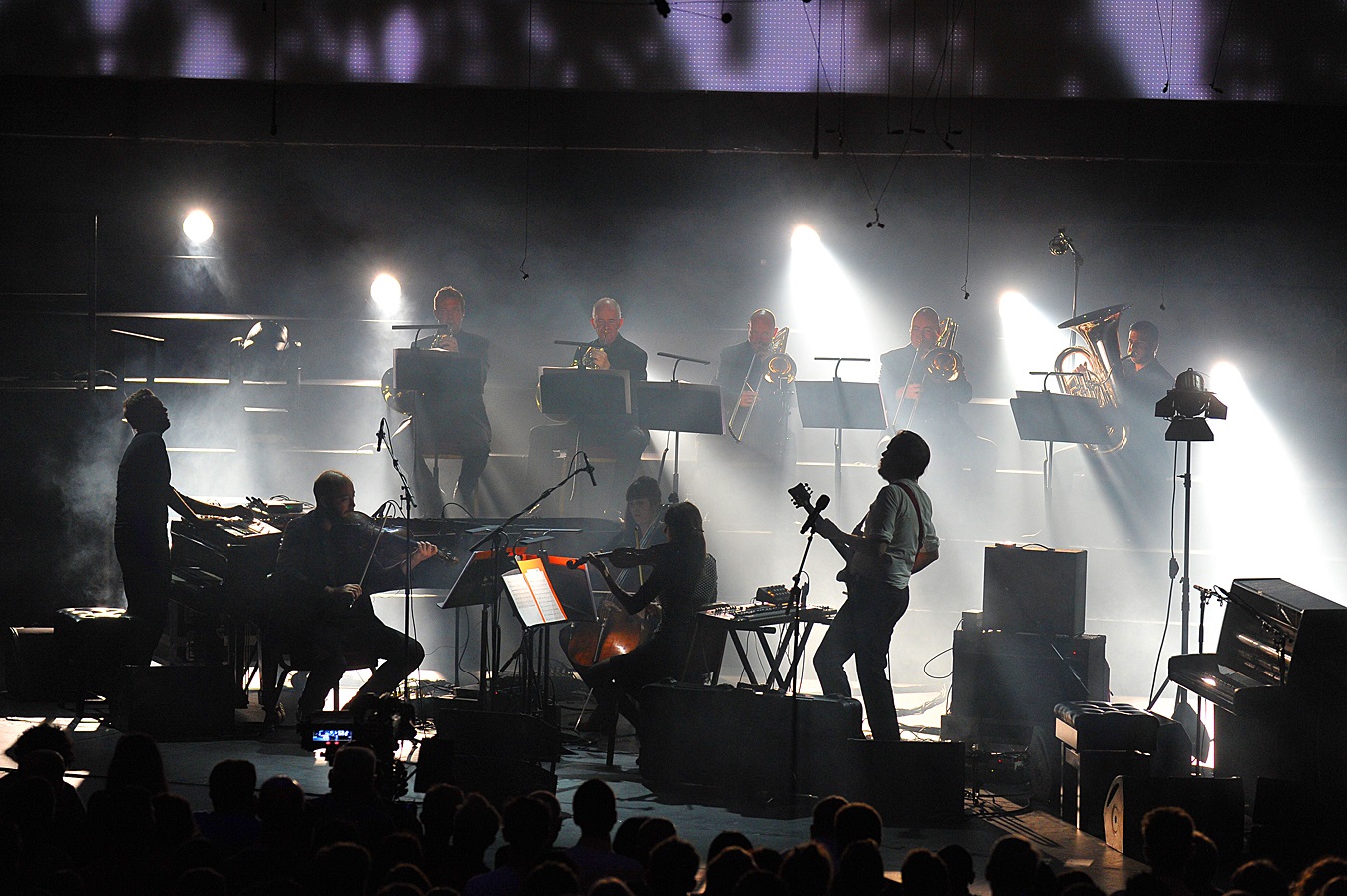
A Winged Victory For The Sullen at the 6Music Prom Picture (c) Chris Christodoulou

Watch here:

http://www.bbc.co.uk/events/empxj5#b0640mhj

The story behind the second BBC 6 Music Prom was a gratifying one, built on a desire for classical music to make itself more available. Mary Anne Hobbs was the catalyst, playing music by Nils Frahm to enthusiastic listeners worldwide. Their response encouraged her to introduce them to his Erased Tapes label mates, A Winged Victory For The Sullen, a duo comprising Dustin O’Halloran and Adam Wiltzie.

Both acts were part of an extended mix for this late night event, aided by atmospheric lighting and smoke to turn the Royal Albert Hall into an after-hours club. Into this already heady environment came A Winged Victory, playing much of their second album ATOMOS. They were joined by an unnamed string trio and London Brass, their task to provide sonorous colour and slow but far-reaching melodies. O’Halloran and Wiltzie were on keyboard duties, drawing out chord patterns and soundscapes to give the listener an airborne sensation. This was further enhanced by members of the Random Dance Company, whose chief Wayne McGregor provided the stimulus for ATOMOS. Their relaxed interpretations of the music belied the effort required to contort their limbs!

The music was expansive, like a slowly changing cloud formation, and crucially had beauty of timbre to match. From the simplest of melodic cells came music of primitive meaning, evoking memories of pop music’s ambient craze twenty years ago but without any vocal samples. Here music was stripped back to its basics, and was all the more moving for the lack of incident and chatter. The crowd was thoroughly absorbed, most stock still but some perceiving the latent energy running through the music.

In truth London Brass could have been used more, their potential to add brightness only sparingly glimpsed. The string trio were more gainfully employed, the cello particularly beautiful when raised above the textures. As their set came to an end so Nils Frahm joined the stage, the two acts uniting in an improvised piece that brought more rhythmic definition – a sign of what was to come from the German pianist.

nils-frahm
Nils Frahm at the 6Music Prom. Picture (c) Chris Christodoulou

Frahm used a team of keyboard instruments, including two ‘prepared’ pianos – that is, with keyboards, hammers and strings all modified to secure the all-important timbres required. Frahm’s music is more obviously derived from classical music, with Beethoven’s Moonlight Sonata, Chopin and Debussy all discernible influences. It has more obvious kinetic energy, moving quickly during Hammers to imply a strong beat, even before the introduction of an incredibly warm bass note to rattle the ribcage.

Frahm was a hyperactive presence, rushing urgently between his pianos and synthesizer, occasionally looping small clumps of chords in the manner of Steve Reich or even Dave Brubeck, but always intent on carrying his music forward. It was largely successful, though the introduction of two toilet brushes for the closing number felt like a gimmick.

What really carried, though, was the intense desire for discovery on the part of the audience. 6 Music had been playing classical music in the lead-up to this Prom, sensitively chosen with the pop music lover in mind, hoping to arouse curiosity – and that is exactly what this sort of Prom should be doing, bringing in people who find classical music and its terminology a daunting proposition.

It was a handsome success, Hobbs having found a way of communicating its appeal while showing how electronic and classical styles are on a fruitful collision course. We should not just be limited to Erased Tapes, though, as Warp, Glacial Movements, Bella Union and One Little Indian are just four more labels excelling in this area.

It is to be hoped that at the very least we will have a sequel. Tom Service presents a program along these lines on 6 Music this Sunday, showing how the two stations do on occasion overlap. Both have open musical policies, and in their current state show the BBC at its best, providing musical stimulation for a clearly hungry crowd.

Under the Surface at the Proms – British composers

Prom 26, 5 August 2015 – BBC National Orchestra of Wales / Tadaaki Otaka at the Royal Albert Hall

ailish-tynan-tadaaki-otaka

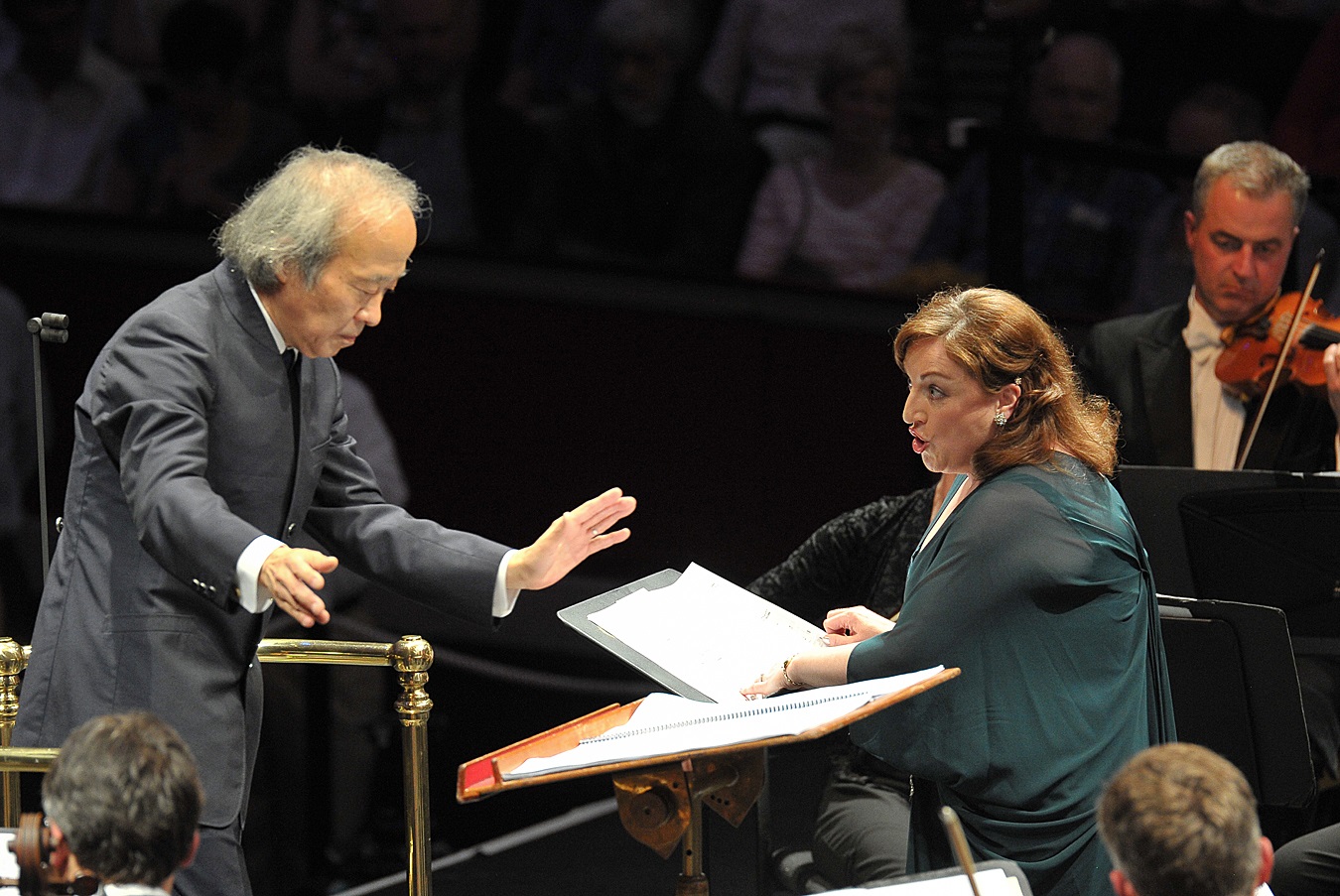
Ailish Tynan and Tadaaki Otaka performing Grace Williams’ Fairest of Stars at the BBC Proms Picture (c) Chris Christodoulou

Only the BBC Proms could come up with a night like this, a programme of partially or wholly neglected British music flattering not only the composers but the BBC National Orchestra of Wales, who had clearly invested a lot of rehearsal time.

Their greatest triumph came last, the Symphony no.2 of William Walton, written in 1957 but receiving only its fourth ever performance at the festival and its first since 1996. Walton’s First gets all the glory in his symphonic output, and understandably so – it’s bold, has strength of character, some terrific tunes and bright orchestral colours. Yet the Second deserves far more, as conductor Tadaaki Otaka showed us here:

http://www.bbc.co.uk/programmes/p02yxs45/player

Although it is a much more anxious and questioning piece it is tightly structured, its melodies unusual but somehow memorable too. The first movement tune has a steep incline to its melody but remains in the head, and certainly did so after this performance, beautifully coloured as it was with orchestral piano and glockenspiel. The second movement had softer colours but was equally worrisome, while Walton, thumbing his nose at ‘serial’ composers who had opted out of tonality, uses all twelve tones in his theme for the finale, in a tuneful sense. Here they were hammered home in orchestral unison, and the climax of the work was hugely impressive.

Earlier we heard some better known works from Walton – a bracing Spitfire Prelude and Fugue – and Elgar, his first orchestral work the Froissart Overture, played with a smile on its face.

Then it was over to do two very different Williams. Ralph Vaughan Williams completed his Concerto accademico, for violin and string orchestra, in 1925. It pays explicit homage to Bach but not in the way Stravinsky and co liked to do at the time. The composer saw this as a much more tuneful exercise, using folk-based material in the process. Listen here:

http://www.bbc.co.uk/programmes/p02yxlqh/player

Despite a good performance the piece remains a curiosity. The first movement was dogged and rather foursquare, the music pressing on rather grimly, so it was left to the second movement to bring what felt like more genuine emotion, bringing to mind the slow movement of Bach’s Brandenburg Concerto no.1 as it did so. Chloë Hanslip, the excellent soloist, was rich in tone both here and in the finale, which reverted to brisk music but in a much more accessible way this time, with a soft-hearted closing section. This was, for me, not the composer’s best.

Grace Williams, a Welsh composer who was a pupil of Vaughan Williams, is not heard much in the concert hall – but Fairest of Stars, for soprano voice and orchestra, suggested she should be. Her writing for the voice was elevated by Ailish Tynan, who looked ready to burst into song as soon as she appeared on stage. Tynan’s voice was the perfect foil for this music, soaring above the clouds brought by the orchestra, and although the words were not always abundantly clear because of the thicker scoring, very much in the Richard Strauss vein, their sentiment was. The top ‘C’ Tynan hit before the end had to be heard to be believed, the crowning glory of the concert’s first half. Listen to the piece here:

http://www.bbc.co.uk/programmes/p02yxqzy/player

The last few years have seen the Proms bring a number of major but neglected British works in from the cold – we have had music by Moeran, Alwyn, Havergal Brian and Howells to name just a few – and it is heartening to see them continuing that tradition. This night was a great success; let’s hope many more will follow.

There will be more Under the Surface features as the Proms progress, exploring lesser known pieces and composers at the festival

Radio 1 Ibiza Prom with Pete Tong

Prom 16: Late Night With … BBC Radio 1: The Ibiza Prom with Pete Tong

pete-tong

Pete Tong

The choice of Pete Tong to present an Ibiza-themed Prom created a fair bit of controversy in the last few weeks, but the decision paid off handsomely in what was effectively a Proms Essential Mix, with almost all the parts played by live instruments.

[Watch here: http://bbc.in/1JxeD63]

Keen listeners to dance and classical music – and there are a number! – will know the gap between the two is not as great as it might seem. A tune like Derrick May’s Strings of Life, for instance, could comfortably sit alongside a piece of Steve Reich – while Moby’s Porcelain would not be out of place if followed by a piece by Erik Satie.

Both songs were part of this set, a cleverly designed montage of 23 tracks that majored on arrangements made by Jules Buckley for the Heritage Orchestra. These were not ordinary arrangements either, including a sousaphone and a bass flute in the mix! They were not wholly successful in the hall itself, either, but have a lot more detail when heard on the radio – the Royal Albert Hall not being built for club music! Naturally the bass dominated – as it probably should in dance music – and some of the mid-range detail, on which Buckley had clearly laboured – was difficult to pick up.

jules-buckley
Jules Buckley at the Ibiza Prom. Picture (c) Chris Christodoulou

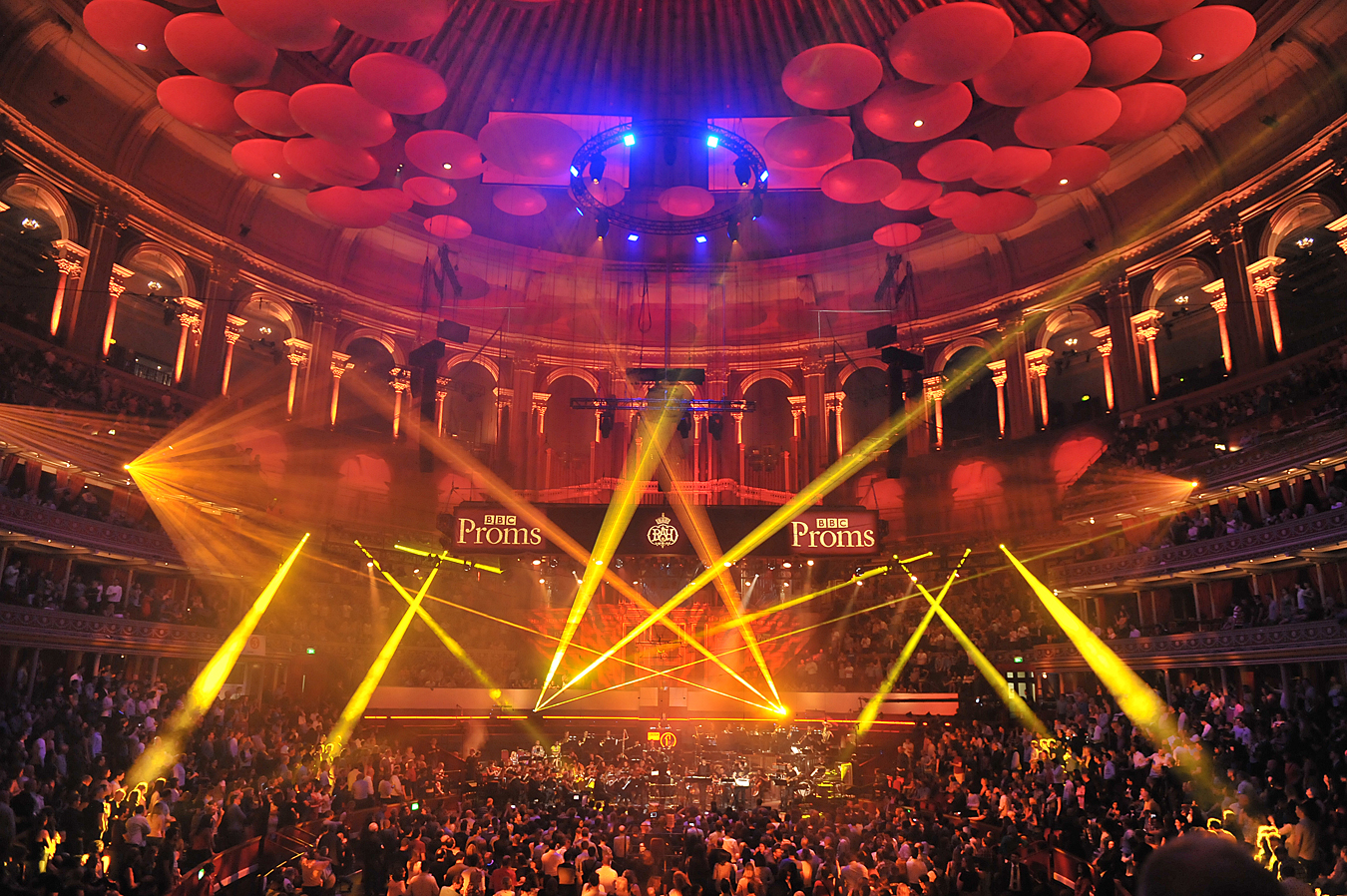
This was not a deal breaker, mind, for a high spirited beginning with Fatboy Slim’s Right Here, Right Now was perfectly judged, and set the tone. The only problem – for me at any rate – was trying to tell my brain that this was a Prom where dancing was not only permitted but actively encouraged, as the below picture shows!

ibiza-prom
The Royal Albert Hall in the Ibiza Prom Picture (c) Chris Christodoulou

The set moved between orchestra-dominated action and guest appearances from Ella Eyre and John Newman, who both acquitted themselves admirably. Eyre has a terrific voice, which she lent to Inner City’s Good Life and her own hit with Rudimental, Waiting All Night. Newman also has past with Rudimental, and his Feel The Love was warmly felt, before a closing cover of The Source feat. Candi Staton’s You Got The Love.

My only two personal regrets were that someone had not tried to arrange Josh Wink’s Higher State of Consciousness – a true Ibiza classic – or, from the blissful end of the spectrum, Groove Armada’s At The River. Those are quibbles, though, for the night was a roaring success, climaxing with the brilliant Café del Mar by Energy 52.

Over the next few days I will publish some links to songs played in the course of the Prom, linking them to classical music – so that you can hopefully see how connections can be drawn between the forms. Safe to say, though, that this particular Prom crossed a few bridges and opened several doors!