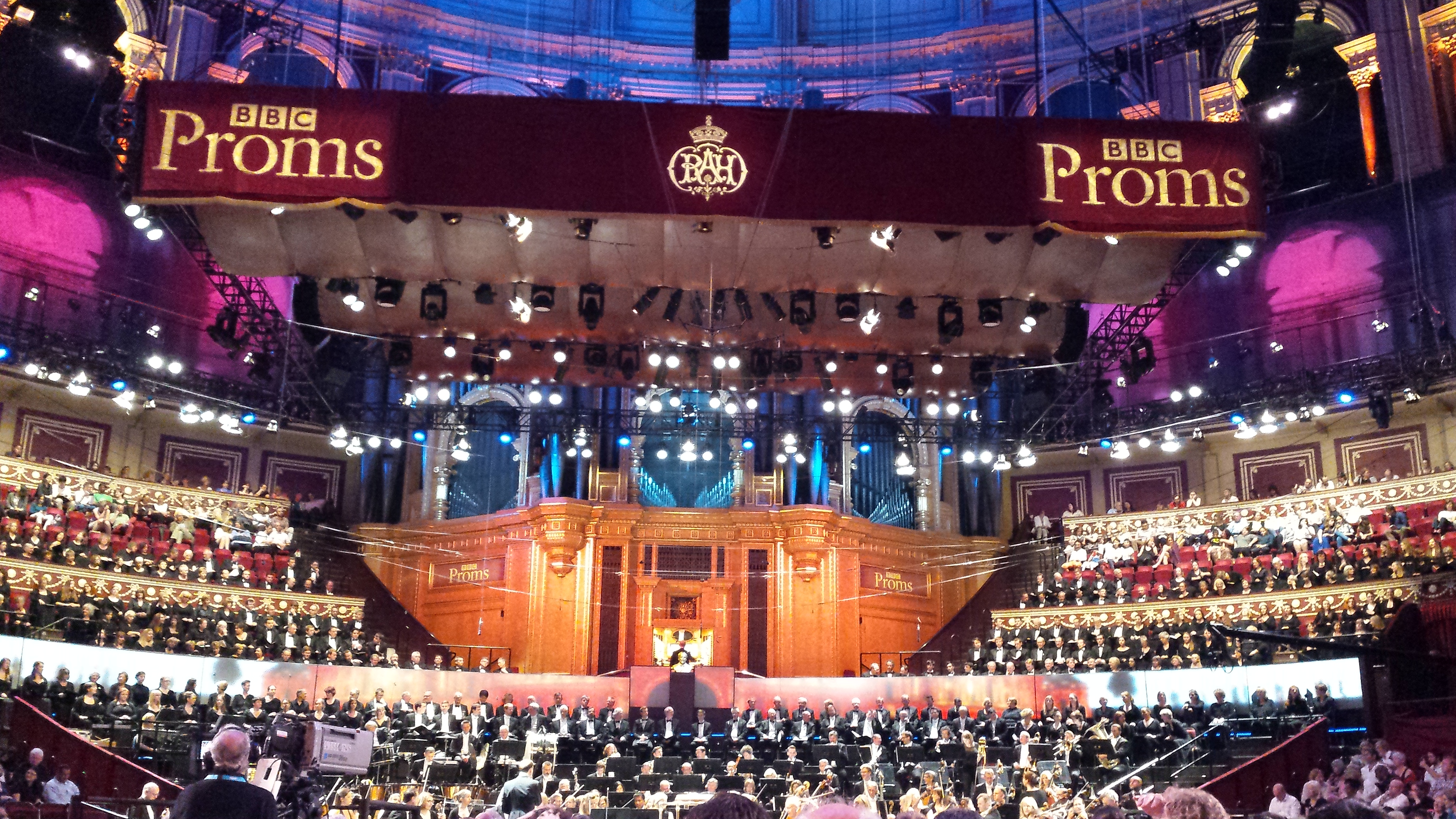
Proms guide and review: Prokofiev Piano Concertos

Prom 14, 28 July 2015 – BBC Symphony Orchestra / Sir Andrew Davis at the Royal Albert Hall

prokofiev-piano-concertos

Pianists Sergei Babayan, Alexei Volodin and Daniil Trifonov take a bow alongside conductor Valery Gergiev after their performance of all five Prokofiev Piano Concertos with the London Symphony Orchestra at the Royal Albert Hall on Tuesday 28 July. Photo: Chris Christodoulou

With Leif Ove Andsnes finishing his cycle of Beethoven’s five piano concertos the previous night, it seemed an odd decision by the Proms to embark on another cycle of five from one composer, all in a single night. Yet Valery Gergiev, the London Symphony Orchestra and a trio of fiendishly talented Russian pianists proved us doubters couldn’t have been more wrong.

Prokofiev’s piano concertos vary greatly in popularity, so much so that nos. 4 & 5 were receiving their first Proms performances – incredible for works now 83 years old! They embody the composer’s relative economy, his refusal to take himself too seriously and his use of the piano not just as a purveyor of bittersweet melody but as a percussive instrument too.

We began with the impudent Piano Concerto no.1, an often outrageous piece prone to bouts of cheeky sarcasm and unexpected charm:

http://www.bbc.co.uk/programmes/p02y9wqh/player
Prokofiev: Piano Concerto no.1 in D flat major, Op.10 (1912) 16 minutes

Daniil Trifonov played this piece superbly, exaggerating Prokofiev’s mischievous nature in a way the composer would surely have enjoyed. Gergiev too reminded us why he remains a peerless conductor in this repertoire, coaxing previously unheard detail and colour from the orchestra. If you listen to the clip above, you will agree it is a relative riot from start to finish!

http://www.bbc.co.uk/programmes/p02y9x3n/player
Prokofiev: Piano Concerto no.2 in G minor, Op.16 (1913) 31 minutes

This detail could be heard again in the cool, luminous slow sections of the Piano Concerto no.2, where Sergei Babayan lulled us into a false sense of security with a sombre opening section. Gradually – like Rachmaninov in his Piano Concerto no.2 before him – Prokofiev moved through the gears, the climax a titanic cadenza (a showy solo episode, cue to follow) that Babayan – Trifonov’s teacher, incidentally – played majestically, bringing goose bumps when the bright lights of the orchestra returned.

The Second is a contrary piece, following these bold romantic gestures with a grotesque second movement march owing much to Musorsgky (cue to follow), before a more elegiac third movement and a finale that gathers itself for showy virtuosity again, shown in the terrific closing pages. The house was brought down once again!

http://www.bbc.co.uk/programmes/p02y9xf1/player
Prokofiev: Piano Concerto no.3 in C major, Op.26 (1921) 30 minutes

Trifonov returned to make it three cracking performances out of three with a sparkling account of the Third, revelling in the different characters Prokofiev uses for the central Theme & Variations (cue to follow). The sleights of hand in the outer movements were dizzying, the pianist a study of concentration as his quick fingers deceived the eye. Gergiev again found insight to the colours of the second movement that normally evade the ear.

http://www.bbc.co.uk/programmes/p02y9xyz/player
Prokofiev: Piano Concerto no.4 in B flat major, Op.53 (1931) 22 minutes

And so into the relative unknown for the Fourth, a work commissioned by the fearsome left handed pianist Paul Wittgenstein – and ultimately rejected. His dissatisfaction relegated the piece to an also ran in Prokofiev’s output, but as Alexei Volodin proved here, that tag is undeserved.

This holds especially for the slow movement, which points towards the composer’s ballets, particularly Romeo and Juliet, which was close at hand in 1931. Indeed a forebear of the music for Juliet the Young Girl can be heard in the fourth movement, which scampered off the leash in this performance before disappearing in a puff of air.

http://www.bbc.co.uk/programmes/p02y9yd5/player
Prokofiev: Piano Concerto no.5 in G major, Op.55 (1932) 22 minutes

Sergei Babayan returned for an imposing performance of the Fifth and final concerto, a convincing account that made a mockery of the work’s non-appearance at the Royal Albert Hall. With melodic lines that dipped low before leaping up high he was never still, rising to the technical challenges while applying a lightness of touch needed to dilute the heavier, percussive moments.

Once again Gergiev and the London Symphony Orchestra, whose stamina was especially praiseworthy, propelled the third movement like a machine testing its upper speed limit, while again the slow movement – this time placed four of five – drew a lump to the throat before Prokofiev characteristically girded himself for an emphatic finish.

On the face of it this could have been an ill-judged experiment, especially with the two least-known works placed last. But the audience and social media reaction proved it to be anything but, for the listeners thoroughly enjoyed this colourful and often theatrical riot of ever-changing moods. While the piano will no doubt have needed some tender loving care at the end of it, Prokofiev’s invigorating music emerged defiant.

Under the Surface at the Proms – Nielsen: Wind Quintet

Proms Chamber Music 2, 27 July 2015 – Royal Northern Sinfonia Winds at the Cadogan Hall

royal-northern-sinfonia-winds

Three of the five Royal Northern Sinfonia Winds taking part in the Cadogan Hall concert – Timothy Orpen (clarinet), Juliette Bausor (flute) and Steven Hudson (oboe). They were joined by Peter Francomb (horn) and Stephen Reay (bassoon)

Nielsen Wind Quintet (1922)

Composers and their anniversaries have long been a prominent feature of the BBC Proms, and this year is no exception.

Happily the BBC have taken the opportunity to celebrate the 150th anniversary of the birth of Carl Nielsen with both hands. The seeds were sown with Sakari Oramo and the BBC Symphony Orchestra, and their cycle of the composer’s six symphonies that fitted snugly into their 2015-16 Barbican Season.

Now at the Royal Albert Hall we have the chance to enjoy the composer’s three concertos, for clarinet, flute and violin respectively – and here, in the second Proms Chamber Music concert of the season at Cadogan Hall, the opportunity to hear the composer’s most popular chamber work.

Audio

http://www.bbc.co.uk/events/ez3zc8#b063dgkd

(Nielsen from 2:25)

The Wind Quintet is a charmer. Written in 1922 after Nielsen was captivated by the Copenhagen Wind Quintet, it celebrates the sonorities a combination of flute, oboe, clarinet, horn and bassoon can offer – and Nielsen cheats a bit by alternating between oboe and its very close relative, the slightly deeper cor anglais (English horn).

The first movement celebrates the sound of the five instruments together and also on their own – while the second spins a lovely melody from the clarinet and uses it as the base for a sunlit movement. The third starts with improvisatory bursts from solo instruments – oboe and clarinet – before a solemn hymn deceives us into thinking the composer has gone all serious – before he enjoys a set of variations on that theme, pairing instruments off and exploring different combinations.

It is a lovely piece to listen to, and the Royal Northern Sinfonia Winds did it full justice, clearly enjoying the interplay. They were equally good with Mozart’s Quintet for piano and wind, where they were joined by the stylish piano playing of Christian Blackshaw, who led what is effectively a concerto reduction.

It was Mozart that Nielsen heard the Copenhagen ensemble playing – and the Wind Quintet in turn led to the Clarinet and Flute Concertos. So Nielsen, in the final decade of his life, proved an accomplished writer for wind instruments – and the Proms’ exploration of his achievements is already proving an enjoyable aspect of the festival.

There will be more Under the Surface features as the Proms progress, exploring lesser known pieces and composers at the festival

Under the Surface at the Proms – Delius and Nielsen

Prom 7, 22 July 2015 – BBC Symphony Orchestra / Sir Andrew Davis at the Royal Albert Hall

in-a-summer-garden

Delius’ garden in Grez-Sur-Loing, France Picture part of a collection at the website

Delius In a Summer Garden (1908)

http://www.bbc.co.uk/programmes/p02xv4kx/player

Is there a less fashionable British composer than Delius?

Not where the BBC Proms are concerned, it would seem – as right from the start the composer’s music has not done particularly well at the festival in the last 50 years. That poor form is exemplified by In a Summer Garden, written about Delius’ garden in Grez-Sur-Loing, France. The piece, receiving its first performance at the Proms since Sir Charles Groves brought it to the festival in 1977, was revived here under Delian specialist Sir Andrew Davis.

Delius’ mastery lies in his orchestration and harmony, with sultry added notes and hazy, impressionistic textures that evoke the laziness of a summer day. Woodwind add bird calls, and lazy melodies flit around the orchestra, before rising to an apex. This performance is as good as any you could wish for, and Davis conducted it with great affection.

Nielsen Clarinet Concerto (1928) with soloist Mark Simpson

http://www.bbc.co.uk/programmes/p02xv6cj/player

Not surprisingly, Nielsen’s Clarinet Concerto is a very different animal to the Delius. One of the composer’s last published works, it was the second in a sequence he was planning to write for members of the Copenhagen Wind Quintet – but sadly due to ill health he did not get as far as oboe, horn or bassoon.

Cast in three movements, the piece takes on a very private demeanour at times, the clarinet asked to play very quietly. This was where Mark Simpson came into his own, with exemplary control and poise that he held right up to the end, despite the necessities of breathing!

In the faster music Nielsen often brings to mind the music of Shostakovich, and the snare drum assumes a prominent role, frequently interrupting the soloist with its own thoughts. David Hockings, the resident BBC Symphony Orchestra percussionist, was on superb form here, and his rat-a-tat traded blows with the clarinet as the outer movements zipped along. On occasion, especially at the start, Simpson could have been louder still – but in his defence the Royal Albert Hall is not the easiest acoustic to work with for such a piece!

There will be more Under the Surface features as the Proms progress, exploring lesser known pieces and composers at the festival

Proms guide – First Night: A tale of two Belshazzars

belshazzars-feast-rembrandt

Belshazzar’s Feast by Rembrandt

Prom 1 – Christopher Maltman, BBC Symphony Orchestra / Sakari Oramo

BBC iPlayer link

http://www.bbc.co.uk/iplayer/episode/b062nrdk/bbc-proms-2015-season-first-night-of-the-proms

Sibelius’ suite begins at 57:45; Walton’s interpretation at 1:18:36.

The Biblical tale of Belshazzar’s Feast, where the downfall of Babylon is predicted by a human hand writing on the wall during a lavish party, inspired three very different responses. The first, from Handel in 1744, took the form of a large scale sacred piece, but the second half of this Prom threw together two very different responses by twentieth century composers.

Sibelius wrote a score of ten scenes, condensing it into a suite of four for concert performance. It finds the composer in typically economic form, though it is a surprise to note the exotic Oriental Procession, colourfully rendered by Sakari Oramo and the BBC Symphony Orchestra. The Finnish conductor is an expert in this music, and found the emotional depths of the stark Solitude and the emotive Nocturne, where flautist Michael Cox spun a delectable web of notes. The finale, Khadra’s Dance, signed off in typical style.

058
The massive forces assembled for Walton’s Belshazzar’s Feast. Photo (c) Ben Hogwood

Walton, on the other hand, throws everything at his 35-minute tale, including the whole story in a choral dramatisation that at times threatened to take the roof off the Royal Albert Hall. With 256 singers (give or take one or two on the naked eye count from the Arena!) this was a massive scale on which to play out the story, and Christopher Maltman did a sterling job in the baritone solo role.

The chorus were the stars, though, and the combined forces of the BBC Singers, the BBC Symphony Chorus and the BBC National Chorus of Wales were absolutely superb; hair-raising, even. Their shout of “SLAIN!” when Belshazzar finally perished was terrifying. No less chilling was the macabre percussion used when the hand appears.

Yet the epic climax of the piece, with Babylon’s redemption trumping the empty jubilation of the feast, was the crowning glory. Brilliantly marshalled by Oramo and superbly sung by the assembled BBC National Chorus of Wales, BBC Singers and BBC Symphony Chorus, this was a piece to fire the starting gun on the 2015 Proms with maximum power. Here’s to the next 75!

Further listening

If this is your first encounter with the music of Walton, a strong recommendation goes to the composer’s Symphony no.1, his finest orchestral composition:

Sibelius‘ incidental music is curiously elusive – so here is some more in the form of his score for the play Pelléas et Mélisande. You will doubtless recognise the first movement, At the Castle Gate, as the music used for the BBC’s The Sky at Night:

If your curiousity is aroused for the third of the Belshazzar interpretations, this Spotify link gives you Handel‘s oratorio in its entirety:

This BBC Prom also included Nielsen’s ebullient overture to Maskarade and Mozart’s masterly Piano Concerto no.20, with soloist Lars Vogt. They are also on the iPlayer link above