In concert – Orchestra of the Age of Enlightenment: Bach Brandenburg Concertos @ Queen Elizabeth Hall

Orchestra of the Age of Enlightenment

J.S. Bach
Brandenburg Concertos:
no.1 in F major BWV1046 (dir. Huw Daniel)
no.3 in G major BWV1048 (dir. Margaret Faultless)
no.5 in D major BWV1050 (dir. Margaret Faultless)
no.4 in G major BWV1049 (dir. Huw Daniel)
no.6 in B flat major BWV1051 (dir. Oliver Wilson)
no.2 in F major BWV1047 (dir. Rodolfo Richter)

Queen Elizabeth Hall, London
Wednesday 13 November 2024

Reviewed by Ben Hogwood Pictures (c) Mark Allan

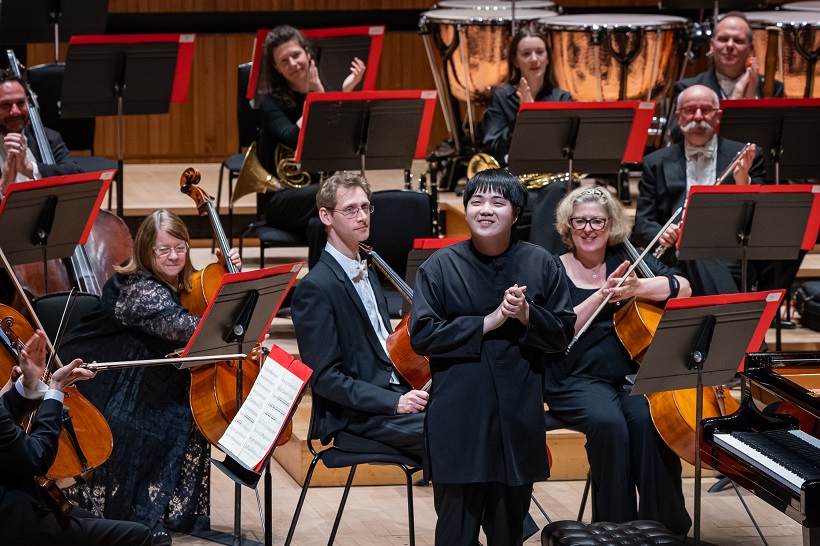
The music of Bach proves a great source of consolation for many in uncertain times, and the underlining feeling from this packed concert was that the Orchestra of the Age of Enlightenment had offered just that, deep into their tour of the great master’s complete Brandenburg Concertos.

The six concertos, written for a variety of instrumental ensembles, were published just over 300 years ago in 1721 and sent to Christian Ludwig, Margrave of Brandenburg. In a crowded field, they have become one of Bach’s best-loved groups of works, and although they were not designed to be played together they respond extremely well to a concert such as this.

It is difficult to imagine a better set of performances than those given by the OAE, playing without a conductor in the spirit of the compositions, assigning the direction of each concerto to the uppermost string player. The program was introduced with a spark by violinist Margaret Faultless, whose enthusiastic demeanour set the tone for the evening. As the notes of the Brandenburg Concerto no.1 in F major lifted off the page Bach’s inspiration was immediately apparent, like walking into a room of animated conversation. The horns of Ursula Paludan Monberg and Martin Lawrence were front and centre, pointed aloft in a necessary but striking pose. The balance between the 13 players was ideal, not just in the busy first movement but in the emotive Adagio, led by the beautiful tones of oboe trio Clara Espinosa Encinas, Sarah Humphrys and Grace Scott Deuchar. Yet the horns took centre stage, powering the bright Allegro, before a perky series of Menuetto dances were bisected by a bracing second trio.

One of the many joys of the concert was the different sonorities of each piece, which changed to nine string instruments for the Brandenburg Concerto no.3 in G major. This had the requisite spring in its step for the quicker outer movements, especially the jovial dialogue of the third. Meanwhile the ensemble elaborated on Bach’s two written chords that make up the slow movement, where the focus was on violin (Faultless) and harpsichord (Steven Devine) Their tasteful improvisations were an ideal foil.

Completing the first half was the Brandenburg Concerto no.5 in D major, in effect an early keyboard concerto. The seven players were positioned closer to the audience, allowing greater intimacy and the chance to appreciate some of the wondrous sequences in the first movement. Taking the lead here were flautist Lisa Beznosiuk, who recorded the concertos with the orchestra back in 1987, alongside Faultless and Devine. They delivered a sublime Affettuoso second movement, a moment of reflection from the fast movements where Devine was a revelation, his virtuosic brilliance never too showy even in the trickiest of cadenzas.

To begin the second half of the concert the mellow sonorities of the recorders took the lead in the Brandenburg Concerto no.4 in G major, with beautiful clarity achieved by Rachel Beckett and Catherine Latham. Violinist Huw Daniel mastered the busy figuration of his part with considerable flair, while the poise of the accompanying ensemble was consistently satisfying. This concerto is deceptively forward looking, with pointers towards Beethoven in the slow movement, which here benefited from the weighty support of viola da gamba (Richard Tunnicliffe) and double bass (Cecilia Bruggemeyer), both ever presents through the evening. The pugnacious finale, with one of Bach’s many earworms, was great fun in the hands of these nine players.

The colours darkened appreciably for the Brandenburg Concerto no.6 in B flat major, whose highest instrument is the viola. Bach’s scoring here is remarkably inventive, and was brought to life as Oliver Wilson led a fluent account of the first movement. The violas showed their versatility as melody instruments in the reduced scoring of the Adagio, reduced from seven to four players and enjoying its elegant dance-like figurations, before the syncopations of the Allegro were winningly delivered.

Finally the Brandenburg Concerto no.2 in F major was a suitably upbeat piece on which to finish, with soloist David Blackadder – having waited an hour and a half to play – enjoying his moment on stage. He made the trumpet line look – and sound – straightforward, when with this instrument it is anything but! Again the balance was carefully wrought, so that the intricate violin contributions of director Rodolfo Richter could be clearly heard. A lightness of touch from the 11 players brought the phrasing of the Andante to life, with some typically spicy harmonies stressed, before the brilliant colours of the closing Allegro assai, and a celebratory closing statement.

It was a treat to hear the six Brandenburg Concertos presented in this way, a reminder that – in the words of Huw Daniel – these concertos deserve to be the centre of attention. The humming of the audience afterwards was testament to their lasting appeal, 300 years on.

You can listen to the Orchestra of the Age of Enlightenment’s recordings of the Brandenburg Concertos from 1987-88 for Virgin Classics below:

Published post no.2,362 – Thursday 14 November 2024

In concert – CBSO Strings / Eugene Tzikindelean: Bach: Goldberg Variations

City of Birmingham Symphony Orchestra Strings / Eugene Tzikindelean (above)

J.S. Bach arr. D. Sitkovetsky Goldberg Variations BWV988 (c1740)

Town Hall, Birmingham
Sunday 10 November 2024, 3pm

Reviewed by Richard Whitehouse Picture (c) Beki Smith

Having already made his mark other than as leader of the City of Birmingham Symphony Orchestra with his performances in recent seasons of concertos by Nielsen and Walton, Eugene Tzikindelean this afternoon directed the orchestra’s strings in a performance of Bach’s Goldberg Variations.

First published 323 years ago, the ‘Goldbergs’ launched the series of works from Bach’s final decade in which formal and technical procedures take on an almost arcane dimension, though this music is always realizable in practical terms whatever its abstraction. Taken up by leading virtuosos in the wake of Liszt, notably Busoni who fashioned his ‘concerto without orchestra’ in 1914, it became synonymous with Glenn Gould whose 1955 recording launched his career internationally as surely as it established Bach’s work in the minds of listeners the world over.

More recently the variations have been arranged for a variety of media, among which that by the violinist Dmitry Sitkovetsky has become among the most familiar – firstly as realized for string trio in 1984, then for string ensemble eight years later. The question as to how large a body of strings is left to the musicians: the present account amounted to 38 players including harpsichord, ideal for the acoustic of Birmingham Town Hall and what was a commendably sizable house. Not the least attraction of this arrangement is the skill with which Sitkovetsky has translated the timbral and textural possibilities of the harpsichord original, such that they sound entirely idiomatic in this context as well as capable of a variety of interpretive nuance; with this aspect proving crucial to the overall persuasiveness of the performance heard here.

The duration of the ‘Goldbergs’ can vary widely, according to just how many of the first-half or second-half repeats of its 30 variations are taken. Those anticipating an account around 78 minutes (given in the programme) might have been disconcerted with the hour-long rendition that resulted, but Tzikindelean’s approach in this respect was wholly consistent in placing the emphasis on those variations which mark strategic formal and expressive junctures. Thus the 15th with its starkly fatalistic aura; the 25th, described by harpsichordist Wanda Landowska as the ‘‘black pearl’’ and an adagio of simmering emotional charge; then the 30th, unfolding as a ‘quodlibet’ of popular melodies which seems intent on countering any previous austerity as it builds to a culmination where the Aria da Capo can bring the whole concept full circle.

Such was certainly true of this superbly realized reading, directed by Tzikindelean with that combination of focus and spontaneity as characterizes his work as leader. It would be wrong, moreover, not to single out those other section-leaders whose contributions were hardly less vital to its success – hence second violinist Lowri Porter, violist Chris Yates, cellist Bozidar Vukotic and double bassist Anthony Alcock; Martin Perkins was a lively continuo presence who enhanced successive variations without ever interposing himself on the overall sound.

A fine demonstration of the collective prowess of the CBSO strings, and there will be similar opportunities to hear the orchestra’s woodwind then brass and percussion at Sunday afternoon concerts in January and March next year, which will hopefully prove to be just as memorable.

For details on the 2024-25 season A Season of Joy, head to the City of Birmingham Symphony Orchestra website. Click on the names to read more about violinist Eugene Tzikindelean and arranger / violinist / conductor Dmitry Sitkovetsky

Published post no.2,359 – Monday 11 November 2024

In concert – Steven Osborne, CBSO / Kerem Hasan: Coleman, Grieg & Beethoven

Steven Osborne (piano), City of Birmingham Symphony Orchestra / Kerem Hasan (above)

Coleman Umoja: Anthem for Unity (2001, orch. 2019)
Grieg Piano Concerto in A minor Op.16 (1868)
Beethoven Symphony no.4 in B flat major Op.60 (1806)

Symphony Hall, Birmingham
Thursday 7 November 2024, 2.15pm

Reviewed by Richard Whitehouse Picture (c) Tristan Fewings

Highly regarded for his work with Welsh National Opera and his five years at the helm of the Tyrolean Symphony, British-Cypriot conductor Kerem Hasan’s is a relaxed though attentive presence that resulted in no mean rapport with the City of Birmingham Symphony Orchestra.

Such was evident from the outset of Valerie Coleman’s Umoja. Written for wind quintet, this ‘Anthem for Unity’ (the latter word in Swahili being the title) went through incarnations for wind sextet and concert band before being expanded to a commission from the Philadelphia Orchestra. Essentially a sequence of free-flowing variations on a theme stated by solo violin after an atmospheric introduction, it emerges in sharply contrasted guises before arriving at   a culminative statement – its evocation of ‘unity’ the more powerful for such overt restraint.

If the remainder of this programme consisted of repertoire staples, there was nothing routine or predictable about the performances. Steven Osborne has doubtless given more consistently accurate accounts of Grieg’s Piano Concerto, but his determination here to throw caution to the wind almost always paid off. Not least in an opening movement at its most perceptive in an unusually cohesive development, then a cadenza which ably sustained emotional tension through to a thunderous close. Building to a fervent rendering of its main theme, the Adagio evinced no lack of pathos, and Hasan secured a seamless transition into the finale – its virile main theme tellingly contrasted with that rapturous flute melody (Marie-Christine Zupancic on fine form), which emerged duly transformed as a majestic apotheosis towards the close.

That Hasan was out to make the case for Beethoven’s Fourth Symphony was evident from an introduction whose speculative mystery was tangibly conveyed, thus making contrast with the first movement’s main Allegro the more potent. Nor was the repeat of the exposition a carbon copy of what preceded it, Hasan channelling its impetus into an eventful development whose hushed transition into the reprise brought a surge of adrenalin no less palpable than that of the brief if thrilling coda. The ensuing Adagio might be felt to lack the drama or heroism of those in the symphonies either side, though its wistful main theme accrued considerable profundity on its successive and varied reappearances – not least through the unforced eloquence of the CBSO woodwind in what becomes something of an all-round showcase for that department.

Hasan drove the scherzo sections of the third movement hard, yet there was never any lack of articulation, while the trio sections had all the ingratiating charm needed. Taking the finale at anything that approaches the composer’s metronome marking can easily become a hostage to fortune, but the CBSO held its collective nerve throughout what was an eventful as well as an exhilarating ride – one fully underpinned by Beethoven’s irreverent humour such as comes to the fore in the tonal and emotional punning of those captivating bars that round off this work.

A persuasive case, then, for Beethoven Four as for Hasan’s conducting. Meanwhile, Sunday afternoon brings an intriguing event in the guise of Bach’s Goldberg Variations arranged by Dmitry Sitkovetsky for string ensemble and directed by CBSO leader Eugene Tzikindelean.

For details on the 2024-25 season A Season of Joy, head to the City of Birmingham Symphony Orchestra website. Click on the names to read more about pianist Steven Osborne, conductor Kerem Hasan, and composer Valerie Coleman

Published post no.2,357 – Saturday 9 November 2024

In concert – Kirill Gerstein, BBCSO / Sakari Oramo: Bacewicz & Busoni @ Barbican Hall

Kirill Gerstein (piano), BBC Symphony Chorus (lower voices), BBC Symphony Orchestra / Sakari Oramo

Bacewicz Symphony no.2 (1951)
Busoni Piano Concerto in C major Op. 39 (1901-04)

Barbican Hall, London
Friday 1 November 2024

Reviewed by Richard Whitehouse Pictures (c) BBC / Sarah-Louise Bennett

Wait years for a performance of Busoni’s Piano Concerto then (at least) two come (almost) at once. As 2024 sees the centenary of the composer’s death and it is much his largest work for the concert hall, this was doubtless to be expected though a welcome occurrence all the same.

Having first played it in Boston seven years ago (later released on Myrios), Kirill Gerstein (below) and Sakari Oramo were intent on utilizing an experience unusual in the context of this work. This was evident at the outset of its Prologo e introito – the long orchestral introduction having a cumulative impetus that carried into the soloist’s imposing entry, with this physicality finding contrast in the delicacy of passagework and the sensitivity of dialogue later in this movement. Nor was there any lack of capriciousness in a Pezzo giocoso whose more ambivalent asides pointedly underlined, and its more populist elements always integrated into the ongoing flow.

Centrepiece in every respect, Pezzo serioso made a memorable impression. The sombreness of its introduction complemented by the undulating poise of Gerstein’s playing in the ensuing barcarolle section, before a remorseless build up of intensity towards its central climax found piano and orchestra in true accord; the re-emergence of earlier themes of a pathos abetted by a conclusion whose gently insistent rhythmic undertow led to an ending of exquisite finesse.

Rarely can the All’italiana have conveyed such scintillating appeal at this headlong a tempo, making for a tarantella of infectious wit but one whose ever more daring flights of fancy never threatened to lose focus – the BBC Symphony Orchestra responded with unfailing conviction, while the climactic cadenza made for a seamless link into the Cantico. Here male voices, placed at the rear of the platform instead of offstage, assumed the musical foreground as this finale built in a rising arc of tension to an apotheosis of a triumph the more cathartic for its sense of release.

How Busoni’s epic work comes over in performance is in part determined by what has been heard earlier in the programme. Tonight’s concert got it just right with a rare hearing (at least in the UK) for the Second Symphony from Polish composer and violinist Grażyna Bacewicz.

Oramo (above) had previously given notice of his sympathy for her music via recordings of the Third and Fourth Symphonies (Chandos), and this performance did not disappoint. Playing for just over 20 minutes, the Second has a variety of incident and overall impact out of all proportion to its length – whether in the opening movement as this alternates between equivocation and resolve, the eloquence of a Lento in which Bacewicz’s orchestration is at its most resourceful, a Scherzo whose poetic asides never threatened to offset its prevailing vivacity, then a Finale that (as with Roussel’s Fourth Symphony which may have provided the model) ended almost too soon yet whose incisiveness always felt apposite to the whole. Throughout, Bacewicz was conscious of the implications of Socialist Realism while steering clear decisively of its values.

Hopefully this and Bacewicz’s First Symphony will be appearing in due course as a follow-up volume. For now, it gave ready enhancement to a concert whose enterprise and conviction are further proof, is such were needed, of that continued rapport between Oramo and the BBCSO.

For details on their 2024-25 season, head to the BBC Symphony Orchestra website. Click on the names to read more about pianist Kirill Gerstein, conductor Sakari Oramo and composer Grażyna Bacewicz

Published post no.2,351 – Sunday 3 November 2024

In concert – Yeol Eum Son, CBSO / Jonathon Heyward: Still, Prokofiev & Sibelius

Yeol Eum Son (piano, below), City of Birmingham Symphony Orchestra / Jonathon Heyward (above)

Still Threnody: In Memory of Jean Sibelius (1965)
Prokofiev Piano Concerto no.2 in G minor Op.16 (1912-13, rev. 1923)
Sibelius Symphony no.5 in E flat major Op.82 (1914-19)

Symphony Hall, Birmingham
Thursday 24 October 2024

Reviewed by Richard Whitehouse Pictures (c) Laura Tiesbrummel (Jonathon Heyward), Marco Borggreve (Yeol Eum Son)

American by nationality, and currently music director of the Baltimore Symphony Orchestra, Jonathon Heyward is no stranger to orchestras in the UK and this afternoon’s appearance with the City of Birmingham Symphony Orchestra confirmed a rapport that will hopefully continue in future seasons.

His symphonic output may now be well covered by recordings, but performances of William Grant Still remain infrequent such that his Threnody came as a welcome novelty. Dedicated to Sibelius in the anniversary year of his birth, this finds its composer in understandably sombre mood (akin to that of his masterly concertante piece Dismal Swamp from two decades earlier) and, while there is little about its content that recalls the Finnish master, the interplay between elegy and processional is effectively handled through to its subdued yet highly affecting close.

It might not have enjoyed the popularity of its successor, but the CBSO has given memorable accounts of Prokofiev’s Second Piano Concerto over the decades and the present reading with Yeol Eum Son (above) was as good as it gets in a piece that does not make things easy technically or interpretatively. Starting reticently, the opening movement duly hit its stride in the capricious second theme before the orchestra made way for Son’s electrifying take on a cadenza which encompasses development and reprise; the orchestra’s climactic return being no less visceral.

Wresting coherence out of the unlikely formal design of this work is hardly an easier task but, here again, there was no doubting Son’s insight as she fairly tore through its Scherzo without loss of clarity; she and Heyward then drawing abrasive irony out of an intermezzo which can easily descend into caricature. Nor was there any lack of focus with a Finale whose headlong outer sections frame one of folk-tinged pathos – afforded a cumulative intensity only outdone by the propulsive closing stage where soloist, orchestra and conductor were thrillingly as one.

If the reading of Sibelius’s Fifth Symphony after the interval did not quite maintain this level of excellence, it was no also-ran as a performance. Heyward might have observed the Tempo molto moderato of its initial movement more literally, as his swift underlying pace made for too precipitate a climax into its scherzo-like second half. The accelerating transition between them was adeptly managed, but there was little room left for manoeuvre during the approach to a coda where not even the CBSO’s unfazed commitment could gain the necessary velocity.

Neither did the second movement lack forward motion, though here Heyward found a viable balance between the andante and allegretto elements – its (mostly) ingratiating poise abetted by felicitous playing from CBSO woodwind. Setting off impulsively, the finale rather lacked eloquence in its ‘swan theme’ but the resourceful evolution of its material was never in doubt. Other performances have conveyed greater emotional breadth thereafter yet, as those indelible six closing chords unfolded, there could be no doubting their decisiveness as parting gestures. Overall, then, this was impressive music-making with Heyward evidently a conductor on a mission. Next Wednesday brings a programme of Spanish evergreens conducted by Kazuki Yamada, with Miloš Karadaglić taking centre-stage in a certain guitar concerto by Rodrigo.

For details on the 2024-25 season A Season of Joy, head to the City of Birmingham Symphony Orchestra website. Click on the names to read more about pianist Yeol Eum Son and conductor Jonathon Heyward – and for a special website devoted to composer William Grant Still

Published post no.2,345 – Monday 28 October 2024