BBC Proms 2023 – Jon Hopkins with the BBC Symphony Orchestra and Jules Buckley

Prom 58

Hopkins
ATHOS (arr. Jules Buckley) (BBC Commission, world premiere)
Feel First Life (arr. Peter Riley & Leo Abrahams)
The Wider Sun (arr. Sam Gale)
Singularity (arr. Simon Dobson)
Music for Psychedelic Therapy – excerpt (arr. Peter Riley)
Form by Firelight (arr. Peter Riley)
Luna Moth (arr. Sam Gale)
Collider (arr. Simon Dobson)
Abandon Window (arr. Tom Trapp)
Recovery

Jon Hopkins (piano, programming), Leo Abrahams (guitar), BBC Singers, BBC Symphony Chorus (chorus master David Young), BBC Symphony Orchestra / Jules Buckley

Royal Albert Hall, London
Tuesday 29 August 2023

by Ben Hogwood photos by Mark Allan / BBC

Electronic and orchestral music are more closely related than you might think, with Jon Hopkins a classic case in point. For 15 years, the pianist and producer has been carefully sculpting his music either as a contributor for other artists (King Creosote, Coldplay and Brian Eno to name just three) or making his own, weather-beaten albums. Starting with Opalescent and Insides, these have developed into immersive meditations (Singularity and the most recent long player Music for Psychedelic Therapy) by way of more full-bodied rave music (2013’s Immunity). How, then, does this music hold up in a packed and expectant Royal Albert Hall?

Extremely well as it turns out. In order to achieve what he described beforehand as ‘a meditation for 5,000 people’, Hopkins has to temporarily turn his back on beat-driven, post-rave landmarks such as Collider or Form By Firelight. When such material appears, its percussive impact is modified so that the main job is done by the timeless, meditative chorale echoing around the hall.

Hopkins’ music is repetitive, but as with the best exponents of minimalism – Steve Reich, Philip Glass and John Adams, for instance – the material under repetition rewards the investment made. The mind is eased, enjoying the upfront melodies but also taking up the option of picking out new threads beneath the surface, like examining a tartan pattern under a magnifying glass.

The tartan analogy is purposeful, for Hopkins’ earlier music has a distinctive Celtic edge furthered by his work with King Creosote. The Wider Sun, from 2009 album Insides, has an authentic left of centre tuning, is slow but packs emotional heft, beautifully arranged by Sam Gale and masterfully weighted by Jules Buckley and the BBC Symphony Orchestra strings.

Before that we hear a new piece, the 25-minute ATHOS demonstrating Hopkins’ control of larger structures. This is a natural direction for his music to be taking after Music for Psychedelic Therapy, for it is effectively an album ‘A’ side of several interwoven tracks. The profile and material of ATHOS sits closely to composers such as Arvo Pärt, and in particular his Credo, but Hopkins has up his sleeve a number of heart-shifting modulations. Accentuated by the Royal Albert Hall organ, these are once heard, never forgotten moments.

So, too, are the choral passages, thanks to pinpoint interpretations from the BBC Singers and BBC Symphony Chorus, whose lines float effortlessly above the orchestral forces. Their vocal control is masterful and effortless, ensuring the sustained notes keep their emotional impact without wavering. Lesser singers would have tailed off long before these ones even think of blinking!

The sequence of music, running for approximately 75 minutes, is well chosen. Only on occasion does the source material become oversimplified, and as it turns out these moments serve as natural pauses for breath in the musical tapestry.

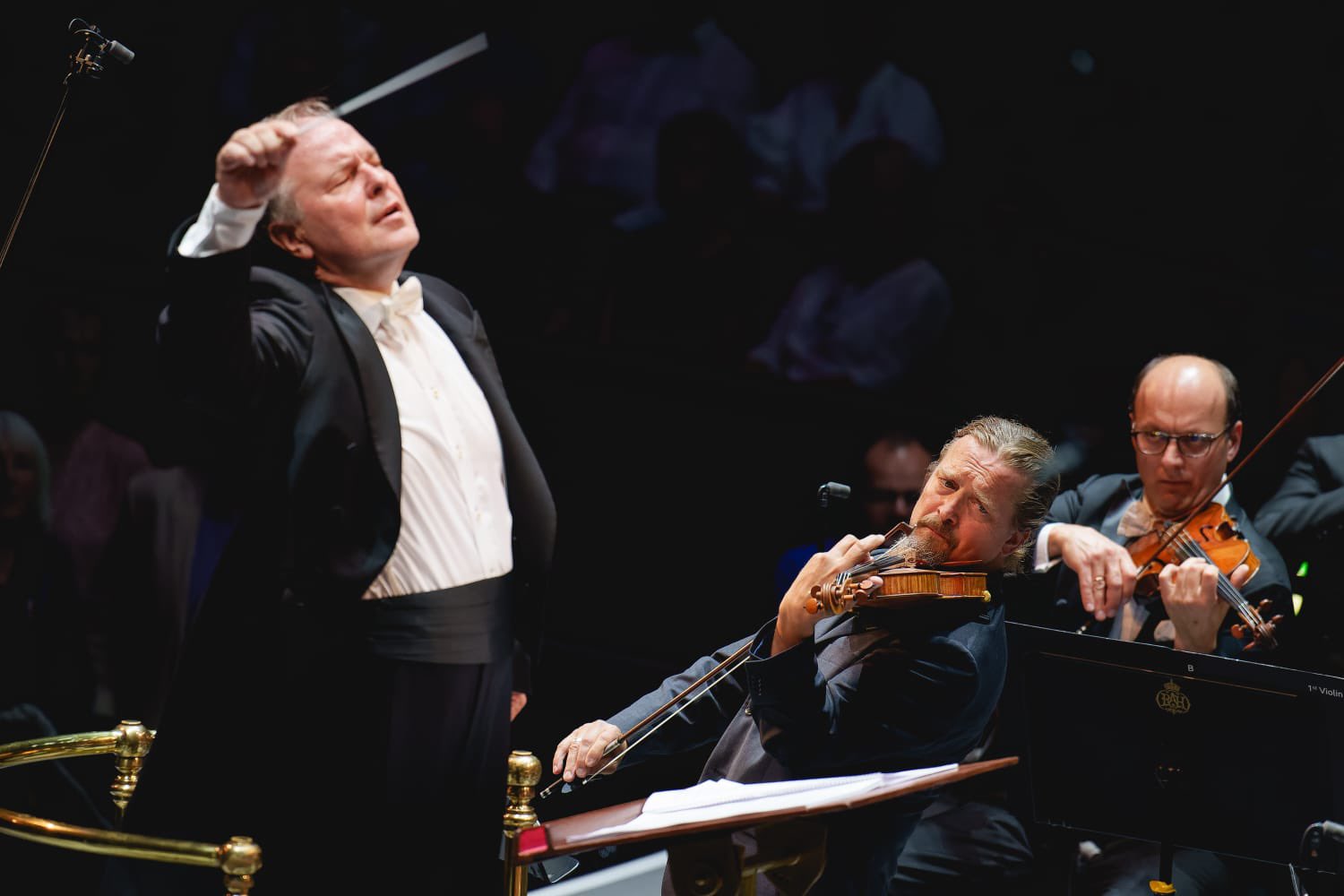
Guitarist Leo Abrahams, appearing for the last two numbers, makes a critical contribution (above). A good friend and established collaborator with Hopkins and Eno, he brings a sharper timbre to the shredded distortion of Recovery, which is – as throughout – complemented by imaginative and sympathetic lighting.

This was a multisensory Prom, containing a different sort of symphony to which the Royal Albert Hall is normally accustomed. Hopkins has proved his credentials in mastering larger structures, and his development in this field will be worth watching for sure. For now, the afterglow remains.

For more on the 2023 BBC Proms, visit the festival’s website at the BBC. For more on the artists, click here to read about Jon Hopkins, Leo Abrahams, Jules Buckley and the BBC Symphony Orchestra

BBC Proms 2023 – Christian Tetzlaff, BBC Symphony Orchestra / Sakari Oramo – Weir, Schumann & Elgar

Prom 51 – Christian Tetzlaff (violin), BBC Symphony Orchestra / Sakari Oramo

Weir Begin Afresh (BBC commission, world premiere) (2022-3)
Schumann Symphony no.1 in B flat major Op.38 ‘Spring’ (1841)
Elgar Violin Concerto in B minor Op.61 (1907-10)

Royal Albert Hall, London
Thursday 24 August 2023

by Ben Hogwood photos by Andy Paradise / BBC

The BBC Symphony Orchestra and their chief conductor Sakari Oramo have been on fine form this Proms season, and for their fourth outing together chose a concert whose first half celebrated the vibrancy of spring.

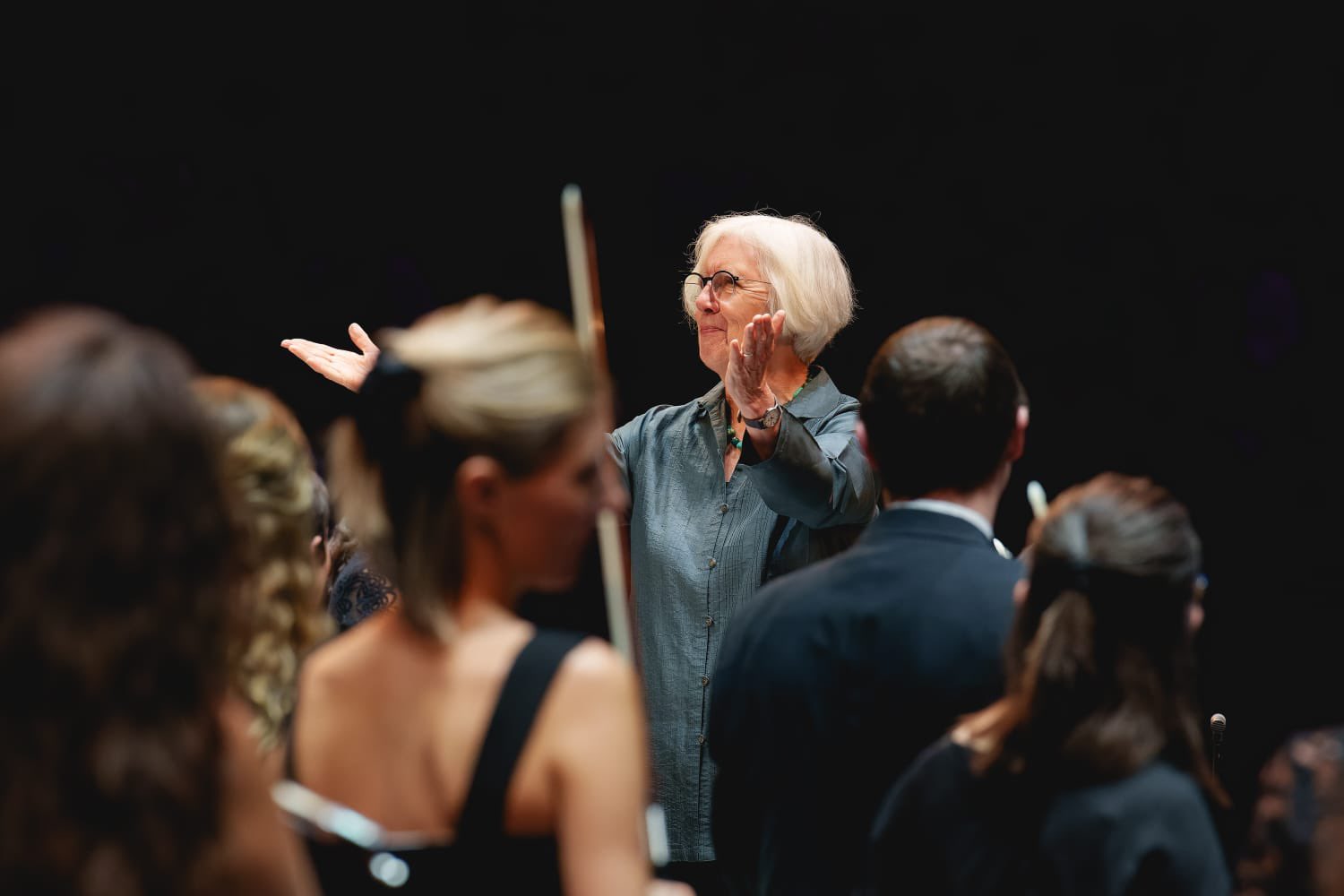
Judith Weir (below) has already written about green matter for orchestra, with her tone poem Forest premiered in 1995 and appearing at the Proms in 2019. Begin Afresh, its title inspired by Philip Larkin verse, takes a more forensic approach, looking at the wonder of trees in an urban setting. Effectively a musical diary, it begins in April, where we found orchestra leader Igor Yuzefovich teaming up with the woodwind section to lead an awakening from months of darkness. Fresh textures and opulent harmonies promised much, but October assumed a heavier tread, trees struggling to produce leaves with the onset of colder weather. Darker colours, including the sharper tone of the piano, came to the fore, but there was strong resolve reminiscent of Sibelius in the colours and phrasing, tonal but restless. True darkness set in among the lean lines of February, where roots fought against the frost, their sinewy profiles etched by the lower strings. Begin Afresh found its victory to be hard-won, but proved to be an attractive and pictorial piece deserving of more outings in the future.

Schumann’s Spring symphony, written in 1841 in the heady aftermath of his marriage to Clara, occupied an odd place in the program but benefited from a freshly minted performance. The initial fanfare set the tone for an interpretation of clarity and poise, the burbling woodwind on fine form. The ensuing Allegro molto vivace was bracing, and was complemented by a softly voiced second movement Larghetto. Here the softer shades were ideally weighted, the strings’ intimate thoughts conveyed with deep feeling. The Scherzo found the violins applying extra force, the theme balanced by two light-footed trio sections that danced happily. Oramo’s fluent reading of this wonderful symphony ended with a convincing last movement affirmation.

If spring was the main focus of the first half, Elgar’s Violin Concerto was ideally suited to late summer. There are many violin concertos in this year’s season – 13 at last count – and although this is the longest work by some distance, it did not tarry here. This was thanks in part to relatively quick tempo choices but mostly due to wholehearted investment from Oramo and soloist Christian Tetzlaff, who clearly loves the piece. From his first statement the violinist was in full, assertive control yet his most meaningful contributions were also the quietest, beckoning the audience in to Elgar’s most intimate thoughts and emotions.

The orchestral counterpoint was clearly and carefully managed by Oramo, himself a dignified Elgarian, with opportunity given for the strings to release ardent feelings in the climax points. The main themes were lovingly delivered, especially in the rapt slow movement Andante, the audience largely silent as the compelling dialogue took hold. While Tetzlaff took every opportunity for virtuoso display, reminding us that no less a violinist than Fritz Kreisler commissioned this work in 1904, none of the acrobatics were for personal gain. Instead they were at the service of Elgar’s expression, which made the final pages all the more telling. As the quiet music took hold a chill spread through the music, a sombre realisation that love – in this case – might not prevail. This realisation unwittingly found a parallel, a musical realisation of the temperatures dropping and the nights drawing in as they do in late August.

The concerto may have had an affirmative finish but these thoughts remained, reinforced by a tastefully restrained encore of the Andante from Bach’s Solo Violin Sonata no.2 in A minor BWV1003. As with the performance before, it was beautifully judged.

For more on the 2023 BBC Proms, visit the festival’s website at the BBC. Meanwhile click on the artist names for more on Christian Tetzlaff, Sakari Oramo and the BBC Symphony Orchestra.

BBC Proms 2023 – Isabelle Faust, Alexander Melnikov, Les Siècles / François-Xavier Roth – Ligeti & Mozart

Prom 47 – Isabelle Faust (violin), Alexander Melnikov (fortepiano), Les Siècles / François-Xavier Roth

Ligeti Concert Românesc (1951)
Ligeti Violin Concerto (1989-93)
Mozart Piano Concerto No. 23 in A, K488 (1786)
Mozart Symphony No. 41 in C, K551, ‘Jupiter (1788)

Royal Albert Hall, London
Sunday 20 August 2023

by Richard Whitehouse photos by Sisi Burn / BBC

A major step in the evolution of musical ‘authenticity’ or vanity project of its artistic director? Celebrating its 20th anniversary, the Paris-based Les Siècles and François-Xavier Roth tonight made their third appearance at the Proms in a programme divided between Ligeti and Mozart.

Long in limbo as with most works of Ligeti’s early years, Concert Românesc now ranks as its composer’s primary crowd-pleaser – a ‘concerto for orchestra’ compact yet entertaining. Roth drew winsome charm from its initial Andantino and no mean impetus from its scherzo, before an Adagio whose dialogue of two horns (one high in the gallery) prefigures those intonational experiments three decades on. The finale did not lack verve, but anyone having heard Jonathan Nott give this piece for a Proms encore will recall just how much more scintillating it can be.

It may have had a long gestation, but Ligeti’s Violin Concerto is now established as the most recent such piece to have entered the repertoire. Technically assured but never merely showy, Isabelle Faust is a fine exponent, and it was not her fault if a lengthy platform reset made for a restive audience response in the teasingly understated Praeludium or plangent fervency of Aria, Hoquetus, Chorale which is one of the composer’s most potent inspirations. Diversely yet modestly scored, this work needs to be projected for its emotional impact to be felt and a certain bemusement met its coruscating Intermezzo and anguished Passacaglia, but not its engaging Appassionato in which Faust’s methodical cadenza fitted seamlessly into context. As, also, did the sparse Andante of Erwin Schulhoff’s Solo Violin Sonata given as an encore.

There was a similar sense of ends not always equating with means in Mozart’s Twenty-Third Piano Concerto after the interval. Playing a (Graf?) fortepiano from deep within the orchestra, Alexander Melnikov summoned playing of admirable dynamic subtlety and emotional poise – notably an Adagio whose bittersweet fatalism was consummately rendered. Just how much detail and articulation could be heard in the farther reaches of this acoustic was uncertain, but the rapport between soloist and orchestra in a sparkling final Allegro could hardly be gainsaid.

Playing to period-pitch in the second half (just occasionally offset by vagaries of intonation), Les Siècles came into its collective own with an engrossing account of Mozart’s Forty-First Symphony, its Jupiterian connotations evident from the outset of an opening Allegro whose distinction between (relative) dynamism and stasis was thrown into relief with Roth’s use of pause for expressive punctuation. Best here were an Andante whose muted while often dense textures were precisely articulated, then a Menuetto whose sweeping gait found contrast in a quizzical trio whose closing phrase was pointedly curtailed. Not that Roth had other than the measure of the finale, fully integrating its thematic unity into a powerfully controlled overall structure, but its underlying progress felt just a shade dogged in the light of what preceded it. That said, there was no lack of impetus when, after the longest of those pauses, Roth led his forces through the magisterial coda; duly setting the seal on a programme that played to this orchestra’s strengths if not always having been designed with the Royal Albert Hall in mind.

For more on the 2023 BBC Proms, visit the festival’s website at the BBC. Meanwhile click on the names for more information on artists Les Siècles, conductor François-Xavier Roth, violinist Isabelle Faust and pianist Alexander Melnikov. You can discover more about Ligeti at this dedicated website

BBC Proms 2023 – Soloists, London Philharmonic Choir and Orchestra / Gardner – Ligeti & Richard Strauss

Prom 36 – Jennifer France (soprano), Clare Presland (mezzo-soprano), Edvard Grieg Kor, London Philharmonic Choir, Royal Northern College of Music Chamber Choir, London Philharmonic Orchestra / Edward Gardner

Ligeti Requiem (1963-5); Lux aeterna (1966)
Richard Strauss Also sprach Zarathustra Op.30 (1896)

Royal Albert Hall, London
Friday 11 August 2023

by Richard Whitehouse photos by Mark Allan / BBC

There did not seem any more concrete reason to build a Prom around the music from Stanley Kubrick’s film 2001: A Space Odyssey other than this being the 55th anniversary of its release, but it at least offered an opportunity to revive one of the last century’s defining choral works.

Much has been made of a then avant-garde composer writing a piece based on a seminal text from the Christian liturgy, but centenary composer György Ligeti’s Requiem is anything but beholden to tradition. Focussing on what would normally constitute the first half of the Requiem Mass itself skews the textual imagery away from any hope of attaining ‘eternal rest’ – the four movements duly proceeding from a sombre Introitus in which the music’s conceptual vastness along with its expressive extremes are laid bare. The Kyrie is the most (in)famous part – emerging in two successive and cumulative waves of micropolyphony both overwhelming and disorientating, not least when rendered with the poise and precision that the combined choirs summoned in the Albert Hall’s expanse. Inevitably, the terror of the infinite gives way to that of the absurd.

Hence the Dies irae sequence, designated On the Day of Judgement and a veritable tour de force of choral outbursts with vocal interjections; Clare Presland’s ominous intoning tellingly offset by Jennifer France’s stentorian pronouncements, with the wind and brass of the London Philharmonic Orchestra visceral in their contribution under the attentive guidance of Edward Gardner. Neither did the Lacrimosa lack gravitas, the soloists musing eloquently if wearily against a stark instrumental backdrop whose essential emptiness carries through to the close.

While not intended as a continuation of the larger work, Lux aeterna still makes for a viable resolution in its undulating yet never static textures such as conjure the presence of ‘eternal light’ without any concomitant spiritual aspect. Set high-up in the gallery, to the right of the platform, the Edvard Grieg Kor evinced a faultless intonation along with a tangible sense of the music’s timelessness – though this piece would maybe have been better placed after the Ligeti instead of before the Strauss, not least as there was no segue between the latter works.

Also sprach Zarathustra was, of course, elevated to a new level of public recognition after its Introduction had been utilized as fanfare in Kubrick’s film, and a less than thrilling rendition here at least ensured this Sunrise could not pre-empt the remainder in Strauss’s free-ranging overview of Friedrich Nietzsche’s influential tract. On fine form overall, the various sections of the LPO relished their passages in the spotlight, reminding one that this piece is as much a ‘concerto for orchestra’ before its own time as the musical embodiment of human aspiration. Pieter Schoemann audibly enjoyed setting The Dance Song in motion and while others have made its climax more intoxicating, Gardner brought a rapt serenity to the Night Wanderer’s Song such as made the tonal equivocation of those final bars the more acute and intriguing.

Numerous recent Proms have followed the second-half work with an ‘official’ encore and, while this practice is not always justified, the inclusion tonight of a certain waltz by another Strauss would have extended the 2001 concept still further and effected a more definite close.

For more on the 2023 BBC Proms, visit the festival’s website at the BBC. Meanwhile click on the names for more information on artists Jennifer France, Clare Presland, the London Philharmonic Orchestra and conductor Ed Gardner. For more on Ligeti, head to this dedicated website

BBC Proms 2023 – Leila Josefowicz, BBC Symphony Orchestra / Sakari Oramo – Berg & Mahler

Prom 35 – Leila Josefowicz (violin), BBC Symphony Orchestra / Sakari Oramo

Berg Violin Concerto (1935)
Mahler Symphony no.7 (1904-5)

Royal Albert Hall, London
Thursday 10 August 2023

by Richard Whitehouse photos by Chris Christodoulou / BBC

The late indisposition of Sir Andrew Davis saw Sakari Oramo at the helm for this programme of Berg and Mahler, an effective coupling even allowing for the replacement of the latter’s Tenth Symphony with his Seventh. Hopefully it will be ‘third time lucky’ for Davis and Mahler 10.

It might have received almost 20 hearings at these concerts, but Berg’s Violin Concerto is not easy to bring off in so resonant an acoustic as the Albert Hall’s. As elegantly as she delineated the initial Andante’s arch-like trajectory, Leila Josefowicz did struggle to make herself heard against a restrained though dense orchestral backdrop. Balance righted itself with the ensuing Allegretto – the soloist’s ingratiating response ideal for its alluring, even coy expression with a bittersweet folksong inflections then its ominous foreshadowing of the work’s second part.

It was in that latter half’s Allegro the performance really took flight, Josefowicz as attuned to its fractious opening pages as to the plangent searching of its cadenza-like central span. Both the seismic start of the movement’s culmination and its convulsive wind-down were assuredly handled – the emergence of Bach’s Es ist genug chorale setting the course for a final Adagio where pensive inwardness and heartfelt supplication were palpably conveyed through to the fervent climax, then a close bringing matters full circle with its mood of beatific resignation.

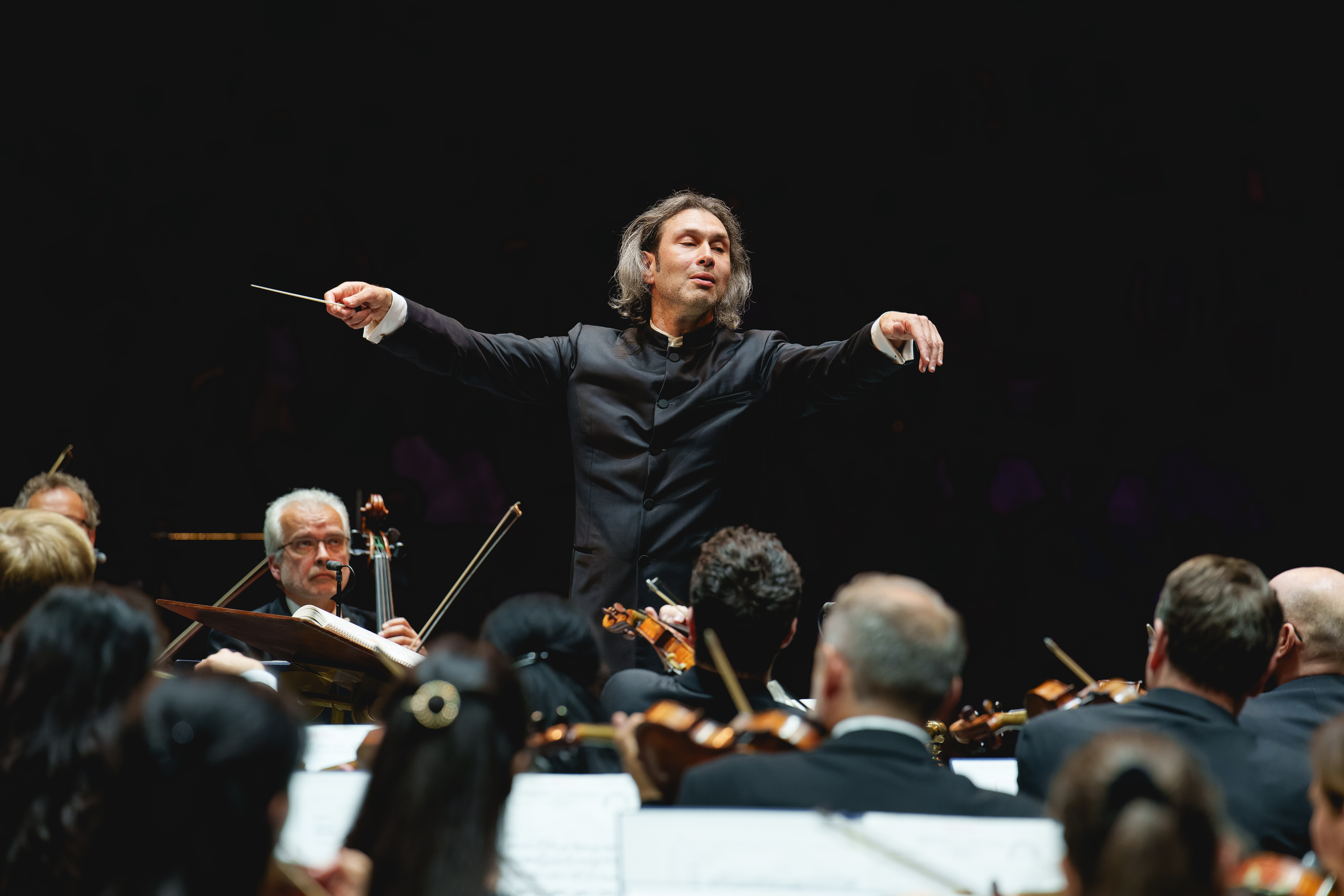
Unheard at the Proms until 1969, Mahler’s Seventh was also the last of his symphonies to win wider acceptance and is still a tough challenge to make cohere. Oramo (above) had its measure though not consistently in an opening movement, the effortfulness of whose introduction pervades its main Allegro yet without impeding its onward and increasingly cumulative course. For all the wonderment of its central interlude then emotional heft of the lead-in to the reprise, there was yet a sense of this music being coerced into shape rather than unfolding with due inevitability. Not so the ‘First Night Music’, its intertwining of the speculative and crepuscular rendered to bewitching effect – Oramo balancing those intricate yet translucent textures with a sure sense of where this movement was headed, namely a resolution not so much tentative as intangible.

Equally elusive, the central Scherzo can seem an exercise in flitting gestures as fail to add up to anything more substantial but here exuded darkly ironic humour as it wended its unsettling way. The ‘shadowy’ duly found its ideal complement in the ‘amorous’ manner of the ‘Second Night Music’ – its underlying affability all too easy to make bland or faceless, yet which here unfolded with a precise feel for its function within Mahler’s teasingly oblique formal scheme. As was almost equally true of the Rondo-Finale – its ordinario marking easy to misinterpret, but in which Oramo’s sure and steadfast if never turgid course made the most of its engaging progress. Hardly alone in not quite making the reappearance of first-movement material feel other than contrived, he nevertheless headed through those final pages with irresistible verve.

This performance would not have been as successful overall without its sterling contribution by the BBC Symphony Orchestra, both in soloistic passages or those tuttis as give the outer movements their impact. Ten years on, the rapport between orchestra and conductor remains undimmed.

For more on the 2023 BBC Proms, visit the festival’s website at the BBC. Meanwhile click on the names for more information on artists Leila Josefowicz, the BBC Symphony Orchestra and their chief conductor Sakari Oramo