
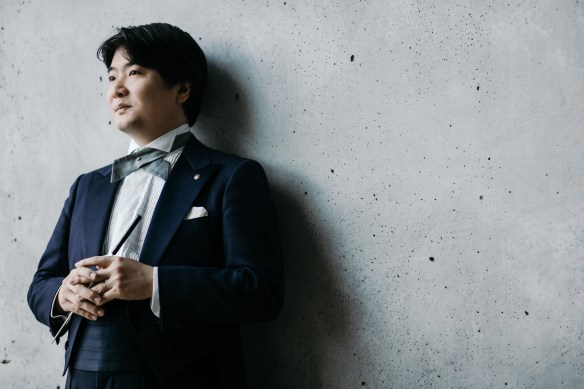
Live review – CBSO Youth Orchestra / Kazuki Yamada: Elgar Symphony no.1, Takemitsu & Richard Strauss

CBSO Youth Orchestra / Kazuki Yamada (above)

Symphony Hall, Birmingham
Sunday 23 February 2020 (3pm)

Takemitsu Dreamtime (1981)
Richard Strauss Till Eulenspiegels lustige Streiche Op.28 (1894-5)
Elgar Symphony no.1 in A flat major Op.55 (1907-08)

Written by Richard Whitehouse

It is hardly an understatement to say that the concerts given each season by the CBSO Youth Orchestra are frequently among the most enterprising and engaging of all those to be heard in Symphony Hall, with this afternoon’s event under Kazuki Yamada proving no exception.

A contrasted pair of tone poems comprised the succinct first half, beginning with a welcome revival of Toru Takemitsu‘s Dreamtime. Conceived as a dance piece for Netherlands Dance Theatre, this is typical of the music from its composer’s maturity in its dissonant (but rarely abrasive) harmonies and its diaphanous textures. Both of these were fully in evidence, with Yamada also mindful to instill a sense of cumulative unfolding as ensures cohesion in music that can easily drift or lose focus. Suffice to add there was little sense of that happening here.

Takemitsu was not a composer given to the humour (ironic or otherwise) permeating Richard Strauss‘s Till Eulenspiegel, heard in an account that initially felt a little stolid in its depiction of that prankster from the Middle Ages; but which soon gained in conviction over the course of Till’s encounters monkish, amorous and social on the way to a vivid depiction of his trial and execution – with its irrepressible pay-off. Assured playing by woodwind and brass were the highlights of a reading to remind one of just how technically exacting this music remains.

112 years on from its premiere and Elgar‘s First Symphony exudes a very different if equally unequivocal virtuosity, such as happily held few fears for these musicians. Japan has a noted line of Elgar interpreters (not least the conductor Tadaaki Otaka), and Yamada demonstrated his credentials with a taut while never inflexible take on the lengthy opening movements – its indelible ‘motto’ theme eloquently and un-fussily rendered, then the main Allegro securing an almost ideal balance between anxiety and rumination across music which strives without ever regaining that calm assurance whose glimpses become the more affecting for their transience. No less impressive was Yamada’s handling of the coda as this winds down towards becalmed resignation, abetted by playing of exquisite finesse from the CBSOYO woodwind and strings.

There was little to fault in a scherzo that alternated the incisive and the wistful with unforced rightness, and how unerringly Yamada judged its transition into an Adagio that, less moulded than it often is, yet unfolding seamlessly towards its serene close. Not that there was anything bland or uninvolving about this music, or a finale that (rightly) followed with minimal pause; the barely suppressed expectancy of its introduction heading into an Allegro whose impetus hardly faltered. Strings never sounded fazed by the contrapuntal intricacy of its development, while brass came into their collective own during an apotheosis where the re-emergence of the motto theme evinced a triumph shorn of bombast or self-regard; the closing bars setting the seal on a performance of a maturity the more remarkable given the age of its exponents.

Elgar One has over the years come in for more than its fair share of objections to its supposed overtones of jingoism and self-gratification. That there was nothing of that here was tribute to Yamada in his drawing so ardent and insightful an interpretation from the CBSOYO players.

Live review – Vilde Frang, CBSO / Kazuki Yamada: Shostakovich Violin Concerto no.1 & Respighi’s Roman Trilogy

Vilde Frang (violin, below), City of Birmingham Symphony Orchestra / Kazuki Yamada (above)

Symphony Hall, Birmingham
Wednesday 19 February 2020

Shostakovich Violin Concerto no.1 in A minor Op.77 (1947-8)
Respighi Feste romane (1928); Fontane di Roma (1916); Pini di Roma (1924)

Written by Richard Whitehouse

Spending parts of their careers under two of the most potent dictatorships this past century, Shostakovich and Respighi might not appear to have much else in common – so all credit to Kazuki Yamada for making the juxtaposition work so effectively for this evening’s concert.

Never planned as a symphony, Shostakovich’s First Violin Concerto is the most symphonic of his six concertante works and responded accordingly to Vilde Frang’s long-breathed while highly involving approach – whether in the introspective probing of the Nocturne (Graham Sibley deftly lucid in the obligato tuba part) or folk-infused fervency of the Scherzo, then a Passacaglia of wrenching eloquence; its speculative postlude giving rise to a cadenza whose cumulative impetus was carried over into the final Burlesque with its irresistible high-jinx then sprint towards the end where soloist and orchestra very nearly finished in sync. Typical, moreover, of this most self-effacing among present-day virtuosi that Frang evidently had no intention of providing an encore – so completely was her performance its own justification.

Hard to imagine the mature Shostakovich setting much store by the orchestral pyrotechnics of Respighi’s Roman Triptych – yet these heady evocations of time and place in the Eternal City remain audience pleasers of a high order, especially when scheduled as this ‘triple whammy’.

Beginning with Roman Festivals might risk premature overkill, but Yamada brought out the ceremonial fervour of Il Giubileo as surely as the teasing playfulness of L’Ottobrata with its journeying forth and amorous encounters. Yamada’s unbridled enthusiasm rather got the better of him in the imposing if unruly climax of Circences, while the CBSO sounded just slightly inhibited during the all-out celebrations of La Befana – its melee of colliding tunes and textures lacking the subtlety that Respighi instils into even his most uproarious passages.

As the late Gerald Larner pointed out, Fountains of Rome pre-dates the incipient era of Italian grandiloquence. Yamada allowed full rein to the effervescent joy of Triton at Morning, then dazzling majesty of Trevi at Midday – its prolonged evanescence hanging as if suspended in Symphony Hall’s ambience. The outer evocations felt less successful, Valle Giulia at Dawn too passive to be alluring and Villa Medici at Sunset lacking pathos (an offstage bell might have helped), yet the delicacy and suppleness of their melodic lines could hardly be gainsaid.

On to Pines of Rome and Yamada was again at his most perceptive in those central episodes – Near a Catacomb yielding a baleful anguish (offstage trumpet judged to perfection), then At the Janiculum bringing rapture without coyness and a closing string tremolo hardly less exquisite than the nightingale above it. Of the Villa Borghese seemed almost too fractious to be exhilarating, but while Yamada set slightly too rapid a tempo for On the Appian Way, the final peroration (organ and additional brass right on cue) was nothing if not resplendent.

Not a triptych for all occasions but a feast of scintillating sonority and one to which the CBSO responded with panache. Principal guest Yamada returns on Sunday afternoon at the helm of the CBSO Youth Orchestra for a varied programme that closes with Elgar’s First Symphony.

Further listening

Here is a Spotify playlist of music from the concert. The CBSO have not recorded these works before but these are fine alternatives:

Further information on the next CBSO concert with Kazuki Yamada as described by Richard can be found at the CBSO website

In concert – Orchestra of the Age of Enlightenment / Iván Fischer: Mozart’s Final Flourish

Orchestra of the Age of Enlightenment / Iván Fischer

Royal Festival Hall, Southbank Centre, London
Friday 7 February 2020

Mozart
Symphonies: no.39 in E flat major K543; no.40 in G minor K550; no.41 in C major K551 ‘Jupiter’ (all composed in 1788)

This concert was recorded for broadcast on BBC Radio 3 on Wednesday 12 February. You can listen to it here

Reviewed by Ben Hogwood

Few orchestras inspire their audience as consistently as the Orchestra of the Age of Enlightenment. Tonight was no exception, presenting ‘Mozart’s Final Flourish’ – his three final symphonies, nos. 39-41, written unusually in a short space of time, without commission, in 1788. The three works represent Mozart’s mastery of the symphonic form, and as conductor Iván Fischer explained to us before the performances began, there is an argument for the three works being viewed as one.

Fischer structured the concert to support his point, the trinity performed in order but with the interval positioned between the second and third movements of the Symphony no.40. This did not prove as much of a hindrance as expected, for the ‘one giant stucture’ – seen as such by no less than Nikolaus Harnoncourt, Fischer’s teacher – was merely paused half way through. Fischer encouraged applause between movements, a tactic which fragmented the performance a little but added to the relaxed atmosphere and will have encouraged first-time attendees.

The performances were very fine indeed. Symphony no.39 in E flat major, no.543 in Köchel’s catalogue of Mozart compositions, does not always get the appreciation it deserves. This is a shame as it is a wonderfully affirmative work, packed full of good tunes that responded well to the orchestra’s lean sound and fresh phrasing. The slow movement Andante was really nicely characterised, its middle section appropriately stern, while the busy finale chattered excitedly, Fischer leading the conversation.

The Symphony no.40 in G minor came as something of a shock to audiences with its ‘Sturm und drang’ approach, in keeping with Haydn and other artistic movements of the day but clearly plumbing emotional depths for the composer. The first movement was tautly argued, relenting a little for the Andante which was perhaps too relaxed in tone. When we returned after the interval the Menuetto disappeared rather quickly, with Fischer’s brisk tempo and an absence of repeats, while the fourth movement brought more abstract qualities to the fore before its final flourish.

And so to the Symphony no.41 in C major, nicknamed the ‘Jupiter’ 40 years or so after its publication. What a remarkable achievement this is, its surface simplicity masking complex inner workings with the serenity of a swan. Fischer, who smiled throughout, revelled in another fine performance, typified by the extra spring given to the exuberant second theme of the first movement. The tender heart of the Andante cantabile was aided by a lovely muted string sound, while the floated delivery from the violins helped the deceptively straightforward themes in the Menuetto. All this was headed for the finale, however, and its masterful fugue. This conversation between parts is the closest thing to perfection in Mozart’s symphonic writing, and the OAE relished both their individual parts and the ensemble workings resulting from them, building enough kinetic energy to sweep us home.

This was a thought provoking and ultimately uplifting evening, and the ideal setting of the scene for anyone moving on to Beethoven next!

Further listening and viewing

A reminder that this concert was recorded for broadcast on BBC Radio 3 on Wednesday 12 February. You can listen here

You can find out more about the Orchestra of the Age of Enlightenment on their website, and you can get an introduction to them in a minute through the video below:

The orchestra appear not to have recorded Mozart’s last three symphonies, but their one-time guest conductor Frans Brüggen made these excellent live recordings with the Orchestra of the 18th Century. They sit relatively closely to the sound heard at this concert:

In concert – Peter Donohoe, London Philharmonic Orchestra / Vladimir Jurowski: Foulds ‘Dynamic Triptych’ & Shostakovich Symphony no.11

Peter Donohoe (piano), London Philharmonic Orchestra / Vladimir Jurowski (above)

Royal Festival Hall, Southbank Centre, London
Wednesday 11 December 2019

Foulds Dynamic Triptych (1929)
Shostakovich Symphony no.11 in G minor Op.103 The Year 1905 (1957)

You can listen to this concert on the BBC Sounds app here, though you may wish to skip the interval of Shostakovich’s String Quartet no.8 for continuity.

Reviewed by Ben Hogwood

The London Philharmonic Orchestra’s Isle of Noises series has attracted – for me at least – some unfair criticism in recent days of the works included in its remit. Granted, the choices are all English, but the composers look beyond these shores with a willingness seemingly out of kilter with the current political climate.

John Foulds is a case in point; a composer who spent the final five years of his life in India before a tragic early death to cholera. Not only did he live in India but he actively explored its musical systems, looking to see how he could incorporate his discoveries and influences into the framework of classical music.

The Dynamic Triptych is a striking example of successful integration. Completed in 1929, its musical language is well beyond its years. In the first movement Foulds becomes obsessed with a modal scale, repeating it over and over rather like Scriabin would do with towers of chords based on intervals of a fourth. The task of playing the modal scales often fell in this performance to the muscular piano part, played with great authority by Peter Donohoe (above). The pianist has spent a great deal of time with this work, recording it with Sakari Oramo and the CBSO in 2006. He led a highly spirited performance, yet despite his brilliant passagework and percussive interventions in the fast music the soul of the work lay in the slow movement.

Here the strings’ quarter tones, beautifully played, brought added mystery to the picture when dressed with evocative percussion, adding to music already in the grip of a poignant sense of loss. Piano and orchestra regrouped for a finale that galloped ahead, Foulds letting the music off the leash to explore more far-flung tonal areas, before a silvery waltz theme was introduced to complement the quickstep. Both fused for a bold and dramatic finale, capping a well-received performance. This was forward looking music of English origin, and not in a 12-tone style either! The LPO should be praised for its inclusion and Vladimir Jurowski, who conducted with characteristic sensitivity, will hopefully explore more of Foulds’ colourful scores in the future.

The colours vanished dramatically after the interval for the opening pages of Shostakovich’s Symphony no.11. This performance took on added poignancy with a dedication from Jurowski to Mariss Jansons, sadly departed the previous weekend at the age of 76. Jansons was guest conductor of the London Philharmonic Orchestra from 1992 to 1997, and he grew up in St Petersburg, on close personal terms with Shostakovich. The Eleventh Symphony, depicting the slaughter of protestors in the city as part of the Russian Revolution in January 1905, could not have been closer to home.

What a performance it was. For an hour we barely moved as Shostakovich’s first-hand account of the action took hold in vivid, cinematic detail. The icy Palace Square of the city could not have been colder in Jurowski’s hands, with ominous timpani rolls signalling tragedy all too early on. When it came, in the second movement, the massacre was delivered by music of uncompromising and stunning power, the proud brass chorale ultimately shut down by deafening percussion before the door slammed shut. Suddenly the square was silent, save for the strings’ icy tendrils which extended once again towards the audience, noticeably holding its collective breath.

The London Philharmonic were absolutely superb. With 22 cellos and basses playing as one, digging in to the ice as though their lives depended on it, the performance was on sure foundations, above which we had special woodwind contributions, with cor anglais (Sue Bohling) and bass clarinet (Paul Richards) just two of several exceptional solos. The percussionists, a vital cog in the Shostakovich machine, judged their contributions ideally too, with sharp snare drum retorts complemented by rolling bass drum and gong.

Still the tension remained, through an elegiac slow movement where the violas’ melody could not have been more poignantly played by David Quiggle and his section. The dedication to Jansons felt most intense here, and the players were given due acknowledgement by Jurowski in their well-deserved curtain call. Yet despite the deeply personal aspect of the performance there were even sharper parallels with the political climate of today, reminding listeners of the protests in Hong Kong and the forthcoming UK election, not to mention the disinformation, code and discrimination that permeate today’s society at every turn.

This account lived and breathed all of those dreadful things, and as the performance reached its shattering climax with tolling bells, Shostakovich was communicating with ever more piercing clarity. It may not be his most accomplished symphony but the Eleventh is one of his most descriptive and emotive. As Jurowski held the score aloft afterwards it was clear he felt the same – and I for one left reeling at the impact of a memorable performance.

Further listening

This Spotify playlist gives recordings of the Eleventh Symphony from Mariss Jansons himself, conducting the Philadelphia Orchestra, and Peter Donohoe with the CBSO under Sakari Oramo in the John Foulds Dynamic Triptych:

You can read a tribute to Mariss Jansons on the London Philharmonic Orchestra website

On record – Rupert Marshall-Luck: Soul (TUTL)

Rupert Marshall-Luck (violin)

Baek Afturundirgero
Blak Alvarann; Bohmerlands Dronning
Debess Variations
Rasmussen Echoes of the Past

TUTL FHR90 [52’25”]

Producer Rupert Marshall-Luck
Engineer Theodor Kapnas

Recorded 2-3 April 2019

Written by Richard Whitehouse

What’s the story?

The violinist Rupert Marshall-Luck takes time out from his extensive commitment to British music (and no less extensive schedule for the EM Records label) for this revealing collection of unaccompanied pieces by composers who were born or are resident in the Faroe Islands.

What’s the music like?

Although a self-governing region of Denmark across more than seven decades, classical or art music was slow in taking root in the Faroes, its music-making almost entirely vocal until the 1960s. As with its northerly neighbour Iceland, the creative scene has subsequently been transformed to the extent that these islands currently enjoy a profile out of all proportion to their population in terms of its range and diversity. Soul may only scratch the surface of this musical wealth, but it also underlines the potential of what might appear a restricted medium.

This disc sets off unequivocally with Echoes of the Past by Sunleif Rasmussen (b1961), an eventful sequence of episodes such as makes full use of the violin’s potential for heightened expression and meaningful display; all the while given focus by a trajectory as unfolds from combative unease towards a searching if tenuous repose. Quite a contrast with Variations for Solo Violin by Edvard Nyholm Debess (b1960), its traditional Faroese hymn-tune providing the basis for six variations which draw on a range of textural and emotional shading, without losing sight of the intrinsic character of the theme before its affecting return. More discursive in its content is Afturundirgero by Kari Baek (b1950), evoking a seascape in which turbulent cross-currents are vividly conveyed through harmonic clashes by turns soulful and astringent.

The remaining two pieces are both by Kristian Black (b1947), born in Denmark but resident over many years in Torshavn where he has been a prime mover in the emergence as well as dissemination of Faroese classical music – not least via his enterprising label TUTL Records. Inspired by a ballad about the Danish queen, Bohmerlands Dronning unfolds as a rhapsody in which various aspects of the ballad can be heard to permeate the content and influence the direction of what is eloquent and ultimately fatalistic music. Blak’s Alvarann also takes its cue from a Faroese ballad, though here progress is audibly more quixotic as the violin charts a course from subdued anticipation, via the steady accumulation of energy, to an impetuous culmination whose unbridled virtuosity leaves no mean drama and even anguish in its wake.

Does it all work?

Yes, not least in that these five pieces amount to a programme the sum of which is greater than its parts and which – given the relatively short playing-time – is best experienced as a whole. A tribute, then, to the resourcefulness of the composers as well as to Marshall-Luck, who renders each work with that combination of interpretative insight and technical finesse familiar from his performances and recordings of British music. More pieces for violin solo, or with piano accompaniment, would be worth encountering – maybe as a follow-up disc?

Is it recommended?

Indeed. The Faroes are a nexus of creativity within the European cultural framework, as this disc makes plain.

Readers can check out the Summartonar Festival of Contemporary Music here, and the TUTL website by clicking here

Stream

Buy

For more information on Rupert Marshall-Luck and on this release, visit his artist website