On record – Adès Conducts Adès: Piano Concerto & Totentanz (Deutsche Grammophon)

Kirill Gerstein (piano), Christianne Stotijn (mezzo), Mark Stone (baritone), Boston Symphony Orchestra / Thomas Adès

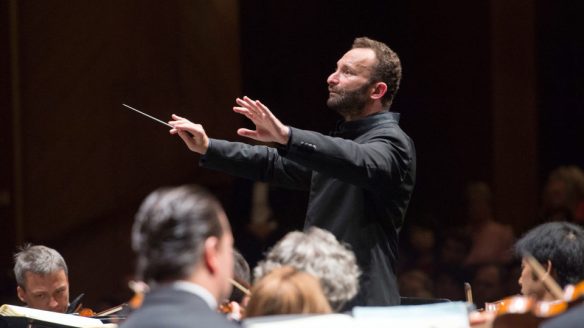
Thomas Adès
Concerto for Piano and Orchestra (2018)
Totentanz (2013)

Deutsche Grammophon 4837998 [55’58”]

Producer Nick Squire
Engineer Joel Watts

Live performances, recorded November 2016 (Totentanz) & March 2019 (Piano Concerto) at Symphony Hall, Boston

Written by Richard Whitehouse

What’s the story?

Thomas Adès has latterly been enjoying a productive association with the Boston Symphony Orchestra. They appear here in two recent and pointedly contrasted pieces which, between them, make for a viable overview of a compositional ethos as absorbing as it is frustrating.

What’s the music like?

From the outset Adès evidently had in mind a ‘proper’ piano concerto, and the Concerto for Piano and Orchestra is precisely that: three movements, of virtually equal length, unfolding along archetypal designs – sonata, ternary and rondo forms – even if their angle of approach is not what it might have been. The first movement abounds in jazzy inferences, albeit with a more relaxed ‘second subject’ to provide a modicum of contrast, while the central Andante is overlaid with intriguing symmetries that offset what might otherwise seem unremarkable material. The final Allegro duly renews the animated dialogue between soloist and orchestra in what could be termed an equable meeting between Gershwin and Ligeti, with Prokofiev putting-in an unexpected appearance toward the decisive and effervescent close. This is not the radical departure from Adès’s previous concertante pieces as might be supposed, though neither is this merely a triumph of concept over content. Whether it manages to revitalize a genre which has had precious few additions during the past half-century remains to be seen.

Certainly, the Concerto makes a telling foil to Totentanz. This is a setting of an anonymous 15th-century commentary to a frieze (destroyed in wartime) where Death visits a succession of those representing the medieval social strata and their responses thereof. Despite utilising male and female voices, it is not a song-cycle so much as a dramatic scena in which loss is considered in the context of a ‘dance of death’ that motivates the greater discourse. Each of those visited is allotted a specific musical expression, though the initial call-and-response is gradually blurred as vocal parts are overlaid in an intensifying activity towards the seismic orchestral culmination.

Characterisation of the remaining protagonists risk losing focus, yet there could be no mistaking the plaintive sensuousness of the encounter with the Maiden or the disarming naïveté of that with the Child as the music wends a weary Mahlerian way to its close. Each encounter is interpretable from different and even competing perspectives which extend the range of expression, while making it ambivalent to the point of disingenuousness.

Does it all work?

Yes, given that both performances meet the challenges of each work head on. Kirill Gerstein sounds unfazed in this world premiere of the Concerto, aligning himself to the orchestra with well-nigh perfect synchronization. The composer secures a truly virtuosic response from the Boston Symphony here and in Totentanz, during which Christianne Stotijn brings a decidedly fraught pathos while Mark Stone responds with burnished intensity. Adès has been lucky in the exponents of his music throughout his career and both these occasions were no exception.

Is it recommended?

It is – not least because these works, markedly different in themselves, suggest a continued desire to bring the flippant and the earnest into unlikely though productive accord. Whether they constitute a surrender to, or a critique of, the zeitgeist remains part of their fascination.

Listen

Buy

You can listen to clips from the recording and purchase, either in physical or digital form, at the Presto website

On record – Oberton String Octet – Slavic Soul (ARS Produktion)

Oberton String Octet [Jevgēnijs Čepoveckis, Veronika Brecelj, Andrii Uhrak and Alberto Stiffoni (violins), Serhii Zhuravlov and Hanga Fehér (violas) Floris Fortin and Dorottya Standi (cellos)]

Shostakovich Two Pieces for String Octet Op.11 (1924/5)
Afanasyev Double Quartet in D major ‘Housewarming ‘(1872)
Glière String Octet in D major Op.5 (1902)

Ars ProduktionARS38305 [59’26”]

Producer Anette Schumacher
Engineer Daniel Comploi

Recorded 19-21 December 2019, Florentinersaal, University of Arts, Graz

Written by Richard Whitehouse

What’s the story?

The debut release from this ‘purpose built’ string ensemble which intends to encompass the repertoire for octet and double quartet, examples of both being featured here together with music by a composer whose ‘enfant terrible’ phase proved as reckless as it was short-lived.

What’s the music like?

Long since a footnote in musical history, Nikolay Afanasyev (1821-98) became a pioneer in Russian opera and chamber music, likely composing this Double Quartet for the inauguration of the St Petersburg Society for Chamber Music. Taking his cue from those four pieces with which Spohr had intended to launch a new medium, it follows an outwardly classical format while being permeated by aspects of Russian folk music. Best are an animated Scherzo with its stately trio, then an Andante of suffused pathos. Both outer movements betray a degree of formal uncertainty, a reminder that Afanasyev (as with Glinka before him) was essentially an autodidact, yet their energy and charm override such failings. Certainly, the Oberton sounds captivated by the qualities of this ‘Housewarming’ which it is (rightly) intent on championing.

Whereas Afanasyev writes for four parts, Glière writes for eight voices in his Octet. One of several works for string ensembles from the outset of his career, this follows audibly in the lineage of Mendelssohn with its emphasis on intensive dialogue and textural richness, even if both its formal layout and tempo indications indicate knowledge of his Russian forebear. Here, too, the middle movements – the second poised between scherzo and intermezzo, and the third an eloquent ‘song without words’ – are highlights, though the initial Allegro yields telling understatement while the finale builds a cumulative momentum that carries all before it. The Oberton are unfailingly alive to its contrapuntal energy and often orchestral sonority, adding another piece to the roster of Octets such as marked their composers ‘coming of age’.

As curtain-raiser, Shostakovich’s Two Pieces duly launches the programme in unequivocal fashion. Written either side of his seminal First Symphony, the ‘Prelude’ fairly abounds in volatile emotion while the ‘Scherzo’ evinces a coursing energy and caustic dissonance that points unerringly to those works immediately following it. What a pity the intended fugue never progressed beyond the sketch stage, though the work as stands remains testament to the ‘confidence of youth’ and the Oberton’s charged reading assuredly takes no prisoners.

Does it all work?

As a programme, undoubtedly. The repertoire for string octet and double string quartet is a select yet significant one, and the Oberton is evidently on a mission to convey this in both performance and recording. Hopefully, this release will be the start of a project as could do worse than to couple each double quartet by Spohr with those octets of Mendelssohn, Gade, Svendsen and Enescu. Moreover, the logistics involved in bringing together eight musicians based around Western and Central Europe will hopefully not limit their live music-making.

Is it recommended?

Very much so. The SACD sound has exemplary definition if almost too great an immediacy in more demonstrative passages, while the booklet notes are succinctly informative. Strongly recommended, with the hope further releases from this ensemble will not be long in coming.

Listen

Buy

You can listen to clips from the recording and purchase, either in physical or digital form, at the Presto website

Read

You can read more about the Oberton String Quartet at their website

On record – Han Chen plays Thomas Adès: Piano Works (Naxos)

Han Chen (piano)

Thomas Adès
Concert Paraphrase on Powder Her Face (2009)
Still Sorrowing (1992)
Darknesse Visible (1992)
Blanca Variations (2015)
Traced Overhead (1996)
Three Mazurkas (2009)
Souvenir (2018)

Naxos 8.574109 [69’43”]

Producer Han Chen
Engineer Ryan Streber

Recorded 5-7 April 2019, Oktaven Audio, Mount Vernon, New York

Written by Richard Whitehouse

What’s the story?

Taiwanese-born and American-based pianist Han Chen releases his third album for Naxos, bringing together almost all the works for solo piano by Thomas Adès (b1971) in readings that depart – sometimes markedly – from earlier practice and are the more impressive for it.

What’s the music like?

Adès’s piano music falls into three well defined phases. Premiered at the London recital that launched his wider career, Still Sorrowing draws on Dowland in a sustained rumination with ingenious use of the keyboard (is Blue-Tack still being used to dampen the middle register?). Darknesse Visible is more directly a Dowland paraphrase, its pianism highly demonstrative in its range of textures and dynamics. An early culmination is marked by Traced Overhead – its three (progressively longer) sections heading from the spiralling upward motion of Sursum, via the animation of Aetheria, to the gradual ascent of Chori whose heightened eloquence is fatefully undermined by its plunging descent near the close. Understandable that Adès then eschewed the piano medium (and largely avoided public performance) for more than a decade.

His return came from a typically unexpected angle. Among the most significant operas this past quarter-century, Powder Her Face might not have obvious pianistic potential, but Adès proved otherwise with a Concert Paraphrase which realigns several musical highlights into a four-part sequence given continuity by the ingenuity with which underlying dance measures merge into and out of each other. Those for whom its theatricality is all may be nonplussed, yet the essentially tragic essence behind the opera’s glittering façade is conveyed even more keenly through such abstract terms. No less ingenious, the Three Mazurkas refashion a genre most associated with Chopin and Szymanowski into music that recalls the études of Ligeti in their technical finesse and those expressive slights of hand capricious and affecting by turns.

Equally modest in their formal dimensions, the most recent two pieces could hardly be more contrasted in content. A test-piece for the 2016 Clara Haskill Competition, Blanca Variations takes a brief piece from Adès’s opera The Exterminating Angel as basis for a study in highly intricate and dextrous pianism. Taken from his score for the film Colette, where it provides a haunting backdrop to the end-credits, Souvenir emerges as a discreet if potent homage to the tradition of French piano music through its slow waltz motion where inference becomes all.

Does it all work?

Yes, even though there are occasions when Adès’s consummate technique risks becoming its own justification. All credit, then to Han Chen (already with excellent releases of Liszt and Rubenstein on Naxos) for ensuring that surface allure is always at the service of an engaged and engaging musical expression. Most of these works have been recorded by the composer, several by numerous other pianists, but Chen clearly has an approach which enables him to render the music very much his own way – extending and enriching its potential accordingly.

Is it recommended?

Indeed. Sound has clarity and definition without seeming clinical, and there are informative booklet notes by Paul Conway. One recent short piece (Berceuse from The Exterminating Angel) has not been included, but it hardly detracts from the qualities of this release overall.

Listen

Buy

You can listen to clips from the recording and purchase, either in physical or digital form, at the Naxos website

Read

For further information on Thomas Adès visit the composer’s website

On record – Sir John Tomlinson, Rozanna Madylus & Counterpoise: Kokoschka’s Doll (Champs Hill Records))

Rozanna Madylus (mezzo-soprano), Sir John Tomlinson (bass), Counterpoise [Kyle Horch (saxophone/clarinet), Deborah Calland (trumpet), Fenella Humphreys (violin), Iain Farrington (piano)]

Music by John Casken, Alma Mahler, Gustav Mahler, David Matthews, Richard Wagner, Anton Webern and Alexander Zemlinsky

Champs Hill Records CHRCD150 [81’54”]

Producer Matthew Bennett
Engineer Dave Rowell

Recorded 21-22 May 2018 & 17 January 2019, Music Room, Champs Hill, Sussex

Written by Richard Whitehouse

What’s the story?

The enterprising ensemble Counterpoise returns with its second release – an ambitious and wide-ranging selection centred upon that redoubtable femme fatale who was Alma Mahler and with a major new piece of music-theatre featuring Sir John Tomlinson from John Casken.

What’s the music like?

The generous programme effectively divides into two parts. The Art of Love opens with four songs by Alma – her setting of Julius Bierbaum’s Mild Summer Night and A Nocturnal Light followed by that of Gustav Falke’s Harvest Song, all of them accorded a fresh perspective in resourceful arrangements by David Matthews. Much the finest is the recently located setting of Leo Greiner’s Lonely Walk, but even this must yield to the radiance of Paul Wertheimer’s Blissful Hour by Zemlinsky, Alma’s lover before Mahler and an underrated Lieder composer.

Matthews’s subtle arrangement of Mahler’s rapturous Rückert setting If You Love for Beauty, followed by his ominous Wunderhorn setting Where the Splendid Trumpet Sounds, proceed Iain Farrington’s violin-and-piano transcription of the start of the Adagietto from Mahler’s Fifth Symphony (it would be worth hearing the rest). Webern’s glinting Trio Movement for clarinet, trumpet and piano is intriguingly countered by Matthews’s hardly longer yet more equable Transformation (with addition of piano); after which, his arrangement of Wagner’s Dreams (last of five settings after Mathilde Wesendonck) underlines its rapt introspection. Rounding off this first part with Liszt’s take on Isolde’s Liebestod might almost be thought rather predictable, but Farrington’s pointedly unshowy rendering is an undoubted pleasure.

The second half of this programme is devoted to Kokoschka’s Doll – a melodrama for bass-baritone and ensemble by John Casken, who has also devised the text in collaboration with Barry Millington. Drawing on the artist’s letters and autobiography, this almost 40-minute piece focusses on Kokoschka’s fractious liaison with a recently widowed Alma Mahler, his near-death experience as a soldier on the Eastern front, then his ill-fated attempt to recreate Alma as a doll to his idealized specifications. Unfolding between past and present, the text provides plenty of leeway for Sir John Tomlinson to convey the tortured while not a little self-seeking protagonist through an adept interplay of speech and parlando – dispatched with his inimitable blend of fiery rhetoric and soulful rumination. Instrumentally the music is rich in timbral and textural nuance, following the emotional ebb and flow of Kokoschka’s musings as they spill over into the irrational. An engrossing concept, skilfully realized, which would certainly be worth presenting in a scenic version at some of the UK’s many studio-theatres.

Does it all work?

As an overall sequence, certainly. Counterpoise is an object-lesson of unity within diversity, whether in the range of music this ensemble brings together or in the arresting nature of the arrangements it favours. Added to which, the singing of Rozanna Madylus is a treat in store.

Is it recommended?

Indeed. Performances and recording leave nothing to be desired, while the booklet features a succinct introduction by Millington along with reproductions from Kokoschka’s drawings of his ‘Alma Doll’ – more appealing visually than it becomes at the denouement of the scenario!

Listen and Buy

You can read more about this release, listen to clips and purchase from the Champs Hill website

Wigmore Mondays – Alessandro Fisher & Roger Vignoles: Nordic Tales

Alessandro Fischer (tenor, above), Roger Vignoles (piano, below)

Wigmore Hall, Monday 16 March 2020 (lunchtime)

You can listen to this concert on the BBC Sounds app here (opens in a new window)

Review and guide by Ben Hogwood

With the Coronavirus pandemic now sadly in full swing, this was the last concert at the Wigmore Hall for some time, the venue now on an enforced break until mid-April at the earliest. It served as a reminder of just how lucky we are to be able to experience live music, and how good it is to have concerts such as this preserved on the radio.

This particular concert was a fascinating program of Nordic tales through the eyes of four composers of different nationality. BBC New Generation Artist Alessandro Fisher and the superb, ever-attentive Roger Vignoles cleverly constructed a program focusing on Scandinavia. Yet we saw it not just through the eyes of one of its favourite musical sons (Grieg) but through three others with strong connections – Robert Schumann (Germany), Frederick Delius (England) and Gunnar de Frumerie (Sweden).

Schumann’s 5 Lieder date from 1840, his famed year of song, and came about from his admiration of Hans Christian Andersen’s ability to blend the childlike and the grotesque in his stories. Each of the five songs behaves in a similar way musically. Märzveilchen (The March Violets) (2:32), are aptly timed here, with an appropriately breezy and outdoor air, Fisher’s clear voice adding to the sunny countenance. In Muttertraum (A mother’s dream) (4:10) a shadow falls over the music, drawing longer as the tenor describes the ominous appearance of a raven, all to the accompaniment of a beautifully shaped single line from Vignoles (below).

For Der Soldat (The soldier) (6:56) the muffled drum is vividly described by Schumann – and Vignoles – and Fisher’s voice takes on a declamatory form but reaches stunned silence at the end, when he realises he has killed his man. In Der Spielmann (The fiddler) (9:55), Fisher’s ringing voice tells of celebration but also an untimely death, before the final Verratene Liebe (Betrayed Love) (13:14) This brief song stays in genial mood despite its subject matter.

You can learn a lot about a composer’s output from their songs, and in the case of Grieg his songs reveal the work of a skilled tunesmith and an effortless ability to set a scene in next to no time. The songs here tell of those skills, and Fisher clearly loved performing them. He begins with two early works, the affectionate To brune Øjne (Two brown eyes) (15:50) and yearning Jeg elsker dig (I love you) (16:55).

Grieg’s depiction of En svane (The swan) is held in magical suspension by both Fisher and Vignoles (19:51), its serene progress leading to the flowing song Med en vandlilje (With a waterlily) (22:26). Prinsessen (24:55) has particularly special pleading from Fisher here, the prince’s entreaties to his beloved falling on deaf ears, while Fra Monte Pincio (28:02) has an urgent delivery, thinking of good times ahead.

To Delius, who visited Norway for a number of epic walks across the country, and whose relationship with the country remained close. He was good friends with Grieg, too, so it is perhaps inevitable they should both share common ground as excellent songwriters. The selection here begins with Twilight Fancies (34:40), Roger Vignoles shading the picture with distant horn fanfares and Fisher judging his vibrato ideally. The song sets a translation of the text used by Grieg in Prinsessen, and the different responses of the composers are fascinating in comparison.

Young Venevil (38:32) strains at the leash, impetuous but ultimately unlucky in love. The Nightingale (40:35) is airy and atmospheric, its chromatic movement nicely managed, while Longing (43:24) brings with it a surge of feeling through the flowing piano and Fisher’s ringing tone.

The music of Gunnar de Frumerie is seldom heard, but he is highly regarded among 20th century Swedish composers. The Songs of the Heart cycle features deeply intimate music, its subject matter woven into natural allegory. The six songs begin with the contemplative, almost rapturous When You Close My Eyes (47:58), then the pure You Make Everything Beautiful (50:10), which feels whiter than white. Blessed It Is To Wait (52:36) carries a feeling of impatience despite its title, before the profound From The Depths Of My Soul (54:16). You Are My Aphrodite (57:05) surges forward with great passion and intensity, Fisher’s effectively surfing the turbulent waves of the accompaniment. Finally Like A Wave (58:24) carries a Debussy-like humidity, sultry and ardent.

Repertoire

This concert contained the following music (with timings on the BBC Sounds broadcast in brackets):

Schumann 5 Lieder Op.40 (1840)
Grieg To brune Øjne Op.5/1, Jeg elsker dig Op.5/3 (1864), En svane Op.25/2, Med en vandlilje Op.25/4 (1876), Prinsessen (1871), Fra Monte Pincio Op.39/1 (1869-84)
Delius From Seven Songs from the Norwegian (1889-90): Twilight Fancies (34:40); Young Venevil (38:32); From Five Songs from the Norwegian (1888): The Nightingale (40:35); Longing (43:24)
de Frumerie Hjärtats sånger (Songs of the Heart) Op.27 (1942, rev. 1976) (47:58)

As an encore, once the Radio 3 microphones had departed, Fisher and Vignoles gave a brilliantly rendered account of Ian VenablesFlying Crooked, a comical but rather accurate portrayal of the flight of a butterfly, in this case a Cabbage White.

Further listening & viewing

Alessandro Fisher has not yet recorded the music given in this concert, but each song is included on the playlist below, in leading versions that include Anne Sofie von Otter’s account of Songs of the Heart:

Grieg’s songs are particularly worthy of further exploration, and these recordings from soprano Claire Booth and pianist Christopher Glynn are a great introduction to his craft:

von Otter meanwhile has recorded a disc of Swedish songs which include the works by Gunnar de Frumerie:

Finally Delius and his Norwegian connection, brilliantly explored in this vocal and orchestral collection from Danacord: