Wigmore Mondays – Lawrence Power & Simon Crawford-Phillips: Le tombeau

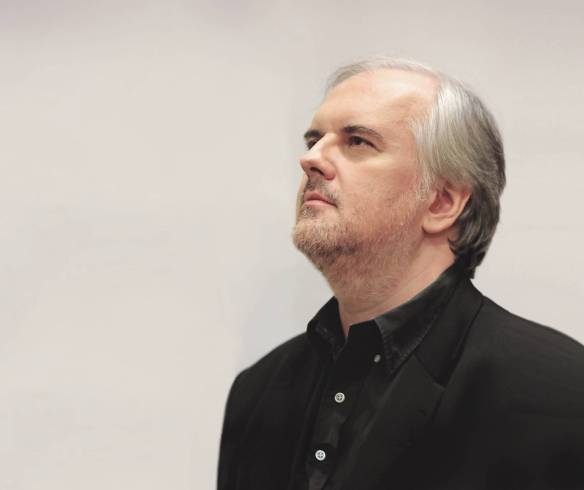
Lawrence Power (viola, above), Simon Crawford-Phillips (piano, below)

Wigmore Hall, Monday 21 October 2019 (lunchtime)

You can listen to this concert on the BBC Sounds app here (opens in a new window)

Review and guide by Ben Hogwood
Photo credit (Lawrence Power) Giorgia Bertazzi

BBC Radio 3’s curious title for this concert was Adventures with a viola, despite Lawrence Power spending the last third of the concert playing the violin. Such is his talent on both instruments that the switch appeared to be effortless, part of an adventurous programme exploring the idea of paying musical homage.

To that effect, the first three pieces in the concert were linked. François Couperin’s expansive Prélude from the Première Suite pour viole (from 3:09 on the broadcast) exploited the lovely tone Power could get from the lower reaches of his viola, which helped accentuate the composer’s chromatic writing. A joint arrangement with Simon Crawford-Phillips of Ravel’s Menuet from the wonderful Le tombeau de Couperin followed (6:40), a fitfully effective version that was perhaps too fast in its execution, rather glossing over the cold central passage and the charm of the Menuet theme itself. The lack of repeats in this gorgeous piece of music accentuated the pair’s quick approach, despite a clever pairing of themes towards the end.

Australian composer Arthur Benjamin is not at all well known in these parts, but has an important role in musical history as a tutor of some repute. His own music can be overlooked because of that, and on this evidence unreasonably so – for Le tombeau de Ravel (10:58) was a pretty adventurous collection of a prelude, six waltzes and a coda, extremely well performed by the duo here. Having originally written it for clarinet and piano, Benjamin followed Brahms’s example by producing a viola and piano version, the instruments having a very similar range. The gruff start leads way to contrasting dances of affection and a quickfire number (17:00) requiring (and receiving) great virtuosity and dexterity from Power. There is charm in this music, too, as the next pizzicato waltz indicates, with tumbling figures from Crawford-Phillips, before a ghostly waltz with harmonics at 20:17 offers a starker picture. This is contrasted by a rousing finish.

We then heard a striking version for viola and piano of Three Berceuses from Thomas Adès’ opera The Exterminating Angel. They are based on two of the duets from Beatriz and Eduardo, the opera’s doomed lovers, and an eerie cradle song. These brought a wide range of colour and virtuosity from Power, with Crawford-Phillips providing expertly judged punctuation. The first Berceuse movement (26:30) was down at heel, with wispy outlines from the viola, then the second (29:44) had more expansive phrases, ending with crushing left hand octaves from Crawford-Phillips. The ghostly ‘round’ of the third (34:04) had the most memorable melody, ending on a decidedly macabre note as a mother cradling a dead lamb rather than her son attempted to rock it to sleep. Power’s harmonics on the viola were cold indeed.

A second group of homages followed, Power switching to violin for the duration. It was piano alone for Stravinsky’s brief but poignant Le tombeau de Claude Debussy (39:56), setting the chorale theme from his Symphonies of Wind Instruments. Crawford-Phillips managed the voicing of the parts beautifully. Tributes to Debussy followed from Erik Satie and the poet Federico Garcia Lorca, Power reading the poem Debussy before Crawford-Phillips played the Satie Élégie (41:59). We then moved to a much more substantial tribute to the Spanish poet in the form of Poulenc’s troubled Violin Sonata.

The work itself had a tricky germination, its composer rejecting a couple of versions while not settling for the completed work either, returning to it in 1949. It is a dramatic piece, paying homage to the poet Lorca in assertive music that spills over into aggression in the first movement (44:10). In the second, an Intermezzo (50:37), Power and Crawford-Phillips painted exquisite shades through the bittersweet musical language, while the finale (56:38) was powerfully wrought, even more so when apparently hitting a wall (59:58) and sinking into desolation. A commanding performance proved Power’s aptitude in switching between musical instruments.

Repertoire

This concert contained the following music (with timings on the BBC Sounds broadcast in brackets):

François Couperin Prélude from Première Suite pour viole (1728) (3:09)
Ravel, arr. Power & Crawford-Phillips Menuet from Le Tombeau de Couperin (1914-17) (6:40)
Benjamin Le tombeau de Ravel (1958) (10:58)
Adès Three Berceuses from The Exterminating Angel (2018) (UK premiere) (26:30)
Stravinsky Le tombeau de Claude Debussy (1920) (39:56)
Lorca Debussy (1921-24) & Satie Élégie from Quatre petits melodies (41:59)
Poulenc Violin Sonata (1942-3, rev. 1949) (44:10)

Further listening

You can listen to most of the music heard in this concert in the available versions on Spotify below, with the exception of the Adès, which has understandably not yet been recorded:

Meanwhile Lawrence Power and Simon Crawford-Phillips can be heard in Arthur Benjamin’s Le tombeau de Ravel as part of this collection on Hyperion, where Power once again switches instruments for the composer’s violin works.

Poulenc‘s instrumental sonatas represent some of his very finest work, and this collection from the London Conchord Ensemble brings them all together:

Wigmore Mondays – Barry Douglas & Borodin Quartet – Shostakovich: Piano Quintet

Barry Douglas (piano, above), Borodin Quartet [Ruben Aharonian and Sergei Lomovsky (violins), Igor Naidin (viola), Vladimir Balshin (cello)] (below)

Wigmore Hall, Monday 14 October 2019 (lunchtime)

You can listen to this concert on the BBC Sounds app here (opens in a new window)

Review and guide by Ben Hogwood

For the 2019-20 season many of the BBC Radio 3 lunchtime concerts at the Wigmore Hall have taken on a playlist appearance. This all-Russian programme was no exception, with Tchaikovsky miniatures acting as a prelude to Shostakovich’s most successful chamber work, the Piano Quintet.

Tchaikovsky‘s The Seasons are a lovely set of miniatures for piano, characterising each month of the year rather than the four seasons. Barry Douglas, who has recently recorded the cycle, clearly holds the collection dear, and his accounts of March (the Song of the Lark) and October’s Autumn song were haunting and thoughtful by turn.

The Borodin Quartet followed with Tchaikovsky’s famous Andante cantabile for strings. The previous week they had given it in context, the second movement of four in the composer’s String Quartet no.1 in D major Op.11, where it is most effective. Here the silvery, muted textures were lovely, and the central section evoked a light dance, but the work’s placement felt constricted knowing the main act was still to come.

All that was emphatically put to bed by a storming performance of the Shostakovich Piano Quintet, as authentic an account as you could wish to hear. The first incarnation of the Borodin Quartet worked closely with the composer on many of his string quartets, and they performed the quintet with the composer on several occasions. The first-hand experience of their predecessors has not diluted the intensity of the experience in transition, and this was a searing account of one of 20th century chamber music’s most powerful utterances.

The Prelude (20:36) and Fugue (25:27) dovetailed beautifully, the former section imposing and powerfully wrought, the latter gathering a mood of grim resilience as the elements of its theme became ever more closely interwoven. This carried through to the outburst that is the Scherzo (35:28). Here Douglas came to the fore, striking the octaves in the upper right hand with shrill clarity, the quartet responding in kind as the textures veered towards the orchestral.

A graceful Intermezzo (39:12) was deeply poignant, the combination of bittersweet violin and simple plucked cello affecting from the outset. Emotions bubbled just under the surface throughout this movement, threatening to break loose at any moment. As the music slipped effortlessly into the finale (45:17) it shifted up a gear, with time for another big theme (46:35) before navigating to the calmer waters of the coda, where resolution was finally found in spite of the slightly ghostly string tone.

This was a tremendous performance, with every ounce of feeling communicated to the audience, occasionally at the expense of tuning in the upper violin area but with an unwavering intensity. The audience loved the repeat of the Scherzo as an encore.

Repertoire

This concert contained the following music (with timings on the BBC Sounds broadcast in brackets):

Tchaikovsky The Seasons Op.37a: March (2:00), October (4:31) (Barry Douglas solo)
String Quartet no.1 in D major Op.11, Second movement (Andante cantabile) (11:12) (Borodin Quartet)
Shostakovich Piano Quintet in G minor Op.57 (1940) (20:36) (Barry Douglas, Borodin Quartet)

Further listening

You can hear the music from this concert on the Spotify playlist below, containing recorded versions by the artists. The Borodin Quartet released Shostakovich’s Piano Quintet with pianist Alexei Volodin for Decca in 2018 – and here it is prefaced by one of the group’s several recorded versions of the Andante cantabile. Barry Douglas’s Tchaikovsky is part of an album of the complete cycle of The Seasons:

Another Russian chamber music powerhouse can be heard below. Tchaikovsky’s Piano Trio, written in memory of pianist Nikolai Rubinstein, is a deeply expressive piece full of pain and resilience. Here it is from Trio Wanderer:

Shostakovich was not done with his piano-based chamber music, adding a substantial Second Piano Trio four years later. You can hear it below with pianist Vladimir Ashkenazy, violinist Zsolt-Tihamér Visontay and cellist Mats Lidström – part of a very impressive all-Shostakovich disc:

On record – CBSO / Edward Gardner – Mendelssohn in Birmingham Vol.5: Overtures (Chandos)

Mendelssohn
Trumpet Overture Op.101 (1825)
Overture to A Midsummer Night’s Dream Op.21 (1826)****
Calm Sea and Prosperous Voyage Op.27 (1828)**
The Hebrides (Fingal’s Cave) Op.26 (1830)*
The Fair Melusine, Op. 32 (1834)
Overture to St. Paul Op.36 (1836)
Ruy Blas Overture Op.95 (1839)***
Overture to Athalie Op.74 (1844)
Lorenda Ramou (piano)

Chandos CHSA5235 [74’53”]

Producer Brian Pidgeon
Engineers Ralph Couzens, Jonathan Cooper and ****Robert Gilmour

Recorded *20-21 October 2013; **15 and ***16 February 2014; ****13-14 July 2015; 10-11 July 2018 at Town Hall, Birmingham

Written by Richard Whitehouse

What’s the story?

For the fifth release in Chandos’s series Mendelssohn in Birmingham, the City of Birmingham Symphony Orchestra and its onetime guest conductor Edward Gardner further traverse the orchestral output of a composer who was not averse to snatching mediocrity from the jaws of greatness.

What’s the music like?

It should be pointed out only a part of this release consists of new material. The Hebrides, Ruy Blas and Calm Sea and Prosperous Voyage first appeared in harness with Symphonies nos.4 and 5, nos.1 and 3, and no.2 respectively; while A Midsummer Night’s Dream was coupled with a selection of the incidental music for Shakespeare’s play as well as the Violin Concerto. Those who have been acquiring this series may thus feel a little short-changed, which perhaps makes purchasing those previously unreleased items as individual downloads the best option.

Proceeding chronologically, the Trumpet Overture reinforced Mendelssohn’s precocity in the wake of his Octet for strings – its breezily incisive manner, opened-out expressively by ominous asides, a viable template for future generations on which to hone their aspirations. Few could have hoped to match A Midsummer Night’s Dream as to prodigality of invention or technical resource, not least in terms of its redefining the orchestra near the outset of the Romantic era. A more prolix structure, Calm Sea and Prosperous Voyage yet merits revival through the limpid eloquence of its introduction and surging impetus of its Allegro towards a rousing peroration. That said, it cannot compare with The Hebrides in terms of an evocation sustained via formal sleight of hand and emotional clarity as remain breath-taking to this day.

Into the 1830s, The Fair Melusine still remains engaging for those subtly tangible images of watery domains (proto-Wagnerian, though the connection is easily overstated) and headlong fate through a vivid if increasingly impersonal idiom. Such impersonality had all but taken hold by the time of the oratorio St Paul, its overture breathing an aura of unforced piety and ‘natural order’ increased by the fugal interplay at its centre then almost apologetic fervency near its close. Mendelssohn rather grudgingly supplied incidental music for Victor Hugo’s play Ruy Blas, but the overture retains its drama and melodic appeal up to the surging coda. Would that Athalie conveyed comparable conviction, but this overture to Jean Racine’s play yields little more then technical proficiency as its composer strives gainfully for inspiration.

Does it all work?

On a technical level, absolutely. Mendelssohn was a master of his craft whose abundant early promise was only intermittently fulfilled by his later music. Tackling these overtures in order of composition (rather than that of this disc) tends to reinforce such an observation, which is not to deny the sheer technical command of even those lesser pieces or of the conviction that Gardner and his players have invested into this programme overall. Save for just a couple of overly headlong climaxes, there is little to fault here in terms of either playing or recording.

Is it recommended?

Yes, with the proviso detailed above. Bayan Northcott’s estimable booklet note mentions the overture to cantata The First Walpurgis Night as being inseparable from its main work, which makes a CBSO recording of this ‘dark horse’ among Mendelssohn works the more desirable.

Stream

tbc

Buy

For more information on this release and to purchase in multiple formats visit the Chandos website

On record – Lorenda Ramou – From Berlin to Athens: Skalkottas Piano Works (BIS)

Skalkottas
Griechische Suite A/K79a (1924)
(Suite) A/K79b (1924)
Sonatina A/K75b (1927)
15 kleine Variationen A/K75c (1927)
Suites – no.2 A/K72 (1940); no.3 A/K73 (1941); no.4 A/K74 (1941)
The Gnomes A/K110 (1939)

Lorenda Ramou (piano)

BISBIS 2364SACD [87’43’’]

Producer & Engineer Christian Starke

Recorded October and November 2017 at Reitstadel, Neumarkt in der Oberpfalz

Written by Richard Whitehouse

What’s the story?

Between 1998 and 2008 BIS undertook a ground-breaking series devoted to Nikos Skalkottas (1904-1949), and this new release features almost all the music for solo piano that was still to be collated. The result is a fascinating journey through one facet of this fascinating composer.

What’s the music like?

As Lorenda Ramou indicates, this recital divides into three parts.

The first of these comprises music written in Berlin during Skalkottas’s study there, including the composer’s two earliest surviving works. Greek Suite is a quirkily appealing amalgam of neo-classical and traditional stylisms with distinct jazz overtones in its closing movement. The ‘Suite’ (its title can only be conjectured as the first two pages of music are missing) develops these influences on a larger scale, not least the scintillating Shimmy tempo finale. Come the Sonatina and Skalkottas’s language has evolved apace – hence the expressively detached Siciliano, then restive finale with its ominous coda; an upbeat to the masterly 15 Little Variations on a Beethoven-inspired theme that finds a natural climax in its laconic recollection following a subdued apotheosis.

The next three pieces were all written in Athens during Skalkottas’s ‘inner exile’ after being repatriated. Ramou’s implication that the Second, Third and Fourth Suites (the earlier First Suite was recorded by Nikolaos Samaltanos on BIS1133/4) form an extended sequence that fuses this composer’s preoccupation with ‘classical’ and popular’ formal archetypes in his mature post-tonal language. Highlights include the angular virtuosity of no.2’s Rapsodie, the inexorable motion of no.3’s Marcia funebre, and the oblique wistfulness of no.4’s Serenade. Performable (also listenable to) separately or as a 30-minute continuum, these confirm Skalkottas’s mastery of a medium about which he often felt equivocal yet to which he contributed some of the most thought-provoking music from the mid-twentieth century.

Also written in Athens, The Gnomes was intended to accompany a Christmas dance-show but rhythmic difficulty led Skalkottas to orchestrate a selection of miniatures by other composers under an identical title (recorded by the Caput Ensemble on BIS1364). Relocated in 2015, the present piece unfolds in two parts of six and three items – the former as tensile and impulsive as the latter – notably an Intermezzo (Chorale) – are hieratic and evocative. What the scenario depicted is unclear, though the presence of a Greek carol rather suggests something seasonal.

Does it all work?

To varying degrees according to when the music was written. The Variations and three Suites can rank with the finest Skalkottas compositions, while the early pieces and The Gnomes are fascinating subsidiary items. Nothing here should be without interest for discerning pianists.

Is it recommended?

Indeed. Ramou is a perceptive guide throughout, even if certain of the more extrovert pieces could evince greater panache. Among the previously recorded works, those from Samaltanos (BIS) of the Sonatina and Variations are coupled with the 16 Melodies, with those by Steffen Schleiermacher (MDG) and Lefki Katanou-Lindahl (Caprice) of Third and Fourth Suites part of miscellaneous recitals. At nearly 88 minutes, this is among the longest discs yet issued, but the range and depth of the SACD sound is wholly commensurate with BIS’s usual standards.

Stream

Buy

For more information on this release and to purchase in multiple formats visit the BIS website

On record – Salviucci: Serenade, Chamber Symphony & String Quartet (Naxos)

Salviucci
Cinque Pezzi (1930)*
Pensiero nostalgico (1931)*
String Quartet in C major (1932)*
Salmo di David (1933)*/***
Sinfonia da camera (1933)**
Serenata (1937)**

***Sabina von Walther (soprano); Ensemble Überbrettl / Pierpaolo Maurizzi (piano)
***Latin text and English/Italian translation.

Naxos 8.574049 [83’05”]

Producer Giovanna Salviucci Marini
Engineer Tommaso Tacchi

Recorded *23-25 July 2017 at Sala dei Concerti di Palazzo Chigi Saracini, Sienna and **4-7 October 2018 at Teatro degli Atti, Rimini

Written by Richard Whitehouse

What’s the story?

Naxos continues its inestimable series devoted to Italian music of the twentieth century with this disc of mainly first recordings by Giovanni Salviucci (1907-1937) – a largely forgotten composer, whom his contemporary Goffredo Petrassi once referred to as ‘‘the best of us all’.

What’s the music like?

Although his composing career lasted barely a decade, Salviucci left several notable works across most major genres. Of those pieces included here, earliest is the Five Pieces for violin and piano – appealing if expressively unvaried music, from which only the lively Alla Festa hints at his later rhythmic ingenuity. Each of them, though, would make an attractive encore; as too would Nostalgic Thought for cello and piano, or Psalm of David for soprano and piano – verse from Psalm 61 with its roots in a modality also drawing on French and Italian sources.

Just before this latter piece, Salviucci achieved something of a breakthrough with his String Quartet. The fast-slow-fast trajectory may yield no obvious surprises, but beneath the intently contrapuntal surface of its outer movements is a quixotic handling of tonality that offsets any risk of predictability. The highlight (in every sense) is the slow movement, an Adagio whose suffused eloquence and finely wrought rhetoric transcend Salviucci’s earlier music. That the piece is unpublished is something this excellent recording should go some way to remedying.

The other two pieces have previously been recorded, which hardly makes them familiar. Its scoring for 17 instruments suggests that the Chamber Symphony may have been conceived with knowledge of Schoenberg’s eponymous work, even though Salviucci’s approach to the balance between wind and strings is less combative and more pragmatic. Outer movements combine rhythmic incisiveness with a harmonic lambency redolent of Vaughan Williams, while the heartfelt Adagio and piquant scherzo confirm an ongoing process of maturation.

A process culminating in the Serenade that was Salviucci’s last completed work. Scored for nine instruments, its textural clarity and harmonic astringency suggest increasing familiarity with the composer’s inter-war contemporaries (Italian and otherwise), and if the lively outer movements are almost too succinct for their motivic ingenuity fully to register, the Canzona elides between soloistic and ensemble writing with deft mastery. The Venice premiere, four days after Salviucci’s death, must surely have rendered the loss of such potential more acute.

Does it all work?

For the most part. Salviucci’s earlier music may be notable more for fluency of technique, but the composer’s idiom evolved apace over his few remaining years, so that one is left only too aware of what he might have gone on to achieve in the very different cultural climate of post-war Italy.

The performances by the excellent Ensemble Überbrettl leave little to chance, with Pierpaolo Maurizzi as astute in direction as he is a pianist. Sound is just a little confined in the chamber works, while Giordano Montecchi’s notes provide a valuable biographical overview.

Is it recommended?

Indeed. Salviucci was already a composer to reckon with, and this generous selection makes an ideal introduction to his music. Hopefully Naxos will now turn to the handful of orchestral works that he completed: in the meantime, the present release should be acquired forthwith.

Stream

Buy

For more information on this release and to purchase in multiple formats visit the Naxos website