In concert – Lawrence Power, CBSO / Nicholas Collon: Stravinsky, Britten & Shostakovich

nicholas-collon

Lawrence Power (viola), City of Birmingham Symphony Orchestra / Nicholas Collon (above)

Stravinsky Symphonies of Wind Instruments (1920, revised 1947)
Britten Lachrymae Op.48a (1950, orch. 1976)
Shostakovich Symphony no.5 in D minor Op.47 (1937)

Symphony Hall, Birmingham
Wednesday 26 May 2pm

Written by Richard Whitehouse

This second in the City of Birmingham Symphony Orchestra’s live concerts, heading out of lockdown, featured works from the first half of the last century – focussing on wind then strings, before bringing the whole orchestra into play for one of the defining symphonies from this period.

It was an astute move to open with Stravinsky’s Symphonies of Wind Instruments as, 14 days short of the centenary of its premiere to a bemused London public, the extent of its innovation and influence was there for all to hear. The performance was attuned to its bracing alternation of diverse musical types, and while the elongated platform layout might have caused passing uncertainties, Nicholas Collon made a virtue of its fluid continuity right through to the final chorale which ‘remembers’ Debussy with an emotion the more acute for its hieratic restraint.

It may have entered the repertoire but slowly, Britten’s Lachrymae is now well to the fore of the viola’s still limited concertante output and Lawrence Power gave a potent rendering of a piece conceived for William Primrose then orchestrated for Cecil Aronowitz. The evocative if sparse writing for strings is a reminder this was Britten’s final creative act, bringing out the ambiguous shadings of these variations on Dowland’s Flow my tears (played and sung at the outset by Power) which culminate with a rendering of the full song in all its grave elegance.

Speaking beforehand, Collon (who gave a perceptive account of the Ninth Symphony with the CBSO some years back) spoke of his pleasure in utilizing the extent of Symphony Hall’s platform to programme a work on the scale of Shostakovich’s Fifth Symphony. Accordingly, this was a performance whose impact and intensity were evident from the outset; the opening movement unfolding gradually but with keen underlying intensity though its searching, then wistful main themes, to a surging development and climactic reprise before subsiding into a fateful coda. If the scherzo was less capricious than it often is, Collon’s trenchant handling   of its outer sections exuded an acerbic charm – offset by the trio’s deadpan humour (with an airily whimsical solo from leader Jonathan Martindale), before a pay-off of ominous import.

The ensuing Largo is the work’s emotional heart in every sense, and this afternoon’s reading made the most of its fraught eloquence with some limpidly unforced string playing then, in the mesmeric central episode, woodwind soliloquys of a spectral remoteness. Nor was there any lack of gravitas as the movement reached a baleful culmination, and from where Collon oversaw a faultless transition through to those consoling final bars. Always difficult to bring off, the finale had the virtue of almost seamless progression through its high-octane opening stages then the musing introspection at its centre – Collon making light of some tricky tempo changes on the way to an apotheosis of unremitting focus. The tonal ambivalence between triumph and tragedy might have been more acute, but its inevitability was never in doubt.

An impressive way to conclude what was almost a full-length concert (and one these players had to repeat just three hours later). The CBSO returns next Wednesday with a less strenuous programme which will include a welcome outing for Mendelssohn’s Reformation Symphony.

For further information about the CBSO’s current series of concerts, head to the orchestra’s website

For further information about the next concert on Wednesday 2 June, click here

In concert – Stephen Hough, CBSO / Edward Gardner: Saint-Saëns, Mazzoli & Debussy

hough-gardiner

Stephen Hough (piano), City of Birmingham Symphony Orchestra / Edward Gardner

Saint-Saëns Piano Concerto no.4 in C minor Op. 44 (1875)
Mazzoli Violent, Violent Sea (2011)
Debussy La Mer L109 (1903-05)

Symphony Hall, Birmingham
Wednesday 19 May 2pm

Written by Richard Whitehouse

It may have been almost six months since the City of Birmingham Symphony last played to live audiences, but the frisson of expectation was palpable as the orchestra gradually took the stage for this first of nine concerts that, at around an hour’s duration, are being heard at 2pm then again at 6.30. The design of Symphony Hall’s platform makes it possible, moreover, to take out the raised platforms and so accommodate a larger number of musicians than would otherwise be possible in what is (hopefully!) a transitional period out of lockdown. Current restrictions still entail the spreading out of listeners, a small price to pay given the quality of acoustic at almost any point in this auditorium, while the rapid entry and exit procedures also enabled punters to assess the remodelled catering areas in advance of their June reopening.

As conducted by Edward Gardner, this programme featured works by two French composers with more in common than either could have suspected. Saint-Saëns nearly always brings out the best in Stephen Hough, and so it proved in this regrettably rare revival of the Fourth Piano Concerto. Its four sections grouped into two movements (a design the composer returned to a decade on with greater panache if less subtlety in his Third Symphony), the piece touches on aspects of sonata, variation and rondo procedures while its plain-spun material is developed in various and intriguing ways. This plus the close integration of soloist and orchestra often makes for a sinfonia concertante than concerto per se, yet there is no lack of virtuosity such as Hough despatched with alacrity – not least the cascading passagework in the final Allegro.

Saint-Saëns and Debussy evinced no mutual esteem, but as the former integrated symphonic elements into his concerto, so did the latter in his ‘three symphonic sketches’ which comprise La Mer. Here the CBSO came into its own, not least in the purposefully contrasted sequence of From Dawn to Midday on the Sea with its crepuscular writing for solo wind and divided strings through to a climactic chorale of visceral immediacy. Perhaps interplay of timbre and texture in Games of the Waves could have been more deftly handled, but Gardner exerted a firm grip over its course then drew real pathos from the final bars. He also found a persuasive balance between the volatile and poetic aspects in Dialogue of the Wind and the Sea, while maintaining steady momentum as issued forth in the chorale on its proudly affirmative return.

Between these works, Violent, Violent Sea by the highly regarded American composer Missy Mazzoli elicited a wholly different response as to its marine concept. Here it is the constant yet rarely insistent melding of translucent harmonies and pulsating rhythms (stemming from marimba and vibraphone) as underpin this music; the sustaining of whose atmosphere is the keener for its succinct duration. The ranging of its relatively modest forces across the extent of the platform also made for rather greater impact than might otherwise have been the case. It certainly added to the attractions of a programme which launched this series of concerts in impressive fashion. The CBSO returns next Wednesday with Nicholas Collon at the helm for a sequence that ends with the uncompromising defiance of Shostakovich’s Fifth Symphony.

For further information about the CBSO’s current series of concerts, head to the orchestra’s website

For further information about Missy Mazzoli, click here

In concert – Members of Birmingham Contemporary Music Group: Huang Ruo: A Dust in Time

dust-in-time

Members of Birmingham Contemporary Music Group [Kate Suthers (violin), Colette Overdijk (violin), Adam Römer (viola), Ulrich Heinen (cello)]

Huang Ruo A Dust In Time (2020)

St Paul’s Church, Hockley, Birmingham
Tuesday 18 May

Written by Richard Whitehouse

The coronavirus pandemic and its attendant lockdowns has put paid to many events, not least a performance of A Dust in Time by Huang Ruo planned by Birmingham Contemporary Music Group for December, after a memorable online account three months earlier. Fortunately, it was possible to reschedule this to coincide with the further lifting of restrictions – enabling a socially distanced audience to hear what, when that created as the consequence of these past   18 months can be assessed more objectively, will come to be regarded as a defining artwork.

Born in southern China and now resident in the United States, Huang has emerged among the more striking composers of his generation (recordings of four Chamber Concertos and three of his ‘Drama Theatre’ pieces are well worth investigating on Naxos). Stylistically his music ranges across Eastern and Western, traditional and original sources – the resulting synthesis notable for its keen integration. An approach evident in this work, contrast between whose underlying concept and formal procedures are outweighed by its overall expressive impact.

Drawing inspiration from the circular concept of the mandala central to Hindu and Buddhist cultures (not least that of Tibet), while unfolding along the lines of a passacaglia which has long been a favoured formal model in European music, A Dust in Time patently evokes issues of transience and becoming over the course of an inevitable yet inexorable progress. Starting and ending on unaccompanied cello, it draws in viola, second then first violins as harmonic and rhythmic movement increase towards the sustained convergence of sound and emotion.

In its shortest incarnation (as previously performed by groups such as the ASKO-Schönberg Quartet) the piece ends here, but this evening it gradually effected a falling-off of tension on the way back to its beginning – deft usage of the Golden Section bringing it full circle at just under an hour’s length. In the earlier stages, listeners may have been reminded of the opening ‘Elegy’ from Shostakovich’s 15th Quartet with its oblique allusion to Russian Orthodox chant and comparable ‘otherness’, but the continuation and outcome could hardly be more different.

The performance, by a quartet from BCMG, was no less impressive than that given online by these same musicians – not least in its immaculate tonal blending and sense of venturing forth on a shared trajectory toward a common goal. Ensemble faltered passingly in the later stages, but never enough to undermine the intense focus and concentration which was brought to the music-making. Certainly, those present were held in thrall through to the transfigured closing bars – heard to advantage in the resonant while never cloying ambience of St Paul’s Church.

Huang has spoken of an extended version in which the piece can be looped round to twice its current length and played by a larger body of strings as an installation, though it is debatable whether music of this intensity would translate into a relatively passive listening experience. Hopefully, tonight’s account will be made available commercially – making possible a larger audience for a work which, together with the Donmar Warehouse’s production Blindness last year, is the surest statement of defiance and transcendence in the face of unforeseen tragedy.

Last year’s BCMG online performance of A Dust in Time can be seen here:

For further information about Huang Ruo you can visit his website here, while more information on the activities of the Birmingham Contemporary Music Group can be found at their website

In concert – Michael Collins & Michael McHale: Widor, Bax, Muczynski & Horovitz @ Wigmore Hall

collins-mchale

Michael Collins (clarinet), Michael McHale (piano)

Widor Introduction et Rondo Op.72 (1898)
Bax Clarinet Sonata in D major (1934)
Muczynski Time Pieces Op.43 (1984)
Horovitz Sonatina (1981)

Wigmore Hall, London
Monday 17 May (review of the online broadcast)

Written by Ben Hogwood

What a joy to see audiences back in Wigmore Hall on a Monday lunchtime, as the venue took its first available opportunity of 2021. The gathering was for an enterprising program of 20th century works for clarinet and piano from Michael Collins and Michael McHale, pleasingly off the beaten track in its selection and proving highly accessible.

Viewed online in this case, the excitement was palpable – from Andrew McGregor’s introduction for the live broadcast on BBC Radio 3 to the performers’ demeanour as they began. The clarinetist successfully overcame an instrument malfunction, too, which caused him to repeat the first few minutes of the Bax sonata.

Collins and McHale began with Widor, however, a competition piece written for students of the Paris Conservatoire in 1898. Both performers settled immediately, Collins with a beautifully floated introduction and McHale with sensitive pedaling, the pianist then echoing the excitable flourishes from of clarinet when the Rondo itself arrived. This work occupies a happy place in Widor’s output, and was a joyful overture here.

The mood deepened for the Clarinet Sonata in D major of Sir Arnold Bax from 1934. First performed by Frederick Thurston, it is an unusually structured work, but the two movements sit together nicely. It was during the beautifully floated opening that Collins had to change his clarinet, but the advantage of this was that we were able to marvel at his control for a second time, supported by rippling figures from McHale. The first movement unfolded as though in one long phrase, revealing the influence of Wagner but establishing Bax’s own melodic grace too. The second movement had impressive urgency, with chromatic surges from the piano and impressive breath control from Collins. A typically deep second theme was matched by a lovely, poised closing section.

The Polish-American composer Robert Muczynski has an intriguing works list including many pieces for woodwind, and the Time Pieces of 1984 are among his most-performed. Each of the four movements looks to bring out different qualities of the clarinet and Collins was fully alive to their possibilities. The busy first piece was enjoyable, clarinet and piano ducking and diving in their interplay, while time became suspended in the outer sections of the second piece, lost in thought. The third explored the timbres of the solo clarinet, wonderfully nuanced by Collins, while the spicy dialogue of the fourth was laden with syncopation and brilliantly played.

The Sonatina for clarinet and piano from Joseph Horovitz dates from 1981, when it was first performed by Gervase de Peyer and Gwenneth Pryor in the Wigmore Hall itself. Like Muczynski, Horovitz is at home writing for wind and brass. Working within a compressed structure, the Sonatina was packed with incident and melody. A perky first movement unfolded with easy, winsome phrases, while the second was more introspective and took time for soul searching. Not so the finale, whose offbeat japes were carefree and witty in this performance, instinctively played.

It was over all too soon – but we were treated to an encore, Collins every bit as enthused as the audience. The warm-hearted Summer, from Paul Reade’s suite Victorian Kitchen Garden, was the ideal choice.

This concert is available to play for 30 days using the YouTube embedded link above.

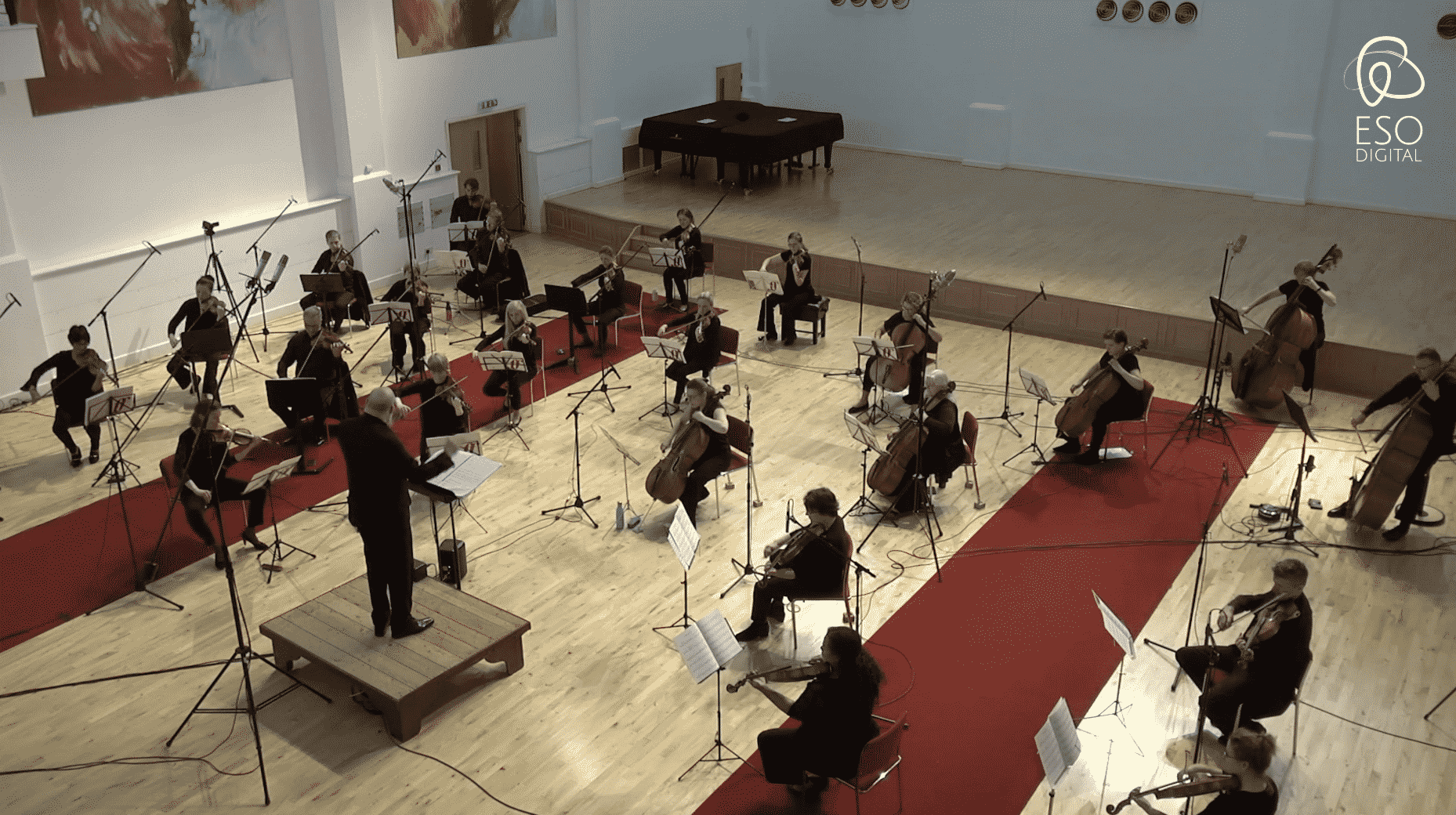
Live review – English Symphony Orchestra / Kenneth Woods: Elgar Reimagined Part 2

ElgarStringQuartet-Screenshot

English Symphony Orchestra / Kenneth Woods

Elgar, arr. David Matthews String Quartet in E minor Op.83 (1918)

Wyastone Concert Hall, Monmouth
Recorded September 22 2020 for online broadcast from Friday 14 May 2021

Written by Richard Whitehouse

Following its programme of miniatures – original and arrangements – for cello and strings in March, this latest online concert by the English Symphony Orchestra returned to Elgar for a reading of his String Quartet arranged by David Matthews for a full complement of strings.

This was the second in a triptych of chamber works composed in rural seclusion at Brinkwells in Sussex, Elgar having escaped the wartime disillusion of London for what was to be his last sustained period of creativity. Less introspective than the Violin Sonata that preceded it while less emotionally charged than the Piano Quintet that came after, the String Quartet is the most finely proportioned of the three – unfolding as a sustained sweep whose subtle transformation of thematic elements across and between its three movements make it among the finest of his later compositions. Heard in this guise, it follows on from the Serenade then Introduction and Allegro as the hitherto missing large-scale work for string orchestra of Elgar’s high maturity – which should hopefully commend it to an audience beyond that of the composer’s devotees.

Matthews has numerous arrangements to his credit (not least Schumann’s Piano Concerto as recast for marimba), and he has been mindful to balance the soloistic and ensemble potential of this music, so the result is neither straightforward transcription nor radical re-conception. The opening Allegro moderato discreetly emphasises an autumnal musing that sets the tone for much of what follows; even finer is the second movement – marked Piacevole – whose equability yields a main theme suffused with intensity, the extent of which is only revealed towards the close. If the emotional acuity of the final Allegro is marginally diffused when rendered for larger forces, there is no lack of rhythmic definition as the music proceeds to a coda whose terse decisiveness is far removed from the opulence of just a few years before.

Its idiomatic nature was enhanced by the ESO’s attentive playing under Kenneth Woods, a natural follow-on to their take on the Piano Quintet in Donald Fraser’s arrangement (Avie). Heard together, these two parts of Elgar Reimagined should make for a desirable recording.

You can watch the concert on the English Symphony Orchestra website here

For more information on the English Symphony Orchestra you can visit their website here