Mozart Piano Sonata no.13 in B flat major K333 (1783-4) Debussy Images Set 1: Reflets dans l’eau (1901-5); Suite Bergamasque: Clair de lune (c1890, rev. 1905) Dupont Les heures dolentes: Après-midi de Dimanche (1905) Hahn Le Rossignol éperdu: Hivernale; Le banc songeur (1902-10) Koechlin Paysages et marines Op.63: Chant de pêcheurs (1915-6) Schmitt Musiques intimes Book 2 Op.29: Glas (1889-1904)
Wigmore Hall, London Monday 28 April 2025 (1pm)
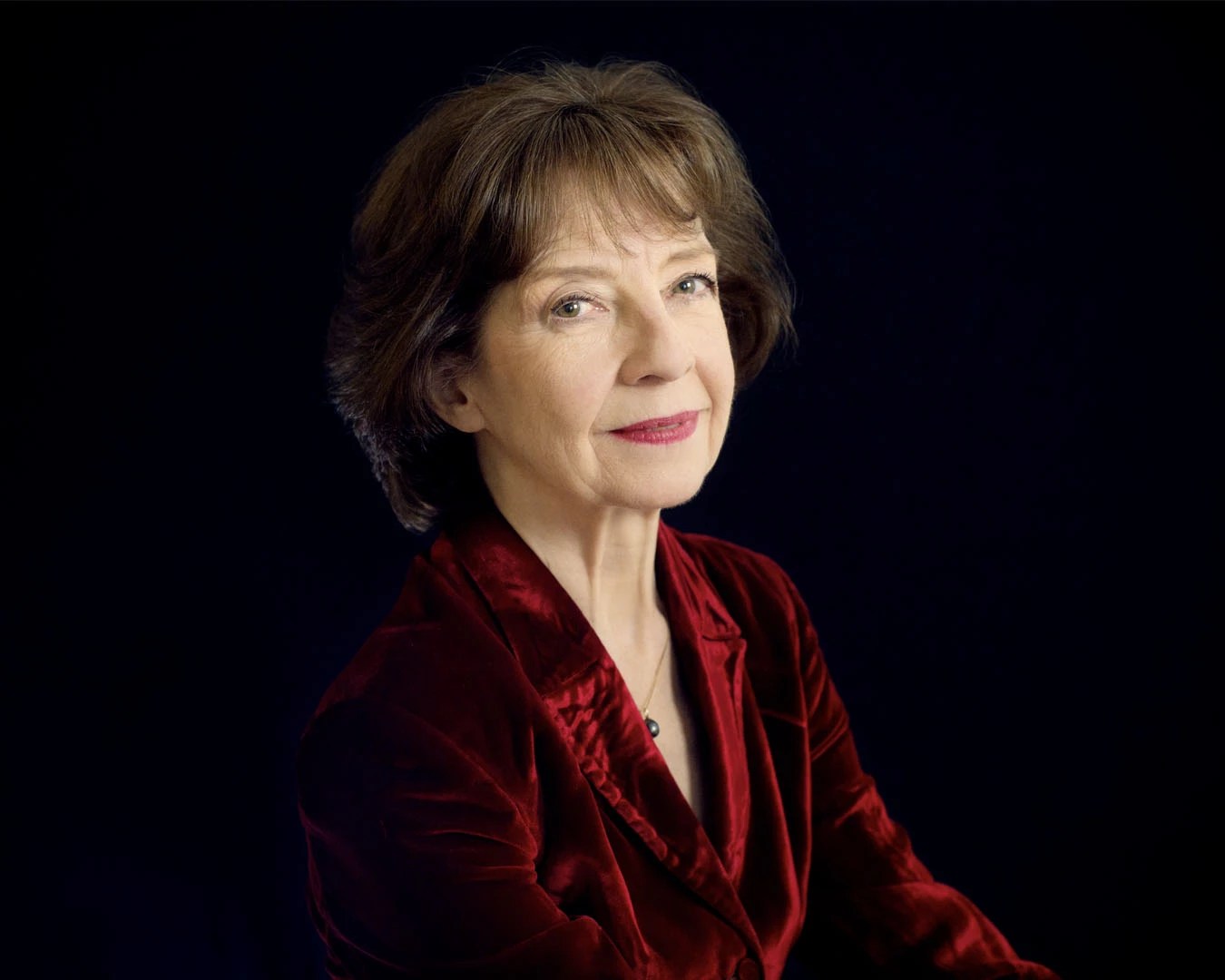
by Ben Hogwood picture of Anne Queffélec (c) Jean-Baptiste Millot
The celebrated French pianist Anne Queffélec is elegantly moving through her eighth decade, and her musical inspiration is as fresh as ever. The temptation for this recital may have been to play anniversary composer Ravel, but instead she chose to look beneath the surface, emerging with a captivating sequence of lesser-known French piano gems from the Belle Époque, successfully debuted on CD in 2013 and described by the pianist herself as “a walk in the musical garden à la Française.”
Before the guided tour, we had Mozart at this most inquisitive and chromatic. The Piano Sonata no.13 in B flat major, K.333, was written in transit between Salzburg and Vienna, and the restlessness of travel runs through its syncopation and wandering melodic lines. Queffélec phrased these stylishly, giving a little more emphasis to the left hand in order to bring out Mozart’s imaginative counterpoint. She enjoyed the ornamental flourishes of the first movement, the singing right hand following Mozart’s Andante cantabile marking for the second movement, and the attractive earworm theme of the finale, developed in virtuosic keystrokes while making perfect sense formally.
The sequence of French piano music began with two of Debussy’s best known evocations. An expansive take on the first of Debussy’s Images Book 1, Reflets dans l’eau led directly into an enchanting account Clair de Lune, magically held in suspense and not played too loud at its climactic point, heightening the emotional impact.
The move to the music of the seldom heard and short lived Gabriel Dupont was surprisingly smooth, his evocative Après-midi de Dimanche given as a reverie punctuated by more urgent bells. Hahn’s Hivernale was a mysterious counterpart, its modal tune evoking memories long past that looked far beyond the hall. Le banc songeur floated softly, its watery profile evident in the outwardly rippling piano lines. The music of Charles Koechlin is all too rarely heard these days, yet the brief Le Chant des Pêcheur left a mark, its folksy melody remarkably similar to that heard in the second (Fêtes) of Debussy’s orchestral Nocturnes.
Yet the most striking of these piano pieces was left until last, Florent Schmitt’s Glas including unusual and rather haunting overtones to the ringing of the bells in the right hand. Queffélec’s playing was descriptive and exquisitely balanced in the quieter passages, so much so that the largely restless Wigmore Hall audience was rapt, fully in the moment. Even the persistent hammering of the neighbouring builders, a threat to concert halls London-wide, at last fell silent.
Queffélec had an encore to add to her expertly curated playlist, a French dance by way of Germany and England. Handel’s Minuet in G minor, arranged by Wilhelm Kempff, was appropriately bittersweet and played with rare beauty, completing a memorable hour of music from one of the finest pianists alive today.
Listen
You can listen to this concert as the first hour of BBC Radio 3’s Classical Live, which can be found on BBC Sounds. The Spotify playlist below has collected Anne Queffélec’s available recordings of the repertoire played:
Ravel Miroirs (1905) Despax Sounds of Music – Concert Paraphrase on The Sound of Music by Richard Rodgers and Oscar Hammerstein (unknown) Fauré arr. Despax Après un rêve Op.7/1 (1877) Debussy Clair de lune (1905) Ravel Gaspard de la nuit (1908)
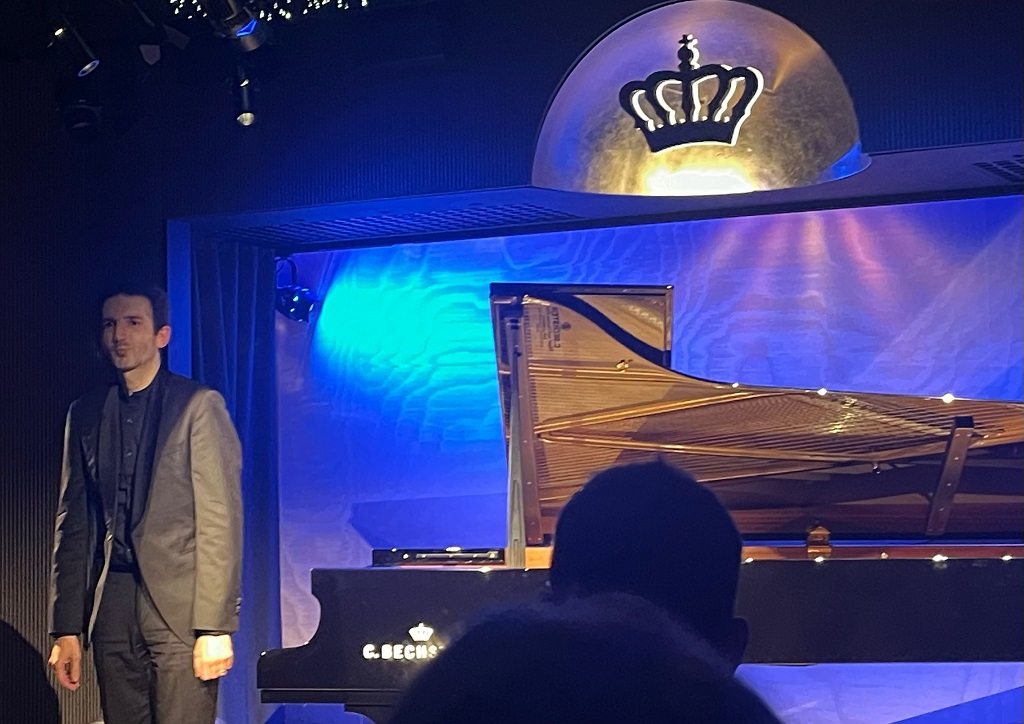
Bechstein Hall, London, 7 March 2025
by John Earls. Photo credit (c) John Earls
The most recognised piece of music by French composer Maurice Ravel is his 1928 large orchestral work Boléro, famously used in the film 10 and by Torvill and Dean when ice dancing their way to a 1984 Winter Olympics gold medal.
But there is also a magnificent repertoire of piano music including for solo piano and this provided the main feature of this recital by Emmanuel Despax, marking the 150th anniversary of Ravel’s birth.
The first set opened with Miroirs (Mirrors), a suite of five short movements Ravel dedicated to his fellow members of the French avant-garde artist group Les Apaches.
Noctuelles (Night Moths) had twinkling moments of calm surfacing through its dark undertones, contemplative birdsong is evoked in Oiseaux tristes (Sad Birds), Une barque sur l’océan (A Boat on the Ocean) captured both the flow and ripple of the waves, Alborada del gracioso (The Jester’s Aubade) had a jittery, Spanish aspect, and the bells of La vallée des cloches (The Valley of Bells) are not peals so much as melancholic, dark flashes.
The set ended with Despax’s Sounds of Music, a ‘Concert Paraphrase’ on Rodgers and Hammerstein’s The Sound of Music. I enjoyed its dark humour and nods to other classical piano composers – “If you hear something you recognise it’s not plagiarism, it’s on purpose” Despax forewarned us.
The second set opened with Despax’s arrangement of Faure’s Après un rêve(After a Dream) which was serious and majestic followed by Debussy’s Clair de lune(Moonlight) which whilst thoughtful and considered was also beautifully delicate and expressive.
But the evening was Ravel’s and it concluded with his epic three part masterpiece Gaspard de la nuit(Gaspard of the Night) derived from the prose poems by Aloysius Bertrand. Described by Despax as a “symphonic work for solo piano” it is notoriously difficult to play.
Ondine’s hypnotic trills are shaken by a short powerful blast towards the end and Despax displayed his virtuosity throughout. Le Gibet presents bells of a different kind to those featured in the earlier set, more disturbing and ominous as the repeating tolls maintained throughout evoke the lone hanged man of its inspiration. The way Despax leaned into his keyboard in rapt concentration reminded me of jazz pianist Brad Mehldau at his most intense. The final piece, Scarbo, depicts a mischievous goblin and was spritely before its dramatic long pause towards the end and a forceful energetic finish. It was as captivating to watch as it was to listen to.
What was clear from this performance is the attachment and affinity that Emmanuel Despax has for the music of Maurice Ravel. This was confirmed by an encore of Pavane pour une infante défunte (Pavane for a Dead Princess) which provided a moving and tender conclusion to the evening.
John Earls is Director of Research at Unite the Union. He posts on Bluesky and tweets / updates his ‘X’ content at @john_earls
Recital Hall, Royal Birmingham Conservatoire, Birmingham Monday 17 & Tuesday 18 February 2025
Reviewed by Richard Whitehouse
Royal Birmingham Conservatoire has put on some notable extended events over recent years, the latest being Best of British – a two-day retrospective of piano music from UK composers past and present, all performed by current, former and associated musicians of this institution.
Monday lunchtime centred on composers ‘Made in Birmingham’, beginning with the Second Sonata of John Joubert. His three such works encompass almost his whole maturity, of which this is the longest – taking in a cumulatively intensifying Allegro, volatile Presto with a more equable trio, then a finale whose fantasia-like unfolding culminates in a powerful resolution. Rebecca Watson was a sure and perceptive exponent. Dorothy Howell’s Toccata was given with verve by Rufus Westley, with Christopher Edmonds’ Prelude and Fugue in G elegantly rendered by Ning-xi Wu. Chiara Thomson was dextrousness itself in Howell’s Humoresque, then Zixin Wen found quixotic humour in her Spindrift, before John Lee and Ruimei Huang enjoyed putting Joubert’s early and engaging Divertimento for piano duet through its paces.
Monday afternoon opened with Frank Bridge – his Three Lyrics given by John Lee with due appreciation of their keen insouciance, as too the menacing aura of his much later Gargoyles. Established as the pre-eminent English art-song composer of his generation, Ian Venables is no less adept in combining violin and piano – witness the expressive poise but also rhythmic impetus of his Three Pieces, to which RBC alumni Chu-Yu Yang and Eric McElroy were as emotionally attuned as they were in plumbing the expressive depths of Gerald Finzi’s Elegy.
Next came John Ireland – his imposing if somewhat discursive Ballade finding a committed advocate in Roman Kosyakov, who had no less the measure of his atmospheric Month’s Mind with its undertones of Medtner. Yinan Tong proved suitably alluring in The Island Spell (the first of Ireland’s Decorations), while Ruimei Hang conveyed elegance as well as playfulness in Bridge’s Three Sketches. Expertly partnered by Sarah Potjewijd, clarinettist Jamie Salters steered an insightful course through the diverting formal intricacy of Ireland’s Fantasy Sonata.
Monday evening commenced with further Ireland in ‘Phantasie’ mode – his First Piano Trio finding a productive accord between its Brahmsian inheritance and his own, subtly emerging personality at the hands of violinist Roberto Ruisi, cellist Nicholas Trygstad and pianist Mark Bebbington. They were joined by violinist Shuwei Zuo and violist Jin-he Huang in Venables’ Piano Quintet, among the most substantial and certainly the best known of his chamber works. Its opening Allegro is preceded by an Adagio whose acute pathos underlies the robust energy of what follows, before a Largo such as takes in the capriciousness of its scherzo-like central section without disrupting its soulful discourse; while the finale’s animation is not necessarily resolved by its slow postlude, a sense of this music come affectingly full circle is undeniable.
The second half found these artists in a performance of Sir Edward Elgar’s Piano Quintet doing full justice to a work which, whatever its eccentricity of form and content, is worthy to stand beside any of his mature masterpieces. How persuasively they elided between the haunting ambivalence of the first movement’s introduction and its trenchant Allegro, with the central Adagio gradually emerging as a statement of great emotional import, then the final Allegro building inevitably to an ending of fervent affirmation. Memorable music-making indeed.
Tuesday lunchtime brought more ‘Made in Birmingham’. Michael Jones gave an interesting overview of his teacher Christopher Edmonds, two more of whose Preludes and Fugues – the elegance of that in E then the rapture of that in A – preceded his Aria Variata which, inspired by wartime experiences in the Crimea, channels the influences of Scriabin and Cyril Scott to personal ends. Zoe Tan teased out unity from within the diversity of Howell’s appealing Five Studies, before Duncan Honeybourne gave of his best in the Third Sonata written for him by Joubert. Inspired by lines from Thomas Hardy on the innate futility of the human condition, its three movements unfold an inevitable trajectory from aggression, through compassion, to a resolution more powerful for its inherent fatalism. A fine piece and performance to match.
Tuesday afternoon brought a varied programme in terms of style and media. Chian-Chian Hsu was alive to the limpid poise of Frederick Delius’s Cello Sonata, while otherwise leaving her attentive pianist Charles Matthews to set the interpretive parameters. Honeybourne was then joined by Katharine Lam in the Sonata for Two Pianos by Andrew Downes – whose subtitle A Refuge in times of trouble indicates the ominous unease, shot through with a consoling warmth, that pervades these three, lucidly designed movements by its underrated composer.
Jing Sun gave her own, attractive take on Bridge’s Rosemary (second of his Three Sketches) – before which, Ren-tong Zhao and Jake Penlington offered an unexpected highlight in Ralph Vaughan Williams’ Fantasia on a Theme of Thomas Tallis as stylishly arranged for two pianos by Maurice Jacobson. A not inconsiderable composer, the latter was represented by his quirky Mosaic with Zijun Pan and Julian Jacobson as fluent duettists; Julian returning for his Piccola musica notturna that feels more Busoni than Dallapiccola, if a haunting study in its own right.
Tuesday evening consisted of four notable works. Daniel Lebhardt opened proceedings with Joubert’s First Sonata, this tensile single movement fusing a variety of ideas into an eventful and, above all, cohesive whole through a masterly formal and motivic development. Not that Ethel Smyth’s Second Sonata was lacking such cohesion and if its three movements, arrayed in the expected fast-slow-fast sequence, seemed indebted to the pianistic idiom of Schumann more than that of Brahms, the unbridled rhythmic elan of its opening Allegro (set in motion by a no less forceful introduction), the gently enfolding harmonies of its central Andante (a ‘song without words’ in spirit), then its impulsive final Presto as surges to an aptly decisive close needed no apology. Just the sort of piece that is worth revival at a festival such as this.
As equally was Howell’s Piano Sonata, its more understated and equivocal emotion no doubt representative of a very different persona and one which Rebecca Watson duly brought out – whether the eddying motion of its initial Moderato, intimate calm of its central Tranquillo, or mounting resolve of its final Allegro to a (more or less) decisive close. Yun-Jou Lin rounded things off with Sarnia – An Island Sequence that is arguably Ireland’s most successful such piece for its keenly evocative quality, as was conveyed here though her scintillating pianism. Quite an embarrassment of riches, but one which came together effectively in performance – thanks not least to Mark Bebbington in his curating of the event. It hardly needs adding that there is an abundance of this music for a ‘Best of British, Part Two’ on some future occasion.
For artist and repertoire details in listing form, head to the Royal Birmingham Conservatoire website – clicking here for Day One and here for Day Two
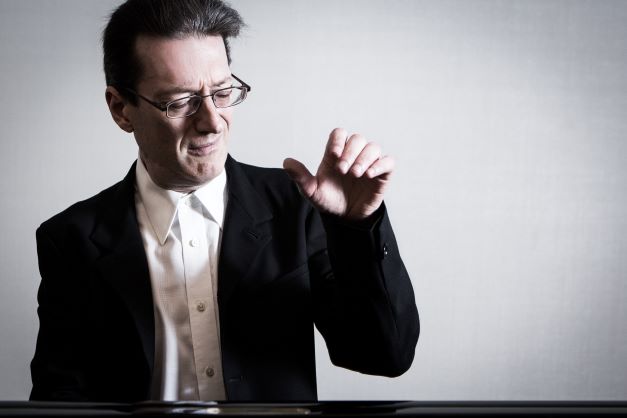
Expecting the unexpected is the most predictable aspect of a recital from Piotr Anderszewski, tonight’s programme no exception in its juxtaposing collection by Beethoven and Bartók with a selection from Brahms and music by Bach that has long been a cornerstone of his repertoire.
Alive to their iconoclastic flourishes and improvisatory asides, Beethoven’s last bagatelles yet emerged as a cohesive and integrated unity as it ventured through limpid musing and angular playfulness then disarming elegance before arriving at a propulsive take on the B minor Presto muscular or energetic by turns. The final two numbers were of a piece with what went before – the one understated and the other’s ingratiation bookended by outbursts of grating humour. Nothing to be taken for granted in this music, then, as Anderszewski intimated only too well.
Although published as four separate collections, there is no reason why Brahms’s late piano pieces cannot be given separately or in autonomous groupings as here. Starting with Op. 119, Anderszewski brought a confiding touch to the plaintive B minor Intermezzo and rendered the lilting syncopation of that in C with real playfulness. Turning next to Op. 118 and the forlorn quality of its A minor Intermezzo complemented ably that in A, whose new-found popularity need not detract from its harmonic subtlety or soulful poise. From Op. 117, the B flat minor Intermezzo struck note of ingrained fatalism intensified by that in E flat minor from Op. 118 – its ‘mesto’ marking here underlined as the music unfolded toward an endpoint of unforced resignation. Anderszewski looked regretful it should end so before duly leaving the platform.
As his recent recording confirms, Anderszewski has forged unerring identity with the Op. 6 Bagatelles where Bartók gave notice of his fast-emerging individuality. Played with minimal pauses (albeit with a 3-3-2-2-2-2 grouping such as brought these into line with the six pieces in each of those other sets), they offer a conspectus of possibilities over his ensuing creative decade that was to the fore here, alongside a cumulative focus evident less in any increasing technical demands as in a gradual opening-out of their emotional world made explicit in the final two numbers as doubtless stems from Bartók’s unrequited love for violinist Stefi Geyer. Thus, the sombre restlessness of Elle est morte merged directly into the valse Ma mie qui danse – this latter’s vicious irony maintained right through to its almost dismissive pay-off.
Had Bach ever entertained any such feelings, they were certainly far removed from the keen objectivity of his First Partita. A little restive in its Praeludium, Anderszewski hit his stride in its gently eddying Allemande then animated Courante. There was no lack of gravitas in its Sarabande, but this was as deftly inflected as was the elegance of its contrasted Menuet dances, then the Gigue made a dextrous yet assertive conclusion to a sequence where (as in everything heard tonight) what was made possible outweighs what had already been achieved.
It would have been possible to combine these works with other pieces – maybe some or even all of Ligeti’s Musica ricercata that Anderszewski will hopefully play at a future recital. For now, a limpid reading of Chopin’s Mazurka in A flat major (Op.58/2) made for an ideal envoi.
To read more on Piotr Anderszewski, visit his website
Schumann Papillons Op.2 (1830-1) Nachtstücke Op.23 (1839-40) Faschingsschwank aus Wien Op.26 (1839-40)
Wigmore Hall, London Friday 12 January 2024 (1pm)
by Ben Hogwood
After extensive examinations of the piano output of Beethoven and Schubert, Llŷr Williams has turned his attention to Robert Schumann. This lunchtime concert at the Wigmore Hall celebrated the release of a double album on Signum Classics starting a series devoted to the composer’s piano works. On this evidence there will be some revelations in store.
That Williams loves Schumann’s music was evident from with the languid introductory chords to Papillons. This early work from the 21-year-old composer is a masked ball, a chance not just to enjoy his love of butterflies but to present a closely connected set of miniature portraits for piano. In a good performance they capture the listener’s imagination, and under Williams’ fingers the music took flight. The clarity of his phrasing was immediately notable, revealing the exquisite details of Schumann’s melodic creations and taking time to let them breathe. With the improvisatory seventh piece (marked Semplice) the ink felt barely dry on the page, while the mood ranged from a relatively stern third piece to a playful eleventh, enjoying the brisk fanfares. Best of all was the Finale, where clever use of the sustain pedal left us with a marching band whose bright melodies hung on the air, the drone of the horns left for the listener to savour.
The Nachtstücke are lesser-known pieces, but Williams revealed just why they should be heard more often. He also revealed something of the turbulent period in which they were composed, with Schumann aware of the imminent death of his brother Eduard and travelling to Vienna in an attempt to alleviate his family’s precarious financial position. Because of this, the nocturnal dreams we might expect from other composers is trumped by active and often troubled thoughts, flitting quickly between moods and contrasting emotions. Williams, though, untangled the knots of Schumann’s musical thoughts. The solemn tread of the first piece, a funeral march, had forward purpose, while the second was a flurry of activity, thoughts running almost out of control until checked by a relatively dreamy central section. At all times Williams was in control of his characterisations, so much so that it was easy to forget the technical demands of this music. This was certainly the case in the outpouring of the third piece, before the chorale and related solos of the fourth were beautifully judged and complemented.
Finally we heard Faschingsschwank aus Wien, companion pieces to the Nachtstücke also written during the ultimately unsuccessful visit to the Austrian capital. These present a different side to Schumann, with Williams enjoying the humour of the first piece, with its catchy motif and cheeky reference to La Marseillaise. This vigorous start contrasted with a heartfelt Romance and a deeper, flowing Intermezzo – between which the Scherzino reasserted the prevailing mischievous mood. So too, did the Finale, where the virtuosity was again beyond question, the helter-skelter figures once again used for poetic purpose rather than display. Williams proved a revelation in Schumann, bringing even his most complex character pieces to life – and maintaining a remarkable clarity of line as he did so. If he keeps this up, there are many treats in store as he journeys further into Schumann’s poetic and deeply personal world.
You can hear Llŷr Williams’ new recording on Spotify below:



 Arcana.fm