Wigmore Mondays – Barry Douglas & Borodin Quartet – Shostakovich: Piano Quintet

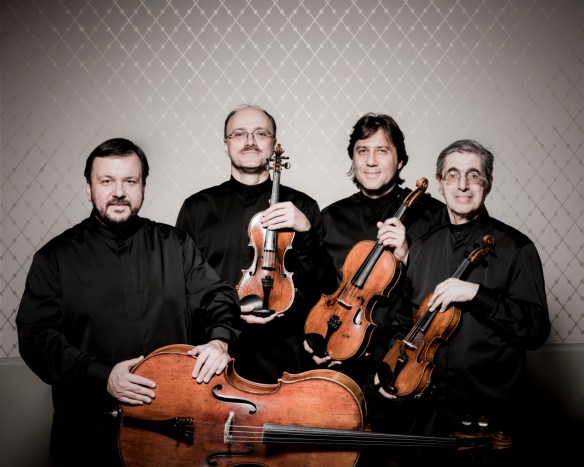
Barry Douglas (piano, above), Borodin Quartet [Ruben Aharonian and Sergei Lomovsky (violins), Igor Naidin (viola), Vladimir Balshin (cello)] (below)

Wigmore Hall, Monday 14 October 2019 (lunchtime)

You can listen to this concert on the BBC Sounds app here (opens in a new window)

Review and guide by Ben Hogwood

For the 2019-20 season many of the BBC Radio 3 lunchtime concerts at the Wigmore Hall have taken on a playlist appearance. This all-Russian programme was no exception, with Tchaikovsky miniatures acting as a prelude to Shostakovich’s most successful chamber work, the Piano Quintet.

Tchaikovsky‘s The Seasons are a lovely set of miniatures for piano, characterising each month of the year rather than the four seasons. Barry Douglas, who has recently recorded the cycle, clearly holds the collection dear, and his accounts of March (the Song of the Lark) and October’s Autumn song were haunting and thoughtful by turn.

The Borodin Quartet followed with Tchaikovsky’s famous Andante cantabile for strings. The previous week they had given it in context, the second movement of four in the composer’s String Quartet no.1 in D major Op.11, where it is most effective. Here the silvery, muted textures were lovely, and the central section evoked a light dance, but the work’s placement felt constricted knowing the main act was still to come.

All that was emphatically put to bed by a storming performance of the Shostakovich Piano Quintet, as authentic an account as you could wish to hear. The first incarnation of the Borodin Quartet worked closely with the composer on many of his string quartets, and they performed the quintet with the composer on several occasions. The first-hand experience of their predecessors has not diluted the intensity of the experience in transition, and this was a searing account of one of 20th century chamber music’s most powerful utterances.

The Prelude (20:36) and Fugue (25:27) dovetailed beautifully, the former section imposing and powerfully wrought, the latter gathering a mood of grim resilience as the elements of its theme became ever more closely interwoven. This carried through to the outburst that is the Scherzo (35:28). Here Douglas came to the fore, striking the octaves in the upper right hand with shrill clarity, the quartet responding in kind as the textures veered towards the orchestral.

A graceful Intermezzo (39:12) was deeply poignant, the combination of bittersweet violin and simple plucked cello affecting from the outset. Emotions bubbled just under the surface throughout this movement, threatening to break loose at any moment. As the music slipped effortlessly into the finale (45:17) it shifted up a gear, with time for another big theme (46:35) before navigating to the calmer waters of the coda, where resolution was finally found in spite of the slightly ghostly string tone.

This was a tremendous performance, with every ounce of feeling communicated to the audience, occasionally at the expense of tuning in the upper violin area but with an unwavering intensity. The audience loved the repeat of the Scherzo as an encore.

Repertoire

This concert contained the following music (with timings on the BBC Sounds broadcast in brackets):

Tchaikovsky The Seasons Op.37a: March (2:00), October (4:31) (Barry Douglas solo)
String Quartet no.1 in D major Op.11, Second movement (Andante cantabile) (11:12) (Borodin Quartet)
Shostakovich Piano Quintet in G minor Op.57 (1940) (20:36) (Barry Douglas, Borodin Quartet)

Further listening

You can hear the music from this concert on the Spotify playlist below, containing recorded versions by the artists. The Borodin Quartet released Shostakovich’s Piano Quintet with pianist Alexei Volodin for Decca in 2018 – and here it is prefaced by one of the group’s several recorded versions of the Andante cantabile. Barry Douglas’s Tchaikovsky is part of an album of the complete cycle of The Seasons:

Another Russian chamber music powerhouse can be heard below. Tchaikovsky’s Piano Trio, written in memory of pianist Nikolai Rubinstein, is a deeply expressive piece full of pain and resilience. Here it is from Trio Wanderer:

Shostakovich was not done with his piano-based chamber music, adding a substantial Second Piano Trio four years later. You can hear it below with pianist Vladimir Ashkenazy, violinist Zsolt-Tihamér Visontay and cellist Mats Lidström – part of a very impressive all-Shostakovich disc:

In concert – Borodin Quartet: Tchaikovsky & Arensky at the Wigmore Hall

Borodin Quartet [(Ruben Aharonian and Sergei Lomovsky (violins), Igor Naidin (viola), Vladimir Balshin (cello)]

Wigmore Hall
Wednesday 9 October

Tchaikovsky String Quartet no.1 in D major Op.11 (1871)
Arensky String Quartet no.2 in A minor Op.35 (1894)
Tchaikovsky arr. Dubinsky Album for the Young Op.39 (1878)

reviewed by Ben Hogwood
Photo credit Simon van Boxtel

The Borodin String Quartet have an unparalleled history in performing Russian string quartets, and the first of their three date mini-residency at the Wigmore Hall found them sitting firmly on home ground.

It could be said that the history of the Russian string quartet begins with Tchaikovsky, whose String Quartet no.1 in D major Op.11 began the programme. This contains his first ‘hit’, the second movement Andante cantabile which even now is a firm favourite in its string orchestra arrangement. Heard in proper context here, the understated emotion of Tchaikovsky’s solemn notes made an even stronger impact, especially when performed with due reverence.

The Borodin Quartet belong firmly to the old school of quartet playing, sitting still and straight-faced as they play, but as the evening unwound so too did their apparently stern countenance. The straight approach worked with this piece however, as an elegant first movement introduction gained weight and resolve, and the Scherzo third movement showed a rustic, outdoor quality. The final movement, capping a piece that doffs its cap to Mozart and Mendelssohn, was aware of the influence of both composers but showed off the uniquely Russian edge.

Anton Arensky’s String Quartet no.2 in A minor was written in homage to the recently departed Tchaikovsky in 1894. Replacing one of the violins with a second cello, the still underappreciated Arensky darkened the colours of the quartet, which has a distinctive if rather lopsided three movement structure. The outer movements take time for religious contemplation, while the inner and most substantial movement of the three spends time with developing a theme written by Tchaikovsky.

This Variations on a theme of Tchaikovsky is itself more popular in a string orchestra arrangement, but as with the older composer’s Andante cantabile it is more effective in context, a great example of how to keep the potentially stale variations format fresh and inventive. This was a superb performance, the Borodin Quartet – through necessity reverting to two violins rather than two cellos – gravely intoning the main subject of the outer movements where time seemed to stand still. The Variations were brilliantly characterised and flew off the page, the ensemble speaking as one – and the final pages emphatically threw off the sadness of the chant-influenced passages, looking forward to more optimistic times ahead.

For the second half the Borodin Quartet turned to their one-time leader Rostislav Dubinsky, and his arrangement for them of Tchaikovsky’s piano cycle Album for the Young. Comprising 24 short pieces for children, it is packed full of dances, character pieces and portraits. Initially the thought was that this would be overindulgent and too whimsical, but as the set unfolded so did Tchaikovsky’s charm and Dubinsky’s invention.

Here was the composer who would eventually write so skilfully for younger ears in The Nutcracker, The Sleeping Beauty and Swan Lake, channelled through the medium of an arranger who was able to send up some of the pieces with clever pizzicato or harmonics. This was where the Borodin Quartet let themselves go more, sending up The Toy Soldiers’ March beautifully, then indulging in colourful accounts of the French, German, Italian and Neapolitan Songs. The scurrying Baba Yaga was a treat, while the last two numbers, The Organ-Grinder’s Song and At Church were curiously ghostly, sending the young audience to what might have been a troubled sleep.

No such troubles here though, as we finished with an encore from Borodin himself, the Serenata alla Spagnola. It was led off decisively by the pizzicato of cellist Vladimir Balshin before its main tune, given affectionately by viola player Igor Naidin. It was a fitting way to end a charming and moving concert.

Further listening

You can hear recorded versions of the music played in this concert on the Spotify playlist below, including the Borodin Quartet‘s recording of the Tchaikovsky String Quartet no.1 and Rostislav Dubinsky‘s own Borodin Trio in the Album for the Young:

Wigmore Mondays – Jess Gillam & Zeynep Özsuca

Jess Gillam (soprano and alto saxophones, above), Zeynep Özsuca (piano, below)

Wigmore Hall, Monday 7 October 2019 (lunchtime)

You can listen to this concert on the BBC Sounds app here

Review and guide by Ben Hogwood

Saxophonist Jess Gillam is proving to be a breath of fresh air for BBC Radio 3 and for classical music in general. Her combination of passionate artistry, technical flair and down to earth presentation is ideal, and brought colour to a dull Monday in October. Her spoken introductions between the pieces in this concert had a nicely judged patter, showing someone at ease with an audience and enthusiastic about the music she plays. The refreshing lack of pretence fed into the inspiring performances too. Gillam was helped by a very well chosen programme of music showing off the versatility of her instrument, in doing so covering a rich variety from the last 300 years.

The Pequeña Czarda of Pedro Iturralde was an ebullient first piece and a sign of things to come, placing the first earworm as well as showing off Gillam’s technique and Zeynep Özsuca’s colourful accompaniment. It draws the odd parallel to Midnight In Moscow in its slow passages, and both performers caught the contrast between these and the helter-skelter faster music.

The Marcello Oboe Concerto in D minor, transposed down a tone into C, illustrated how well works for oboe can transcribe for the saxophone, especially when played with as much control as there was from Gillam and Özusca here. The saxophone is a much louder instrument but Gillam really enjoyed the subtle colours available, and this worked especially well in the famous Adagio (11:08 on the broadcast link). In the outer movements Özusca found great clarity to bring the part writing to life.

Anna Clyne’s new piece Snake and Ladder introduced electronics to the equation, reminding us how the saxophone is one of the most versatile instruments between classical and rock music. Written for saxophone and distortion pedal, it was an effective and enjoyable piece, though sat at the back of the hall we had what sounded like wow and flutter from the breathing.

This led through a bit of a stylistic jolt to Poulenc’s Oboe Sonata, which appeared to be presented in original form without an arrangement – certainly none was credited. Gillam clearly loves this piece and played it beautifully, though the more plaintive oboe tone from which the third movement especially benefits was understandably more difficult to find (from 30:06). This movement, an elegy to Poulenc’s great friend Prokofiev, is effectively the last music he wrote and as such is very profound. Gillam did however do a brilliant job with the fast central movement (25:56 on the broadcast), with spiky counter thrust from Özsuca, while the first movement had established the mood.

We then heard from composer Rudy Wiedoeft, an American composer who raised the profile of the saxophone worldwide. His Valse Vanite, an original piece, drew on his love of transcribing other composers, and it was as though Chopin had taken a vacation in Harlem. Both musicians clearly have a lot of affection for this piece, and Gillam’s ornamentation was exquisitely done.

A reduced version for saxophone and piano of John Harle’s RANT! followed, this enjoyable and tuneful piece drawing on folk tunes from Gillam’s native Ullswater. That the composer, also Gillam’s teacher, was in the audience said much for the bond and mutual respect the two enjoy.

A soulful Pièce en forme de habanera followed, Ravel leading nicely into Gillam’s party piece. Milhaud‘s Scaramouche is the work she played in orchestral form at the Last Night of the BBC Proms in 2018, though it is arguably more effective in partnership with piano. Özsuca was a little far back in the mix to begin with but the fast movement was still hugely enjoyable, followed by a thoughtful slow movement and perky Brazileira (58:48), Gillam breaking into a grin once more as she played the catchy tune.

The audience would have been happy with this as the final earworm with which to leave, but a bonus was in store in the form of Duke Ellington’s In a Sentimental Mood (not on the broadcast), the encore showing off Gillam’s remarkable breath control in slower music.

This was a really enjoyable concert, and it was so refreshing to see another younger artist throwing off any shackles that classical music might present, and offering it out as music, pure and simple. Proof if it were ever needed that music should be there for everyone to enjoy!

Repertoire

Jess Gillam and Zeynep Özsuca played the following music (with timings on the BBC Sounds broadcast in brackets)::

Iturralde Pequeña Czarda (2:03)
Marcello Oboe Concerto in D minor (7:34)
Clyne (Snake and Ladder) for saxophone and electronics (19:27)
Poulenc Sonata for oboe and piano (21:05)
Wiedoeft Valse Vanité (35:00)
Harle RANT! (40:27)
Ravel Pièce en forme de habanera (47:53)
Milhaud Scaramouche Op. 165b (51:13)

Further listening

Some of the music played in this concert can be heard on Gillam’s debut album Rise. This includes the orchestral version of John Harle’s RANT!, and the works by Iturralde, Marcello and Wiedoeft – and of course the finale of the Milhaud:

Gillam’s teacher John Harle has a very impressive recorded legacy, raising the profile of the classical saxophone in contemporary classical music. The Sax Drive album (one in a series of PR own goals when it comes to saxophone album titles!) is well worth exploring for the three concertos it holds from Stanley Myers, Richard Rodney Bennett (his Concerto for Stan Getz) and Michael Torke:

Meanwhile if you liked the music of Milhaud you will find this hugely attractive collection from EMI to be very much your thing:

On record – Kronos Quartet & Terry Riley: Sun Rings (Nonesuch)

Written by Ben Hogwood

What’s the story?

The Kronos Quartet and Terry Riley have a rewarding history of collaboration covering more than 35 years. Sun Rings is surely one of the most emotive pieces in that history, and is certainly one of the most performed since its premiere in 2002. Here it receives a first full recording.

The work dates back to a commission from NASA, who were looking to mark the 25th anniversary of the launch of the Voyager 1 space probe. They specifically wanted to know if the Kronos could use the ‘space sounds’ collected from the Voyager crafts by physics professor Don Gurnett, who developed plasma wave instruments to receive them. On hearing the results Kronos leader David Harrington immediately contacted Terry Riley to get him on board.

While writing in New York, Riley was interrupted by the World Trade Center attacks of 11 September 2001. They inspired him to turn the focus of his work to peace.
This is the first recording of Sun Rings in its entirety, a chance for those in more than 50 countries who have already experienced it live to hear it in recorded form. Weighing in at nearly 80 minutes, it is a big work, expanding the quartet by adding San Francisco-based vocal ensemble Volti to two of the longest sections, Earth Whistlers and Prayer Central.

What’s the music like?

Fascinating, and timeless in a way that suggests the deep space into which the Voyagers continue to travel. There is a restless edge too, as it seeks the lasting peace Riley had in mind.

After the space sounds set the work in perspective, Hero Danger is a rewarding combination of the otherworldly electronics and the string quartet, with thoughtful lines suggesting a slightly worrisome contemplation. In response Bebopterismo carries urgent anxiety in its angular melody, the music put on edge.

Riley’s musical language is interesting, never purely ‘minimalist’ but repeating his more distinctive melodic ideas. There are rather beautiful dovetails between violin and viola halfway through Planet Elf Sindoori, but just when the ear thinks the sonorities of Sun Rings have been fully established, Earth Whistlers comes as quite a surprise.

It is here the choir are introduced, and this substantial movement makes much of their pure tones. It does perhaps distract from the subject at hand, replicating in a way the interruption of the September 11 attacks on Riley’s thoughts. When we train our gaze fully on Voyager again with The Electron Cyclotron Frequency Parlour there is an intriguing displacement between the close up quartet sound and atmospherics further away, but the focus has shifted.

Prayer Central, the most substantial movement, is soft and contemplative but becomes more animated and off the beat. Venus Upstream is full of anxiety, as though time is limited, its tension spiked by the alarm in the background. The spoken quote from Alice Walker to begin the last section is telling, asking, “Do you really know where you are at this point in time and space and in reality and existence?” It is just the right side of preaching, helped by some lovely cello playing from Sunny Yang.

Does it all work?

Most of the time, though with the caution that for maximum effect the piece is best heard in full and in a quieter place. Then the field recordings really come through to the front. Sun Rings is a substantial piece of work, though there are some natural dips in inspiration once the ideas of each section have been exposed. The use of the choir may split opinion too.

Is it recommended?

Yes. For those following the Kronos Quartet and Terry Riley it is an essential purchase, while providing further evidence of the positive effect astronomy can have as a creative stimulus, not to mention the endless drive for world peace. Between them Riley and the quartet have looked outside of the box to create something unique and, on this evidence, a major work that will last in spite of a few reservations.

Listen

Buy

You can get Sun Rings from the Nonesuch website

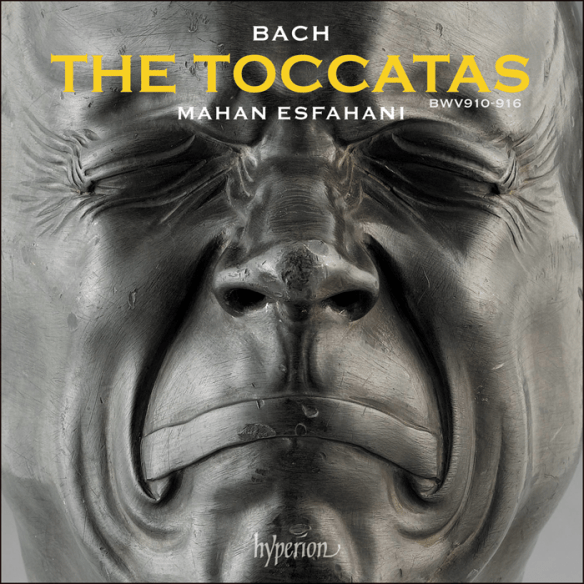
On record – Mahan Esfahani: J.S. Bach – Toccatas (Hyperion)

J.S. Bach
Toccata in F sharp minor BWV910
Toccata in C minor BWV911
Toccata in D major BWV912
Toccata in D minor BWV913
Toccata in E minor BWV914
Toccata in G minor BWV915
Toccata in G major BWV916

Mahan Esfahani (harpsichord)

Hyperion CDA 68244 [76’54”]

Recorded August 2019 at St. John the Baptist, Loughton, Essex

Producer Sébastian Chonion
Engineer David Hinitt

Written by Ben Hogwood

What’s the story?

Mahan Esfahani has been playing a lot of J.S. Bach lately. With a series of the composer’s complete keyboard works ongoing at the Wigmore Hall, and with a well-received account of the Goldberg Variations in the bag from his stint at Deutsche Grammophon, now would seem the ideal time to document his thoughts on some of Bach’s most extrovert and unpredictable works for harpsichord, the Toccatas.

What’s the music like?

Exuberant and even flamboyant. Those are two words you might not readily apply to Bach, certainly in the wrong performance, but this is the sort of recording to remind you that not only was Johann Sebastian a master of the more theoretical processes in music, he could write music of breathtaking originality too.

The Toccatas are the work of a young man looking to experiment and explore, and also to entertain. Esfahani really captures that spirit of freedom from the first to last notes, the Toccata in G major setting us down in a crumpled heap around 76 minutes later.

It helps to have the performer’s accompanying notes on the works, and how difficult it is to arrive at a scholarly direction on how they should be played. What matters as much is the performer’s input, and – as he acknowledges – the producer and engineer, to whom he expresses heartfelt thanks as his own ‘therapists’.

Does it all work?

Emphatically, yes. This feels like just the right stage in Esfahani’s career for him to tackle these works, and his response is stylish and reverent, outgoing too – so that the more overtly display-dominated items are real audience pleasers, and the telling pauses or slow passages are delivered with gravitas and great feeling.

For there is music of great theatre and occasion here. Presented in catalogue order, we begin with the Toccata in F sharp minor BWV910, which begins with a thrilling rush of the right hand, before dance figures take over. A stern central section leads to a rediscovery of its positive stance towards the end.

The Toccata in C minor BWV911 follows, its fugue deliberately paced to start with and then allowed to pick up its natural momentum. Esfahani, so assured in his playing, brings each part in with a firm inevitability as the closing pages approach before signing off emphatically.

The Toccata in D major BWV912 features some really impressive, florid passage work, while the D minor work, BWV813, feels like an answer with its stern, imposing contours. This work really springs forward in Esfahani’s hands around the 3:30 mark, before a superb, authoritative finish, with the pleasure of hearing the keys released at the end.

The instrument’s lower register really sings in the Toccata in E minor BWV914, notable for its bold lines, before an extremely descriptive episode that is so strongly characterised it feels like a scene from a play. When the big rush of counterpoint comes later, Esfahani again exerts close control.

The Toccata in G minor BWV915 starts with a sense of occasion, a cascade in the right hand before a nimble dance and a flourish, before the final Toccata in G major BWV916, a solo concerto in all but name. This has a celebratory air, its descending motif in clumps of chords rather like a peal of bells. Then a slow, thoughtful movement in E minor (the closest relative key of G) provides a reflective episode before a lively return home for an upbeat finale.

Complementing these seven impressive utterances are an ideal harpsichord sound and recording, the church chosen by Hyperion offering just the right amount of depth to the recorded sound, so we hear the clarity of Bach’s writing but also its ambitious scope.

Is it recommended?

Without hesitation. If you tend towards the organ works when listening to Bach played on the keyboard, this is just the disc to show you what you are missing on the harpsichord side of the equation.

Mahan Esfahani plays these works with formidable technique and with passion too, taking every opportunity to bring Bach’s flourishing works to life. What a cover, too!

Buy

For more information on this release and to purchase in multiple file formats, you can visit the Hyperion website