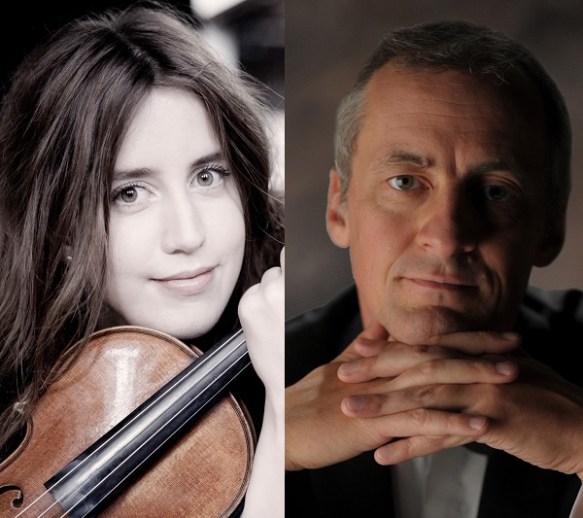
Wigmore Mondays – Vilde Frang & Aleksandar Madžar play Bartók and Schubert

vilde-frang-aleksandar-madzar

Vilde Frang (left, violin), Aleksandar Madžar (right, piano)

Bartók Violin Sonata no.1 (1921) (33 minutes)

Schubert Fantasy in C major D934 (1827) (21 minutes)

Listen to the BBC Radio 3 broadcast here, until 16 November

Arcana’s commentary

It is easy to see why Vilde Frang is held in such high regard. This contrasting program of Bartók and Schubert showed a steely side to her playing in the former, but also a purity of tone that could be easily appreciated throughout.

These qualities served her well in a powerful rendition of Bartók’s massive Violin Sonata no.1, but she could not have made this impact without Aleksandar Madžar’s superb piano playing, notable for its clarity and rhythmic precision.

Bartók and rhythm are inseparable, and the hold that folk music has on his compositions was all too clear in the syncopations and cross rhythms that Frang and Madžar exploited here. The angular tunes of the first movement (first heard at 2:07) had an assertive mood, brilliantly played.

Richard Bratby’s excellent program note reminded us how modern the music must have sounded in 1922, when Bartók himself played piano with violinist Jelly d’Aranyi, who became an important creative muse. Frang and Madžar powered through the first movement, making light of its technical difficulties, but in the second movement time stood still. Frang’s sweet but thoughtful tune, initially heard alone (from 14:26), was complemented by a solemn and mysterious chorale from Madžar (16:00), the two forces gradually aligning but still lost in a distant world.

The finale arrived with a flourish (25:15), both performers tackling it with some relish and achieving a remarkable unity of ensemble at the end (from 32:30), finishing with a terrifically spicy, bluesy chord.

Schubert’s Fantasy in C major can seem like a long piece in the wrong hands, but here it came alive. Completed in the last year of his life, it is conceived in a single span of four distinct sections, and is a very original piece of writing. Balance between the violin and piano is key, and this was spot on for the moving opening statement, where Madžar had a lot of work to do but was always responsive to Frang’s soft intonation (from 37:09)

A bracing Allegretto section (from 40:23) led to the centrepiece, a Theme & Variations (45:44) The origin of the theme, a Schubert song, was abundantly clear in this lyrical performance, while there was some sparkling playing from Madžar as the variations took hold (try 48:57) This flair and musicality continued to the return of the soft first movement theme, now shaping up in the finale (52:36), an emotional reunion in these hands before a convincing finish (from 57:40).

This was a superb concert, affirming Vilde Frang as one of the best violinists of her generation on the concert circuit, but also illustrating just what a fine pianist Aleksandar Madžar is too. Hear this if you can!

Further listening

You can hear more of Vilde Frang in an early album recorded for Warner Classics with Michail Lifits. Here she brings a sunny tone to violin sonatas by Grieg (no.1) and Richard Strauss, full of youthful exuberance, while there is more Bartók in the form of his Sonata for solo violin, a tour de force:

by Ben Hogwood

Ensemble L’imaginaire play the music of Richard Barrett at St John’s Smith Square

ensemble-limaginaire

Ensemble L’imaginaire (above): Keiko Murakami (flute), Adam Starkie (clarinet),        Philippe Koerper (soprano saxophone), Maxime Springer (piano), Adaq Khan (sound engineer)

St John’s Smith Square, London; Sunday 16th October, 2016

the light gleams an instant (1996)
Zungenentwurzeln (1997)
fold (2016)
Katasterismoi (1999)
dying words II (2013)
epiphyte (2016)
interference (2000)

The Sunday afternoon concert series from St John’s has been a welcome development on the London calendar – not least when it means the appearance of such as Ensemble L’Imaginaire, the Strasbourg-based group currently touring this programme of music by Richard Barrett.

Swansea-born and now Belgrade-based, Barrett (b1959) has long had a cult following in the UK with just the occasional high-profile premiere (notably by the BBC) serving to reacquaint listeners of his importance. An ambitious and questing conceptualist, numerous pieces have been planned as components of larger and evening-length projects – making this afternoon’s selection of works from the past quarter-century a viable ‘composition’ in itself; not least in its focussing on those scientific and arcane issues that have long been central to his activities.

This sequence began with the light gleams an instant – part of the larger work Tract, whose interplay of filigree activity in the right hand with headlong motion in the left gives rise to an exacting and meaningful virtuosity that Maxime Springer took audibly in his stride. Between these instrumental pieces came electronic ‘interludes’ themselves related to larger projects – the first being Zungenentwurzeln (‘‘the uprooting of tongues’’), with its inspiration in Paul Celan and visceral anatomical sound-imagery. Next was fold, originating as a piece for oboe and here transformed for soprano saxophone that underlined antecedents in Roscoe Mitchell (and a reminder that Barrett has enjoyed a productive association with Evan Parker) besides setting a tough assignment for the performer which Philippe Koerper acquitted with panache.

This was followed by Katasterismoi (‘‘transformations into stars’’), embodying astronomical reflections past and present through a tactile process of developing variation. Its sound source was the biwa, making for a tangible link into Dying Words II – whose flautist also intones an ancient Japanese text on the impermanence of things in the natural world and in which Keiko Murakami’s performing from memory was an unarguable fete. The last electronic item was epiphyte, its analogy to intruding while not parasitic plant growth represented by a dextrous texture unfolding in stealthy terms. Finally, interference alludes both to electromagnetic and quantum theories via a circuitous solo for contrabass clarinet informed by bass drum strokes and apocalyptic fragments from Lucretius as Adam Stirkie coordinated with evident aplomb.

The fact that this programme was presented as a continuous sequence lasting for just under an hour should evince no qualms, but it was a pity that the sequence could not have been heard without interruption so as to underline its highly integrated nature as both the composer and performers intended. All four of the performers – not forgetting sound engineer Adaq Khan, who throughout secured an impressive sense of musical space and definition in the reverberant acoustic of St John’s – duly took the stage at the close for renewed and enthusiastic applause.

The audience of barely more than two-dozen punters was regrettable given the stature of this composer. Not that Barrett will be tempted to succumb to the blandishments of much present-day music, but his combative and provocative work deserves much wider acknowledgement.

Richard Whitehouse

Ensemble L’imaginaire ends its UK tour of Richard Barrett at Canterbury University on Wednesday 19th October at 1.10pm. Further information can be found at the Ensemble l’imaginaire website

Wigmore Mondays – Nicholas Angelich plays Chopin & Liszt

nicholas-angelich

Nicholas Angelich

Chopin 2 Nocturnes, Op.55 (1842-4) (12 minutes)

Chopin 3 Mazurkas, Op.59 (1845)

Liszt Piano Sonata (1854)

Listen to the BBC Radio 3 broadcast here, until 9 November

Arcana’s commentary

A very satisfying blend of poetic 19th century piano music from Nicholas Angelich. By beginning with a well-chosen selection of Chopin he set the scene perfectly for the drama that is Liszt’s Piano Sonata, one of the great works for the instrument and a real test of any pianist’s clout.

First, though, the Chopin – and two contrasting works that bear the title Nocturne. This was a form of music that was more or less invented by the composer John Field and taken up by Chopin, who found it an expressive means with a relatively free form. The first of the two (from 1:46 on the broadcast) was distracted in mood and more than a little downcast. Thoughtfully played, it gradually became more animated before calm was restored with the theme at 5:58. The second nocturne (7:43) had a more open sound, with an almost constant ripple of watery accompaniment.

Angelich’s performances of the Mazurkas showed just how different Chopin’s interpretation of this dance could be.

The last of the three (22:10) was the most dramatic, shifting tellingly from major to minor key at 23:08, and ending there from 25:31.

You could say that Liszt’s Piano Sonata is a one-act play in four scenes – or you could equally say that it is a four-act play. Such is its formal design that both approaches work across the course of half an hour, and it really is one of those pieces the listener can be totally absorbed in.

For that you need the right performance of course, and this one from Nicholas Angelich fitted the bill in every way. The drama should begin even before the first soft, low notes are sounded, and here the period of silence beforehand built the anticipation nicely.

Then once we were under way at 27:30 Angelich set out the musical arguments, allowing the first movement to build its tension through to the start of the faster music at 28:20. After this the music really got going, though it was around the 36:27 where the tempo was really flying, leading up to a grand statement of the slow theme from Angelich at 38:05, a great demonstration of both power and grace at the piano.

This performance really came into its own in the slow movement however (from 41:00), setting a restful and uncommonly sublime mood, until a warning at 48:05 where the music from the start revealed itself again. Other points of note to look out for in the recording are at 48:43 where the fugue begins.

Angelich made a real and clear sense of this tricky passage, beginning with the theme and continuing at 48:55 with the ‘answer’ – as fugues are wont to do. Then the pyrotechnics ensued, a showy movement but one that Angelich kept under control, especially at 52:13 and a triumphant return of the big, slow theme. The coda, from 57:38, was exquisitely paced, and the end, when it came, was soft and petered out to the silence with which the Sonata began.

A performance as impressive for its quiet moments as its loud ones – and a Liszt sonata packed full of incident, drama and romance the whole way through.

Further listening

Angelich has very helpfully recorded something of a ‘concept’ album that begins with the Liszt Sonata. This work was dedicated to Schumann, so we also get that composer’s set of eight fantasy pieces Kreisleriana, one of his very best piano works. Completing the album are two Etudes by Chopin, the subject of Schumann’s dedication.

by Ben Hogwood

Remus Azoiţei and Eduard Stan play Enescu at the Romanian Cultural Institute

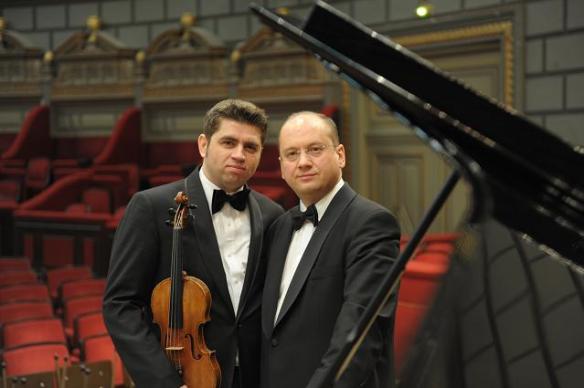
azoiteistanduoofficial1Enescu Concerts Series 2016/17 – Remus Azoiţei (violin) and Eduard Stan (piano) Photo: Cristian Drilea

Romanian Cultural Institute, London; Thursday 6th October, 2016

Porumbescu Ballade (1880)

Enescu Impressions d’enfance, Op. 28 (1940)

Fauré Violin Sonata No. 1 in A, Op. 13 (1876)

Ravel Tzigane, M76 (1924)

Almost a decade on from its inception, the Enescu Concerts Series is central not only to the activities of the Romanian Cultural Institute but also performance and wider understanding of George Enescu’s music in the UK. This latest season got off to an impressive start with a recital given by Remus Azoiţei and Eduard Stan, whose traversal of Enescu’s music for violin and piano is the recorded benchmark for this crucial aspect of the composer’s output; not least in the case of the Impressions d’enfance that was Enescu’s last major work for the medium.

Completed at the outset of the Second World War, Impressions could be described as a suite were it not for the motivic rigour informing every aspect of these 10 vignettes of childhood not merely evoked but recreated by Enescu over the course of a piece no less cohesive than the violin sonatas preceding it. Such was the impression left by tonight’s hearing – from the deft stylization of Moldavian street music in The Fiddler, through the exquisitely detailed recollections of ‘things lived and dreamed’ that emerge as the music unfolds, to the Sunrise that makes an eloquent and emotionally heightened apotheosis. The often intuitive interplay between the two musicians was undoubted, while the spontaneity with which they rendered Enescu’s detailed expression markings confirmed their appreciation of this music’s essence.

The account of Fauré’s First Violin Sonata was hardly less impressive. As the composer’s breakthrough piece in terms of wider acclaim, it has retained its place in the repertoire and this duo assuredly had the measure of the opening Allegro’s darting flights of fancy then the Andante’s melodic easefulness over Fauré’s favoured barcarolle underpinning. The scherzo had wit and insouciance aplenty, and if the finale can feel just a shade contrived in context, the formal and expressive conviction with which it rounds off this work was never in doubt.

Either side of these works came showpieces with a vengeance. His operettas remain unknown outside Romania, though Ciprian Porumbescu (1853-83) lives on through the Ballade which emphasizes the ‘doina’ melodic style that became a mainstay of later Romanian composers. Enescu was doubtless familiar with this piece and also championed Ravel’s Tzigane which, however uncharacteristic of the French master it may seem, is a rhapsody firmly within the virtuoso tradition and given here with just the right combination of soulfulness and panache.

Azoiţei and Stan duly returned for an encore in the guise of the Bagatelle by Ion Scarlatescu (1872-1922), whose quick-fire virtuosity brought this recital to an engaging close. This new series of the Enescu Concerts could scarcely have been launched in more impressive fashion.

Richard Whitehouse

Remus Azoiţei’s and Eduard Stan’s recording of Enescu’s complete music for violin and piano is on Hänssler Classics

Meanwhile The Enescu Concert Series continues at the Romanian Cultural Institute on Thursday 3rd November, when pianist Raluca Stirbat plays Enescu‘s Prelude & Scherzo and Third Sonata, along with Franck‘s Prelude, Choral et Fugue and Liszt‘s First Mephisto Waltz. Further details can be found at the Romanian Cultural Institute website

Wigmore Mondays – Steven Isserlis & Olli Mustonen in Prokofiev, Schumann and Mustonen

steven-isserlis-olli-mustonen

Steven Isserlis (cello), Olli Mustonen (piano) (both above)

Schumann 3 Romances, Op 94 (1849) (11 minutes); 3 pieces from Album für die Jugend, Op 68: Sheherazade; Winterszeit I & II (1848) (9 minutes)

Olli Mustonen Frei, aber einsam (UK premiere) (2014) (4 minutes)

Schumann arr. Isserlis Intermezzo from F.A.E sonata (1853) (3 minutes)

Prokofiev Cello Sonata in C, Op 119 (1949) (23 minutes)

Listen to the BBC Radio 3 broadcast here, until 2 November

Arcana’s commentary

Schumann is arguably Steven Isserlis‘ favourite composer. The clues are there in the enthusiasm with which the cellist talks about his music, the affection he gives to each of the melodic lines, and in this concert the construction of an imaginative suite of works for cello and piano, where his natural and extremely intimate lyrical side was to the fore.

Schumann did not write a fully-fledged sonata for cello and piano, but he did complete a number of pieces either directly for the combination or in a form that could be naturally arranged. Such is the case with the 3 Romances, published for oboe and piano as Schumann’s Op.94 but making a seamless transition to the cello.

In this performance the first Romance (from 1:47 on the BBC iPlayer) is a little doleful, the second (from 5:22) is notable for a relatively stormy central section, while the third (9:13) brings the instruments together in thoughtful unison.

After this Isserlis sat head bowed, listening intently as Olli Mustonen performed pieces from Album for the Young as though he and the listener were the only two people in the room. The first piece is Sheherazade (from 13:19), finding the level of intimacy that Schumann’s pieces for the young so consistently achieve, then from 17:10 we hear Winterszeit I and then the changing moods of Winterszeit II (19:01)

Mustonen himself then turns composer, with Frei, aber einsam (from 22:06), a piece for Isserlis alone written with the grace and intimacy of Schumann. It also has a bit of his childlike mischief when it gathers confidence – rather like a bird emerging from the nest – and starts flying along.

Mustonen uses the notes F-A-E as his starting point – which offers a strong like to the next work, heard from 26:46 we hear a tender performance of an arrangement of Schumann’s Romance for the collaborative FAE Sonata, a work written in tandem with Brahms (who contributed the famous Scherzo) and Albert Dietrich. It uses the notes ‘F-A-E’ in the simplest possible way – but also the most personal.

Following this attractive suite is the Cello Sonata of Prokofiev. Typically for the Russian composer this is full of good tunes, and in this performance (from 32:26) Isserlis and Mustonen bring them all to life in a vivacious performance. Isserlis had his way with the audience in the hall, too, with a few glances that sent up the more humourous moments of the second movement perfectly (from 42:46). There is music of romantic power, too, whether in the powerful climax of the first movement (at 41:11) or in the big finale (from 47:27) which sweeps impressively through its return to the main tune at 51:47.

A wonderfully affirming concert ends on a sad note with a tribute to the late conductor and violinist Sir Neville Marriner, the face of the Academy of St Martin-in-the-Fields, who passed away the day before at the age of 92. Isserlis chose the second of Schumann’s Five Pieces in Folk Style (from 56:42), and with Mustonen proceeded to give a touching and affectionate encore.

Further listening

For more music related to this concert, try the Schumann and the FAE playlist on Spotify below. This includes the whole of the collaborative FAE Sonata, the oboe and piano version of the 3 Fantasy Pieces in a wonderful recording from Heinz Holliger and Alfred Brendel and, to finish with, a rare recording of the Cello Sonata no.1 by Myaskovsky. He was the composer who raved about Prokofiev‘s Cello Sonata after its early performances – so here is his own moment in the sun:

by Ben Hogwood