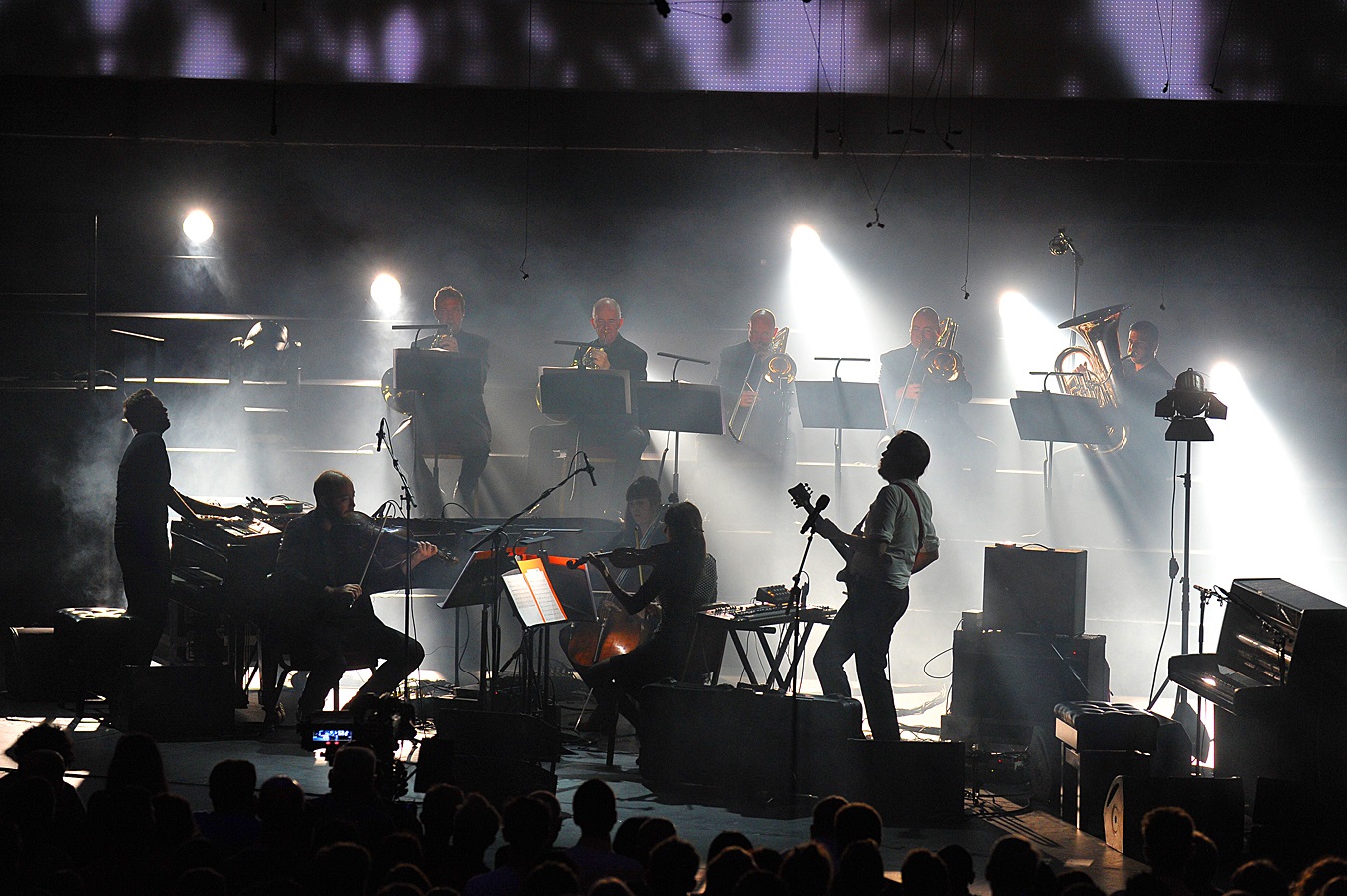
Bedroom Community at the Royal Festival Hall

Organist James McVinnie and Bedroom Community take on the Royal Festival Hall organ for a night.

james-mcvinnie
James McVinnie Picture (c) Magnús Andersen

This thoroughly absorbing and often invigorating showcase for Icelandic record label Bedroom Community centred around the Royal Festival Hall organ. Yet at the same time it gave the audience an introduction to the diverse talents on the label, perhaps best described as a Nordic counterpart to ECM.

However that description shouldn’t typecast the label, as the evening began with a singer-songwriter. I have to say the tremulous voice of Puzzle Muteson was not to my taste, especially when covering New Order’s True Faith, but it is undoubtedly individual and charmed many of those present. His performed his own material with his own intricately picked guitar and sensitive accompaniment from James McVinnie on the piano. Meanwhile another vocalist, the new Bedroom Community signing Jodie Landau, gave us a hint of things to come with a rich, sonorous vocal that made Valgeir Sigurðsson’s Do but kill me something of a showstopper, uplifting in spite of its title.

McVinnie himself was the curator of the evening, and although it was nearly half an hour before we heard the organ itself, in his hands we got a sense of just how diverse the great Festival Hall instrument can be. We enjoyed the delicate but pointed approach of Nico Muhly in Rev’d Mustard his installation prelude and Beaming music, the notes positioned like stalactites in a cave, but it was the contrasting sonorities of Philip Glass’s Mad Rush that proved the big talking point of the first half. This was vintage Glass; soft, mellow asides on one registration cutting dramatically to imposing, craggy features where the organ resounded heroically. McVinnie’s performance was superb.
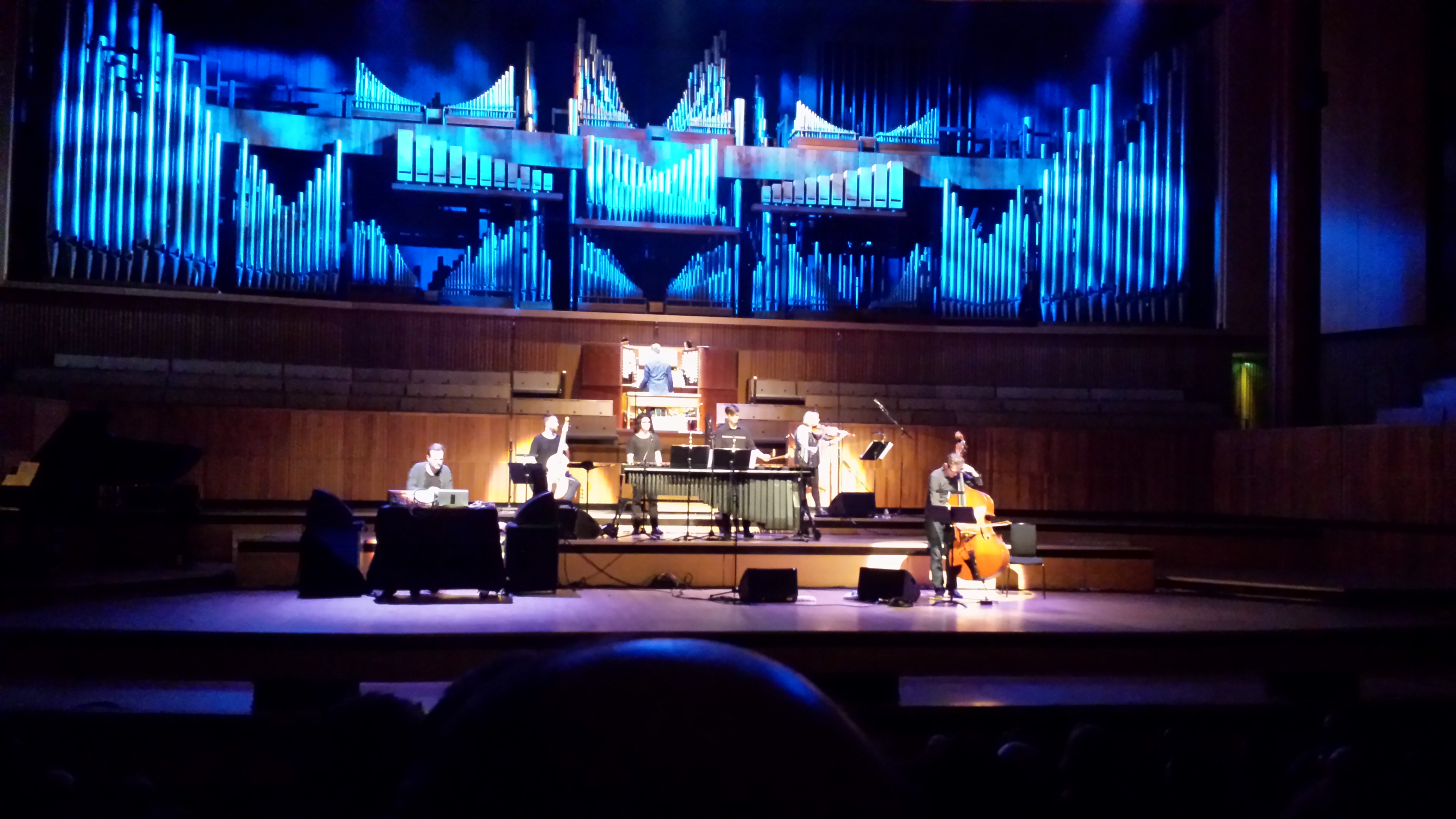
bedroom-community

James McVinnie and friends at the Bedroom Community night, Royal Festival Hall, Thursday September 24. Photo (c) Ben Hogwood

Equally thrilling was Bach’s Passacaglia and Fugue, the registrations again imaginatively thought out so that we got a strong sense of the composer’s genius, threading the variations on the steady bass line through the eye of a needle before the great fugue stacked up in front of us.

The new music here was most impressive, and for that we also had viola player Nadia Sirota to thank. A vivid Étude 3 by Muhly set her against the organ, while Bryce Dessner’s solo piece Delphica 3 used the instrument in a knowledgeable but passionate way, building from the profile of a study to a heart on sleeve utterance. We also heard the world premiere of Median Organs by Dessner, written for McVinnie and again notable for intricacy and strength of feeling. Dessner’s compositional career dovetails with his work as part of The National to increasingly powerful effect.

The addition of stringed instruments gave the show variety and extra depth. Double bassist Borgar Magnason lent eerie lines to the Ben Frost film soundtrack There are no others, there is only us, where hordes of starlings assembled in black and white on the projection, to music that matched their movements. It was a moving portrait of one of nature’s mystifying yet wholly affirmative wonders.

In the second half viola da gamba player Liam Byrne explored the limits of his instrument, joining McVinnie and composer Sigurðsson in a response to the Bach Chorale Prelude Ich ruf zu dir. Although the bass notes on the electronics resounded too heavily this was a brilliant piece of musicianship from all three players, sensitively expanding on Bach’s music to illustrate its contemporary dimensions, while also clearly listening to each other as the improvisation took hold. It was unexpectedly moving and, in its free approach and generous musicality, symptomatic of the evening as a whole.

Wigmore Mondays – Kathryn Stott

kathryn-stott
Photo (c) Nikolaj Lund

Kathryn Stott (piano) performs piano music by Fauré, Franck, Ravel and Graham Fitkin

Wigmore Hall, London, live on BBC Radio 3, 14 September 2015

Listening link (open in a new window):

http://www.bbc.co.uk/programmes/b06c9nwj

on the iPlayer until 20 October

Spotify

In case you cannot hear the broadcast, here is a Spotify playlist of the music in this concert – most of which Kathryn Stott has recorded.

https://open.spotify.com/user/arcana.fm/playlist/14B8Ld3EVlXF6jlyZUeA9y

What’s the music?

Fauré: Nocturne no.4 (1884) (8 minutes)

Franck: Prélude, Chorale et Fugue (1884) (20 minutes)

Ravel: Sonatine (1905) (12 minutes)

Fitkin: Relent (1998) (10 minutes)

What about the music?

Fauré wrote a good deal of extremely attractive piano music, ranging from dreamy Barcarolles and Impromptus to the Nocturnes, which tend to be more moody. Kathryn Stott’s choice for this concert, the fourth of thirteen such works Fauré completed, is one of the lighter coloured examples.

César Franck, treated as French although he was born in Liège, which is now Belgium, wrote a lot of organ music – but is not often regarded as a composer of piano music. This is a shame, because in the Prélude, chorale et Fugue he shows off a distinctive style and an adventurous harmonic approach, while also acknowledging a debt to J.S. Bach in the form and construction of the piece. This reaches its apex in the central chorale, a kind of hymn tune that is first heard in a solemn intonation but which then rings out in glorious technicolour.

Ravel completes the triptych of French piano works, his Sonatine a model of economy and precision – but also an intimate piece of three movements that is quite beautifully written for the piano. The word Sonatine refers to the short length of the piece rather than anything else that might be modest – for this is one of Ravel’s finest piano works.

Kathryn Stott ends her recital with Graham Fitkin’s Relent, completed in 1998 and written for Stott herself. On the composer’s website, Fitkin writes of how “This piece is about time. It is about my perception of time, its various manifestations and ultimate inevitability. I think about the way I use my time, how much I need and just how long it feels like. I think about continuous time, circular time and our society’s preoccupation with marking the passage of time. And then I think about the relentless addition of time and how for me some day it will just stop.”

Performance verdict

Initially this concert was to be given by Tine Thing Helseth, with Kathryn Stott in support at the piano, but the Norwegian trumpeter sadly had to withdraw through illness.

In her place Stott constructed a fine recital, moving naturally from the nocturnal thoughts of Fauré through a passionate performance of the Franck, beautifully played and extremely well voiced so that the themes could be clearly heard.

Stott is a modest performer – by which I mean she has a gracious air when performing – and that suited her performance of the Ravel and Fauré especially. However when she needs the power it is easily found, and the performance of Fitkin’s Relent brought out the kinetic energy of the piece perfectly.

What should I listen out for?

Fauré

1:22 – a relatively gentle beginning to the piece, which is deceptively simple in its execution, harking back a little to Chopin. The theme comes back at 2’29, this time in ‘octaves’ – that is, the tune is doubled by another finger in the right hand playing an octave higher on the keyboard.

The mood then darkens as we head into the minor key. As Stott herself was quoted in Fiona Talkington’s introduction on Radio 3, Fauré’s “harmonic language is fascinating, and I’m never bored by it”. Greater turbulence can be felt in the music – but an inner radiance returns with the theme at 6:41. The piece finishes in serene mood at 8’53”.

Franck

10:51 – the Prélude suggests a relatively relaxed approach and is almost improvisatory at first, before we hear the main theme in octaves. Despite being based on an older form this to me is a forward looking piece, using some spicy harmony and strong romantic leanings.

16:18 – the Chorale section begins (chorale essentially another word for hymn), and we first here the Chorale itself in subdued form at 17:21. At 18:37 we hear it in another key, the mood of contemplation starting to give way to more passionate thoughts – and when we hear it once more at 20:20, the effect is like a peal of bells.

21:30 – the fugue section begins, though the fugue itself doesn’t start until 22:56, initially retreating into quiet thoughts but then gathering momentum. Once again it softens though, the choral theme peeping through the rippling piano textures at 27:58. At 30:06 the final peal of bells rings out, ending with an emphatic double ‘B’ from the left hand.

Ravel

32:24 – this piece is notable for its clean lines and immaculate structure but also for the intimate atmosphere that Ravel immediately conjures within seconds of this first movement beginning. It has a slightly melancholic feel but is essentially positive. Some of the quieter music is beautiful and dreamy, especially at the end.

37:05 – Ravel leads more or less straight into the second movement, a Minuet (a dance in triple time). This has a persuasive lilt, as well as the same feel of intimacy carried over from the first movement.

40:07 – the third movement, a much more forthright piece of music marked Animé (Animated).The textures of the piano here suggest rippling water. The piece moves to a convincing finish at 43:54, Ravel’s structure nigh-on perfect.

Fitkin

44:57 – immediately Fitkin’s use of the piano suggests mechanical movements. The writing is incredibly bold, from the big, beefy sound of the lower register of the piano – often dealt out in octaves – to the syncopated lines from the right hand. These suggest a strong jazz influence, but possibly even the sound of a gamelan.

As the piece progresses so its mechanical nature continues, with a terrific amount of energy generated in its ten minute duration.

Encore

55:57 – ChopinPrelude for piano in E minor (3 minutes) – an encore of suitable stillness to follow the Fitkin, Chopin’s E minor prelude is one of his most popular, and one of his most sorrowful too.

Further listening

There are plenty of options available for further listening after this varied concert. Those enjoying the Ravel would be urged to seek out more of the composer’s piano music, in particular Gaspard de la nuit. The Franck may have its roots in the past a bit more but has some pretty exotic harmonies – and anyone enjoying it might want to head for Debussy’s suite Pour Le Piano, another look back to the past with an especially beautiful Sarabande at its heart.

Meanwhile for lovers of the Fauré the composer’s piano music has a particular late night beauty, as this selection of Barcarolles and Impromptus suggests. All are tagged onto the end of the original playlist here:

https://open.spotify.com/user/arcana.fm/playlist/14B8Ld3EVlXF6jlyZUeA9y


Proms premiere – Colin Matthews: String Quartet no.5

colin-matthews

String Quartet no.5 by Colin Matthews

Apollon Musagète Quartet (Paweł Zalejski & Bartosz Zachłod (violins), Piotr Szumieł (viola) & Piotr Skweres (cello)) (Proms Chamber Music 3)

Duration: 12 minutes

BBC iPlayer link

http://www.bbc.co.uk/events/ecq5v2#b06402nt (Matthews begins talking at 13:19, then the piece at 15:34 and ends at 27:36)

What’s the story behind the piece?

In conversation with Petroc Trelawny before the performance, Matthews reveals that his string quartet rate of composition has been approximately one every ten years, but that the gap is now narrowing.

This work was written for the 75th anniversary of the Tanglewood Festival and is conceived in a single movement. “I wanted to do something very different from the others”, he says, and the silences are a starting point. “The work begins very hesitantly”, he explains, and works up to only one big climax.

Did you know?

Colin Matthews worked as Britten’s assistant in the last few years of his life, and was essentially his right hand man for proof reading and even composition. You can read an interview about his exploits here

Initial verdict

It is possible to detect the hand of a mature composer at work here. So many new pieces rely on shock tactics and volume to make themselves heard, but Colin Matthews shuns all of that with an economic approach that actually brings forward greater emotion.

The faltering start from the quartet, together, becomes a distinctive motif that runs through the piece, and although the music does indeed build and get to a more secure footing, it never fully shakes off the uneasy start from the muted quartet. It is at times reminiscent of a Bartók quartet slow movement, or even Britten, in the intensity of its expression, though it never fully sounds like those composers. The Fifth Quartet says a lot in a relatively short duration, convincing in spite of its emotional doubt, as it retreats into the shadows at the end.

Second hearing

tbc!

Where can I hear more?

Colin has a BBC page devoted to him here

The 6Music Prom – Nils Frahm and A Winged Victory For The Sullen

Prom 27: Late Night With … BBC 6 Music: Nils Frahm and A Winged Victory For The Sullen

a-winged-victory-for-the-sullen
A Winged Victory For The Sullen at the 6Music Prom Picture (c) Chris Christodoulou

Watch here:

http://www.bbc.co.uk/events/empxj5#b0640mhj

The story behind the second BBC 6 Music Prom was a gratifying one, built on a desire for classical music to make itself more available. Mary Anne Hobbs was the catalyst, playing music by Nils Frahm to enthusiastic listeners worldwide. Their response encouraged her to introduce them to his Erased Tapes label mates, A Winged Victory For The Sullen, a duo comprising Dustin O’Halloran and Adam Wiltzie.

Both acts were part of an extended mix for this late night event, aided by atmospheric lighting and smoke to turn the Royal Albert Hall into an after-hours club. Into this already heady environment came A Winged Victory, playing much of their second album ATOMOS. They were joined by an unnamed string trio and London Brass, their task to provide sonorous colour and slow but far-reaching melodies. O’Halloran and Wiltzie were on keyboard duties, drawing out chord patterns and soundscapes to give the listener an airborne sensation. This was further enhanced by members of the Random Dance Company, whose chief Wayne McGregor provided the stimulus for ATOMOS. Their relaxed interpretations of the music belied the effort required to contort their limbs!

The music was expansive, like a slowly changing cloud formation, and crucially had beauty of timbre to match. From the simplest of melodic cells came music of primitive meaning, evoking memories of pop music’s ambient craze twenty years ago but without any vocal samples. Here music was stripped back to its basics, and was all the more moving for the lack of incident and chatter. The crowd was thoroughly absorbed, most stock still but some perceiving the latent energy running through the music.

In truth London Brass could have been used more, their potential to add brightness only sparingly glimpsed. The string trio were more gainfully employed, the cello particularly beautiful when raised above the textures. As their set came to an end so Nils Frahm joined the stage, the two acts uniting in an improvised piece that brought more rhythmic definition – a sign of what was to come from the German pianist.

nils-frahm
Nils Frahm at the 6Music Prom. Picture (c) Chris Christodoulou

Frahm used a team of keyboard instruments, including two ‘prepared’ pianos – that is, with keyboards, hammers and strings all modified to secure the all-important timbres required. Frahm’s music is more obviously derived from classical music, with Beethoven’s Moonlight Sonata, Chopin and Debussy all discernible influences. It has more obvious kinetic energy, moving quickly during Hammers to imply a strong beat, even before the introduction of an incredibly warm bass note to rattle the ribcage.

Frahm was a hyperactive presence, rushing urgently between his pianos and synthesizer, occasionally looping small clumps of chords in the manner of Steve Reich or even Dave Brubeck, but always intent on carrying his music forward. It was largely successful, though the introduction of two toilet brushes for the closing number felt like a gimmick.

What really carried, though, was the intense desire for discovery on the part of the audience. 6 Music had been playing classical music in the lead-up to this Prom, sensitively chosen with the pop music lover in mind, hoping to arouse curiosity – and that is exactly what this sort of Prom should be doing, bringing in people who find classical music and its terminology a daunting proposition.

It was a handsome success, Hobbs having found a way of communicating its appeal while showing how electronic and classical styles are on a fruitful collision course. We should not just be limited to Erased Tapes, though, as Warp, Glacial Movements, Bella Union and One Little Indian are just four more labels excelling in this area.

It is to be hoped that at the very least we will have a sequel. Tom Service presents a program along these lines on 6 Music this Sunday, showing how the two stations do on occasion overlap. Both have open musical policies, and in their current state show the BBC at its best, providing musical stimulation for a clearly hungry crowd.

Under the Surface at the Proms – Nielsen: Wind Quintet

Proms Chamber Music 2, 27 July 2015 – Royal Northern Sinfonia Winds at the Cadogan Hall

royal-northern-sinfonia-winds

Three of the five Royal Northern Sinfonia Winds taking part in the Cadogan Hall concert – Timothy Orpen (clarinet), Juliette Bausor (flute) and Steven Hudson (oboe). They were joined by Peter Francomb (horn) and Stephen Reay (bassoon)

Nielsen Wind Quintet (1922)

Composers and their anniversaries have long been a prominent feature of the BBC Proms, and this year is no exception.

Happily the BBC have taken the opportunity to celebrate the 150th anniversary of the birth of Carl Nielsen with both hands. The seeds were sown with Sakari Oramo and the BBC Symphony Orchestra, and their cycle of the composer’s six symphonies that fitted snugly into their 2015-16 Barbican Season.

Now at the Royal Albert Hall we have the chance to enjoy the composer’s three concertos, for clarinet, flute and violin respectively – and here, in the second Proms Chamber Music concert of the season at Cadogan Hall, the opportunity to hear the composer’s most popular chamber work.

Audio

http://www.bbc.co.uk/events/ez3zc8#b063dgkd

(Nielsen from 2:25)

The Wind Quintet is a charmer. Written in 1922 after Nielsen was captivated by the Copenhagen Wind Quintet, it celebrates the sonorities a combination of flute, oboe, clarinet, horn and bassoon can offer – and Nielsen cheats a bit by alternating between oboe and its very close relative, the slightly deeper cor anglais (English horn).

The first movement celebrates the sound of the five instruments together and also on their own – while the second spins a lovely melody from the clarinet and uses it as the base for a sunlit movement. The third starts with improvisatory bursts from solo instruments – oboe and clarinet – before a solemn hymn deceives us into thinking the composer has gone all serious – before he enjoys a set of variations on that theme, pairing instruments off and exploring different combinations.

It is a lovely piece to listen to, and the Royal Northern Sinfonia Winds did it full justice, clearly enjoying the interplay. They were equally good with Mozart’s Quintet for piano and wind, where they were joined by the stylish piano playing of Christian Blackshaw, who led what is effectively a concerto reduction.

It was Mozart that Nielsen heard the Copenhagen ensemble playing – and the Wind Quintet in turn led to the Clarinet and Flute Concertos. So Nielsen, in the final decade of his life, proved an accomplished writer for wind instruments – and the Proms’ exploration of his achievements is already proving an enjoyable aspect of the festival.

There will be more Under the Surface features as the Proms progress, exploring lesser known pieces and composers at the festival