On Record – Hats Off Gentlemen It’s Adequate – Nostalgia for Infinity (Glass Castle)

reviewed by Richard Whitehouse

Four decades or more since its heyday and progressive (prog) rock continues to be at the thin end of the wedge when it comes to critical respect (if hardly public acclaim), which is unfair to music featuring as much stylistic variation and aesthetic nuance as any comparable genre.

Formed around a decade ago, Hats Off Gentleman It’s Adequate is in essence the joint project of Malcolm Galloway and Mark Gatland – who, between them, have put together a catalogue fairly permeated by imagery of dystopian futures and human catastrophe. Such is evident on this fourth album, Nostalgia For Infinity duly taking its cue from the novels of astrophysicist Alastair Reynolds in which the very notion of scientific ‘progress’ is poised, now more than ever, on a knife-edge between the enhancement of civilization and its wholescale destruction.

Something to bear in mind when traversing a lengthy and impeccably realized album that, if it springs few genuine surprises, is rarely less than appealing in its seriousness and eloquence. While most of these 12 tracks might inhabit a sound-world of resonant synths and mid-tempo rumination – tracks such as Arc, a heady evocation of the triumphs and ultimate tragedy of HMS Ark Royal; Inhibitors, with its imaginatively treated flute from Kathryn Thomas; and Sixth Extinction, in its driving impetus, absorb the mind as surely as they arouse the senses.

Warmly recorded but not lacking in impact, with a booklet that explains the aim behind each track and includes lyrics of those with vocals, Nostalgia For Infinity testifies to the dedication of those who created it and a reminder that progressive need not be at the expense of integrity.

Stream

Buy

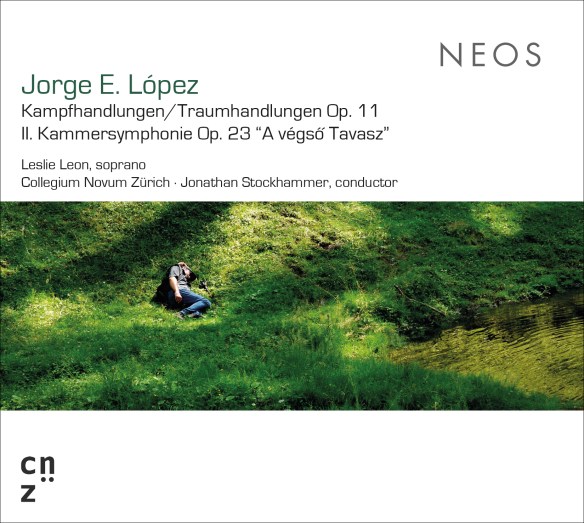
On record – Jorge E. López: Kampfhandlungen/Traumhandlungen & Kammersymphonie II (NEOS Music)

López
Kampfhandlungen/Traumhandlungen Op.11 (1995, rev. 1998)
Chamber Symphony no.2 Op.23, ‘A végsö Tavasz’ (2009-11)*

*Leslie Leon (soprano); Collegium Novum Zürich / Jonathan Stockhammer

NEOS 11912 [74’43”]

Producer Wulf Weinmann
Engineers Leandro Gianini, *Ueli Würth

Recorded 12 April 2018, TOnhalle Maag, *11-15 February 2019 at Radiostudio, Zurich

Written by Richard Whitehouse

What’s the story?

The always enterprising NEOS label releases a second disc devoted to the music of Jorge E. López (b1955) – a composer who has pointedly reassessed that dislocated juncture between late Romanticism and early Modernism, with little concern for any eventual accommodation.

What’s the music like?

Little heard (if at all) in the UK, López was born in Havana then spent his formative years in New York and Chicago, latterly moving to Austria and residing in Vienna since 2008. Largely self-taught as a composer, he was unknown until Michael Gielen championed his Landscape with Martyrdom (Intercord – hopefully to appear as part of SWR Music’s Gielen Edition), as singular an Op. 1 as any in musical history. Since then he has gradually built up a catalogue of 30 predominantly large-scale works, with increasing emphasis on the symphonic genre.

López has frequently spoken of the importance to his thinking of Surrealism, albeit not as an aesthetic but rather a method of musical construction as intuitive as it is flexible. This is made plain in Kampfhandlungen/Traumhandlungen – a visceral workout for large ensemble which emerges in stages from those elemental, Xenakis-like beginnings toward a more individuated discourse with prominent roles for cor anglais and bass trumpet; the whole piece adhering to that ‘Scenes of Combat/Tissue of Dreams’ interplay as posited by its title. Despite an aura of primal metamorphosis as might recall Birtwistle, López’s expressive range is informed more by evocation of human activity in the way his music proceeds in an often erratic while always fascinating trajectory; one whose denouement is the more conclusive for its unexpectedness.

Hardly the first composer to have embraced symphonic writing belatedly, López has focussed increasingly on the genre (he is currently completing his Fifth). The first two are for chamber forces, the Second taking its subtitle – which translates as The Final Spring – from the late 19th-century Hungarian poet Endre Ady. Should this bring to mind an exercise in ruminative introspection, the music confirms otherwise – its 52 minutes unfolding over five movements that consist of a compressed sonata design, further skewed by cadenzas for piano and horn; a sizeable and disruptive scherzo at length waylaid by (surreal) intimation of children’s songs; a halting and edgy intermezzo periodically arraigned by percussive fusillades; another scherzo that rapidly assumes a Mahlerian façade, where the soprano functions as a constituent of the ensemble in that her singing makes phonetic rather than semantic sense; then a finale whose martial undertow affords recollections of earlier movements (notably the first) as it heads to a conclusion of an inevitability which, not for the first time with López, arises out of nothing.

Does it all work?

It does, once one accepts López is not so much breaking the rules of formal and expressive continuity as refashioning them according to his needs; something Jonathan Stockhammer conveys in gratifying measure through these assured readings by Collegium Novum Zürich.

Is it recommended?

Very much so. The sound could hardly be improved on for clarity or perspective, and there is an informative overview by Jens Schubbe with a more subjective appreciation by Láng Zsolt. NEOS will hopefully be issuing further releases by this fascinating and absorbing composer.

Listen

Buy

You can listen to clips from the recording and buy this release at the Presto website

Read

You can read more about this release on the NEOS website, while for more information on Jorge E. López head to the Musica Austria website

On record – John Gardner: The Ballad of the White Horse, An English Ballad (BBC Concert Orchestra / Hilary Davan Wetton)

John Gardner
The Ballad of the White Horse Op.40 (1958/9)*
An English Ballad Op.99 (1969)

*Ashley Riches (baritone), *Paulina Voices, *City of London Choir, BBC Concert Orchestra / Hilary Davan Wetton

EM Records EMR CD057 [64’30”]

Producer Neil Varley
Engineer Michael Bacon

Recorded 10 & 11 November 2017 at AIR Studios, Hampstead, London

Written by Richard Whitehouse

What’s the story?

EM Records issues a further release devoted to John Gardner (1917-2011), featuring one of the most significant among his numerous larger choral works and one of the most engaging among his orchestral pieces. Both are accorded performances of dedication and commitment.

What’s the music like?

Although he essayed a succession of works in all the main genres during the 1950s, Gardner later felt that his cantata The Ballad of the White Horse marked a watershed both stylistically and in the practicable nature of its writing. Drawing on the epic 1911 ballad of that name by G. K. Chesterton (reduced by Gardner from over 500 verses to less than 100), this relates the story of King Alfred as he seeks to free England from the Danish yoke; culminating with the defeat of King Guthrum in the Battle of Ethandune, the latter’s converting to Christianity and his subsequent baptism. All of which is played out against the already ancient White Horse at Uffington – grown over and neglected as a reflection of the people’s moral failings, thence to be scoured when England rises again in what is yet a perpetual process of decline and renewal.

As ‘ballad’ ostensibly suggests, this piece features a great deal of choral singing in rhythmic unison with recourse to more polyphonic writing mainly at key junctures, though such is the suppleness of Gardner’s harmonic thinking that his music never feels stolid in continuity or uniform in its content. A pity, perhaps, that the solo baritone and girls’ choir could not have appeared more extensively, but this is itself offset by the resourceful use of the orchestra to reinforce and open-out that expressive directness as is the work’s determining trait. Equally of note is the relative length and emotional density of those eight constituent sections which, while they unfold separately, merge into a cohesive and cumulative whole that the composer himself felt he had seldom matched. Six decades on and its qualities can hardly be gainsaid.

Also included here is An English Ballad, written for youthful forces but in no sense an ‘easy ride’ in terms of its technical requirements. There is no vocal element, but the lines inscribed on the title-page actually are ‘set’ by electric guitar; its signal contribution, along with that of vibraphone, indicative of Gardner’s penchant for jazz and willingness to embrace elements of the latter-day vernacular. Musically the piece proceeds as a free fantasia around and about the theme heard toward its midpoint, rounded off by a section whose High-Jinx proves infectious.

Does it all work?

Indeed, given that Gardner was an instinctive composer for voices – eschewing the (wanton?) complexity of his relative contemporaries as well as that calculated simplicity all too evident in choral music of the present. Ashley Riches makes a forceful yet never unduly vehement contribution, while the City of London Choir and Paulina Voices respond enthusiastically to Hilary Davan Wetton, who steers ‘White Horse’ with audible conviction as to its cumulative structure and draws a feisty response from the BBC Concert Orchestra in An English Ballad.

Is it recommended?

Very much so. Often admired for his facility in writing carols and choral miniatures, Gardner was no less resourceful when working on a larger scale. Wide ranging sound and informative booklet notes (by the composer’s son Chris) round out what is an engaging and desirable disc.

Listen and Buy

You can discover more about this release at the EM Records website, where you can hear clips from the recording and also purchase.

Read

You can read more about John Gardner by heading to his own website

On record – Philip Sawyers: Symphony no.4 & Hommage to Kandinsky (BBC NOW / Woods)

Philip Sawyers
Symphony no.4 (2018)
Hommage to Kandinsky (2014)

BBC National Orchestra of Wales / Kenneth Woods

Nimbus Alliance NI6405 [64’32”]

Producer Simon Fox-Gál
Engineers Simon Smith, Mike Cox

Recorded 15 & 16 January 2020 at Hoddinott Hall, Cardiff

Written by Richard Whitehouse

What’s the story?

Nimbus continues its coverage of Philip Sawyers (b1951) with this release of his most recent symphony, heard alongside a major symphonic poem written some years earlier, in what are impressively assured readings by the BBC National Orchestra of Wales and Kenneth Woods.

What’s the music like?

The emergence of Sawyers as a major symphonist of his generation has been among the more significant aspects of latter-day British music. From the overtly demonstrative First Symphony (2004), via the highly concentrated Second (2008) to the decidedly equivocal Third (2015), is to encounter a composer intent on expanding his idiom incrementally and without any fear of repeating himself. Hence the Fourth Symphony, whose three movements might be felt to take on the (unintentional) model of Bruckner’s Ninth from a distinctly contemporary perspective.

Such is immediately clear from the opening Moderato whose tonal ambivalence underpins an emotional restlessness set in motion by those granitic brass chords at the outset. Formally this is Sawyers’ most individual sonata design to date, its accrued tension duly carrying over into a scherzo with passing elements of intermezzo rather than an actual trio as ensures maximum continuity. There follows an extended Adagio of tangible weight and no little profundity, its focus ensured through a long-term transition from D minor to D accomplished as seamlessly as its incorporation of motifs from earlier in the score. Sawyers says that after this ‘‘there was nothing more to say’’, reinforced by a sustained apotheosis which resolves those chords from the outset with a finality only viable for a composer in command of his musical components.

Little that Sawyers writes is without symphonic potential, as is evident from his Hommage to Kandinsky. Scored for large forces and lasting almost 30 minutes, its subtitle A Symphonic Poem for Orchestra indicates this is no mere evoking of the Russian-born artist’s canvasses – though one aspect of his Composition IV has been transmuted into musical terms towards the start. Structurally the piece unfolds through alternating passages of relative stasis and motion, and if slower sections predominate as it progresses, there is never a risk of expressive inertia owing to the deftness with which existing motifs take on greater intensity while timbral and textural aspects are enriched accordingly. This latter aspect is crystallized at the close when an emphatic chordal cluster gradually dies down, to leave only the purest of C major tones.

Does it all work?

Yes, not least when this release judiciously combines two of Sawyers’ most distinctive and absorbing pieces. Never a composer who could be accused of favouring the easy option, his large-scale organization is, in both instances, as fascinating as it is resourceful. It helps when Kenneth Woods, who premiered Sawyers’ previous two symphonies (the Third as the initial commission of his 21st Century Symphony Project), is unstinting in his advocacy – securing playing of verve and finesse from the BBC NOW in the spacious ambience of Hoddinott Hall.

Is it recommended?

Indeed. The annotations deftly interlace Woods’ descriptive commentary with Sawyers’ own analytical observations, and the booklet cover is graced by artwork from Philip Groom. It will be fascinating to hear just where Sawyers goes from here on his eventful symphonic odyssey.

Listen

Buy

You can listen to clips from the recording and purchase, either in physical or digital form, at the Presto website

Read

You can discover more about this release at the Wyastone website, and more about Philip Sawyers by heading to his own website

Switched on – Bruce Brubaker & Max Cooper – Glassforms (InFiné)

What’s the story?

The music of the so-called ‘minimalists’, led by Philip Glass and Steve Reich, has always provided a strong link between classical and electronic music, and has naturally inspired a number of artists positioned at that junction.

Reinterpretations of Glass and Reich have varied considerably though, from those who like to perform the music straight with no added frills to those who have added drum tracks and remixed them beyond almost all recognition. In that sense the music has been an inspiration, but it has on occasion proved difficult to get the balance right.

Pianist Bruce Brubaker and scientist / electronic music producer Max Cooper have teamed up for their own reinterpretation of the music of Philip Glass, approaching it with a view to adding subtle enhancements rather than radically changing its essence. Cooper has developed his own system for musical expression with Alexander Randon, taking live feeds from the piano to drive his own systems.

What’s the music like?

Brubaker performs well-known Glass piano pieces such as Mad Rush, Two Pages and Metamorphosis 2 with great sensitivity, to which Cooper adds the expressive studio touches and atmospherics. That may seem like straightforward solution, but both performers have to be careful to avoid over-egging what Glass has already done.

The pair link the originals with improvised music of their own. This is through a series of five preludes where Brubaker channels the spirit of Glass but brings in external influences from the likes of Liszt and Bach to galvanizing effect.

There are so many notes in the busy keyboard pieces such as Mad Rush that to do too much would not work – but here the judgement of both performers is right on the money. The piano parts are essentially the same, but Cooper cleverly highlights elements of the busy lines with his own spotlit textures, putting shards of white noise on the top of the likes of Mad Rush and opening out the sound with long bass notes, taking us from intimate beginnings to cinematic, big-venue textures. He does this without compromising the solitary world of a piece like Metamorphosis 2, and each one makes an unexpectedly weighty emotional impact.

While the reinterpretations of pieces like Tirol Concerto are excellent, Brubaker and Cooper’s interpretation of Two Pages is outstanding. It is ideally paced, the tracer lights of the keyboard operating over great waves of synthesizer pads, the chords shifting simply but with a devastatingly effective emotional payoff. So far each listen to this particular track has left a tear in the eye!

Does it all work?

Yes. It is immediately clear that Brubaker and Cooper hold the music of Glass in the utmost respect, but also that they know how to bring it forward and point it towards a slightly more club-orientated audience. There are no beats at any point, but the electronic sounds and textures bring them much closer – and Glass’s own rhythmic impetus is enough in any case. Each track is carefully woven and lovingly produced, and sounds great on headphones.

Is it recommended?

Very much so. Glass and Reich have had some excellent remix treatment in the last 25 years or so, but Bruce Brubaker and Max Cooper have really raised the game with this album, which is both wholly complimentary to Glass but offers something new in its own right. It is a really fine  achievement.

Listen

Buy