Switched On – The Orb: Abolition of the Royal Familia (Cooking Vinyl)

reviewed by Ben Hogwood

What’s the story?

The Orb need no introduction of course, being long familiar to admirers of ambient music since 1988. Theirs is an ever-changing line-up, orbiting the one constant of the equation, Dr Alex Paterson, and on this, their 17th studio album, Michael Rendall is elevated to the top table. He joins Paterson at the controls for a record including a number of starry guest turns.

Regular collaborators Steve Hillage and Miquette Giraudy (aka System 7) and Youth appear, alongside Roger Eno, David Harrow of On-U Sound, and – this being The Orb – a four legged friend, the Paterson pooch Ruby.

The album takes as its lead the royal family’s nod to the East India Company and its opium trade – both an inspiration and a protest against a movement causing two wars between India and China in the 18th and 19th centuries.

What’s the music like?

Lovely. There is little sense of explicit protest, and the guests all fit in to the overall mood seamlessly. The Orb have a very happy knack for matching quantity with quality, and even though it is barely a year since their last outing, Abolition of the Royal Familia sounds fresh and very much at ease in its own company.

At 77 minutes it’s a good stretch, but that gives the listener even more room to drift in and out of focus if required. Working together as Paterson and Rendall do means the door is never closed to a variety of styles and, very happily, humour too.

The speed with which Daze slips into a comfortable groove might surprise, a lead on which House of Narcotics and Hawk King build with their chugging beats. The latter displays The Orb’s familiar ambient house credentials as well as paying affectionate tribute to one of their most famous fans.

Gradually the tracks pan out and we experience more horizontal musical thoughts. Spacious intros provide warmth on a Californian scale, the listener allowed to bathe in consonant harmonies that drift back and forward like the ebbing of the tide. Shape Shifters (In Two Parts) goes further, adding a dreamy trumpet solo from 17-year old Oli Cripps, who Paterson met in his local record shop.

Also easing into the long form bracket is The Weekend It Rained Forever, a spacey, piano-led number towards the end, proving the ideal foil for the clattering breakbeats of The Queen Of Hearts preceding it.

Happily the band’s trademark collage of samples will make you smile, despite the inevitable rejection of a Prince Charles number. “We are WNBC”, begins Afros, Afghans and Angels, “the West Norwood Broadcasting Corporation. Streaming live to you whoever, wherever and whatever you are.” Yet a surprising and devastating payoff is saved for the finish. “Stay in your homes, do not attempt to contact loved ones or attorneys”, runs the key refrain of Slave Till U Die No Matter What U Buy, the Jello Biafra homage unintentionally marking itself out as an isolation anthem for our time.

Does it all work?

Yes. It is arguably too long, but with music like this duration is much less of an issue, especially with plenty going on around the perimeter on headphones. Certainly seasoned Orb followers will not see it as a problem. It could also be argued that Abolition of the Royal Familia does not introduce anything particularly new – again, not a problem, since The Orb always know how to reach those ambient parts few others can reach.

Is it recommended?

Yes. Abolition of the Royal Familia falls seamlessly into line alongside the recent additions to The Orb’s cannon, and has many moments of genuine bliss. It is like a sonic warm bath at either end of a trying day.

Stream and Buy

Buy

Switched On – BVDUB: Ten Times The World Lied (Glacial Movements)

reviewed by Ben Hogwood

What’s the story?

Life begins at forty, goes the saying – but that is the figure on which Brock Van Wey, or BVDUB as he is better known in musical circles, is closing in. That’s forty albums, too, an astonishing achievement when you consider the consistency of his ability to write pure musical ambience that also touches the heart.

Van Wey’s fifth for the Glacial Movements label has a provocative title, especially in these testing times for the world against which he rails. It has a powerful order to it as well – ten tracks, each of them recorded on the tenth of the month, recording ending ten months after it began.

For the first time Van Wey dispenses with vocals, letting his electronics and sound files do the talking.

What’s the music like?

Ten Ways The World Lied is incredibly descriptive, and also profoundly moving if heard at the right time and place. The slow moving musical motifs are often cast in the midst of thick, ambient clouds, yet there is a deep set feeling too that connects them closely to the earth.

Van Wey’s layered approach has a keen sonic beauty on headphones or on big speaker systems, the textures swirling closely around the listener but also allowing for an expanse of vast space.

Despite the titles there is no obvious protest element to the music, though it does feel very closely connected to primal and natural forms. Not Yours To See is underwritten by a lovely piano line, while Not Yours To Give sounds like a distant choir. Not Yours To Find is very richly textured, the sounds floating, while Not Yours To Keep pans out further, moving slowly but surely before a warmer swirl of sounds near the end.

Not Yours To Take keeps the soft harmonies but adds a lovely heat haze, and while Not Yours To Rule is similarly warm Not Yours To Break provides the ultimate resolution, a warm breeze that gradually settles on a beautifully held note.

Does it all work?

Yes. Once again BVDUB secures the deceptively difficult combination of simplicity and powerful expression, through musical content that moves slowly but can prove to be completely hypnotic and calming.

Is it recommended?

Very much so. An excellent collection of a producer who has been a deserved mainstay of electronica’s top table for more than two decades, and whose music can cover a wide selection of dancefloors. It should encourage listeners to delve even further into his considerable early output. I know I will!

Stream and Buy

On Record – Tony Allen & Hugh Masekela: Rejoice (World Circuit)

reviewed by Ben Hogwood

What’s the story?

A joyous one indeed, for this is a collaboration between two of the very finest jazz musicians of the latter half of the 20th century. Nigerian drummer Tony Allen and South African trumpeter Hugh Masekela met through links to Fela Kuti in the 1970s. Thanks to their close association, the two had long since talked about makng an album together.

Finally in 2010 the opportunity arose through a helpful collision of touring, and recordings were made – but were unfinished when Masekela died in 2018. Allen and producer Nick Gold, who recorded the original sessions, finished the original tapes last summer in the same studio, adding the bass, keyboard and vibes with the help of Tom Herbert, Joe Armon-Jones, Mutale Chashi and saxophonist Steve Williamson.

What’s the music like?

The best thing about Rejoice is that it immediately transports its listeners to happier times. Allen has described it as ‘a kind of South African-Nigerian swing-jazz stew’, and that gives an indication of the ease with which the two rub their different styles into the mix.

After an introductory chant it’s not long before we hear the two protagonists as instrumentalists, Allen’s propulsive break beat and Masekela’s bright treble an ideal match on Robbers, Thugs and Muggers (O’Galajani).

Agbada Bougou is more staccato in its delivery, the two trading musical thoughts with a nice lilt to the duet of Masekela’s trumpet and Williamson’s saxophone. Coconut Jam trips along with Allen’s bustling snare, while the vocals come to the fore on Never in a chant of ‘Lagos Never gonna be the same without Fela’. The lyrics of Rejoice are split between Zulu, Yoruba and English, another gesture celebrating diversity and unity.

Slow Bones is a real highlight, with intricate but propulsive drumming from Allen creating a funky undercarriage to Masekela’s inflections, while Obama Shuffle Strut Blues gets the trumpet and saxophone up close again, brilliantly shadowing each other over Allen’s expansive beats.

Does it all work?

Yes. Although Masekela wasn’t present for the final editing processes it is difficult to imagine how they could have been more effectively wrought, the feeling of spontaneity between the two master instrumentalists running through the album.

Is it recommended?

Yes, and especially so given the climate in which we find ourselves. Rejoice!, as its title implies, is a celebration of the freedom we have when making music together, and the creative fires that music making can ignite. We can take this inspiration on board and put it to good use in the future.

Stream

Buy

You can buy Rejoice from the Norman Records website

Switched On – Various Artists: Velvet Desert Music Vol.2 (Kompakt)

reviewed by Ben Hogwood

What’s the story?

The idea behind Velvet Desert Music is to present a modern alternative to those wide-open vistas created in the 1960s and 1970s by so-called ‘Acid Western’ films. Jörg Burger is the man Kompakt have tasked with this musical vision, and after a successful first instalment he broadens horizons further with this follow-up.

What’s the music like?

Just as Burger would have wanted, the music for Velvet Desert Music is wide open and easy on the ear, but it is also refreshingly off beat and unpredictable at times. He operates with a freedom that allows him to introduce grooves like Paulor’s WE two thirds of the way through, bringing a chunky ’80s beat to the bottom of the big horizons.

Occasionally the percussion does get quite congested, but not in a bad way, as Michael Mayer’s opening track Not So Far Away confirms. After that the musical camera pans out, establishing an easier, four to the floor beat with The Velvet Circle’s Vertigo, before the soothing vocal of Charlotte Jestaedt wraps around Mount Obsidian’s Ride.

Elsewhere the offbeat grooves of Fantastic TwinsBetween The Dog And The Wolf and Sascha Funke’s In Der Tat have a glint in the eye, while a second appearance from Mount Obsidian brings maximum bliss with the Cubenx edit of Casa Delfines, before some attractive Krautrock-style noodling from Lake Turner/WEM/Hand and East County Lines. Burger weighs in with his own Velvet 77 mix of Pluramon’s Dragon Slayer, showing a metallic edge to the steel guitar and flecks of piano, before The Novotones close with the starry-eyed Angel of Doomsday, and its sotto voce vocals.

Does it all work?

Pretty much. Burger keeps things ticking over nicely, and there are several moments where the inner ear loosens up very nicely. The track choices are good, and the blend of contrasting grooves keeps things interesting.

Is it recommended?

Yes, especially if you found the first volume to your taste. The second Velvet Desert Music works equally well on headphones or on surround sound, positioned ideally as a collection to offer easy going respite. And that, after all, is what we all need right now.

Stream

Buy

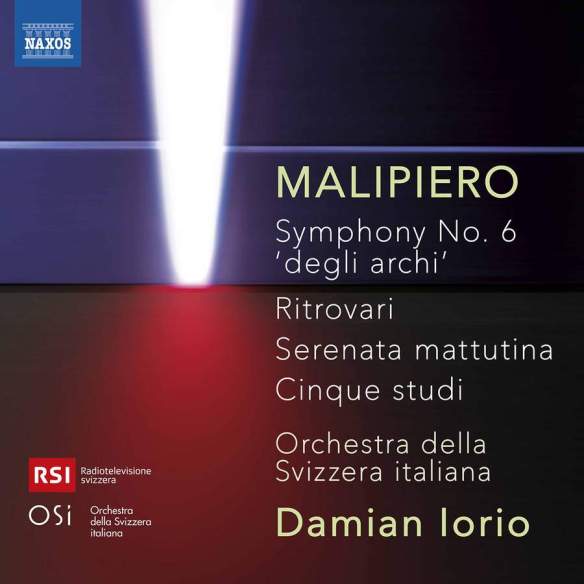
On record – Orchestra della Svizzera italiana / Damian Iorio – Malipiero: Symphony no.6, Serenata mattutina etc (Naxos)

Orchestra della Svizzera italiana / Damian Iorio

Malipiero:
Symphony no.6 ‘degli archi’ (1947)
Ritrovari (1926)
Serenata mattutina (1959)
Cinque studi (1959-60)

Naxos 8.574173 [58’32”]

Producer and Engineer Michael Rast

Recorded 2-5 May 2017, Auditorio Stelio Molo RSI, Lugano

Written by Richard Whitehouse

What’s the story?

The Naxos label continues its long-term traversal of the extensive orchestral output by Gian Francesco Malipiero (1882-1973) with the present collection, which juxtaposes two of the Venetian composer’s most intriguing such pieces alongside two of his most characteristic.

What’s the music like?

Most substantial is the sixth of Malipiero’s 17 symphonies (only 11 of these are numbered sequentially). Its subtle, ‘of the strings’, is significant in this being a work written with the intrinsic sound of these instruments to the fore – notably in the modally infused harmonies that determine musical content and formal follow-through; the latter worth bearing in mind given the composer’s determination to eschew thematic development of the Austro-German tradition in favour of a motivic evolution that, as Ernest Ansermet pointed out, ‘’generate[s] other motif [that] do not carry the musical discourse – they are, rather, carried by it”. This is evident in the brusquely compressed first and third movements, but also the arching phrases of the lento (one of Malipiero’s finest inspirations) and the fantasia-like format of the finale.

The two sets of shorter pieces were written almost 35 years apart, but the stylistic difference between them is not merely one of ‘historical inevitability’. Thus, the Rediscoveries are full of formal quirks (not least the way in which the plangent central lento’s going off at a tangent is carried over into the ensuing intermezzo), along with an expressive acerbity redolent more of Milhaud than Hindemith. By the time of the Five Studies, Malipiero was in all senses the elder statesmen of Italian music and was held in high esteem – albeit as a figurehead rather than an active influence – by the post-war generation. It is not difficult to hear elements of Dallapiccola or even Maderna in these terse and gnomic utterances, though the penultimate Lento evinces a ruminative poise and emotional serenity which could only be by Malipiero.

Which leaves Morning Serenade, scored for a diverse ensemble handled with unobtrusive mastery and unfolding as a sequence of subtle variations on its opening idea that gradually draw the music deeper and more contemplatively into itself. Whether or not this piece was intended as a literal evocation, it assuredly sums up those qualities of Malipiero’s mature language which are most likely to appeal to listeners of the present and, for which reason, might be considered an ideal point of entry into an output that defies easy categorization.

Does it all work?

Almost always. Malipiero was never a composer for whom technical processes or emotional accessibility are paramount. Rather, he sought out new approaches to age-old issues that may have bemused his contemporaries but will intrigue those willing to listen without prejudice.

Is it recommended?

Indeed. The performances here could hardly be bettered, with Damian Iorio securing playing of real precision and impetus from his Swiss Italian musicians. Earlier recordings of the Sixth Symphony (by Antonio de Almeida on Naxos) and Morning Serenade (by Stefano Cardi on Stradivarius) are surpassed, while sound and annotations leave little to be desired.

Hopefully Naxos might yet issue one of the numerous stage-works informing every phase of Malipero’s career; in the meantime, this disc is cordially recommended to devotees and newcomers alike.

Listen

Buy

You can listen to clips from this disc and purchase a copy at the Naxos website here

Read

You can read Arcana’s interview with conductor Damian Iorio here, where he talks more extensively about his experience of more modern Italian classical music