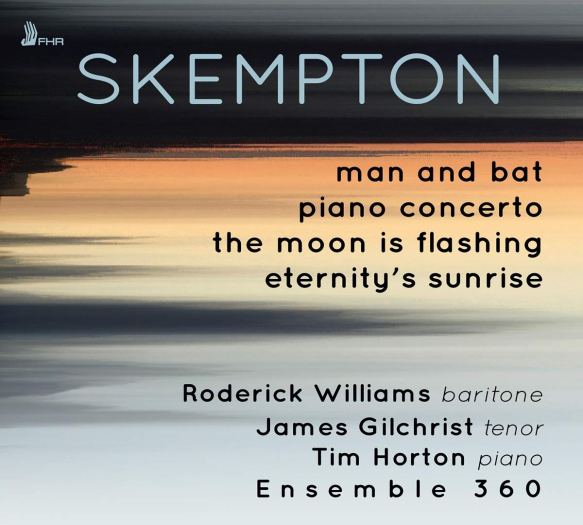
On record – Skempton: Man and Bat, Piano Concerto & The Moon is Flashing (First Hand Records)

Howard Skempton
Eternity’s Sunrise (2003)
The Moon is Flashing (2007, arr. 2018)
Piano Concerto (2015, arr. 2018)
Man and Bat (2017)

James Gilchrist (tenor, The Moon is Flashing); Roderick Williams (baritone, Man and Bat); Tim Horton (piano, Piano Concerto); Ensemble 360

First Hand Records FHR90 [70’25”]

English texts included
Producer Tim Oldham
Engineer Phil Rowlands

Recorded 20 July 2019 at Upper Chapel, Sheffield (Man and Bat), 5-7 February 2019 at All Saints’ Church, East Finchley, London (others)

Written by Richard Whitehouse

What’s the story?

A welcome addition to the recorded representation of Howard Skempton (b1947), including two pieces specially arranged by the composer for reduced forces and also two pieces written specifically for ensemble, all performed by artists closely associated with Skempton’s music.

What’s the music like?

Vocal writing has been a mainstay of Skempton’s in over recent years, the two largest pieces here setting poems by D.H. Lawrence. The term ‘setting’ is used advisedly, given Skempton’s approach is not one of expressive interpretation; rather one in which those individual words articulate a vocal line which, in its turn, articulates the instrumental writing so as to provide context.

Such is the premise on which Man and Bat operates – Lawrence’s highly descriptive, indeed discursive poem treated as a formal framework around which the ensemble unfolds a dialogue of constantly varying (not necessarily developing) motifs and phrases as provide an aural equivalent to what is being described. A not dissimilar approach is pursued in Snake, but here the musical treatment is audibly more static as befits a poem centred upon thought rather than action. This provides the concluding stage in a triptych preceded by a setting of Chris Newman’s self-deprecating A Day in 3 Wipes then, before it, the quizzical humour of Skempton’s own The Moon is Flashing which affords this diverse cycle its overall title.

The other two pieces are both instrumental, while being highly differentiated in themselves. Skempton has used generic titles only sparingly, his Piano Concerto predictable only in its avoidance of obvious models or precursors – the five movements (each lasting between two and four minutes) amounting to a series of vignettes in which the soloist variously combines with the ensemble, here a string quartet rather than string orchestra as originally conceived. Its title might suggest a natural piece with which to open, but Eternity’s Sunrise also makes for a persuasive rounding-off – a perfectly proportioned entity which amounts to a sequence of variations on an undulating theme apposite to the lines from William Blake that provided inspiration. Once again, Skempton’s writing is affecting through its sheer self-effacement.

Does it all work?

Very much so. From an output dominated by miniatures for the piano or accordion (his own instrument), Skempton has amassed a sizable and ever more varied catalogue from which the present release offers a judicious selection. It helps when the performances are so responsive to those qualities of emotional restraint and attention to detail that define the essence of this music. Roderick Williams and James Gilchrist can be relied upon for unforced insight, as too can the underrated pianist Tim Horton and the grouping of soloists which is Ensemble 360.

Is it recommended?

Indeed. Skempton now enjoys a substantial discography which features a number of releases devoted to his music (most notably those on the NMC label), to which should now be added this latest from the always enterprising First Hand Records. The sound has all the focus and detail necessary with this composer, whose succinctly informative notes on each piece are complemented by anecdotal observations from each of the soloists. Those who are new to Skempton will find this an ideal way into his compositional ethos, where little is as it seems.

Stream

Buy

For more information on this release and to purchase in multiple formats visit the Presto website

On record – Shostakovich: The Bedbug; Love and Hate (Naxos)

Shostakovich
The Bedbug Op.19 – complete incidental music (1929)
Love and Hate Op.38 – complete film-score (1935)

Mannheim Opera Chorus / Dani Juris; Deutsche Staatsphilharmonie Rheinland-Pfalz / Mark Fitz-Gerald

Naxos 8.574100 [58’54”]

Russian transliterations and English translations included
Producer Roland Kistner
Engineer Bernd Nothnagel

Recorded 18-21 February 2019 at Philharmonie, Ludwigshafen, Germany

Written by Richard Whitehouse

What’s the story?

Naxos continues its ground-breaking traversal of the film and theatre music by Shostakovich with this coupling of scores long unheard as originally conceived, thanks in part to the work of Mark Fitz-Gerald in having reconstructed these from extant sketches and soundtracks.

What’s the music like?

Shostakovich’s earliest theatre score was for The Bedbug, a scatological comedy by the ill-fated Vladimir Mayakovsky whose two parts were set in the then-present and 50 years later in 1979. The main items include several astringent dance numbers audibly akin to Stravinsky and Weill, while others were recycled for later dramatic projects (most notably the Wedding Scene [track 6] which soon became the Overture to Erwin Dressel’s opera Armer Columbus), with resourceful usage of such instruments as saxophone, mandolin and musical-saw. An air of sardonic detachment pervades this music which doubtless contributed to the production’s brief theatrical run and its subsequent oblivion, but the confidence and panache with which Shostakovich acquits himself can hardly be gainsaid. Although the parodying of such Soviet archetypes as firemen and pioneers soon became taboo in a Soviet Union beholden to Stalin, the experience gained served the composer well in subsequent ballets and revues, so making the present score a significant harbinger for what was to follow over the ensuing five years.

That said, it is the score for Love and Hate that leaves the stronger impression here. Directed by Albert Gendelshtein, this one of several films resulting from Soviet-German cooperation in the interwar period and which ceased in 1937 when the gulf between Stalin’s and Hitler’s ‘socialism’ became unbridgeable. In its quirkily compelling amalgam of post-expressionist and socio-realist elements, this film is more than mere historical curio – as Shostakovich’s music makes plain in an expressive directness evident from the outset. Most notable in this respect is the song How Long Will My Heart Ache and Moan?, initially allotted to mezzo and female chorus [track 19], and a series of searchingly descriptive pieces as culminates in the surging intensity of The Funeral [track 33]. It is at such junctures that the more elegiac aspect of the Fifth Symphony (two years hence) comes into focus, making one regret that no suite was previously compiled. Maybe this will now prove possible given the score’s timely availability, so enabling a vital link in its composer’s evolution to be properly appreciated.

Does it all work?

Yes, not least owing to the insight of Fitz-Gerald’s realizations with regard to those missing or fragmentary sections – where he captures the Shostakovich spirit in full measure – as also to the commitment of the Deutsche Staatsphilharmonie Rheinland-Pfalz in realizing the often wilful while always arresting nature of the composer’s inspirations. Forward but not unduly immediate sound, with extensive annotations by Fitz-Gerald, musicologist Gerard McBurney and Soviet cinema authority John Leman Riley, further enhance the attractions of this release.

Is it recommended?

Indeed, and it is to be hoped Fitz-Gerald will be continuing his exploration of this one facet of Shostakovich’s output as is still inadequately covered in terms of publication or recording. Several of the composer film and theatre scores from the 1930s still await such rehabilitation.

Stream

Buy

For more information on this release and to purchase in multiple formats visit the Naxos website, with an article on the recording here

Switched On – Pop Ambient 2020 (Kompakt)

What’s the story?

Wolfgang Voigt has every right to be proud as one of the flagship series of the Kompakt label, Pop Ambient, reaches its 20th edition. Cologne’s finest label refuses to rest on its laurels, mind, delivering a set of old and new music, best enjoyed horizontally.

What’s the music like?

Blissful. Kompakt have not been doing this sort of compilation for 20 years without reward – they know the quick routes to peace of body and mind, as made possible in music.

There is a pleasing mix of familiar and relatively new names here. In the former camp sit Thomas Fehlmann and the bubbling textures of Liebesperlen, Raumschmiere‘s brooding Notre-Dame and two Andrew Thomas contributions, Song 9 and Sleep Fall.

Into the latter group come the easy paced guitar instrumental from Urquell, who also contributes Alles Bleibt Anders. On a similar plain is Gen Pop‘s Iron Woman and early Kompakt contributor Klimek‘s All The Little Horses, though the same producer’s Requiem For A Butterfly offers darker, widescreen strings. For even deeper ambience Yui Onodera offers the incredibly calming Cromo 4, while Joachim Spieth is even more immersive on Meteor.

The ambience deepens still further through the thick, soothing blanket of Markus Guentner‘s Clade.

Does it all work?

Yes. The ebb and flow of the tracks is ideally judged, and the high ratio of exclusives and new tracks make the 20th edition of this series as collectable as ever.

Is it recommended?

Without hesitation. Pop Ambient has a reassuringly regular place in the calendar of down tempo music, and this is it’s best collection for some time. On a personal level, with the world experiencing such stress and change at present, this is just the sort of music required to counteract it!

Stream and Buy (from November 29)

Switched On – Max Cooper: Yearning For The Infinite (Mesh)

reviewed by Ben Hogwood

What’s the story?

For anyone who attended his sellout Barbican show, the release of Max Cooper‘s second album will be big news indeed. As Arcana reported, this was a rare occasion where a gig lived up to its ambitious title, and since this is the music behind that gig attendees will need little encouragement.

For those new to the story, Max Cooper is a progressive artist and bioscientist looking to explore music through algorithms and pre set patterns in a way that doesn’t dilute its emotional impact. In other words, music that makes you think and feel while pushing the boundaries of composition. “We are rats in the wheel”, he says, “imprisoned by our nature to endlessly pursue. But the view of the essence of this process as a whole, is a beautiful thing.”

What’s the music like?

Cooper’s music is flexible in a way that rewards lovers of ambient music as much as those who love wide, sweeping vistas rich in percussion.

Yearning For The Infinite is a through composed work able to be enjoyed as an hour long stretch or in its constituent parts. Let There Be establishes the wide scope of the ambient sound, seguing into the pulses of Repetition where the extent of the emotion becomes clear. Parting Ways presses forward with a deliberate beat but Perpetual Motion hits a more natural, syncopated groove. After a brief repose Aleph2‘s thick textures are capped by rolling percussion, then Scalar fires rallies of drum and bass around processed vocals from Alison Moyet. Busy beats ricochet through Penrose Tiling while Morphosis has dazzling beauty.

Does it all work?

Yes. On occasion you may find some of the beats too busy for your mood, but that should not be a problem. As Cooper progresses through his voyage the listener is drawn right in to the action, and will find it easy to stay to the end.

Is it recommended?

Yes, without reservation to Cooper devotees, but also to lovers of Jon Hopkins, Nils Frahm or Floating Points. The music here forges a deeply individual path that makes it one of the electronica albums of the year.

Stream

Buy

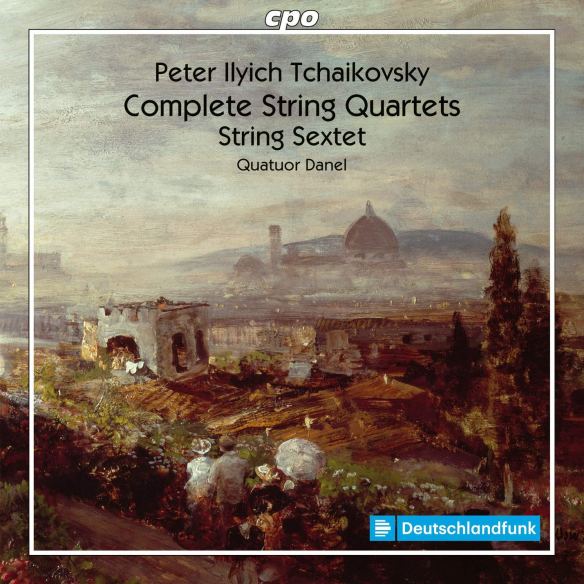
On record – Quatuor Danel: Tchaikovsky – Complete String Quartets & Souvenir de Florence (CPO)

Quatuor Danel [Marc Danel & Gilles Millet (violins), Vlad Bogdanas (viola), Yovan Markovitch (cello)], Vladimír Bukač (viola)*, Petr Prause (cello)*

Tchaikovsky
String Quartet no.1 in D major Op.11 (1871)
String Quartet no.2 in F major Op.22 (1873-4)
String Quartet movement in B flat major (1865)
String Quartet no.3 in E flat minor Op.30 (1876)
String Sextet in D minor Op.70, ‘Souvenir de Florence’ (1890)*

Written by Ben Hogwood

What’s the story?

This is a very welcome release from the Quatuor Danel. Having already given us complete cycles of Weinberg and Shostakovich – a total of 32 string quartets – they extend their reach back to Tchaikovsky and the first major quartet cycle in Russian music. There are two discs which include the three published quartets, the quartet movement and Souvenir de Florence, the composer’s String Sextet.

What’s the music like?

Following these pieces is a very interesting way of charting Tchaikovksy’s development as a composer.

The String Quartet no.1 in D major gives evidence of his major early influences, with Mozart and Mendelssohn in evidence. It also contains as its second movement the Andante cantabile, removed and arranged for string orchestra and very popular as a standalone piece for reflection.

The String Quartet no.2 in F major is weightier, with a more overtly Romantic musical language as Tchaikovsky shows more obvious emotion in his writing. The String Quartet no.3 is unusually cast in E flat minor, not a key string players regard with great affection, but one which offers very effective, dark colouring in an elegiac work.

The cycle is nicely positioned at regular intervals in the composer’s career, predated by a Quartet Movement in B flat major from the mid-1860s and capped by the String Sextet, Souvenir de Florence, from 1890, written while the composer was working in the Italian city.

Does it all work?

Yes. These are excellent performances from a quartet clearly attuned to Russian chamber music. They enjoy the graceful music with which the String Quartet no.1 starts, gliding forward with poise and elegance. As the development of the ideas gathers pace and intensity, so the quartet become more animated, convincingly driving through to the final bars. The Andante Cantabile is fresh and free of indulgence, its central dance offsetting the thoughtful main material. The Scherzo has plenty of cut and thrust, plus an enjoyable, bubbly trio, while the finale is in a similar vein but sunnier, enjoying the major key and some glorious melodies from Marc Danel’s violin.

Once fully in to gear, the String Quartet no.2 has an exuberant first movement. It is a high voltage performance, occasionally brimming over with its high spirits, but with a nicely judged and serene close. The quartet enjoy the rustic sounds of this work, particularly evident when Tchaikovsky uses open fifths in the lower parts, and they get admirable clarity from the big textures in the middle of the Andante.

The String Quartet no.3 receives a telling performance, getting right to the heart of Tchaikovsky’s thoughts. Sombre and thoughtful in its introduction, the first movement soon has admirable depth, the transition to the faster music ideally judged. The quartet relish Tchaikovsky’s fulsome writing but also the deeply soulful character of the movement’s second theme. The Scherzo is light on its feet, enjoying the exchanges from the top of the first violin to the bottom of the cello and back again, while the muted start to the third movement is particularly intense, deeply telling in its sorrowful and respectful closing pages. The finale largely shakes off these shackles but for a brief reference to the mood of the third.

As a useful postscript the Quartet Movement has a quiet and mysterious beginning, and it is not initially obvious where the work is going but then it blooms into a full structured movement, using the influence of Schubert and Mendelssohn to strong effect.

Finally a spirited account of the Souvenir de Florence, busy and upfront from the start, with plenty of energy from the six players – but with time too to enjoy both the softer second theme of the first movement and the lovely slow movement, where the cello line blooms beautifully. The shimmering central section here has plenty of drama, then the sound becomes earthy as the cello line returns. Textures are occasionally stretched in the third movement but the finale has a dramatic sense of urgency as well as a lovingly dispatched, broadly phrased second theme bringing brief parallels to the composer’s fantasy overture Romeo and Juliet. After this the sextet secure a thoroughly emphatic and affirming finish.

The big challenge with these works is getting the melodies to sing through the full textures with which Tchaikovsky writes, but the Quatuor Danel achieve the right balance throughout these excellent versions.

The elegance of the first quartet is immediately appealing, as is the red blooded cut and thrust of the second and the deeply emotive third, the best performance here. Having the Quartet Movement and an excellent account of Souvenir de Florence is the icing on the cake.

Is it recommended?

Yes. There is formidable competition in these pieces from the Borodin String Quartet, in company with Genrikh Talalyan and Mstislav Rostropovich for the Souvenir de Florence, and also from the Gabrieli and Chilingirian Quartets.

Yet despite these the Quatuor Danel offer an excellent modern alternative, with excellent performances and recording all round. It’s time for Tchaikovsky’s string quartets to come in from the cold.

Listen

Buy

You can listen to clips from the Quatuor Danel’s Tchaikovsky cycle and purchase a copy at the Presto website here