Under The Surface – Havergal Brian: Symphonies 8, 21 & 26 (Naxos)

Havergal Brian: Symphonies Nos. 8, 21 & 26 – New Russia State Symphony Orchestra / Alexander Walker

Reviewed by Richard Whitehouse

What’s the story?

Naxos’s Havergal Brian cycle, begun a quarter-century ago on the Marco Polo label, reaches an important milestone with a disc that features the composer’s only previously unrecorded symphony, alongside notable such works from his middle- and late- periods.

What’s the music like?

The premiere recording is that of the Twenty-Sixth Symphony, written as Brian approached his 90th birthday and among his most concentrated – for all that the overall mood is one of relative good humour. Of its three allegros, the first is a boisterous sonata design that cannily elides development and reprise, while its successor is a lively intermezzo with unexpectedly aggressive trios then a pointedly understated ending which leads directly into the finale – an off-kilter rondo whose more ambivalent episodes make possible a coda whose decisiveness is more than a little fractious. Unheard since two performances in its composer’s centenary year, the piece yields unexpected subtleties – Alexander Walker drawing a tensile response from his New Russia State Orchestra forces in this lesser while not unappealing addition to the Brian canon.

The significance of the Eighth Symphony has never been in doubt. If not the first of Brian’s one-movement such works, it is the first in which this composer grappled with the potential of symphonic continuity in earnest. Compared to Sir Charles Groves’s 1977 recording (EMI/ Warner), Walker opts for less strongly characterized individual sections in favour of greater underlying cohesion – the piece thus emerging as more than the sum of its already fascinating parts. A further plus is the definition accorded harp and piano, their contribution being crucial to the motivic evolution of music whose mystical qualities are offset by elements of sardonic humour and fraught eloquence. Nor are the enigmatic final bars undersold, though the quiet concluding dissonance as horn and trombones collide might have evinced greater presence.

By comparison, the Twenty-First Symphony tended to be heard as Brian’s marking time prior to embarking on a new and more challenging phase. This, at least, was always the feeling of Eric Pinkett’s pioneering 1972 account with the Leicestershire Schools Symphony Orchestra (Unicorn/Heritage), though such equable classicism has little place in Walker’s conception – the charged opening Allegro, its gawky introduction transformed into a surging coda, being a case in point. The Adagio emerges as one of its composer’s most searching, its increasingly wracked expression barely held in check, then the Vivace’s nimble scherzo with two livelier trios makes way for a finale whose muscular variations build inexorably toward an apotheosis the more powerful for its relative succinctness in what is an unequivocal statement of intent.

Does it all work?

Indeed. This is a major appraisal of three contrasting Brian symphonies, grippingly conveyed by an orchestra which now sounds audibly at ease with this composer’s recalcitrant idiom.

Is it recommended?

Yes, not least when the recorded sound is arguably the best yet secured from this source, and John Pickard’s booklet notes offer a wealth of informed observation. Incidentally, the Eighth Symphony has not been performed since a 1971 broadcast and never given in concert. Maybe Alexander Walker would like to take the plunge as this piece approaches its 70th anniversary?

For more information on this release, you can visit the Naxos website. For more information on the New Russia State Symphony Orchestra click here, and for the conductor Alexander Walker’s website click here


On record: Trent Reznor & Atticus Ross – The Vietnam War Soundtrack (UMC)

The Vietnam War – A Soundtrack by Trent Reznor and Atticus Ross

Reviewed by Ben Hogwood

Summary

You may have seen The Vietnam War, an ambitious 10-part series directed by Ken Burns and Lynn Novick that has aired on the BBC through Autumn and Winter. This is the first of two companion soundtracks, featuring over 90 minutes of original material composed by Trent Reznor and Atticus Ross.

Its companion is also a double album, with 38 songs including heavyweights of the era from The Beatles, Bob Dylan, Nina Simone, Simon & Garfunkel and Procol Harum.

What’s the music like?

Atmospheric and moody – but with considerable depth. Reznor and Ross write in a deceptively simple style, setting scenes through unhurried motifs and brushes of instrumental colour. Much of this colour is dark and foreboding, suggesting an underlying threat. The Forever Rain does this most vividly, suggesting the approach of an enemy vehicle.

There is an exquisite tension at play in the music, helped by the subtle use of quarter tones that can distort and pull a suggested moment of consonance in the harmony towards something more weird. Other Ways To Get To The Same Place uses these subtle variations in pitch to introduce disquiet.

There are more comforting moments – the opening Less Likely, for instance, then A World Away, where mottled piano and harp combine in an affecting loop, but by the time Justified Response arrives the tension built up throughout is released with great power. We hear cold electronic drums for the first time, then a full-on, four to the floor bluster.

Does it all work?

Yes. As background music it is extremely effective if rather disquieting, demanding more input on the part of the listener. Ross and Reznor suggest mood, emotion and peril with a surprising combination of subtlety and intensity.

Is it recommended?

Definitely. This is a cut above the average soundtrack music, and an ideal accompaniment to the visuals. The score complements the pop heavyweights elsewhere, which could hardly be bigger hitters – A Whiter Shade Of Pale, The Sound Of Silence and A Hard Rain’s A-Gonna Fall to name just three. Get both for a full picture of the climate.

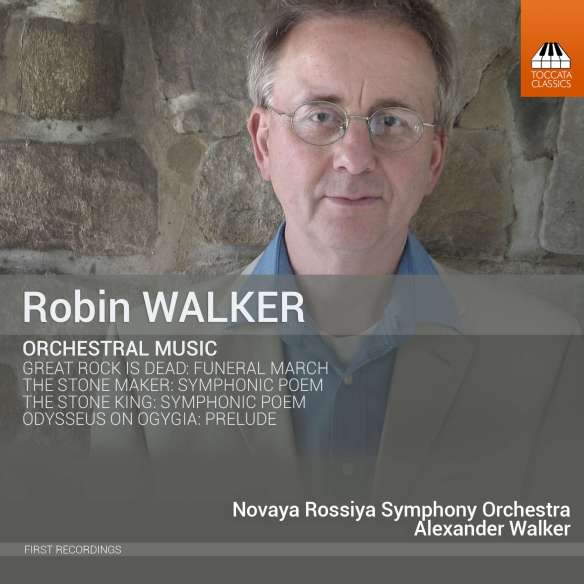
On record: Robin Walker: Orchestral Music (Toccata)

Walker Great Rock Is Dead; Odysseus on Ogygia; The Stone King; The Stone Maker

Novaya Rossiya Symphony Orchestra / Alexander Walker

Toccata Classics TOCC0283 58’13”

Producer Pavel Lavrenenkov Engineers Gennady Tarabantov and Alexander Karasev Recorded September 2nd-5th at Studio 5, Russian State TV and Radio Company Kultura, Moscow

Reviewed by Richard Whitehouse

Summary

The first disc devoted to the orchestral music of Robin Walker (b1953), whose idiom evolved over several decades before arriving at the singular and uncompromising music featured here, in what is another venture facilitated by the redoubtable Martin Anderson of Toccata Classics.

What’s the music like?

Readers with longer memories may recall certain pieces by Walker which attracted attention during the 1980s, not least the ensemble piece Dance/Still and the plangent Seven Last Words for electric guitar and percussion. Several of his chamber and instrumental works were issued by Riverrun Records (RVRCD66) at the turn of the century, yet anyone familiar with that disc will likely be surprised with what they find here. Interesting, too, that Walker (to judge by his website) is intent on covering his tracks, Ustvolskaya-like, regarding most of his earlier music.

Much the longest work is The Stone Maker, completed in 1995 after an eight-year gestation and described as a symphonic poem, though it could be assessed in terms of a one-movement symphony. The composer’s booklet note avoids any concrete programme, focussing instead on its modification of symphonic archetypes (notably Beethoven’s Fifth and Brahms’s First) in the light of his own aesthetic. This is worth bearing in mind because, unlike numerous of his contemporaries, Walker has not repudiated Modernism per se but reintegrated it into his highly individual take on the musical past. Tippett and Birtwistle are mentioned as guiding presences, and the more visceral passages of this work do indeed recall the latter composer (notably his Earth Dances), but there is equally a modally-inflected tonal underpinning such as sustains its 32 minutes with demonstrable purpose. No less striking are those stretches of more inward expression, notably that before the inexorable final build-up – while the tailing-off that ensues, and the suspenseful concluding bars are both realized with exquisite finesse.

None of the shorter pieces that emerged a decade on suggest a notable broadening or opening -out of Walker’s approach. The Stone King (2005) is another symphonic poem, though here the overall duration (barely a third of the earlier piece) militates against the emotional force shoe-horned into this music with its elemental ground-plan of equilibrium lost then regained. Great Rock is Dead (2007) is a funeral march inspired by the death of the composer’s father, implacable in its forward motion though any sense of emerging triumph is tenuous at best – not helped by the Bruckner-cum-Sibelius bathos of a coda that fails to convince. Best is the Prelude to Odysseus on Ogygia (2011), as adapted from the eponymous opera Walker wrote after 1995 and whose simmering intensity bodes well for this 90-minute ‘staged symphony’.

Does it all work?

Not always (as detailed above), but when it does come together this is impressive music – imbued with that sense of naturally accruing momentum which readily holds the attention. Anyone responsive to the tradition within which Walker is working needs to hear this disc.

Is it recommended?

Indeed, especially given these performances are so attuned to its essence. Alexander Walker secures a committed response from the Novaya Rossiya Symphony Orchestra, which is heard to advantage in a recorded ambience that amply brings out the filmic opulence of this music.
To listen to clips from this release and for further information visit the Toccata Classics website, while for more on Robin Walker you can visit the composer’s website

On record: The Flautadors – Bavardage (First Hand Records)

The Flautadors (Catherine Fleming, Merlin Harrison, Celia Ireland, Ian Wilson, recorders)

First Hand Records FHR55 Playing time: 60’24”

Reviewed by Richard Whitehouse

Summary

Since its formation in 1997, The Flautadors has been at the forefront of recorder consorts in Europe and this latest disc, its fifth, features a selection of modern pieces, interlaced with arrangements of Scottish traditional songs, celebrating its 20th anniversary in fine fashion.

What’s the music like?

Two works by Japanese composers offer contrasting takes on aspects of Occident and Orient. Black Intention IV (1980) has Making Ishii exploiting microtonal tuning and extended playing techniques as akin to those of the European avant-garde – whereas in Idyll 1 (1976), Ryohei Hirose draws on Indian harmonic procedures to overly sensuous effect. With its combination of recorders and triangles, Arbos (1977) is a microcosm of the interplay between incremental melodic growth and relative harmonic stasis that Arvo Pärt pursued henceforth.

Two pieces by younger British composers underline the virtuosic potential of the recorder consort today. Bavardage (2002) finds David Murphy exploring the idea of gossip as springboard to quick-fire exchanges and emergence of a volatile momentum, whereas the calmer exterior of Leo Chadburn‘s De la Salle (2001) belies the intervallic intricacy (and the number of recorders) in what is atmospheric if at times unsettling music. Which leaves Terry Riley‘s In C (1964), that blueprint for American minimalism whose equably insistent pattern-making responds tellingly to the unity-within-diversity afforded by seven recorder players and 25 recorders.

As arranged by Ian Wilson, the Scottish traditional songs emphasize the lyrical aspect of recorder playing. Thus, the limpid poignancy of Ca the yowes and robust gaiety of Dandy Dancer, the virile impetus of Bose and Butter and reel-driven energy of The Deil Among the Tailors. Neil Gow’s Lament immortalised the 18th-century fiddler’s second wife in warmly elegiac terms effortlessly conveyed here, and though it may be less than four decades old, Sir Peter Maxwell Davies‘s Farewell to Stromness is a timeless classic whose pensiveness (and greater fervency of its central section) comes through unabated in this artless transcription.

Does it all work?

Yes. The Flautadors has long excelled right across the board when it comes to the recorder repertoire and such diversity is in evidence throughout this disc – which is recorded with an ideal blend of space and clarity, and informatively annotated by members of the ensemble.

Is it recommended?

Indeed. Those who still hold to antiquated notions of what recorder music is should find this disc stimulating and enjoyable in equal measure. Note that The Flautadors will be playing some of these pieces in their 20th anniversary concert at Milton Court on 26th November.

To listen to clips from this release and for further information visit the Flautadors website, while ticket information for the Milton Court concert can be found here

On record: Steve Elcock: Orchestral Music, Volume One (Toccata)

Elcock Symphony no.3 Op. 16 (2005-10); Choses renversées par le temps ou la destruction op.20 (2013); Festive Overture op.7 (1997)

Royal Liverpool Philharmonic Orchestra / Paul Mann

Reviewed by Richard Whitehouse

Summary

The first release devoted to Steve Elcock, whose distinctive and uncompromising music went unheralded until four years ago when Toccata Classics supremo Martin Anderson took up the cause which resulted in the recording of the works featured here in Liverpool earlier this year.

What’s the music like?

Born in Chesterfield in 1957 and residing in central France for over three decades, Elcock has amassed a select catalogue (currently running to op.26) with five symphonies at its core. The present disc is dominated by his Third Symphony, composed over five years and cast in three movements whose relative contrasts become subsumed into the powerfully cumulative whole.

The opening Allegro veers between dynamism and stasis as to override thematic distinctions in its underlying sonata-form, heading to a tensile yet unresolved ending. Elements of parody are accentuated in the ensuing ‘Ostinato’, whose middle section emphasizes a coarse melody which points up the lunging and often violent activity around it. Its climax spills over into a final ‘Passacaglia’ as long as its predecessors combined, while given focus by its methodical alternation between loud and quiet expression, along with a steady sarabande rhythm which underpins the ultimately tragic tone. The winding down to an ominous, trill-suffused centre then intensified surge towards a tragic outcome is duly capped by the stark closing cadence.

A notable achievement, but scarcely less impressive is Choses renversées par le temps ou la destruction (Things knocked down by time or destruction). This symphonic triptych moves from the tense expectancy of ‘broken columns’ with its dismantling of the 14th Prelude from Book Two of Bach’s ‘48’ (played on harpsichord by Richard Casey), through the amorphous textures then eventual eruption of ‘mills of god’, to the all-round confrontation of ‘last man standing’ whose unfolding as a slow rondo effects the blackly humorous waltz near its close.

By contrast, the Festive Overture is in the lineage of pieces by such as Walton and Arnold, though Elcock draws comparably on Shostakovich’s eponymous piece and Elliott Carter’s Holiday Overture for its lively interplay of blithe melody and ingenious counterpoint.

Does it all work?

Yes, notwithstanding a passing tendency to over-score and the occasional pre-emptive climax. Elcock’s music has energy and momentum, but also eloquence and resourcefulness, as amply holds the attention. Mention is made of the ‘Nordic-British’ symphonic tradition, though that of European modernism is frequently detectable with the imaginative handling of orchestral texture and a rhetoric leavened with irony. For someone largely self-taught in composition, moreover, Elcock’s sense of control over form and expression is rarely less than impressive.

Is it recommended?

Indeed, not least when the Royal Liverpool Philharmonic Orchestra sounds so committed to the cause under the guidance of Paul Mann. The latter contributes an informative overview of these pieces, complemented by the composer’s autobiographical outline. Further instalments are planned, rightly so, but it would be a pleasure to hear these works – the Third Symphony in particular – in live performance; affording this music the tangibility it amply warrants.

To listen to clips from this release and for further information visit the Toccata Classics website, while for more on Steve Elcock you can visit the composer’s website