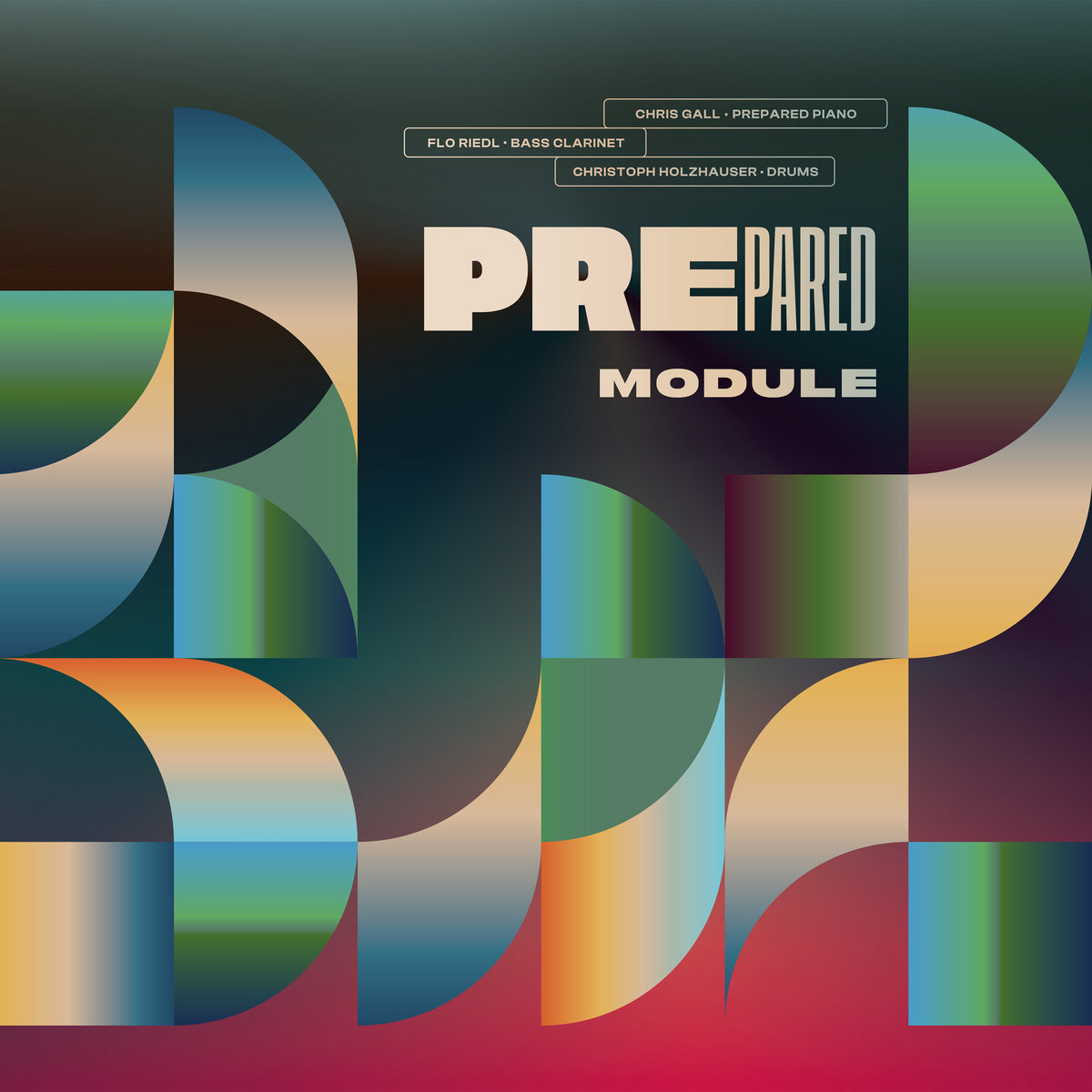
Prepared are a trio of jazz musicians from Munich, with pianist Chris Gall, bass clarinettist Flo Riedl and drummer Christoph Holzhauser. Gall plays Argentinian tango with Quadro Nuevo, Riedl plays what is described as ‘folklore-free folk music’ with Dreiviertelblut and Holzhauser is part of German hip hop ensemble Moop Mama.
As Prepared they take short musical motifs and build them into more substantial pieces, in the manner that minimalists such as Steve Reich might work but with several leanings towards jazz, especially in their syncopated rhythms.
What’s the music like?
Engrossing and a lot of fun. Gall’s piano is subtly modified in performance, and the wide range of colours he can secure from the instrument are made through hammering, tapping and plucking, bringing out its more percussive elements. Riedl’s bass clarinet is versatile, too, adding a really pleasing rasp to the texture, whether in bass part or melodic content. It often provides the essential syncopations that keep the music in the air. Holzhauser, meanwhile, is a virtuoso who plays with an improvisatory air but can switch between swinging disco beats and more complicated rhythmic exchanges.
When things cut loose and get into the groove on Modul Vier IV the trio resemble fellow dance enthusiasts Brandt Brauer Frick, but are more obviously jazz-bound in their thinking on Modul Eins II, which enjoys a persuasive sequence of crossrhythms, cutting effectively to the dampened piano. Modul Vier II is made of an attractive, rippling piano figure from Holzhauser, while the invigorating syncopations of Modul Zwei II are prompted by the clarinet.
Does it all work?
Pretty much – the trio have a very clear musical chemistry, and the fluid working out of their ideas is compelling to listen to. The colour combinations made by their instruments are ideal.
Is it recommended?
It certainly is. There is a good deal of enjoyment to be had from a trio who like to push the rhythmic envelope, bringing elements of jazz and disco into close correlation and having a lot of fun as they do so.
For fans of… Brandt Brauer Frick, Christian Prommer, Bugge Wesseltoft, Henrik Schwarz
As every year passes, it seems to me the importance of music and culture in our lives gets ever greater. Unfortunately this is not recognised by the vast majority of our politicians or those in education. Shouting our love of music from the rooftops is therefore more important than ever! It’s something Arcana has done for nearly 10 years…and as we close in on that special anniversary we do so with a mixture of thankfulness and regret.
I am incredibly grateful to have the new music that we have enjoyed together – and to have Richard Whitehouse giving regular despatches and typically probing insight from Birmingham and the classical recording world. This is along with John Earls whose London gig-going and home reading contributions have been incredibly welcome – along with a couple of very welcome reports from Jon Jacob.
My principal regret with Arcana is that I don’t have enough time to devote to it, with a day job that takes care of the working hours – but I do feel incredibly privileged to be able to bring to you another set of thoughts on the best of 2024 as experienced on these pages.
As you may know Arcana tends to focus on music we either like or are likely to enjoy. This means the review pages tend to celebrate more than criticize, though rest assured we won’t hesitate to if we need to! I see this sort of site as a place for communal enjoyment, to share what we love – with classical and electronic music as two main points of reference, with rock and pop orbiting close around. There are no rules to what we cover, and if it’s good it’s more likely to be written about! On which note…
Right on the junction between classical and electronic sits Belle Chen, whose inventive Ravel in the Forest, on the excellent Platoon label, cast an enchanting spell with its tasteful reimagining of the French master’s music. Also occupying this space is Erland Cooper, whose Carve The Runes…was a culmination of a captivating story of loss and recovery – and Debbie Wiseman, whose spellbinding music for Wolf Hall: The Mirror and The Light captured our hearts.
Now you might be following Kim’s advice on one of her singles to head for The Coast…but whether you are or not, we at Arcana thank you for reading our articles this year and for your general encouragement. We’re taking a break for a couple of weeks, but look forward to returning in 2025 for another year of music, new and old. If you want to contribute, do get in touch…but for now, Merry Christmas and / or Happy Holidays, and here’s to another year of sharing music we love.
Ben Hogwood editor, Arcana.fm
Published post no.2,403 – Tuesday 24 December 2024
Sonic Cathedral – the label that celebrates itself – marks two decades in existence with this handsomely packaged box set of classics and rarities. It’s no exaggeration to say that Nathaniel Cramp’s lovingly directed label has played a big part in the continued regeneration of shoegaze, a form of music whose versatility and staying power has continued to confound anyone miserly enough to criticise it.
By drawing on the best shoegaze from the late 1980s – and utilising some of the pioneers – Sonic Cathedral has looked for new talent and become a forward looking enterprise. Certain qualities have been retained and built upon, such as a penchant for winning remixes – marked in a disc entitled ‘Recalibrate Yourself’ – and a generous number of Yuletide covers and originals, marked in the brilliant ‘Celebrate Your Elf’. The label’s original best-ofs are found on the very fine ‘Celebrate Yourself’, while Reverberate Yourself! A Congregation Of Sonic Cathedral Live Recordings is a collection of exclusives from right down the front of the gig.
What’s the music like?
This is a brilliant collection, capturing each aspect of the Sonic Cathedral label and what has made it special. Celebrate Yourself is the true ‘best of’, rounding up 20 of the best tracks since the label began as a club night. These include the shimmering, hazy beauty of Pye Corner Audio, whose Warmth Of The Sun features Andy Bell, and the warm-hearted Early Years beauty Fluxus. Lorelle Meets The Obsolete, one of the label’s best aditions, shine on Balance, while there is a dreamy Dot Allison contribution in the shape of Unchanged. The easy tread of Neil Halstead’s Spin The Bottle is appealing. Mildred Maude bring their distinctive guitar sound to CPA II, while a new addition from Emma Anderson, Queen Moth, is beguiling. It’s great to see the label’s newer names on such good form.
If you want an extra groove laden underneath, the Recalibrate Yourself collection delivers in spades. Perhaps inevitably Andrew Weatherall takes the limelight with the laconic beat applied to Early Years’ Hall Of Mirrors, but there is plenty else to enjoy. James Holden gives a dazzling remix of XAM Duo’s Cold Stones, a flurry of exhilarating synths, while Maps’ take on Not Me But Us’ When We See is suitably epic. Meanwhile the Pye Corner Audio remake of Lorelle Meets The Obsolete’s Unificado is a wall of noise, a real thrill.
Complementing the studio recordings, Reverberate Yourself is a brilliant live collection, right from the label’s roots. It is led off by a powerhouse performance from Lorelle Meets The Obsolete, whose account of What’s Holding You? is a thrilling tour de force. ‘Epic’ is definitely the word here, applicable to The Early Years and their account of The Simple Solution, Slowdive’s Golden Hair from Los Angeles, and bdrmm’s Mono from Leeds, but there are more intimate moments too, such as Mark Peters at The Band Room in Yorkshire and Dean Wareham’s When Will You Come Home.
The icing on the cake is Celebrate Your Elf, led off by a wonderfully starry The Box Of Delights from Mark Peters, who also delivers a winsome Silent Night. Fairewell makes two excellent contributions in Christmas Eve and In The Bleak Midwinter, while A Place To Bury Strangers enjoy a bruising encounter with Kool & The Gang’s Celebration. Wrapping things up is Maps – a technicolour remix of The Box Of Delights and a stellar cover of East 17’s Stay Another Day.
Does it all work?
Emphatically. It’s easy to imagine that Sonic Cathedral could have doubled the choices on this compilation and still not lost the quality. There are winning musical moments at every turn.
Is it recommended?
Heartily. This is a lovingly compiled anniversary treat, capturing every aspect of a record label whose status has only grown over that time. We’re lucky to have them!
Saint Etienne’s twelfth album, their first in three years, is written as an antidote to the chaos of daily life, an ambient complement to the sheer speed and noise of 21st century life.
Pete Wiggs captures its essence: “We wanted to continue the mellow and spacey mood of the last album, perhaps even double down on it, but it’s a very different album, not based on samples; Songs, moods and spoken pieces drift in and out whilst rain pours down outside. It’s the kind of record I like to listen to in the dark or with my eyes closed. Half Light is about the edge of night, the last rays of the sun flickering through the branches of trees, communing with nature and seeing things that might not be there.”
Bob Stanley also expressed an interest the band had in finding the state between wakefulness and sleep, a kind of dream space with broken-up thoughts and random memories.
What’s the music like?
Soothing, sonorous and often beautiful. Sarah Cracknell’s voice proves ideal for such an ambient sojourn, whether in spoken word or in the soft vocal tracks that are dotted through the album.
The field recordings create an easy ambience, dressing the music with thoughts that drift in and out of focus. The music, too, finds sharp points of reference among its foggier reminiscences. The clarinet is put to fetching use on the wistful When You Were Young, which has a beautiful chorus – as does Nightingale.
No Rush brings a mottled beauty to its slowly shifting chords, not a million miles from the Romanza of Vaughan Williams’ Symphony no.5 in its ability to stop the senses. Gold is more obviously song-based, while Preflyte opens out into wider textures, bells tolling before Cracknell’s heartfelt vocal. Hear My Heart is a beauty, the voice against a windswept canvas.
Does it all work?
It does. Saint Etienne are masters of pop music dressed with a forlorn beauty, but this clever use of field recordings and textures shows them to be equally adept at making music that supports relaxation of the mind.
Is it recommended?
Enthusiastically. The Night achieves just what it set out to do, which is to provide an antidote to the over stimulation we receive in our daily lives. It is an understated beauty.
For fans of… Broadcast, Stereolab, Yo La Tengo, Bibio, Cocteau Twins
Ives Four Ragtime Dances (1902-04, rev. 1916) Fugue in Four Keys on ‘The Shining Shore’ (c1903) The Pond (c1906, rev, c1912-13) The Rainbow (first version, 1914) An Old Song Deranged (c1903) Skit for Danbury Fair (c1909, real. Sinclair) The Gong on the Hook and Ladder or Fireman’s Parade on Main Street (c1911, rev. 1934) Chromâtimelôdtune (c1923, real. Singleton) Tone Roads – no.1 (c1913-14); no.3 (c1911/13-14) Set of Incomplete Works and Fragments (ed. Singleton/Sinclair, 1974) March no.2, with ‘Son of a Gambolier’ (c1892) March no.3, with ‘My Old Kentucky Home’ (c1893) March ‘The Circus Band’ (c1898-99, rev. 1932-33) Arrangements (1896-97) – Schubert: Marche militaire in D, D733 No. 1 (1818). Schumann: Valse noble, Op. 9 No. 4 (1834-35). Schubert: Impromptu in C minor, D899 No. 1 (1827)
Orchestra New England, Orquesta Sinfónica de Navarra (arrangements) / James Sinclair
Naxos American Classics 8.559954 [75’43”] Editions John Kirkpatrick, Jacques-Louis Monod, James Sinclair, Kenneth Singleton and Richard Swift Producers Neely Bruce, Jan Swafford Engineers Benjamin Schwarz with Jonathan Galle and Gonzalo Noqué
Recorded 24/25 October 2023 at Auditorio Barañaín, Pamplona-Navarra, Spain (arrangements), 12-14 March 2024 at Colony Hall/Choate Rosemary Hall, Wallingford CT, USA
Reviewed by Richard Whitehouse
What’s the story?
Naxos continues its long-term series devoted to the orchestral music of Charles Ives with this volume of shorter pieces and arrangements, several of them recorded for the first time and conducted by James Sinclair, whose involvement with the composer now stretches back across 50 years.
What’s the music like?
Miniatures for a variety of forces are found right across the four decades of Ives’s composing and range from unformed experiments to perfectly realized exemplars of his idiom. Many of these were collated in the dozen or so Sets that Ives assembled at various stages in his career (recorded on Naxos 8.559917) while there are various others which resist any such compiling, and these can mostly be found here – often in critical editions prepared by a formidable team of Ives scholars, hence rounding out the picture of his creativity in the most immediate terms.
Written at the outset of the genre’s golden age, the Four Ragtime Dances neatly complement each other as regards form and content; elements from each finding their way into the second movement (The Rockstrewn Hills) from the Second Orchestral Set, which builds upon their anarchic humour accordingly. Following the shimmering polytonal ambivalence of the Fugue on ‘The Shining Shore’, the unworldly evocations The Pond and The Rainbow find Ives at his most intimate and confessional – as does the admittedly more genial An Old Song Deranged. Not so Skit for Danbury Fair, its inherent iconoclasm finding greater focus in the graphically descriptive The Gong on the Hook and Ladder or contrasting Tone Roads Nos. 1 and 3 which embody Ives’s thinking on indivisibility of life and music in the most uncompromising terms.
It was once thought Chromâtimelôdtune might be the missing Tone Road No. 2, yet this late and possibly incomplete piece is likely an acerbic response to the Modernism emerging from post-war Europe which seemingly preoccupied Ives in those twilight years of his composing. The three song-based Marches date from an earlier and ostensibly more carefree phase, their debunking couched in humorous terms, while the Set of Incomplete Works and Fragments is a judiciously conceived entity that should not have had to wait 50 years for its first recording. The orchestrations are from Ives’s study with Horatio Parker at Yale: that of Schubert’s First Marche Militaire and Schumann’s Valse noble (from Carnaval) are expert but anonymous, that of Schubert’s First Impromptu results in a ‘theme and variations’ of striking prescience.
Does it all work?
Yes, inasmuch that the effectiveness of these pieces largely depends on the conviction of their performers and, with Sinclair at the helm, this can be taken for granted. As can the excellence of Orchestra New England in repertoire it has often been playing for decades, and if Orquesta Sinfónica de Navarra might appear an unlikely choice for Ives’s undergraduate arrangements, it acquits itself admirably. The sound throughout is unexceptionally fine, and Sinclair’s own annotations are succinctly informative as to the genesis and context of some intriguing music.
Is it recommended?
Indeed, this is a necessary addition to a valuable series – hopefully to be continued before too long with recordings of the Fourth Symphony and Universe Symphony as partially realized by David Porter, of which Sinclair gave a memorable account at the Aldeburgh Festival in 2012.
Listen & Buy
For buying options, you can visit the Naxos website – or listen to the recording on Tidal below:



 Arcana.fm