Online music recommendations – Oxford Lieder Festival

Over the last few years the Oxford Lieder Festival has established itself as one of the most attractive prospects in the autumn events calendar for classical music. Given the challenges faced by the sector in this most trying of years, it gives great pleasure to report that the team, led by artistic director Sholto Kynoch, have gone above and beyond the call of duty to present this year’s model.

An online extravaganza lasting ten days, the festival continues its penchant for the use of attractive venues in the city, presenting them in an online format with Tall Wall Media which is both easy to navigate and admire.
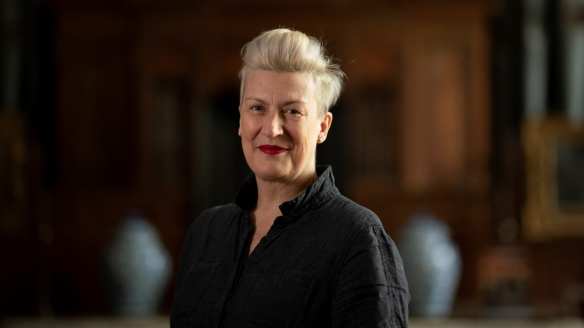
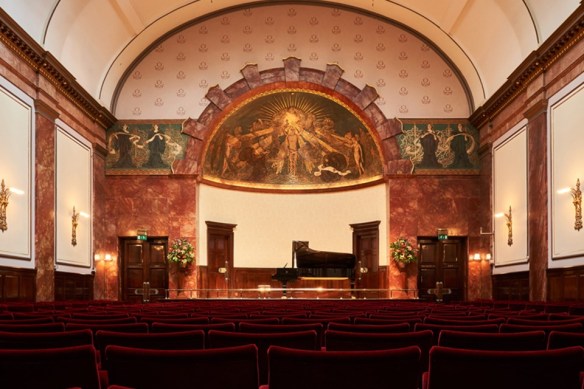
The artistic standard remains as high as ever, as does the programming. Viewers on Saturday were treated to James Gilchrist immersing himself in ancient lute songs, with the florid tones of Elizabeth Kenny alongside, from where we switched to the Hollywell Music Room. Here we found the redoubtable Dame Sarah Connolly (above) and Eugene Asti in a program including Schumann’s Frauenliebe und -leben and a rapt account of Mahler’s Rückert-Lieder, time standing still during the final two songs, a darkly atmospheric Um Mitternacht and an expansive Liebst su um Schönheit.

Many of the Oxford Lieder concerts include a slot for emerging artists, a healthy recognition of the outstanding young talent coming through in the world of song. On this occasion it was bass William Thomas who lent his fulsome tones to a quintet of Schubert songs. We also heard a nicely linked quintet songs from Finzi, Quilter, Haydn and Geoffrey Bush.

The festival has a very healthy instinct for presenting songs in context and giving them the right level of background through guest musicological experts. Natasha Loges illuminated Brahms’ Lieder contributions with music from baritone James Atkinson and pianist Ana Manastireanu while on Saturday 17 October, the festival’s final day, we will get a fascinating chance to explore the song prior to Beethoven in the company of baritone Stephan Loges and Eugene Asti.
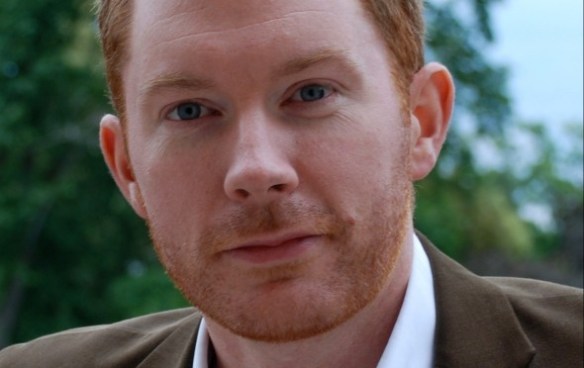
On Tuesday 13 October, the lunchtime concert found tenor Robin Tritschler (above) giving a superb hour of music with pianist Graham Johnson from the Hollywell Music Room, journeying round the Zodiac with all the spirit of first-time voyagers. Travelling through works from Barber, Schubert, Ives, Rebecca Clarke and Argento, their ultimate destination was the Songs of the Zodiac of Geoffrey Bush. This inventive cycle provides a setting for each sign, helpfully introduced by Johnson before the two offered vivid characterisation. Here there was plenty of wit but tenderness too.

The following lunchtime tenor James Gilchrist and pianist Anna Tilbrook included a substantial world premiere of a work by Michael Zev Gordon, a composer Gilchrist studied with at King’s College Cambridge in the 1980s. There was a rather nice irony about a work with its genesis in Cambridge receiving its first performance in Oxford, and Gordon’s Baruch – Ten Propositions of Baruch Spinoza showed itself to be an impressive piece indeed.

Fusing elements of chant and more modern, English song – Holst’s great Betelgeuse came to mind in the final Ex hoc tertio cognitionis… – it was a dramatic performance that definitely warrants a further viewing. The cycle started with Gilchrist using a harsher tone but as it unfolded the voice blossomed to fill the space around, helped by the sensitive balance provided by Tilbrook. In the words of Gordon, these were ‘aphorisms meant to be heard and pondered; here sung and pondered’. Gilchrist complemented this with an affectionate and yearning account of a work he has known since childhood, Beethoven’s An die ferne Geliebte – the first clearly defined song cycle.
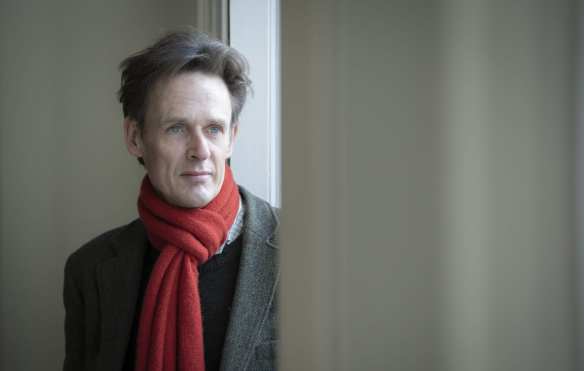
Today’s lunchtime concert was rather special with Ian Bostridge (above) joined by pianist Saskia Giogini at Merton College Chapel in a characteristically intense account of Britten’s Canticle I: My Beloved Is Mine. The camera work should be mentioned here, as it captured the glorious chapel in an ideal complement to Britten’s arrangements of Five Spiritual Songs, where Bostridge was masterly, and in the beautiful Bach, the arias Ich habe genug, from the cantata of the same name, and Der Ewigkeit saphirnes Haus (from Laß, Fürstin, laß noch einen Strahl). Taken on their own, these two – with the Oxford Bach Soloists – reminded us of the true value of live performance, even when given online in these restricted times.

The Oxford Lieder Festival continues until Saturday 17 October, where it will include a performance of Schubert’s Schwanengesang from tenor Christoph Prégardien and pianist Michael Gees. Before then you can enjoy concerts from baritone Benjamin Appl and Sholto Kynoch, mezzo-soprano Kitty Whately and Simon Lepper and a keenly anticipated collaboration between soprano Lotte Betts-Dean and guitarist Sean Shibe. All concerts are available online until 1 November, or 15 November with the event’s Pioneer Pass – which is much appreciated if you want to catch up with recommended concerts from Carolyn Sampson and Joseph Middleton, not to mention the Hermes Experiment!

For further details visit the festival website
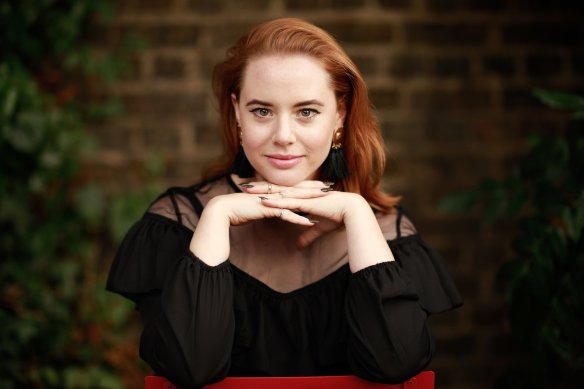
In concert – Lotte Betts-Dean & Joseph Havlat @ Bishopsgate Institute

Lotte Betts-Dean (soprano), Joseph Havlat (piano)

Bishopsgate Institute, London
Friday 9 October, 1pm (review of the online broadcast)

Written by Richard Whitehouse

Hindemith Nine English Songs (1942-4): no.2, Echo; no.7, Sing on there in the Swamp
Varèse Un grand sommeil noir (1906)
Schoen Sechs Gedichte von Fritx Heinle (1932)
Szymanowski Before Bedtime Op.49/1 (1922-3)
Schoen Sechs Lieder für Kinder (1927)
Malipiero Omaggi (1920) – no.1, A un papagallo
Casella X-Berceuse Op.35/11 (1920)
Tyrwhitt-Wilson Trois petites marches funèbres (1916) – no.1, Pour un homme d’état; no.2, Pour un canari
Schoen Das Anti-Hitler Lied (1941); Das Heimkehrlied (c1940)
Spoliansky Das Lila Lied (1920)
Schoenberg Brettl-Lieder (1901) – no.1, Galathea

The recently returned lunchtime series at Bishopsgate promises an extensive range of music and artists. This afternoon’s recital was no exception in focussing on songs by Ernst Schoen (1894-1960), the German composer and radio pioneer who for some years resided in London.

Their programme divided into four complementary parts, Lotte Betts-Dean and Joseph Havlat began with ‘Music for Friends’ – two gently laconic settings by Hindemith of Thomas Moore and Walt Whitman being followed by the sombre rumination as drawn by Varèse from Paul Verlaine’s poem in almost the only extant piece of this composer’s earlier years. The settings of Fritz Henle (whose life was terminated by his own hand at the outbreak of the First World War) reveal Schoen having absorbed the expressionism of Schoenberg’s Book of the Hanging Gardens cycle in songs that, elusive and unaffected by turns, were perceptively rendered here.

The second part centred on ‘Music for Children’, with the first of Szymanowski’s enchanting Children’s Rhymes followed by a set from Schoen. Here the inspiration lay in those nonsense rhymes after Russian texts which Stravinsky had penned the previous decade, albeit with an ironic edge rather more akin to Schulhoff’s songs and piano miniatures from the early 1920s.

The third part brought ‘Music for Dance and the Stage’ in the guise of pieces danced by Henri Châtin Hofmann (1900-1961) to Dadaist choreography (recently recreated when this selection was presented in Warsaw) which fairly typified the decadence and provocation of the Weimar Republic’s heyday. Insouciant miniatures by Malipiero and Casella were thus juxtaposed with two of the funeral pieces by Lord Berners, whose Satie-esque whimsy was shot through with an ominousness which Havlat (replacing an indisposed Samuel Draper) realized accordingly.

The fourth and final part focussed upon ‘Music for Politics’, Schoen’s pointed castigation of Hitler and his fervent contemplation on ‘coming home’ followed with a sardonic number by Mischa Spoliansky such as persisted as a Gay Rights anthem long after it had been created. Betts-Dean and Havlat upped the emotional ante in these latter songs, bringing the advertised programme to a close. Time, though, for two more of Schoen’s children’s songs and the first of Schoenberg’s Brettl-Lieder – the soprano’s coyness making up for any lack of sensuality.

An arresting recital by artists who will hopefully perform this and similar music again soon.

This concert can be accessed at the Bishopsgate Institute Facebook page

In concert – April Fredrick, English String Orchestra / Kenneth Woods perform Richard Strauss

April Fredrick (soprano), Members of the English Symphony Orchestra / Kenneth Woods

Wyastone Concert Hall, Monmouth
Friday 18 September (review of the online broadcast)

Written by Richard Whitehouse

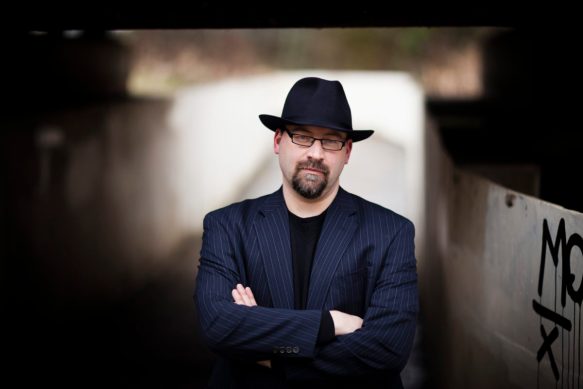
The continued difficulties in mounting live concerts with an audience has led to any number of virtual and online presentations, of which the English Symphony Orchestra’s Music from Wyastone is among the most imaginative. As organized and curated by Kenneth Woods, the ESO’s redoubtable music director (below), this promises a fresh perspective on various (often if not always) familiar pieces – performed in chamber reductions which respect the need for social distancing and illuminate aspects of the music not always evident in its more familiar guise.

Such was made manifest in the present account of Strauss’s Four Last Songs, as heard in the transcription by James Ledger made for Felicity Lott’s farewell concert at the Wigmore Hall seven years ago and whose large ensemble emphasizes the wistful eloquence of these songs without undue enervation. It helped that April Fredrick was at one with Ledger’s conception and Woods’s realization, whether in the lithe ardency of Frühling or the eddying rumination of September – this latter a candidate for the most perfectly realized of all Strauss’s songs.

The rapturous emotion of Beim Schlafengehen can verge on the cloying, but there was no risk of that here as Fredrick imbued this setting of Hermann Hesse with a plangent emotion such as most renditions gloss over, complemented by Zoë Beyers’ unaffected handling of its violin solo. Joseph von Eichendorff‘s Im Abendrot was hardly less impressive, the expressive trajectory seamlessly sustained from impassioned opening to hushed close with its valedictory allusions to Strauss and Mahler – over which Fredrick’s vocal hovered with mesmeric poise.

A chamber reduction by Tony Burke of Morgen! – Strauss’s setting of John Henry Mackay – for similar forces made for an unexpected if welcome encore. Here too it was the purity and understatement of Fredrick’s approach that most readily compelled, in the process drawing this relatively early song into the emotional orbit of those written over half-a-century later. A fine ending to this first instalment of what promises to be a rewarding series, and one which looks set to reaffirm the significance of the ESO within the context of British music-making.

This concert can be accessed free until the end of Tuesday 22 September at the English Symphony Orchestra website

Further information about the Music from Wyastone series can be found here

Online music recommendations – Wigmore Hall’s new season

The Last Night of the Proms is a defining point in the musical calendar; once it has past summer literally becomes autumn where classical music venues are concerned, bringing with it a whole new set of possibilities.

Except this is 2020 of course, and the rulebook for live events has not just been completely rewritten but is subject to endless revisions, as the Coronavirus pandemic regulations change and as the government resets its guidelines.

In the midst of this confusion and with (sadly) a lack of constructive action and urgency from the Department for Culture, Media & Sport, the Wigmore Hall’s unveiling of a packed new season of concerts is all the more impressive.

The hall led the return to live classical music back in June, which already seems a long time ago – and the sight of Stephen Hough playing to an empty venue might have been bittersweet but was also unexpectedly moving. Building on the success of that venture, the new season is even more ambitious.

Starting tonight, with Christian Gerhaher and Gerold Huber performing Berg and Schubert, the season runs right the way through to 22 December. During September each weekday will have two concerts, with an hour’s lunchtime recital at 1pm, broadcast by BBC Radio 3, and the evening concert at 7.30pm. All will be streamed on the Wigmore Hall channel and on YouTube.

Happily there are too many highlights for Arcana to list here – but during September you would be well advised to keep near a screen! The first lunchtime recital, on Monday 14 September, will see Alban Gerhardt and Markus Becker playing Shostakovich, Schumann and Beethoven – while other highlights of the first week include a concert from Rachel Podger and Kristian Bezuidenhout on Tuesday 15 September, with Bach and Froberger, and a richly imaginative song recital from Dame Sarah Connolly and Malcolm Martineau, the next lunchtime.

Later we have a characteristically imaginative recital from guitarist Sean Shibe (Friday 18), an all-Bach masterclass from pianist Angela Hewitt (Saturday 19), Quatuor Danel continuing their Shostakovich and Weinberg series (Wednesday 23) and a fascinating juxtaposition of Ravel and Couperin from pianist Cédric Tiberghien (Thursday 24). The following evening sees a combination of French and American songs from baritone Gerald Finley and pianist Julius Drake.

And that’s just the first week! With so many riches in store, head to the Wigmore Hall website – where you can get planning. If you’re lucky enough to live closer to London you might be considering attending in socially distanced person, but if not then the online concerts will be rich and stimulating indeed.

In order to watch the Wigmore Hall’s online content, you need to head to their website and create a free account here. Once set up, you’re ready to roll! Alternatively you can watch at the Wigmore’s own YouTube channel

Online music recommendations – Summer sessions in London

With the continued restrictions on live performance preventing orchestras from performing in the conventional sense, ensembles have been giving concerts and subscriptions online. Two of the biggest London orchestras have been running series through the summer which are highly recommended.

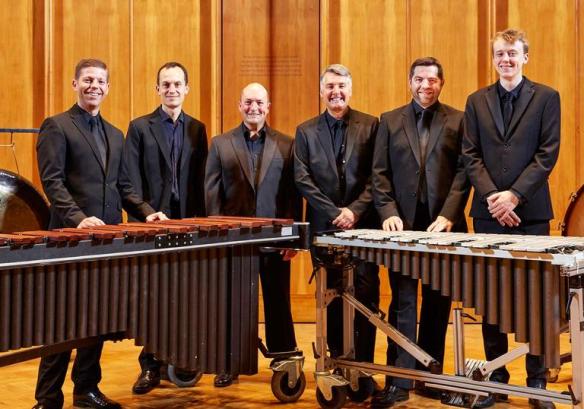
The London Symphony Orchestra have been giving a series of Summer Shorts at LSO St. Luke’s through July and August, and is set to conclude in thrilling fashion with a concert from the LSO Percussion Ensemble on Friday 21 August at 1pm. You can watch it on the LSO website here

The programme begins with Chick Corea’s Duet Suite, arranged by Simon Carrington, before two pieces from Gwilym Simcock – his Quintet, which the ensemble have already recorded, and the shorter piece Barber Blues.

Also available to watch is the concert from the Friday just gone, given by the piano trio Belinda McFarlane (violin), Jennifer Brown (cello) and pianist Elizabeth Burley. Their intriguing hour of music begins with Judith Lang Zaimont’s Nocturne, before A Winged Spirit, the new piece from Hannah Kendall. Wrapping things up is Rachmaninov’s passionate but seldom heard Trio élégiaque no.1:

Across town in the Henry Wood Hall, the different sections of the London Philharmonic Orchestra have been giving concerts for reduced forces. Their Summer Sessions began on July 15 with a rather lovely set for strings, including the Elgar Serenade for Strings, the first Concerto Grosso of the Op.6 set by Corelli and Grieg’s sunny Holberg Suite:

Then the winds stepped up on two weeks later, playing Rossini’s Sonata no.1, Mozart’s wonderful Serenade in E flat major K375 and Janáček’s Mládí:

Brass and percussion were next, with a program of fanfares and divertimenti featuring works by Sir Malcolm Arnold, Richard Bissill, Leonard Salzedo, Stanley Woods and Simon Carrington:

Finally the orchestra will celebrate the 250th anniversary of Beethoven’s birth with a vibrant program including the Septet in E flat major, the Quintet for piano and wind and the lesser known Trio for piano, flute and bassoon. You can catch that concert on the London Philharmonic Orchestra’s YouTube channel here