Arcana at the opera: Fidelio @ Garsington Opera

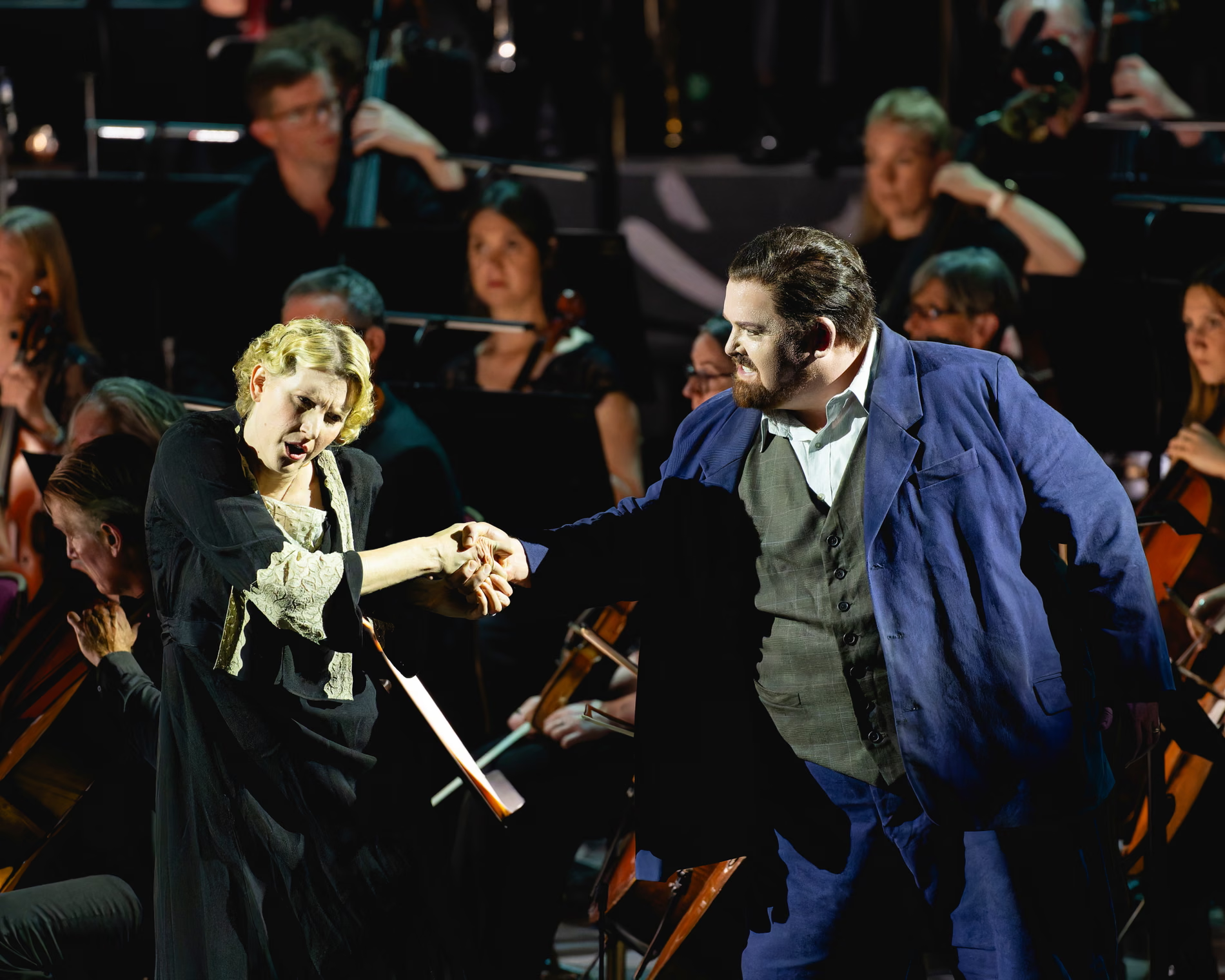
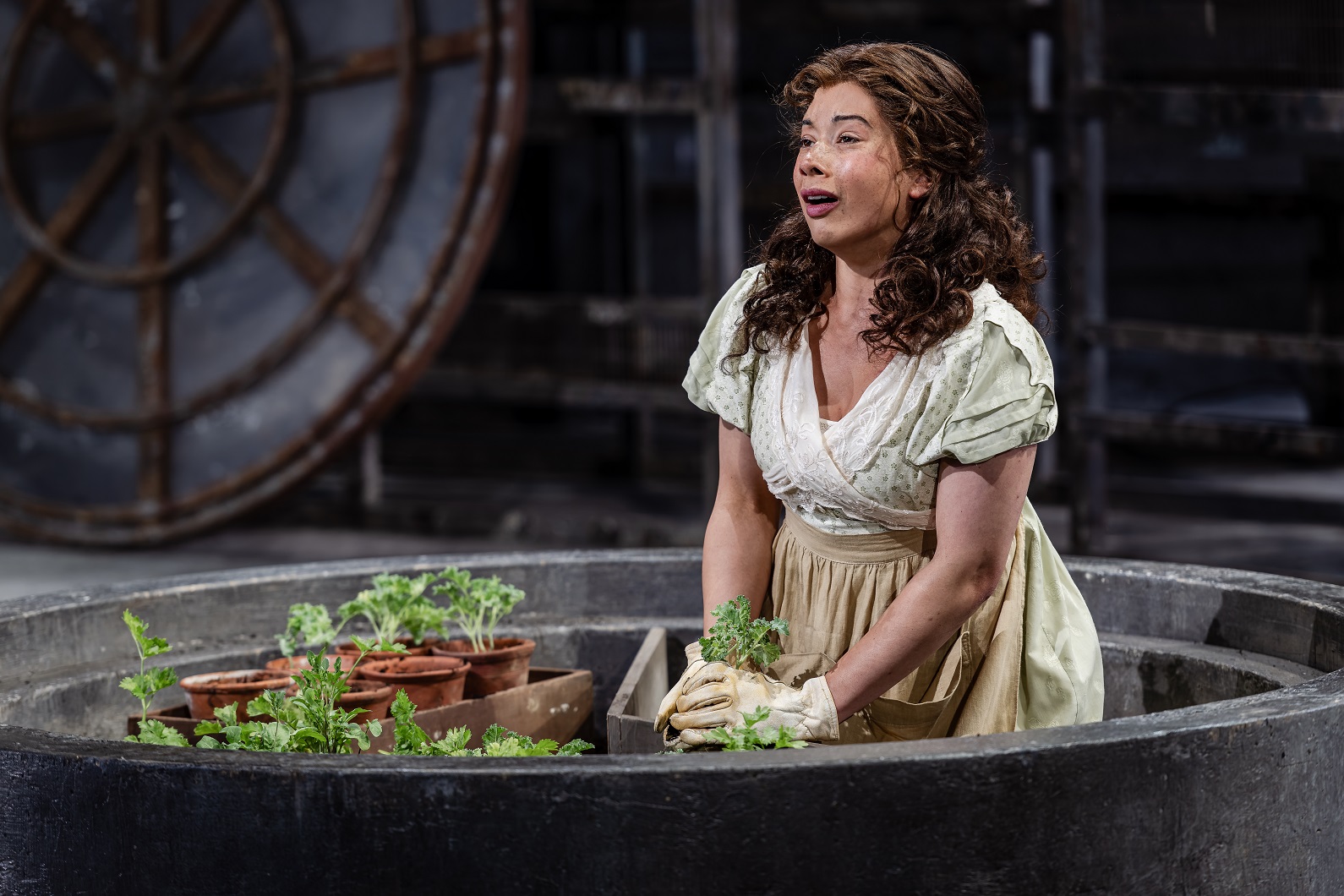
Beethoven’s Fidelio, Garsington Opera at Wormsley, Stokenchurch, UK | Pictured: Robert Murray (Florestan); Sally Matthews (Leonore) | Image © Julian Guidera 2025

Fidelio (1804-5, rev. 1814)

Music by Ludwig van Beethoven
Libretto by Joseph Sonnleithner and Georg Friedrich Treitschke, after Jean-Nicolas Bouilly
Sung in German with English surtitles

Leonore, disguised as Fidelio – Sally Matthews (soprano), Florestan, her imprisoned husband – Robert Murray (tenor), Don Pizzarro, prison governor – Musa Ngqungwana (bass-baritone), Rocco, gaoler – Jonathan Lemalu (bass-baritone), Marzelline, his daughter – Isabelle Peters (soprano), Jacquino, prison warder – Oliver Johnston (tenor), Don Fernando, king’s minister – Richard Burkhard (baritone), First Prisoner – Alfred Mitchell (tenor), Second Prisoner – Wonsick Oh (bass)

John Cox (original director), Jamie Manton (revival director), Gary McCann (designer), Ben Pickersgill (lighting)

Garsington Opera Chorus, The English Concert / Douglas Boyd

Garsington Opera, Wormsley
Friday 27 June 2025

review by Richard Whitehouse Photos by (c) Julian Guidera

Few operas have been subject to matters of time and place as has Fidelio. Beethoven’s sole opera, by his own admission, caused him the greatest difficulty among all his works to ‘get right’ and, even today, it can all too easily emerge as a compromise between what had been intended and what (conceptually at least) was feasible. All credit, then, to Garsington Opera for this revival which not only avoided the likely pitfalls first time around but has improved with age – in short, a production that amply conveys the essence of this flawed masterpiece.

Beethoven’s Fidelio, Garsington Opera at Wormsley, Stokenchurch, UK | Pictured: Isabelle Peters (Marzelline) | Image © Julian Guidera 2025

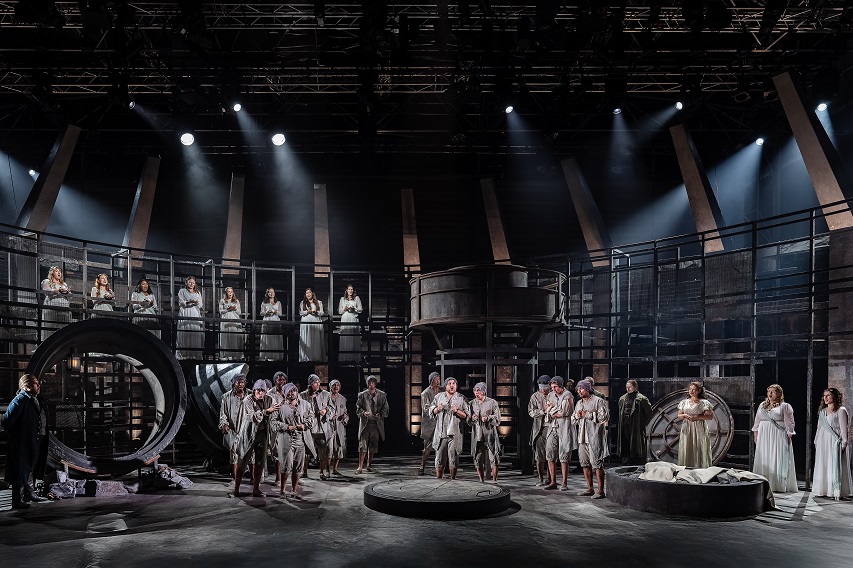
That original staging had been directed by John Cox, whose productions are rarely less than durable and with such as his 1973 Capriccio or his 1975 The Rake’s Progress being close to definitive. For this second revival, Jamie Manton has streamlined the basic concept such that everything which takes place can be envisaged from the outset and hence ensures consistency across the production as a whole. He is abetted by Gary McCann’s designs, their monochrome stylings imparting a grim uniformity which could not be more fitting given that this drama is played out around and inside a prison. In particular, the hole front-of-stage from out of which the prisoners emerge and into which Florestan is to be committed is a device made elemental merely by its presence, while the final scene avoids the agitprop from an earlier era in favour of a straightforward tying-up of narrative loose-ends the more affecting for its understatement. Effective without being intrusive, Ben Pickersgill’s lighting enhances the changing moods of an opera which takes in domestic comedy and visceral drama prior to its heroic denouement.

Beethoven’s Fidelio, Garsington Opera at Wormsley, Stokenchurch, UK | Pictured: Garsington Opera Chorus | Image © Julian Guidera 2025

Vocally the opening night was a little uneven without there any real disappointments. If Sally Matthews initially sounded a little inhibited in the title-role, this most probably reflected its ambivalent nature rather than any lack of expressive focus; certainly, her commitment in the ‘Abscheulicher…Komm Hoffnung’ aria such as defines her emotional persona was absolute, as was her seizing hold of that climactic quartet to which the entire drama has been heading. Sounding as well as looking his part, Robert Murray avoided the rhetorical overkill that too often mars portrayals of Florestan – his mingled vulnerability and fatalism maintained right through to the duet ‘O namenlose Freude’ whose eliding of elation and doubt intensified its emotive force whatever its actual length, though without pre-empting what is still to come.

Beethoven’s Fidelio, Garsington Opera at Wormsley, Stokenchurch, UK | Pictured: Musa Ngqungwana (Don Pizarro); Richard Burkhard (Don Fernando) | Image © Julian Guidera 2025

As Don Pizarro, Musa Ngqungwana was imposing in presence and thoughtful in approach – his lack of histrionics preferable in a role which too often descends into caricature. That said, he was upstaged in their duet ‘Jetzt, Alter, jetzt hat es Eile!’ by Jonathan Lemalu who was in his element as Rocco; materialist aspiration outweighed by the humanity invested into a role where comedy rapidly gives way to pathos. Marzelline and Jaquino may have but little to do after the first scene, but Isabelle Peters was eloquence itself in her aria ‘O war ich schon mit dir vereint’ while Oliver Johnston veered engagingly between eagerness and consternation. Richard Burkhard made for an authoritative if never portentous Don Fernando, while Alfred Mitchell and Wonsick Oh afforded touching cameos during a memorable ‘Prisoners’ chorus’.

Beethoven’s Fidelio, Garsington Opera at Wormsley, Stokenchurch, UK | Pictured: Jonathan Lemalu (Rocco); Isabelle Peters (Marzelline); Garsington Opera Chorus | Image © Julian Guidera 2025

Nor was the Garsington Opera Chorus to be found wanting as a whole in its contribution to the finales of each act – the first as moving in its pallor, infused with radiance, as the second was in the unfettered joyousness which offset any risk of that final scene becoming merely a celebratory tableau. The English Concert sounded rarely less then characterful, even though humid conditions likely explained some occasionally approximate intonation – happily not in Rachel Chaplin’s scintillating oboe obligato which shadows Florestan’s aria ‘In des Lebens Frühlingstagen’ as if an extension of his character. Douglas Boyd directed with assurance an opera with which he has long been familiar, his tempos unexceptionally right and always at the service of the opera. The author Michael Oliver was surely correct in his observation that the Leonore original is superior in theatrical terms to the Fidelio revision, yet this latter was nothing if not cohesive through Boyd’s astute dovetailing of individual numbers, as between speech and music, so that any seeming discontinuities were made more apparent than real.

Some 211 years after the successful launch of its final version and Fidelio remains an opera acutely sensitive to political context and polemical intent. Beethoven himself was, of course, partly responsible for this but subsequent generations have sought, often recklessly, to foist their own preoccupations onto his music so as to distort or even negate its essence. There was no risk of that happening here thanks to the balanced objectivity of this production but also to its conviction that the composer’s guiding vision is, and always will be, its own justification.

Fidelio runs until 22 July 2025 – and for further information and performances, visit the Garsington Opera website

Published post no.2,581 – Monday 30 June 2025

On this day 80 years ago – world premieres of Britten’s ‘Peter Grimes’ & Prokofiev’s ‘War & Peace’

by Ben Hogwood Picture from the current Welsh National Opera production of Peter Grimes

Eighty years ago today, two landmark operas of the 20th century received their world premieres.

Britten’s Peter Grimes, given its first performance at Sadler’s Wells under Reginald Goodall on 7 June 1945, is a breakthrough work in his output, one that would tie his music indelibly to the Suffolk coast. Telling the story of Grimes, the outcast fisherman, it captures the mysterious North Sea in rare clarity. You can read more about the opera’s history at my Good Morning Britten site, dedicated to the composer. The video links below are to a complete performance of the opera, with the Royal Opera conducted by Colin Davis:

Meanwhile the famous 4 Sea Interludes extracted from the work, Britten’s remarkably pictorial orchestral suite, are below – where you can follow the score:

Prokofiev‘s War and Peace is an altogether different beast – a mammoth project which first reached the public in the Great Hall of the Moscow Conservatory on 6 June 1945, where nine scenes from the opera were performed.

The finished opera is an epic dramatisation of Leo Tolstoy’s novel, which occupied Prokofiev from 1941 right up to the year of his death, 1953. Here is a famous recording conducted by Mstislav Rostropovich:

Published post no.2,557 – Saturday 7 June 2025

On Record – Benjamin: Picture A Day Like This (Nimbus)

George Benjamin
Picture a day like this (2021-23)

Woman – Marianne Crebassa (mezzo-soprano)
Zabelle – Anna Prohaska (soprano)
Artisan/Collector – John Brancy (baritone)
First Lover/Composer – Beate Mordal (soprano)
Second Lover/Composer’s Assistant – Cameron Shahbazi (countertenor)
Mahler Chamber Orchestra / Sir George Benjamin

Nimbus NI8116 [60’09’’] English libretto included

Producer & Engineer Etienne Pipard
Live performance, 5 July 2023 at Theâtre du Jeu de Paume, Aix-en-Provence

Written by Richard Whitehouse

What’s the story?

Nimbus continues its long association with the music of George Benjamin by releasing his most recent opera, as recorded during its initial production at the Aix-en-Provence Festival and here featuring an impressive line-up of musicians under the direction of the composer.

What’s the music like?

Surprising as was the emergence of Benjamin as an opera composer, he has consolidated his standing accordingly – the ‘lyric tale’ Into the Little Hill (NI5964) duly followed by the full-length Written on Skin (NI5885) then Lessons in Love and Violence (NI5976). In spite of its greater length, Picture a day like this marks his return to the intimacy and understatement of that first venture in terms of its reduced cast and chamber forces – for all that the underlying ‘theme’ seems nothing if not significant in its consideration of life above and beyond death.

Unfolding across seven scenes, the narrative relates a Woman’s search for a ‘happy person’ to redeem the death of her child – during which she encounters a pair of Lovers, a retired Artisan and a renowned Composer; their happiness and contentment in each case pure self-deception. After a despairing monologue, she meets a Collector whose attempted empathy leads her to a garden where the arcadian aspect proves as illusory as the contentment of Zabelle: one whose ostensibly tragic story still enables her to glimpse a future beyond what she has experienced.

Musically this work finds Benjamin at his most subtle and often rarified though never merely inscrutable. Understandably eschewing those respectively sustained expressive build-ups then jarring histrionics of his previous two stage-works, the present opera focusses on incremental changes of emphasis both vocally and instrumentally to maintain a fluid if always perceptible momentum. Allied to this the texture has a poise and finesse, notable even by the standards of this composer, as largely mitigates any sense of the drama played out at an emotional remove.

It could hardly be bettered in terms of performance. Marianne Crebassa brings eloquence and no little fervour to the Woman, while Anna Prohaska evokes Zabelle with mounting gravitas. The other singers are nothing if not attuned to their doubling of roles – notably John Brancy’s fractured Artisan, Beate Mordal’s unfulfilled Composer and Cameron Shahbazi’s narcissistic Lover. Long an able exponent of his own music, Benjamin secures playing of responsiveness from the Mahler Chamber Orchestra as he steers this work forward with audible inevitability.

Does it all work?

Yes, providing one accepts that Benjamin’s idiom is inward if not necessarily inward-looking and elusive without its being inaccessible. The ethos of this opera is likely to be experienced at a remove from the drama it articulates, with the listener becoming absorbed in the onstage action but never coerced into an intended response. That what one takes from listening to it is no more permanent than it is predetermined is itself testimony to the conviction of Benjamin’s and librettist Martin Crimp’s fashioning a parable simultaneously of its own yet outside time.

Is it recommended?

Indeed, given the fascination of its subject, the nature of its treatment and the assurance of its realization. Hopefully a DVD presentation of this or the subsequent Royal Opera production will be forthcoming. Even if or when it appears, this release can be strongly recommended.

Watch

Buy / Further information

For purchase options and more information on this release, visit the Nimbus website.

Published post no.2,303 – Tuesday 17 September 2024

On Record – Helen Field, David Wilson-Johnson, soloists, Millennium Sinfonia / James Kelleher: Havergal Brian: The Cenci (Toccata Classics)

Brian
The Cenci (1951-2)

Helen Field (soprano) Beatrice Cenci
David Wilson-Johnson (baritone) Count Cenci
Ingveldur Ýr Jónsdóttir (contralto) Lucretia
Stuart Kale (tenor) Cardinal Camillo/An Officer
Justin Lavender (tenor) Orsino/Bernardo
Jeffrey Carl (baritone) Giacomo/Savella/First Judge/Second Judge
Nicholas Buxton (tenor) Marzio/Third Guest/A Cardinal
Devon Harrison (bass) Olimpio/Colonna/Third Guest
Serena Kay (soprano) First Guest/Second Guest
The Millennium Sinfonia / James Kelleher

Toccata Classics TOCC0094 [two discs, 101’32’’]
Producer & Engineer Geoff Miles Remastering Adeq Khan
Live performance, 12 December 1997 at the Queen Elizabeth Hall, Southbank Centre, London

Reviewed by Richard Whitehouse

What’s the story?

Toccata Classics fills a major gap in the Havergal Brian discography with this release of his opera The Cenci, given its first hearing 27 years ago by a notable roster of soloists with The Millennium Sinfonia conducted by James Kelleher, and accorded finely refurbished sound.

What’s the music like?

The third among the five operas which Brian completed, The Cenci emerged as the second of its composer’s seminal works inspired by Percy Bysshe Shelley (1792-1822). While his ‘lyric drama’ on the first two books of Prometheus Unbound (1937-44) had set its text almost word for word, Brian was ruthless in adapting his ‘tragedy in five acts’ – the outcome being a rapid traversal of a drama whose themes of incest and parricide made it publicly unstageable in the UK until 1922, some 103 years after publication in Livorno where it had partly been written.

Two further operatic treatments emerged either side of that by Brian. Berthold Goldschmidt’s Beatrice Cenci (1949-50) won first prize in the Festival of Britain opera competition in 1951 but itself went unheard 1988 (ironically enough, in a concert performance at Queen Elizabeth Hall), and Alberto Ginastera’s Beatrix Cenci (1970-71) went unstaged in his native Argentina until as recently as 2015. Whereas both these operas centres on the heroine of Shelley’s play, Brian’s focusses more on its ensemble as to content with the emphasis shifting from father to daughter as it unfolds. Compared to the poised yet rather self-conscious lyricism favoured by Goldschmidt or the full-on expressionism of Ginastera, moreover, its often circumspect and sometimes oblique emotional demeanour renders Shelley’s drama from an intriguing remove.

Not its least fascination is the Preludio Tragico that, at 14 minutes, is less an overture than an overview of what ensues – akin to Beethoven’s Leonora No. 2 in its motivic intricacy and expressive substance – which would most likely warrant a balletic or cinematic treatment in the context of a staging. Perfectly feasible as a standalone item, this received its first hearing in 1976 and was recorded by Toccata Classics in 2009 (TOCC0113). Ably negotiated by his players, Kelleher’s lithely impulsive account accordingly sets the scene in unequivocal terms.

What follows are eight scenes which encapsulate this drama to compelling if at times reckless effect. The initial three scenes correspond to Shelley’s first act and culminate with the gauntly resplendent Banquet Scene, but Brian’s fourth scene goes straight to the play’s fourth act with the despairing exchanges of Beatrice and Lucrecia. The fifth scene finds daughter and mother in a plot to murder Count Cenci that soon unravels, then the last three scenes take in Shelley’s fifth act as fate intervenes with Beatrice, Lucretia and stepbrother Giacomo facing execution. Save for a crucial passage where the Papal Legate arrives to arrest Cenci, omission of which jarringly undermines continuity in the fifth scene, Brian’s handling of dramatic pacing leaves little to be desired – the one proviso being the excessive rapidity with which certain passages, notably several of Cenci’s, need to be sung that would have benefitted from a slight easing of tempo. Musically, this is typical of mature Brian in its quixotic interplay of moods within that context of fatalism mingled with defiance as few other composers have conveyed so tangibly.

Does it all work?

Very largely, owing to as fine a cast as could have been assembled. Helen Field is unfailingly eloquent and empathetic as Beatrice, with such as her remonstrations at the close of the fifth scene and spoken acceptance at that of the eighth among the highpoints of mid-20th century opera. David Wilson-Johnson brings the requisite cruelty but also a sadistic humour to Count Cenci, and Ingveldur Ýr Jónsdóttir is movingly uncomprehending as Lucretia. The secondary roles are expertly allotted, notably Justin Lavender’s scheming Orsino and stricken Bernardo. The Millennium Sinfonia responds to Brian’s powerful if often abrasive writing with alacrity under the assured guidance of James Kelleher, and if the sound does not make full use of the QEH’s ambience, its clarity and immediacy tease unexpected nuance from the orchestration.

This set comes with two booklets. One features the libretto devised by Brian, duly annotated to indicate omissions or amendments (yet a number of anomalies in this performance remain unaccounted for). The other features Shelley’s own preface to the first edition, with articles by Brian afficionados including John Pickard’s informative overview of the music and Kelleher’s thoughts on its performance. Charles Nicholl’s speculations as to the ‘real’ Beatrice Cenci are more suited to activities on a culture cruise than to Brian’s opera but are entertaining even so.

Is it recommended?

It is indeed. The Cenci is unlikely to receive further performances (let alone staging) any time soon, so this reading gives a persuasive account of its manifest strengths and relative failings. Kelleher is ‘‘formulating plans to return to conducting’’ and ought to be encouraged to do so.

Listen & Buy

You can listen to samples and explore purchase options on the Toccata Classics website Click on the names for more on conductor James Kelleher and to read more about the opera at the Havergal Brian Society website

Published post no.2,298 – Wednesday 11 September 2024

Arcana at the opera: New Year @ Birmingham Opera Company

New Year (1985-88)

Opera in Three Acts

Music and libretto by Sir Michael Tippett
Sung in English with English surtitles

Jo Ann – Francesca Chiejina (soprano), Donny – Sakiwe Mkosana (baritone), Nan – Sarah Pring (mezzo-soprano), Merlin – Lucia Lucas (baritone), Pelegrin – Joshua Stewart (tenor), Regan – Samantha Crawford (soprano), Presenters – Grace Durham (mezzo-soprano), Oskar McCarthy (baritone)

Keith Warner (director), Michael Hunt (associate designer), Mariana Rosas (chorus director), Nicky Shaw (designer), Simone Sandrini (choreographer), John Bishop (lighting designer), Matt Powell (video designer)

Birmingham Opera Company Chorus, Actors and Dancers, City of Birmingham Symphony Orchestra / Alpesh Chauhan

The Dream Tent @ Smithfield, Birmingham
Sunday 7 July 2024

reviewed by Richard Whitehouse Photos (c) Adam Fradgley

Around a decade ago, Birmingham Opera Company mounted a production of Tippett’s opera The Ice Break which vindicated this opera as a dramatic entity, so making its composer’s fifth and final opera New Year a logical further step in the rehabilitation of a latterly neglected and frequently derided dramatist. What was seen and heard tonight was typical of BOC only in its playing fast and loose with a work that, far from representing a creative decline, finds Tippett pushing – unequivocally even if erratically – against the boundaries of what may be feasible.

Since its staging at Houston in 1989 then at Glyndebourne the following summer, New Year has barely surfaced in considering what was a productive and diverse era for opera in the UK – occasional revivals of its suite a reminder of those riches that more than outweigh any dross. Much of the problem lies in just what this work is – a masque whose ‘‘primary metaphor’’ is dance. What better than to locate it in a ‘Dream Tent’, which here functions as the scenic and sonic environment where ‘‘Somewhere and Today’’ collides with ‘‘Nowhere and Tomorrow’’?

Keith Warner’s direction makes resourceful use of the space therein. At its centre, a circular platform enables the presenters to comment on the action, as well as a means of bringing its climactic aspects into acute focus. At either end are a house where the humans are domiciled, then a white cube that opens-up to reveal a spaceship from where the time-travellers emerge. Along either side are gantries for chorus and orchestra – the former as volatile in its comings and goings as the latter is inevitably static, but their synchronization was hardly ever at fault.

Above all, such an array allows free rein to Simone Sandroni’s choreography – as animated or visceral as the scenario demands and abetting a sense of the opera playing out in real-time to onlookers either side of the dramatic divide, which duly blurs in consequence. Both Nicky Shaw’s designs and Matt Powell’s video make acknowledgement of that period from which New Year emerged, while John Bishop’s lighting comes decisively through the haze of ‘dry ice’ to illumine the production and denote the proximity of this opera to the heyday of MTV.

Vocally there was little to fault. As the reluctant heroine Jo Ann, Francesca Chiejina overcame initial uncertainty for a rendition affecting in its vulnerability; to which the Donny of Sakiwe Mkosana was a telling foil in its reckless self-confidence and excess of adrenalin. They were well complemented by the Merlin of Lucia Lucas, duly conveying hubris poised on the brink of disaster, and the Pelegrin of Joshua Stewart whose growing desire to bring together these separate but not thereby competing worlds bore eloquent fruit in his love-duet with Jo Ann.

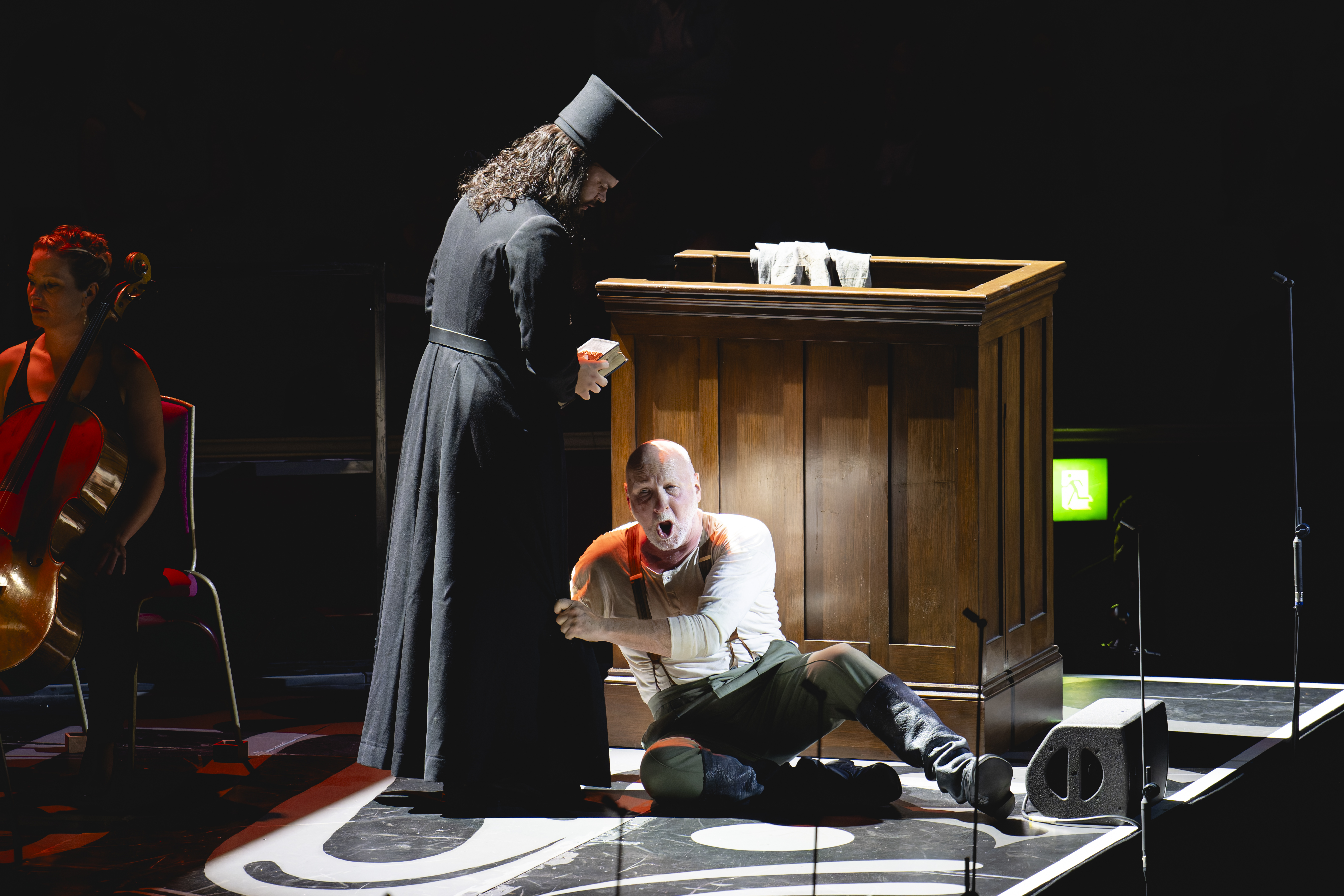
It was those other two main roles, however, that dominated proceedings. Sarah Pring gave a powerful while never inflexible portrayal of Nan, her innate fervency in contrast to the steely authority of Samantha Crawford (above) whose Regan approaches the human world with something between trepidation and disdain – not least in her confrontation with Donny, where Tippett’s would-be rap provoked some amusement. Splitting the role of Presenter worked effectively, Grace Durham and Oskar McCarthy (below) duly enhancing the stage-action with no little panache.

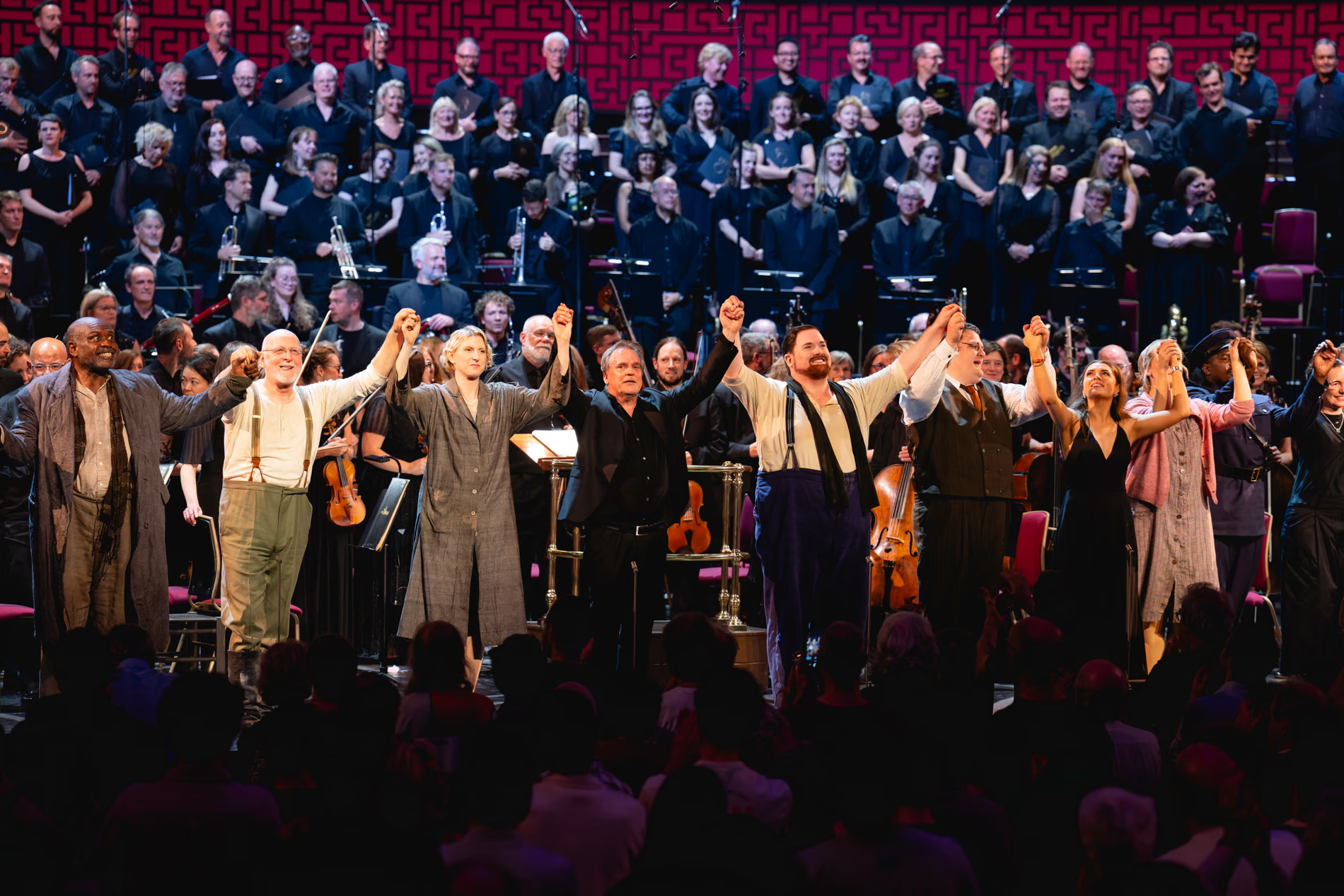
Not for the first time, BOC Chorus came into its own for what is among the most extensive and immediate of Tippett’s choral contributions to opera – the oft-favoured device of Greek Chorus afforded a visceral twist as it conveys the ominous and often violent attitudes of ‘the crowd’. That many of those involved have signed-up specifically for the occasion only adds to the rawness and physicality of its collective presence: something that the composer was at pains to capture, and which could not have been realized this directly in earlier productions.

Conducting the City of Birmingham Symphony Orchestra with typical discipline and energy, Alpesh Chauhan brought requisite vibrancy and clarity to Tippett’s writing. Less purposefully wrought than in his previous operas, there is no lack of subtlety or imagination – the frequent reliance on percussive sonorities to sustain the overall texture hardly an issue when so deftly realized as here. Is there a more moving passage in his output than the dance for Jo Ann and Pelegrin after their duet – Tippett’s musical past and present brought into disarming accord.

Playing for around 105 minutes, New Year is relatively expansive next to Tippett’s preceding two stage-works so that certain aspects of those outer acts do verge on diffuseness. That this hardly came to mind on the opening night was tribute to the conviction of those involved in seeking to reassess what this opera might be and, moreover, what it is there to do. Far from having run out of ideas, Tippett had a surfeit of these that he struggled to make cohere but in which he so nearly succeeded. Do see this engaging and enlightening production from BOC.

Further performances on 9, 10, 12 & 13 July – for more information head to the Birmingham Opera Company website

Published post no.2,233 – Monday 8 July 2024