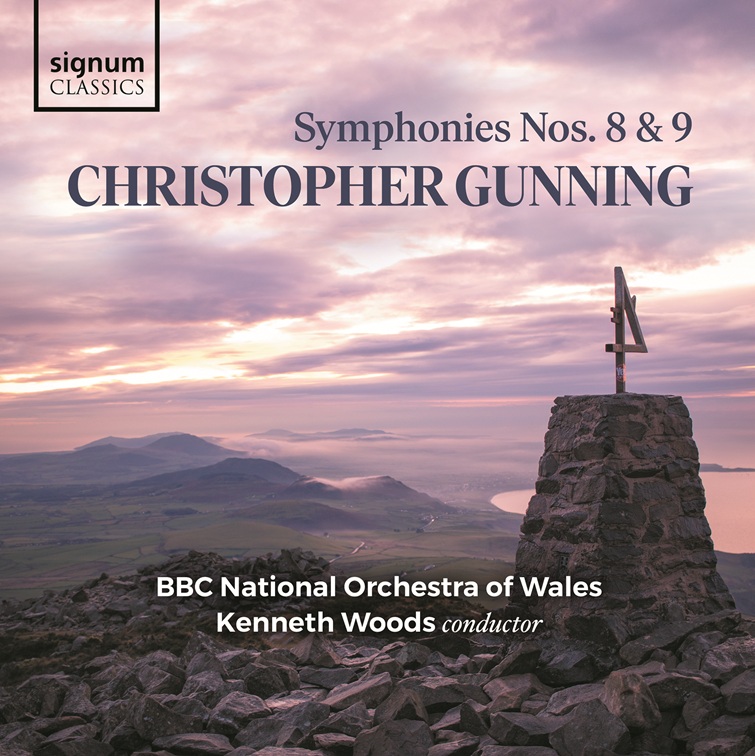
On Record – BBC National Orchestra of Wales / Kenneth Woods – Christopher Gunning: Symphonies nos. 8 & 9 (Signum Classics)

BBC National Orchestra of Wales / Kenneth Woods

Christopher Gunning
Symphony no.8 (2015)
Symphony no.9 (2016)

Signum Classics SIGCD949 [67’33”]
Producer Phil Rowlands Engineer Mike Hatch

Recorded 11-13 March 2024, Hoddinott Hall, Wales Millennium Centre, Cardiff

Reviewed by Richard Whitehouse

What’s the story?

Signum Classics continues its coverage of the late Christopher Gunning with this coupling of two symphonies, a genre that dominated the composer’s thinking in later years, and which get the advocacy they deserve from the BBC National Orchestra of Wales with Kenneth Woods.

What’s the music like?

Although he studied at London’s Guildhall School of Music and Drama with early ambitions as a symphonist, Gunning’s subsequent career was centred on scores for film and television with successful excursions into popular music. Not until 2001, when he was nearing 58, did he complete his First Symphony that was followed by a further 12 over the next two decades, along with several concertos and other orchestral pieces, in what is among the more notable instances of a composer moving between very different disciplines with comparable success.

Written for modest and what might be called ‘late-Classical’ forces, both symphonies are as integrated formally as they are resourceful motivically while, in both instances, movements are merely numbered rather than designated by tempo or expression. The Eighth Symphony consists of three movements unfolding from a sonata design of deft formal proportions with a slower introduction, via a slow movement whose ruminative cast is enhanced by plaintive contributions from flute and cor anglais, to a finale whose scherzo inclinations afford it an impetus and lightness maintained through to the decisive close. An earlier era of American symphonism (ostensibly that of Walter Piston or Randall Thompson) can be detected in its harmonic colouring and melodic contours, but Gunning’s personality is audible throughout.

Scored for slightly larger forces and with four movements, the Ninth Symphony feels no less focussed formally while admitting a wider range of or, at least, of more ambivalent emotions. Thus the opening movement again adheres to sonata design, with a more discursive (though never rhapsodic) take on its primary ideas. This is followed by a speculative or even fugitive scherzo, then a slow movement whose sustained eloquence arguably makes for the highlight of either symphony. It only remains for the finale, its progress as purposeful as it is eventful, to afford a conclusiveness that feels not at all premeditated, let alone predictable. If, in both these works, there is a tangible inner drama which is being played out, Gunning is first and foremost a symphonist for whom abstract concerns override any more subjective tendencies.

Does it all work?

It does indeed – thanks, above all, to Gunning’s unstinting focus on what symphonic form is and can be. Those familiar with any of his other symphonies will know that there is nothing anecdotal or half-baked about his handling of the genre, which emerges as the self-sufficient concept it ideally should be. It helps, of course, that Woods renders both these works with the insight expected from a conductor whose 21st Century Symphony Project has been crucial in rehabilitating the symphony in the UK, and who secures committed playing from BBCNOW.

Is it recommended?

Very much so. Recorded with all the necessary definition, and informatively annotated, this is well worth acquiring by those who are not yet acquainted with Gunning’s symphonic odyssey. Only recordings of the 11th, 13th and the revised First remain to complete an important cycle.

Listen / Buy

You can hear excerpts from the album and explore purchase options at the Signum Classics website, or you can listen to the symphonies on Tidal. Click on the names to read more about composer Christopher Gunning, the BBC National Orchestra of Wales and conductor Kenneth Woods

Published post no.2,782 – Thursday 29 January 2026
On this day – the first performance of Tchaikovsky’s ballet ‘The Nutcracker’ in 1892

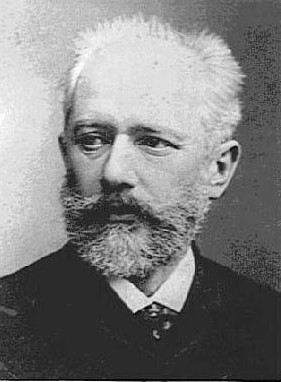
by Ben Hogwood. Image by Charles Reutlinger, used courtesy of Wikipedia

On this day in 1892, the first performance took place of Tchaikovsky’s popular seasonal ballet The Nutcracker Op.71, a musical and staged interpretation of Alexandre Dumas’s French version of the E.T.A. Hoffmann fairy-tale The Nutcracker and the Mouse-King.

The premiere was staged at the Mariinsky Theatre in St Petersburg, conducted by Riccardo Drigo, and found favour with the Czar, but not so much the public, who preferred the shorter Nutcracker Suite Tchaikovsky fashioned from the ballet.

Here is the full ballet, with the Rotterdam Philharmonic Orchestra conducted by Yannick Nézet-Séguin:

Published post no.2,752 – Thursday 18 December 2025

On this day – the first performance of Tchaikovsky’s ‘Rococo’ variations in 1877

by Ben Hogwood. Image by Charles Reutlinger, used courtesy of Wikipedia

On this day in 1877, the first performance took place of Tchaikovsky’s Variations on a Rococo Theme Op.33.

Composed for solo cello and orchestra, the piece had a chequered history. The German cellist William Fitzenhagen, who gave the premiere in Moscow under the baton of Nikolai Rubinstein, made unsanctioned cuts and amendments to Tchaikovsky’s original, meaning the composer’s intended structure and phrasing went awry.

Here is the original version, with cellist Johannes Moser and Case Scaglione conducting the Orchestre national d’Île-de-France:

Published post no.2,734 – Sunday 30 November 2025

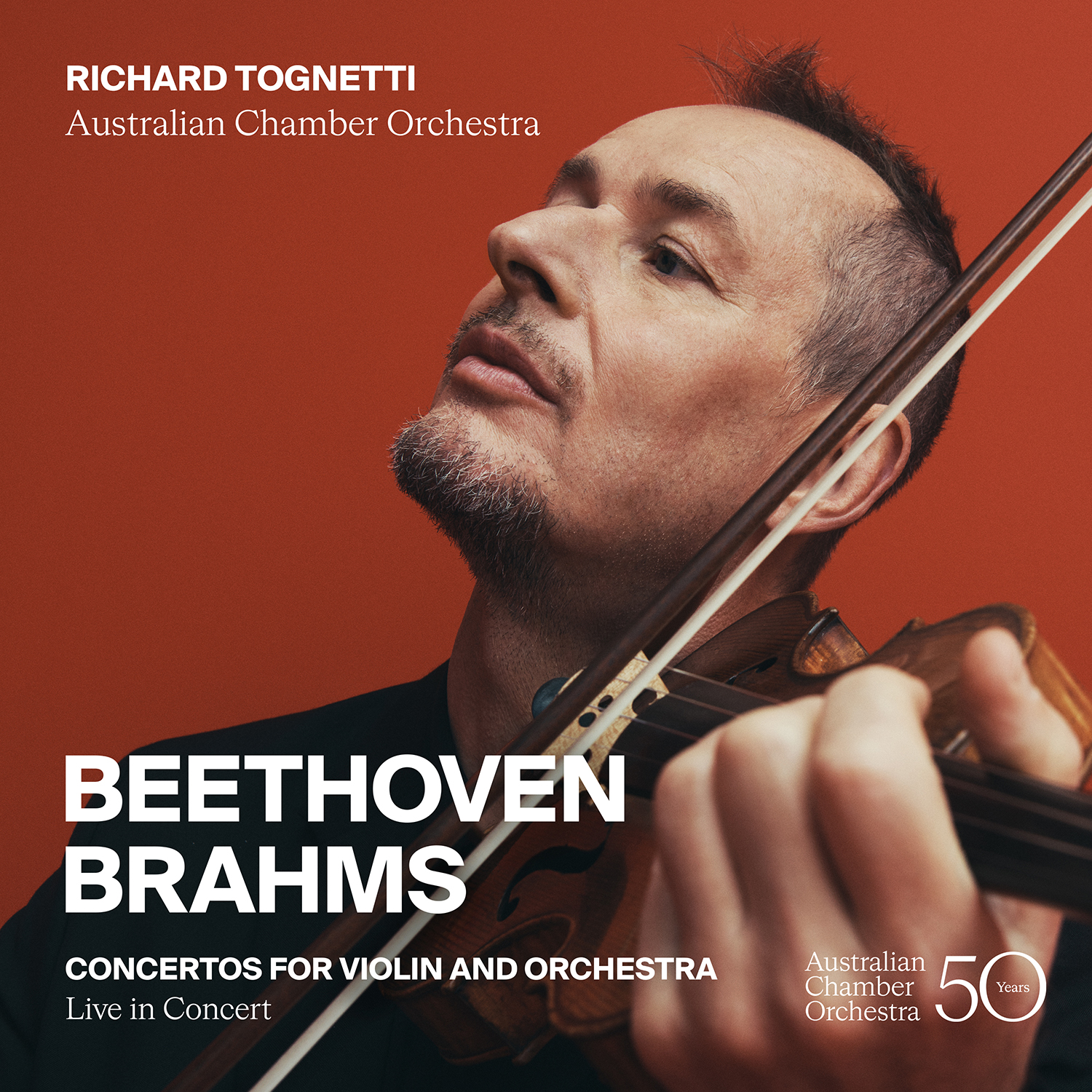
News – Australian Chamber Orchestra celebrate 50 years with new recording

published by Ben Hogwood from the original press release

The Australian Chamber Orchestra (ACO) continues its 50th anniversary celebrations with the release of a landmark new album, Beethoven & Brahms: Concertos for Violin and Orchestra, featuring Artistic Director Richard Tognetti as soloist. Timed to coincide with the 50th anniversary of the Orchestra’s very first concert, on 21 November 1975 at the Sydney Opera House, this release pays tribute to the ACO’s remarkable legacy while also honouring Artistic Director Richard Tognetti’s extraordinary 35 years of leadership.

Recorded live, the album showcases Tognetti and the ACO at their most vital and alive. Beethoven’s Violin Concerto in D major, Op. 61 was recorded in 2018 and Brahms’s Violin Concerto in D major, Op. 77 earlier this year. These cornerstones of the violin repertoire are reframed with the clarity, intimacy, and daring that have become hallmarks of the ACO’s sound.

It is the first time that Richard Tognetti has recorded the Brahms Concerto and his first full recording of the Beethoven for over 25 years.

Over the last five decades the ACO has become one of the world’s most dynamic ensembles, renowned for fearless programming, boundary-pushing collaborations and a singular, expressive sound. Tognetti has been at the centre of this transformation, reshaping the Orchestra into a globally recognised force through relentless curiosity and risk-taking artistry. More than a celebration, this album is a statement of intent: an affirmation that, at 50, the ACO remains as fearless, passionate, and forward-looking as ever.

Beethoven & Brahms: Concertos for Violin and Orchestra will be available as a special limited-edition vinyl release, with each copy signed by Richard Tognetti, as well as being released as a CD and in digital streaming and download formats.

Full details can be found on the Australian Chamber Orchestra website

Published post no.2,724 – Thursday 20 November 2025

On this day, 150 years ago – the first performance of Tchaikovsky’s ‘Polish’ Symphony

by Ben Hogwood. Image by Charles Reutlinger, used courtesy of Wikipedia

On this day 150 years ago, the first performance took place of Tchaikovsky’s Symphony no.3 in D major, his Op.29, took place with the Moscow Symphony Orchestra conducted by Nikolai Rubinstein. The work carries the unofficial nickname Polish, on account of the Polonaise composed for its fifth and final movement.

The Third is almost certainly the least performed of Tchaikovsky’s symphonies, yet it is increasingly winning a place in the hearts of the composer’s fans. Listen below and you will see why, for the piece has an abundance of melodic charm and character:

Published post no.2,724 – Wednesday 19 November 2025