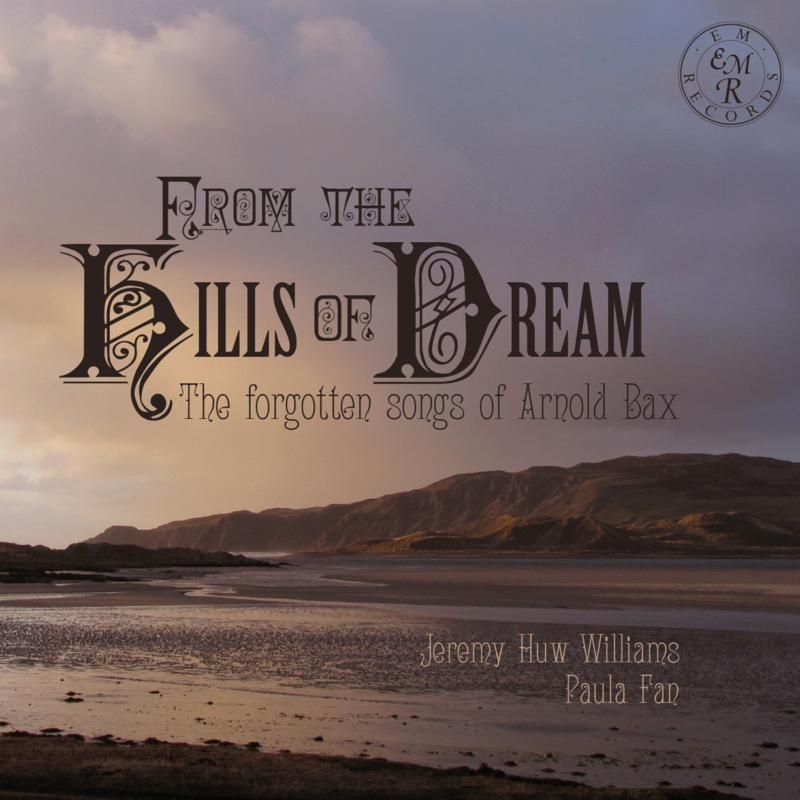
On record – Jeremy Huw Williams & Paula Fan – From The Hills of Dream: The Forgotten Songs of Arnold Bax (EM Records)

bax-songs

Jeremy Huw Williams (baritone), Paula Fan (piano)

Bax
The Grand Match (1903). To my Homeland (1904). Leaves, Shadows and Dreams. Viking-Battle-Song (1905). I fear thy kisses, gentle maiden. The Twa Corbies (both 1906). Longing. From the Hills of Dream (both 1907). Landskab (1908). Marguerite (1909). Das tote Kind (1911). Welcome, Somer. Of her Mercy (both 1914). A Leader (1916). The Splendour Falls (1917). Le Chant d’Isabeau. A Rabelaisian Catechism (both 1920). Carrey Clavel (1925) – all world premiere recordings

EM Records EMRCD073 [77’56”]

Producer Jeremy Huw Williams Engineer Wiley Ross

Recorded 13, 14, 16, 22 & 23 October 2020 at Jeff Haskell Recording Studio; 13 November 2020 at Jim Brady Recording Studios, University of Arizona, Tucson, USA

Written by Richard Whitehouse

What’s the story?

EM Records continues its coverage of lesser-known (or the lesser-known music of) English composers in an extensive survey of ‘forgotten’ songs by Arnold Bax, of which only a few were publicly performed in his lifetime with several of them first heard as recently as 2018.

What’s the music like?

Although he is best known for his symphonies and tone poems, songs with piano occupy a not unimportant place in Bax’s output – particularly over his formative years. This selection unfolds chronologically – opening with a lively setting of Moira O’ Neil’s The Grand Match, then continuing pensively with Stephen Gwynn’s To My Homeland in which Bax’s love of Irish culture was first manifest. Two settings of ‘Fiona Macleod’ (aka William Sharp) – the evocative Leaves, Shadows and Dreams, then the (would-be) heroics of Viking-Battle-Song – precede a ravishing take on Percy Shelley’s I fear thy kisses, gentle maiden, before The Twa Corbies finds Bax experimenting (not always successfully) with recitation in this traditional text. Two further settings of Macleod – the poised elegance of Longing, then the searching inwardness of From the Hills of Dream – lead on to this composer’s only treatment of a text in Danish, that of Landskab (Landscape) by Jens Peter Jacobsen, whose three manuscripts imply syntactical problems never adequately resolved despite the music’s gentle eloquence.

Bax set four texts by William Morris, among which the warmly expressive Marguerite went (surprisingly) unheard until now. The sombre symbolism of Conrad Ferdinand Meyer’s Das tote Kind is underplayed despite being in the original German, and two rondels by Geoffrey Chaucer – the wistful charm of Welcome, Somer then deft humour of Of her Mercy – exude sentiments to which he is more attuned. This is even more evident in A Leader, a setting of George Russell’s poem that underlines Bax’s emotional involvement with those issues and persons of Ireland’s ill-fated Easter Uprising that ranks among the composer’s finest songs. Few are likely to prefer his dogged setting of Alfred, Lord Tennyson’s The Splendour Falls to that by Britten (or the Delius part-song), whereas the traditional Le Chant d’Isabeau has appealing winsomeness. A Rabelaisian Catechism is a salacious take on another traditional text, with a little help from Vaughan Williams and Wagner, while Carrey Clavel matches Thomas Hardy’s wry observation of scorned love to a tee and makes for a delightful close.

Does it all work?

Most of the time. Almost from the outset, Bax was an inventive but also interventionist setter of texts, such that the poet’s sentiments are not necessarily those conveyed in his songs. This might explain why he increasingly eschewed the genre once he had found his true metier in orchestral and chamber media, so that there are very few songs from the mid-1920s onwards. That said, the literary range of what Bax did set as well as the expressive range of his settings ensures his contribution is a notable one and is enhanced by those songs featured on this disc.

Is it recommended?

Yes, not least through the advocacy of Jeremy Huw Williams whose unstinting advocacy is underpinned by Paula Fan’s perceptive accompaniment. The extensive booklet notes are by the Bax authority Graham Parlett, to whose memory this release is appropriately dedicated.

Listen and Buy

To listen to excerpts from this disc and view purchase options, visit the EM Records website. To read more about Arnold Bax, visit his dedicated composer website, and for more on the performers, click on the names of Jeremy Huw Williams and Paula Fan. Finally for more information on the English Music Festival, click here

Online concert – Raphael Wallfisch, English Symphony Orchestra / Kenneth Woods: Elgar Reimagined

Elgar, arr. Fraser Miniatures for cello and strings: Chanson de Matin; Chanson de Nuit; The Wild Bears (Wand of Youth Suite No.2); Nimrod (Enigma Variations); Romance Op.62; Sospiri Op.70; Mazurka; Pleading; In Moonlight; Salut d’Amour; Adieu

Raphael Wallfisch (cello), English Symphony Orchestra / Kenneth Woods

Live performance at Guildhall, Worcester, 29 October 2021

by Richard Whitehouse

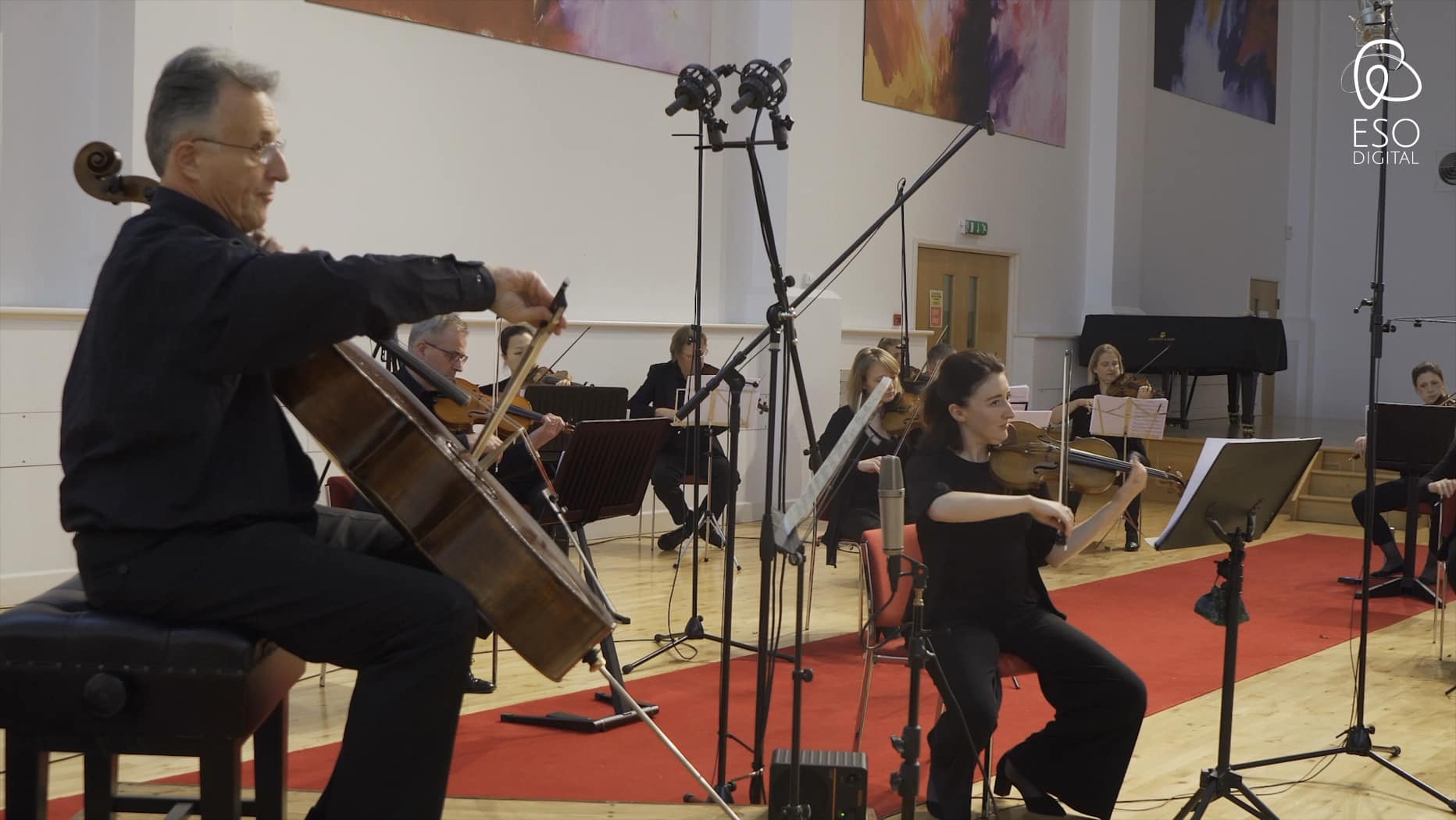
An afternoon concert at last year’s Elgar Festival, these Miniatures for cello and strings had been arranged by Donald Fraser for Raphael Wallfisch. Extending to an 11-movement suite, its viability in terms of smaller groupings was certainly demonstrated by this performance.

Chanson de Matin provided a mellifluous entrée, and if the cello’s assumption of the melodic line marginally obscured the strings’ contribution, that could not be said of Chanson de Nuit whose sombre inwardness was unerringly realized. Nor did The Wild Bears lose on impetus, and if the arrangement conjured Saint-Saëns, this only served to underline the importance of ‘Second Empire’ music on Elgar’s own thinking. Interesting, too, how the Romance brought soloist and strings into an even closer accord than the composer’s version with orchestra. The highlight, however, was Sospiri, for presenting one of Elgar’s finest inspirations in a striking new light. Salut d’Amour then conveyed the music’s essence without cloying, but the cello’s dominance in Nimrod detracted from its subtlety of orchestration as an ‘Enigma Variation’.

A wistful take on Adieu provided an affecting encore, but almost all these pieces would make a viable such item after the Cello Concerto or another British concertante work. What was a relaxed occasion does not imply any less commitment from Wallfisch and the English String Orchestra, heard to advantage with Kenneth Woods in the acoustic of Worcester’s Guildhall. The Miniatures sequence can be heard in full on Elgar Reimagined (Lyrita), but this selection offered an attractive contrast to those larger symphonic works heard elsewhere at the festival.

These works are available for viewing on the English Symphony Orchestra website, by way of a subscription or free trial. Further information on the Elgar Reimagined series can be found here. Meanwhile click on the names for more on Raphael Wallfisch, the English Symphony Orchestra and Kenneth Woods

Online concert – English Symphony Orchestra / Kenneth Woods: Composer Portrait – Walter Arlen

Walter Arlen
Songs of Songs (1955)
The Poet in Exile (1991)

Anna Huntley (mezzo-soprano), Gwilym Bowen (tenor), Thomas Mole (baritone), BBC National Chorus of Wales, English Symphony Orchestra / Kenneth Woods

Studio recording at BBC Hoddinott Hall, Cardiff, 17-20 February 2022

by Richard Whitehouse

Although he is likely best known by his trenchant music criticism for the Los Angeles Times, Vienna-born Walter Arlen has made a distinguished contribution to music administration and is increasingly being recognized as a composer. Several releases of his songs and piano music can be heard on the Gramola label, and this latest of the English Symphony Orchestra online concerts provides a welcome introduction to two of his works that feature orchestra – the one drawing on ancient Jewish sources with the other on poems from a leading modern author.

Whether The Song of Songs is indeed harbinger of monogamy in the Judeo-Christian moral code, it contains some of the eloquent expression in either of the Biblical testaments and has long provided a potent inspiration for musical treatment. In just under 30 minutes, Arlen’s ‘dramatic poem’ takes in the main narrative – the lively opening chorus features much sub-divided writing for female chorus underpinned by incisive orchestral textures. As the piece unfolds, it becomes evident that emotional emphasis is placed upon the solo contributions – whether those of King Solomon as sung with burnished warmth by Thomas Mole, those of the Shepherdess rendered with winsome poise and not a little insouciance by Anna Huntley, or those of the Shepherd which Gwilym Bowen here projects with no mean virility but also tenderness. Nor is the BBC National Chorus of Wales found wanting in passages with textural intricacy and intonational accuracy at a premium. If the final resolution does not bring the expected closure, the direct and unaffected appeal of this setting certainly warrants revival.

Yet the real discovery is The Poet in Exile, a song-cycle to texts by the Polish-American author and cultural eminence Czesław Miłosz. For all its undoubted depth and profundity, these texts are not easily rendered in musical terms, and it is to Arlen’s credit that he goes a considerable way towards elucidating them thus. As the latter states, these poems ‘‘dealt with situations echoing my own remembrance of things past’’; a quality which holds good from the trenchant rhetoric of ‘Incantation’, via the sombre rumination of ‘Island’ then the whimsical elegance of ‘In Music’ and controlled fervour of ‘For J.L.’ (with its distinctive obligato for harpsichord), to the confiding intimacy of ‘Recovery’. Inquiring listeners may already have heard these songs with piano on one of the Gramola releases with Christian Immler accompanied by Danny Driver (GRAM98946), but this version – as orchestrated by Kenneth Woods after an arrangement by Eskender Bekmembatov – makes for a richer and wider-ranging context for a vocal line projected with real assurance by Thomas Mole.

Throughout these works, the musicians of the ESO are heard to advantage in the spacious acoustic of Hoddinott Hall and are directed by Woods with sure sense of where to place the emotional emphasis – especially important in conveying the meaning of the songs. If not a major voice, Arlen’s output is always approachable and often thought-provoking. Anyone who has encountered it will enjoy getting to know his music on a larger scale and hearing it played so persuasively: a worthy present for the composer in advance of his 102nd birthday.

These works are available for free public viewing from 13-17 May on the English Symphony Orchestra website

For further information on Walter Arlen, click here – and for the appropriate Gramola Records link click here. Meanwhile click on the names for more on Czesław Miłosz, the English Symphony Orchestra and Kenneth Woods

Another spring symphony – Benjamin Britten

by Ben Hogwood

In the last week Arcana have explored three very different symphonies with a springtime theme or feel. Now here is a fourth, a very different beast, from the pen of Benjamin Britten.

A number of years back I wrote about this piece for my Good Morning Britten blog, marking the composer’s centenary. There is a lot of scholarly debate as to whether this really is a proper symphony, but as Michael Kennedy points out in his booklet note for Britten’s own recording on Decca, it follows in the tradition of choral symphonies from Vaughan Williams and Holst, while taking more influence from the Mahler symphonies in which voices were used.

The Spring Symphony was commissioned by Serge Koussevitsky for the Boston Symphony Orchestra, and began with a rather different concept. When Britten wrote to the conductor, he said, ‘I am planning it for chorus and soloists, as I think you wanted; but it is a real symphony (the emphasis is on the orchestra) and consequently I am using Latin words’.

Things changed, as Humphrey Carpenter’s biography of the composer details. ‘Both Eric Crozier and Elizabeth Sweeting believe that the Spring Symphony owes its existence to a particular Suffolk landscape, ‘somewhere between Snape and Ufford’, writes Crozier. According to Sweeting, Britten visited this spot on a picnic with her, his housekeeper and Pears. It was ‘a glorious spring day, one of those that seem to be out of time; and she believes that this experience crystallized his love of the Suffolk countryside.’

The work actually enjoyed its first performance in the Netherlands, where, with Koussevitsky’s blessing, Eduard van Beinum conducted the first performance at the Concertgebouw in Amsterdam on 14 July 1949. A little Latin remained, Britten including the ancient song Sumer is icumen in in the work’s climactic final pages.

Britten says this is ‘a symphony not only dealing with the Spring itself, but with the progress of Winter to Spring and the reawakening of the earth and life which that means’. Carpenter maintains that ‘sweetness is the work’s predominant character – most of the poems are in the pastoral tradition – and it is much to Britten’s credit that the music never becomes cloying. This is largely due to the orchestration. Coming to it from the exigencies of the English Opera Group chamber ensemble, Britten treats the full-size symphony orchestra of the Spring Symphony (triple woodwind, four percussionists and two harps) as a palette from which he selects only a few colours at a time, with stunning results.’

Britten recorded the work first, though the version below is a live concert given by Leonard Bernstein in 1963. Once the ear becomes used to the sound it is easy to appreciate the intensity of the performance from singers and orchestra alike:

An Easter Oratorio

This joyful piece of music was written by Bach in Leipzig, in April 1725. It has four vocal soloists, who take on the parts of Mary Magdalene (alto), the ‘other’ Mary (soprano) and the apostles Simon Peter (tenor) and John (bass).

It is a relatively short work, with a bright orchestra consisting of trumpets, timpani, wind and strings, and its celebratory air is perfect for the festival as it tells of the events of the first Easter day.