On record: Stephen Wilkinson – A Celebration of Conductor and Composer (Prima Facie)

stephen-wilkinson

William Byrd Singers, *BBC Northern Singers / Stephen Wilkinson

Dickinson Late Afternoon in November (1975)*

Ellis Sequentia in tempore Natali Sancti (1965)

McCabe Siberia; Visions (both 1983).

Traditional (arr. Wilkinson) Four Choruses from Grass Roots (2003); Betjeman’s Bells (2012)

Wilkinson That Time of Year (1976)

Prima Facie PFCD147 [60’55”] English texts included

Reviewed by Richard Whitehouse

What’s the story?

The always enterprising label Prima Facie releases an album to celebrate the centenary of the conductor and composer Stephen Wilkinson (b1919), whose many decades of work with both the BBC Northern Singers and the William Byrd Choir is appropriately commemorated here.

What’s the music like?

The selection begins with Peter Dickinson’s Late Afternoon in November, a setting of a poem he himself wrote and one whose distanced, often desolate imagery inspires music in which the underlying slowness of pulse and stark emphasis placed on certain words or phrases yields an anguished tone rare in the composer’s output. This performance by the BBC Northern Singers was indeed the world premiere and emphasizes Wilkinson’s assured direction of a demanding piece, the commitment in whose realization hardly something that could be taken for granted.

The remainder is sung by the William Byrd Singers, of whom Wilkinson was the director for almost 40 years. It duly makes the most of Visions, John McCabe‘s elaborate and often eight-part setting of a poem by James Clarence Mangan whose ranging across mellifluous vocalise and visceral chant is conveyed accurately and with not a little sensitivity. If that of the same poet’s Siberia encourages a more direct and (understandably) plangent response, the overall textural variety in this four-part chorus is felicitously judged throughout what is another responsive reading.

For many years a senior producer for BBC Radio in Manchester, David Ellis is also a notable composer, witness his resourceful and often imaginative response to the traditional sequence for Christmas time Sequentia in tempore Natali Sancti. In its astute alternation between full choir and solo voices, it makes for an admirable foil to the straightforward approach adopted by Wilkinson in That Time of Year – a setting of Shakespeare’s Sonnet LXXIII that enfolds its autumnal musings within a sound-world that is monochrome while luminous in character.

The programme is interspersed with Wilkinson’s arrangements of four folksongs taken from his collection Grass Roots – being Welsh, English, Irish and Scottish respectively. Thus, the ruminative As I walked out is followed by the gentle eloquence of Rowing down the Tide, the winsome melancholy of The Lark in the Clear Air, before the steadily accumulating vivacity of The Piper o’ Dundee. Also included here is the charming Betjeman’s Bells, three settings of texts by the Poet Laureate whose music was ingeniously derived from traditional sources.

Does it all work?

As an overall sequence, very much so. While none of these pieces makes use of the extended techniques encountered in much post-war choral music, they are rarely easy technically and the care in preparing these performances (including several world premieres) is evident from every bar. A pity that full recording details have not been included, though the quality of the remastering means that few, if any, allowances need be made for presumed older recordings. The booklet notes place each of these pieces within a meaningful as well as relevant context.

Is it recommended?

Indeed. That Wilkinson is still active as composer, and reader for his daughter’s early-music ensemble Courtiers of Grace, is itself gratifying. This archival release goes much of the way towards explaining why his presence on the English choral scene has been a beneficent one.

For further information on this release, and to purchase, visit the Prima Facie Records website, and for more on Stephen Wilkinson click here

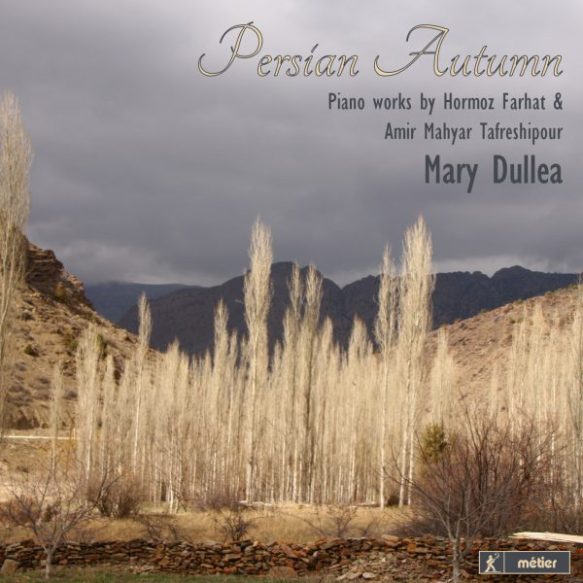
On record – Persian Autumn: Mary Dullea plays piano music by Farhat and Tafreshipour (Métier)

Mary Dullea (piano)

Farhat
Toccata (1952)
Piano Sonata no.1 (1955-7)
Piano Sonata no.2 (2010)
Tafreshipour
Yasna (1999)
Pendar (2013)
Shabahang (2017)
Celebration at Pasargadae (2006)

Métier MSV28610  [72’32”]

Producers Adaq Khan, Amir Mahyar Tafreshipour

Recorded 20-21 December 2019 at Menuhin Hall, Cobham

Written by Richard Whitehouse

What’s the story?

The always enterprising Mary Dullea releases an album of piano music by Iranian composers of the older and middle generations, both having been acclaimed on either side of the Atlantic for their highly contrasted yet equally imaginative amalgam of Eastern and Western sources.

What’s the music like?

Hormoz Farhat (b1928) received his musical education in the USA and has resided in Ireland over four decades. Composing in all the main genres, he has also researched extensively into the Persian modal system, whose influence is evident throughout those works of his maturity.

Premiered by pianist and composer Alexander Tcherepnin, Toccata is among Farhat’s earliest acknowledged works – its alternating declamatory and ruminative manner resulting in music whose virtuosity gained widespread attention. Farhat was fortunate in his exponents, the First Piano Sonata being premiered and advocated by his teacher Lukas Foss – doubtless attracted by its formal rigour and tensile emotional trajectory. A restive opening Allegretto is followed by a subdued if hardly serene Adagio then a Moderato that quizzically elides between scherzo and intermezzo, before the final Rondo draws on motivic elements from earlier movements in its oblique while purposeful course toward the peremptory close. Coming over a half-century later, the Second Piano Sonata is more expansive but never unfocussed in its conception. The initial Allegretto outlines without articulating a sonata design, in what feels closer to a freely unfolding fantasia, then the central Largo yields an improvisatory and often confessional aura, countered by the final Animato in waves of tension and release on the way to a pensive close.

Having pursued musical studies in Esbjerg and London, Amir Mahyar Tafreshipour (b1974) has written a significant amount of chamber and instrumental music – as well as the first harp concerto by an Iranian composer. Recently, he has turned his attention to the operatic domain.

The four pieces recorded here attest to their composer’s acute sense of evocation and formal cohesion. Yasna refers to the Zoroastrian act of worship over an intensifying span as is both hieratic and incantatory, while Pendar – a term implying ‘thought’ and which is also the title of a series of pieces for solo instruments – unfolds as though a stream of consciousness that plays on listeners’ expectations in numerous and intriguing ways. Its title meaning ‘nocturne’, Shabahang was inspired by the crashing of waves against the coasts of the west of Ireland as also the south-east of Iran; its encroaching remoteness finding contrast with the often festive spirit, tempered by more contemplative aspects, of Celebration at Pasargadae – whose outer sections finding this composer at his most emotionally outgoing and uninhibitedly virtuosic.

Does it all work?

Yes, given the highly differentiated yet inherently personal manner by which both composers channel aspects of their heritage via overtly if never inflexibly European means. It helps that Dullea is so attuned to the musical idioms of these composers as also their technical demands.

Is it recommended?

Indeed. Sound is a little hard in more forceful or energetic passages, while remaining clear and well balanced throughout. Notes on each of these pieces are succinct but informative, and this is music which inquiring listeners and pianists alike should certainly find worth investigation.

Listen & Buy

You can get more information on the disc at the Divine Art website, where you can also purchase the recording. Meanwhile for more information on Amir Mahyar Tafreshipour, head to the composer’s website. For more on Mary Dullea click here

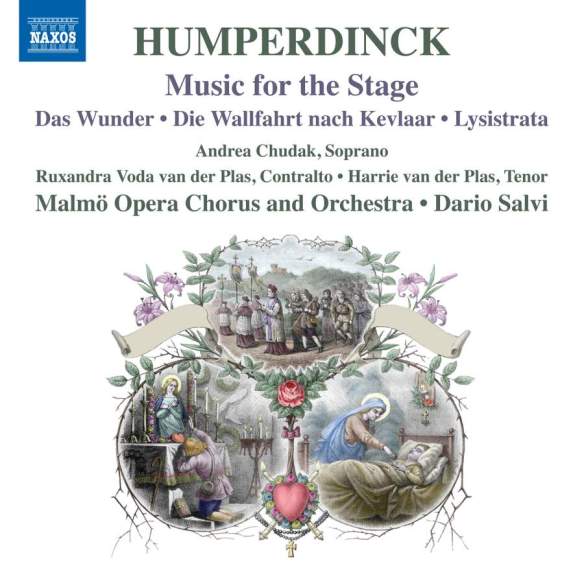
On record – Dario Salvi conducts Humperdinck: Music for the Stage (Naxos)

a Andrea Chudak (soprano); b Ruxandra Voda van der Plas (contralto); c Harrie van der Plas (tenor); d Robert Bennesh (organ); Malmö Opera Chorus and Orchestra / Dario Salvi

Humperdinck
Die Heirat wider Willen (1905) – Prelude to Act Two
Der Kaufmann von Venedig (1905) – Incidental Music (abce)
Das Wunder (1912) – Suite (arr. Lotter) (d)
Die Wallfahrt nach Kevlaar (1878) (acd)
Lysistrata (1908) – Incidental Music (e)

Naxos 8.574177 [73’27”] German texts can be found here: http://www.naxos.com/libretti/574177.htm

Producer / Engineer Sean Lewis

Recorded 13-17 August 2019 at Bengt Hall-salen, Malmö, Sweden

Written by Richard Whitehouse

What’s the story?

Naxos continues its exploration into late-Romantic byways with this selection of theatre and choral works by Engelbert Humperdinck, presented so as to confirm a composer whose music more than makes up for what it might lack in overall individuality with expressive generosity.

What’s the music like?

The recent appearance of William Melton’s biography (Toccata Press) was of great value in conveying Humperdinck as a figure both selfless and humane; and a composer whose output reflects these qualities so that a personable and appealing musical idiom is always to the fore.

The selection gets underway with the Prelude to the second act of The Forced Marriage, after Alexandre Dumas, and the most likely among Humperdinck’s ‘forgotten’ operas to be worthy of revival. At least, the glowering intensity of this music set in the Bastille suggests as much.

Humperdinck contributed music to several productions by Max Reinhardt, with that for The Merchant of Venice running the gamut from very brief vocal or instrumental cues to such as a lilting Sarabande and a Procession of Masks which exude an engaging verve. The Casket Song draws a winsome response from female soloists and chorus, while the most extended item is an orchestral commentary on the text In such a night whose (not unduly) Wagnerian overtones and gently emergent rapture ought to secure more regular hearings in its own right.

Despite a lavish ‘multi-media’ premiere at Covent Garden, the sanctimonious scenario of the film The Miracle sealed its fate. Adolf Lotter’s suite deserves better – the evocative Prelude for organ leading into the lively Procession and Children’s Dance, then a festive ‘Banquet Scene’ finds contrast with the chaste Dance of the Nuns. A whimsical March of the Army is itself juxtaposed with the plangent Death Motif, before the Christmas Scene bestows a typically glowing atmosphere which the Finale to Act One builds to an eloquent apotheosis.

Much the earliest work, the cantata after Heine’s ballad The Pilgrimage to Kevlaar established Humperdinck’s reputation and is still occasionally revived – though not in the original version recorded here. If those swirling textures of the first section remind one that Humperdinck was soon to prove an invaluable amanuensis for Wagner, the central section renders the brunt of the narrative with considerable fervency, before the final section tempers the ostensibly tragic turn of events with a forceful reaffirmation of belief prior to its warmly consoling conclusion.

Finally, to incidental music for Aristophanes’ Lysistrata – comprising a perky Entr’acte for brass and woodwind, a vaunting Festal Procession that juxtaposes then combines male and female voices, then a Closing Song that elaborates its woodwind melodies to piquant effect.

Does it all work?

Yes, bearing in mind that Humperdinck never sought to impress his personality on the task at hand. Within its self-imposed limits, the theatre music is always suited to what is portrayed on stage, with the Heine setting among the most persuasive instances of a much-maligned genre.

Is it recommended?

Indeed. The various vocal and choral contributions have all the requisite limpidity and poise, while the Malmö Opera forces acquit themselves with verve and elegance under the capable guidance of Dario Salvi – whose efforts in raising the profile of this music compels respect.

Listen & Buy

You can get more information on the disc at the Capriccio website, or purchase from Naxos Direct. Meanwhile for more information on the recent Toccata Press book on Humperdinck, you can head to their website

On record – Alexander Tcherepnin: My Flowering Staff (Toccata Classics)

Alexander Tcherepnin My Flowering Staff (1912-13)

Inna Dukach (soprano), Tatyana Kebuladze (piano), with Paul Whelan (bass) Acmeist Male Choir

Toccata Classics TOCC0537 [57’55”] Russian (Cyrillic) text and translation included

Producer/Engineer Jeremy Gerard

Recorded 21-23 June 2017, 29 December 2018 and 4 January 2019 at the Gurari Studios, National Opera Center, New York City

Written by Richard Whitehouse

What’s the story?

Toccata Classics comes up with another first in My Flowering Staff, a song-cycle of almost an hour’s length by Alexander Tcherepnin (1899-1977), most of whose content was divided across three separate collections and has only now been returned to its original conception.

What’s the music like?

His reputation established initially through his piano music (a representative selection from which, including several archival recordings by the composer, can be found on TOCC0079), Tcherepnin worked intensively on setting this volume of lyrics by Sergei Gorodetsky (1884-1967) during 1920-21, before he summarily abandoned the project with three texts awaiting music. Instead, he published 24 of these songs – albeit to French translation – as his Opp. 15, 16 and 17, then never returned to the song format on such a scale. The other songs remained unheard until 2018, by which time the original Russian texts of the published items had been restored and the undeniable ambition of Tcherepnin’s vision could be more readily adduced.

Not that adducing such a vision is therefore straightforward. Gorodetsky may have reined-in his more abstruse symbolism when he penned these 38 lyrics during 1912-13, but a tendency towards inward communing is seldom far away and it could be precisely this obscurity which attracted Tcherepnin in the first instance; enabling him to align his own preoccupations with the passage from youth to maturity, and from innocence to experience, with the poet’s own ruminations. Anyone expecting a continuity of narrative akin to the song-cycles of Schubert will only be disappointed, yet the fervency of Tcherepnin’s approach is its own justification.

Stylistically, too, these songs exude those attributes of inward ecstasy and ominous anxiety as Tcherepnin’s older contemporaries had previously found in this poet. Vocal lines tend toward the declamatory and have recourse to a wide compass, while the piano writing is harmonically questing without becoming congested or unidiomatic (hence the imposing solo that precedes the 22nd poem) – a consequence of his mastery over this instrument whether as composer or performer. The expressive ambit is opened-out with a setting of the 16th poem for bass and (optional) male chorus, while the overall cycle is framed by an Epigraph and Epilogue which distil those qualities of yearning and fulfilment that dominate the cycle as a whole. Whether Tcherepnin thought its execution to have fallen short of its ambition cannot now be answered.

Does it all work?

Almost, though it is not always easy to perceive the formal trajectory Tcherepnin was intent on pursuing or to what expressive end it was directed. That said, the omitted songs are quite the equal of those he did publish and to hear them all in sequence affords its own fascination. It helps when Inna Dukach renders the overall cycle with just the right alternation of plangent rhetoric or confiding intimacy and receives astute accompaniment from Tatyana Kebuladze. Nor are Paul Whelan and Acmeist Male Choir found wanting in their solitary contribution.

Is it recommended?

Yes, given the conviction of this performance and excellence of recorded sound. Benjamin Folkman’s detailed annotations go a long way to elucidating Tcherepnin’s conception, while Dina Dukach’s English translation similarly clarifies many aspects of Gorodetsky’s musings.

Listen

Buy

You can discover more about this release at the Toccata Classics website, where you can also purchase the recording.