On Record – Leon Bosch, Lviv National Philharmonic Orchestra of Ukraine / Theodore Kuchar – Thomas de Hartmann: Orchestral Music Vol. 2 (Toccata Classics)

Leon Bosch (double bass), Lviv National Philharmonic Orchestra of Ukraine / Theodore Kuchar

Thomas de Hartmann
Symphonie-Poème no.1 Op.50 (1934)
Fantaisie-Concerto Op.65 (1942)

Toccata Classics TOCC0676 [81’49’’]
Producers and Engineers Andriy Mokrytskiy and Oleksii Grytsyshyn
Recorded 15-23 September at National Philharmonic Hall, Lviv

Reviewed by Richard Whitehouse

What’s the story?

Toccata Classics continues its exploration of orchestral music by Thomas de Hartmann with first recordings for two of his most characteristic works, idiomatically realized by the most fervent of present-day advocates and further confirming the intrinsic value of this composer.

What’s the music like?

De Hartmann heralded a return to original composition, after more than a decade focussed on his collaboration with philosopher Georges Gurdjieff, with the first of four pieces designated Symphonie-Poème. Those having heard the unfinished last of these (recorded on TOCC0633) may be taken aback by what they encounter – this 65-minute work drawing on such expansive symphonic precursors as Rachmaninoff’s Second and Glière’s Third, but with a formal logic and harmonic practice all its own. Not least in the imposing first movement, whose brooding introduction presages its synthesis of fantasia and fugue with an underpinning of sonata form to result in a construct as diverse in musical content as it feels cumulative in its overall design.

That the composer continued from here says much for his ambition, but the work does justify itself as a totality – whether in a Scherzo that unfolds as continually evolving structure rather than the usual ternary form, an Andante whose recourse to martial rhythm and Ukrainian folk -music gives it a distinctive colouring and emotional affect, then finale (interestingly marked Allegretto feroce) such as projects this covertly autobiographical statement defiantly into the ‘present’ through a trenchant rhythmic profile that builds inexorably toward the visceral close. Received with guarded admiration and not a little consternation at performances in Paris and Brussels in the mid-1930s, this is a major inter-war work as well warrants its belated revival.

So, too, does the Fantaisie-Concerto which de Hartmann wrote with the double-bass playing of Serge Koussevitzky vivid in his mind’s ear decades afterwards (the latter had long since turned to conducting, and it is not stated who premiered this piece). Drawing on elements of dance, the outer Allegros indicate those quizzical and capricious qualities which come to the fore in the composer’s later music, but the central Adagio leaves the most lasting impression. This ‘Romance 1830’ draws on an earlier setting of Vasily Zhukovsky, along with images of Glinka and his bass-playing servant, in what is a ‘song without words’ of no mean eloquence or evocative poise: qualities duly enhanced by the subtle understatement of its orchestration.

Does it all work?

Yes, though the larger work will likely take a few listens for its overall coherence to become manifest. That it does so is owing primarily to the conviction of de Hartmann’s thinking, but also to that of Theodore Kuchar in having the measure of this opulent score and conveying it to the musicians of the Lviv National Philharmonic Orchestra, who almost always sound unfazed by its demands. The concerto benefits from the expertise of Leon Bosch, affirming this as among a handful of pieces that establish the double bass as a concertante instrument in its own right.

Is it recommended?

Indeed – not least as the orchestral sound has been so sympathetically captured, detailed and spacious in equal measure, with informative notes by Elan Sicroff and Evan A. MacCarthy on life and work respectively. Cordially recommended, with the third instalment keenly awaited.

Listen & Buy

You can listen to sample tracks and purchase on the Toccata Classics website. For further information on the artists, click on the names for more on Leon Bosch, Theodore Kuchar and the Lviv National Philharmonic Orchestra Click on the name for more on composer Thomas de Hartmann

Published post no.2,158 – Wednesday 24 April 2024

On Record – April Fredrick, Thomas Humphreys, ESO Chorus, English Symphony Orchestra / Kenneth Woods: Sawyers – Mayflower on the Sea of Time (Nimbus)

April Fredrick (soprano), Thomas Humphreys (baritone), ESO Chorus, English Symphony Orchestra / Kenneth Woods

Sawyers Mayflower on the Sea of Time (2018)

Nimbus NI6439 [58’57’’]
Producer and Engineer Tim Burton Engineer Matthew Swan
Live recording, 17 June 2023 at Worcester Cathedral

Reviewed by Richard Whitehouse

What’s the story?

Philip SawyersMayflower on the Sea of Time was to have been launched with performances in Worcester Cathedral four years ago, but the pandemic inevitably derailed this. Happily, the composer’s largest work so far was finally heard last June in the venue as originally intended.

What’s the music like?

Commissioned to mark the 400th anniversary of the sailing of the Mayflower from Leiden to Plymouth, this is an oratorio in concept but equally a choral symphony in design. Its libretto, mainly by the artist Philip Groom, features set-pieces for various Old and New World figures largely for soprano and baritone alongside summative passages for chorus. Self-deprecating about his literary abilities, Groom yet achieves a viable balance between the characterization of individuals as part of a continuous and cumulative trajectory relating that of ‘the journey’.

There are four continuous parts: Persecution and Journey, a sonata design which informs the Pilgrims’ flight from religious persecution and their decision to cross the Atlantic; Arrival in the New World, a slow movement charting their arrival then tentative initial interaction with native cultures; Survival and Making our Community, a brief scherzo in which the Pilgrims’ industriousness and idealism all too soon becomes its own justification; and Our New World, a sizable rondo-finale whose looking to the future is framed by choruses of growing fervour.

Sawyers’ writing for the chorus is expert and resourceful, not least when this elides between a depiction of Pilgrims or Natives with that of a more abstract commentary, while solo sections allow his lyrical impulse free reign – not least towards the end of the second and fourth parts, closing with luminously ecstatic choruses that accentuate an essentially affirmative message. Worth noting is the poignant incorporation of a motet by Thomas Tomkins into its fourth part, which also sets lines by Walt Whitman with a tangible understanding of its expressive syntax.

Does it all work?

Almost always, and not least owing to the persuasiveness of this performance. April Frederick and Thomas Humphreys (the latter after a slightly strained start) can hardly be faulted in their commitment or insight, while the new-founded ESO Chorus evinces a power and immediacy abetted by Worcester Cathedral’s spacious acoustic to belie its modest forces. The ESO gives its collective all throughout, conveying the textural intricacy and the emotional heft of music whose overall formal integration is fully conveyed through Kenneth Woods’ astute direction.

The initial performances might have fallen through, but the associated educational project did go ahead and enabled several hundred youngsters to experience the piece at first hand. This is worth remembering given Mayflower should have a ready appeal for those who know little of the historical background or, indeed, contemporary music. That it can be rendered by around two-dozen singers ought to commend it to enterprising choral societies able to muster the 45 musicians, especially when Sawyers’ writing for both is often exacting but always practicable.

Is it recommended?

Very much so. The sound captures the resonance of its acoustic with no loss of definition, and there are detailed notes by composer, author and conductor. A pity the actual text could not be included, but that this can be scanned via a QR code is another incentive for younger listeners.

Listen & Buy

You can listen to sample tracks and purchase on the Wyastone website. For further information on the artists, click on the names for more on April Fredrick, Thomas Humphreys, the English Symphony Orchestra and their conductor Kenneth Woods. Click on the name for more on composer Philip Sawyers

Published post no.2,157 – Tuesday 23 April 2024

On Record – Roderick Williams, Rupert Marshall-Luck, BBC Concert Orchestra / John Andrews – La Belle Dame (EM Records)

Roderick Williams (baritone) (Holst, O’Neil, Quilter & Scott), Rupert Marshall-Luck (violin, Brian), BBC Concert Orchestra / John Andrews

Brian orch. Marshall-Luck Legend B144 (c1919)
Delius Petite Suite d’Orchestre no.1 RTVI/6 (1889-90)
Holst Ornulf’s Drapa H34 (1898, rev. 1900)
Mackenzie Colomba Op.28 – Prelude (1883)
O’Neill La Belle Dame sans Merci Op.31 (1908)
Quilter orch. anonymous The Faithless Shepherdess Op.12/4 (1908)
Scott The Ballad of Fair Helen of Kirkconnel Op.8 (1900)

EM Records EMRCD085 [61’21’’] English texts included
Producer Neil Varley Engineers Andrew Rushton, Robbie Hayward
Recorded 5-7 January 2023 at Battersea Arts Centre, London

Reviewed by Richard Whitehouse

What’s the story?

EM Records continues its enterprising schedule with this collection of mainly vocal settings from the early twentieth century – heard alongside early orchestral pieces by Mackenzie and Delius, plus a recent orchestration of what is Havergal Brian’s only surviving chamber work.

What’s the music like?

This album’s title is also that of the 1819 poem by John Keats, its tale of ecstasy recollected in despair tangibly conveyed by Norman O’Neill in a setting which surely ranks among his finest concert works before music for theatre productions became his focus. Only marginally less compelling, Cyril Scott’s take on a typically over-elaborate ballad by Walter Scott has a keen sense of atmosphere – not least as rendered by Roderick Williams with an appropriate Lowland burr. Less involving emotionally, Holst’s setting of verse from an early Ibsen play is rather forced in its rhetoric – though the passages of emotional impulsiveness, allied to an acute feeling for orchestral textures, does presage those masterpieces of his maturity. Roger Quilter’s setting of a favourite Elizabethan lyric launches the collection with brusque charm.

Of the orchestral pieces, Delius’s early Première Petite Suite is here heard in full for the first time. Influences are easy to discern – Bizet in its whimsical Marche, Grieg in its winsome Berceuse, Massenet in its vivacious Scherzo then Fauré in its plaintive Duo – but never to the detriment of this music’s appeal, while the final variations on a sternly unison theme with ecclesiastical overtones will keep even seasoned Delians guessing as to its provenance. The likelihood of Alexander Mackenzie’s lyrical drama Colomba being revived is slim, but the Prelude to its first act has an evocative ardency which concludes this album in fine style.

John Andrews has the measure of these contrasting idioms and gets committed playing from the BBC Concert Orchestra. Roderick Williams is on fine form, as is Rupert Marshall-Luck in the Legend by Havergal Brian he himself has orchestrated. Ranging widely in expressive profile, while building considerable fervour during its relatively brief span prior to a calmly eloquent close, it is a stylish adaptation of the violin-and-piano original which has enjoyed increasing exposure this past decade. Marshall-Luck speculates whether Brian intended his own orchestral realization yet, given the composer had evidently written an orchestral piece with this title around 1915, it seems not impossible that the duo version is itself a reduction.

Does it all work?

Yes, in that the whole proves greater than the sum of its parts. Certainly, the works by Scott and O’Neill find these contemporaneous while otherwise very different figures at something near their best, while the Delius makes for an attractive sequence which deserves more than occasional revival. As, too, does the Brian given that comparable shorter concertante pieces by figures such as Saint-Saëns are being taken up by a younger generation of violinists. The spacious sound and extensive annotations are both up to EMR’s customary high standards.

Is it recommended?

Indeed. Hearing the Holst prompts the thought that, with the 150th and 90th anniversaries of his respective birth and death falling this year, now would be the ideal time for revival of his orchestral suite Phantastes – which has seemingly remained unheard since its 1912 premiere.

Listen & Buy

La Belle Dame is due for release on 19 April, but you can hear excerpts and look at purchase options on the EM Records website. For more information on the artists click on the names of conductor John Andrews, baritone Roderick Williams, violinist Rupert Marshall-Luck and the BBC Concert Orchestra

Published post no.2,126 – Saturday 23 March 2024

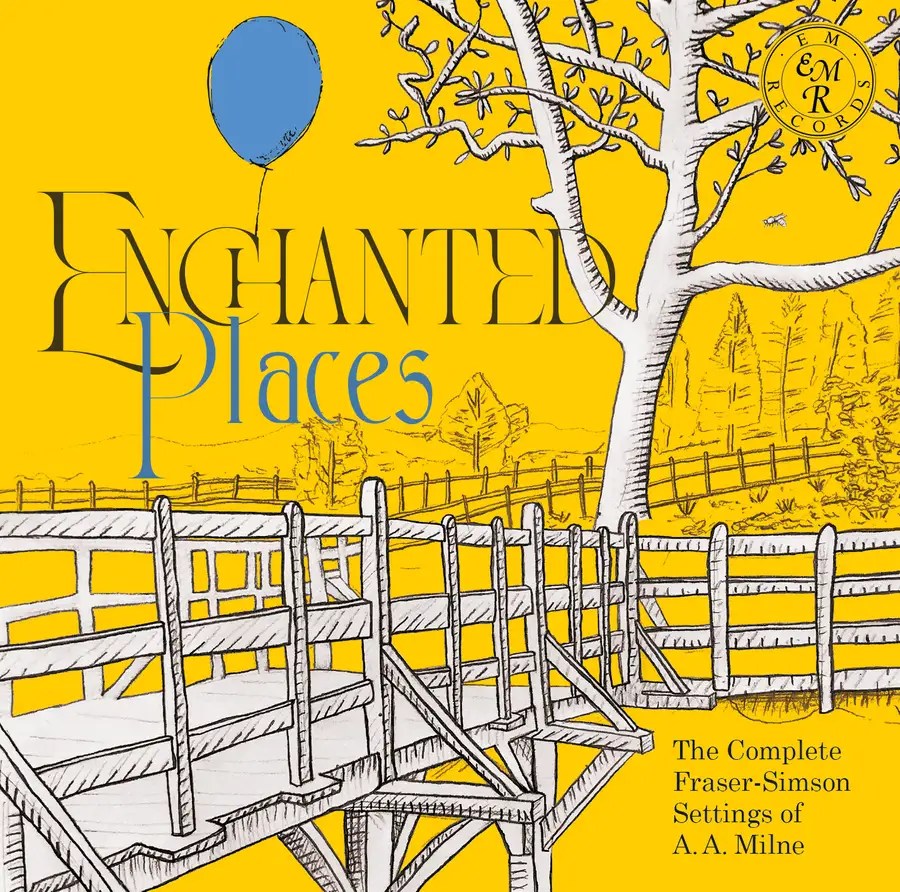
On Record – Enchanted Places: The Complete Fraser-Simson Settings of A. A. Milne (EM Records)

Grant Doyle (baritone) and John Kember (piano) with Brian Sibley (narrator)

EM Records EMRCD082 [two discs, 2h29m17s]
Producers Grant Doyle, John Kember Engineer Nick Taylor
Recorded 2019 and 2020 at Porcupine Studios, Mottingham, London

Reviewed by Richard Whitehouse

What’s the story?

EM Records continues its coverage of lesser-known and neglected English music with this complete traversal of A. A. Milne settings by Harold Fraser-Simson, more than appropriate when this year coincides with the centenary of Milne’s first collection of poems for children.

What’s the music like?

One among a notable generation of ‘light music’ composers, Fraser-Simson (1872-1944) had a brief if successful career with his songs and musicals; his musical comedy The Maid of the Mountains enjoyed one of the biggest West End successes during the latter years of the First World War and is still occasionally revived (the complete score was recorded by Hyperion in 2006). Although Simson’s star waned after the mid-1920s, his settings of Milne’s poems from the collections When Were Very Young (1924) and Now We Are Six (1927) have kept his name alive. Along with Milne’s books of short stories, these centre upon his son Christopher Robin and the latter’s nursery toys – above all, his bear Winnie-the-Pooh. They have held their own, moreover, throughout an era when the Disney franchise has continued to grow exponentially.

The songs themselves were published in six books between 1924 and 1929, alongside Milne’s poems with illustrations by Ernest Shepard which had graced the original collections. Private recordings were made at this time by Cicely Fraser-Simson with her husband as pianist, while Christopher Robin recorded several for HMV in 1927, and they have continued to attract the attention of singers both amateur and professional. Nor have the poems lost their appeal for subsequent generations of composers (Oliver Knussen drawing on a selection of them in his 1970 opus Hums and Songs of Winnie-the-Pooh), but Fraser-Simson’s settings have retained their charm along with a pathos accrued over the intervening decades. The present recording features 10 songs recorded for the first time to make this collection complete in all respects.

Does it all work?

Yes, not least given the quality of these performances. A seasoned exponent of opera, Grant Doyle gets to the heart of these settings – his singing of a warmth and precision that offsets any risk of sentimentality. Nor can his diction be faulted – no potential purchaser is likely to be without Milne’s original books but having them to hand is hardly necessary – while John Kember accompanies with subtlety and discretion. Devotee of all things Pooh, Brian Sibley narrates his handful of texts with due feeling for their unforced and often ingenious scansion.

This might not be the only way to realize these settings (a comparably extensive collection by Volante Opera Productions (Prima Facie) features seven singers), but the consistent and characterful nature of Doyle’s approach is its own justification. Those wishing to sample this release should go to The King’s Breakfast (CD2, tracks 26-29), essentially a cantata in which singer, narrator and pianist are joined by four other musicians to deftly imaginative effect, or evergreens Vespers (1, 39) and Buckingham Palace (2, 3) which emerge newly minted here.

Is it recommended?

Yes. The sound has an ideal combination of clarity and definition, while Sibley’s booklet notes on composer, author and project could hardly be bettered as an informed introduction. Put the Disney treatment aside and enjoy these settings for the winsome humour as initially intended.

Listen

Buy

You can explore purchase options for this album at the EM Records website. For more information on the artists click on the names of Grant Doyle, John Kember and Brian Sibley

Published post no.2,091 – Sunday 18 February 2024

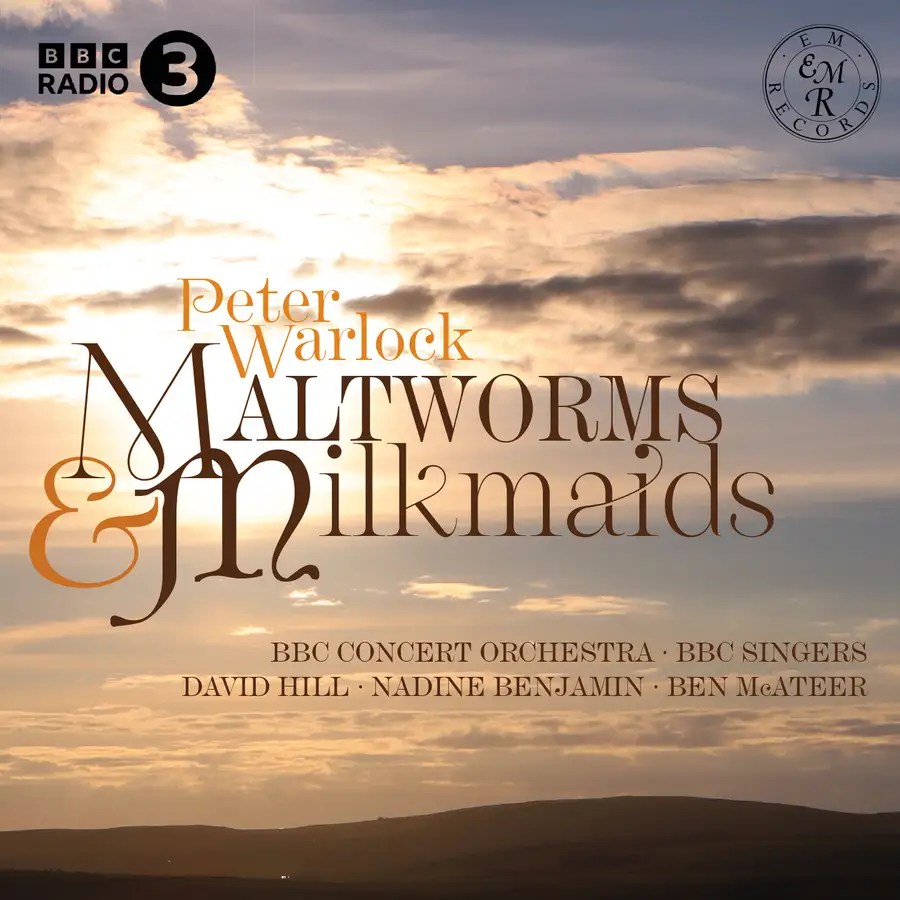
On Record – Maltworms and Milkmaids: Warlock and the Orchestra (EM Records)

Warlock
As Ever I Saw (1918, orch. anon)
An Old Song (1917-23)
Mr Belloc’s Fancy (1921/30, orch. Frederick Bye)
Captain Stratton’s Fancy (1921, orch. Peter Hope)
Serenade (1921-2)
Milkmaids (1923, orch. Henry Geehl)
Adam Lay Ybounden (1922, orch. Reginald Jacques)
Little Trotty Wagtail (1922, orch. David Lane)
The Birds (1926, orch. anon)
The Country-man (1926, orch. Gerrard Williams)
Yarmouth Fair (1924, orch. Kenneth Regan)
Sorrow’s Lullaby (1926-7)
One More River (1925)
Maltworms (1926, with E. J. Moeran)
Capriol (1926-8)
A Sad Song (1926)
Pretty Ring Time (1925)
The First Mercy (1927, orch. Fred Tomlinson/John Mitchell and William Davies)
Three Carols (1923)

Nadine Benjamin (soprano), Ben McAteer (baritone), BBC Singers, BBC Concert Orchestra / David Hill

EM Records EMRCD080 [73’52”] English texts included. Orchestrations by Warlock unless stated
Producer Neil Varley Engineer Robert Winter
Recorded 14-16 January 2022 at the Colosseum, Watford

Reviewed by Richard Whitehouse

What’s the story?

The always enterprising EM Records issues yet another ‘first’ in the guise of this collection featuring the songs with orchestra by Peter Warlock (aka Philip Heseltine), which includes many of those orchestrated by others with two-thirds of them here recorded for the first time.

What’s the music like?

Although his output barely extended beyond a decade and centred largely upon miniatures, Warlock left a substantial legacy of songs whose piano accompaniments mostly respond well when arranged for larger forces. Most of them are divided between soprano and baritone, in which latter Ben McAteer fairly captures their essence – whether the modal poise of the early If Ever I Saw, the heady (slightly forced?) jollity of those ‘fancies’ inspired by Mr Belloc and Captain Stratton, or the deftly barbed humour of Milkmaids. He draws tangible pathos from The Countryman and panache from Yarmouth Fair, with the rumbustious One More River and uproarious The Cricketers of Hambledon duly given their head. A highlight is the first recording of Maltworms, co-written with Ernest Moeran and rendered with suitable levity.

Nor is Nadine Benjamin other than fully attuned to the sentiments of her selection. Hence the soulfulness of A Sad Song or limpidity of Pretty Ring Time, both heard in what are Warlock’s only orchestrations of his solo songs, with The First Mercy an eloquent setting of words by frequent collaborator Bruce Blunt. Most affecting, though, is Sorrow’s Lullaby where soprano and baritone combine for a lengthy and often plangent setting of Thomas Beddoes in which the stark introspection of Warlock’s masterpiece The Curlew is never far beneath the surface.

The BBC Singers make their presence felt in the carol Adam Lay Ybounden and the whimsical Little Trotty Wagtail and winsome The Birds. No compromise is brooked in the rousing Fill the Cup, Philip or wistful choral incarnation of The First Mercy, then a closing trio of carols takes in the capricious Tyrley, Tyrley, the serene Balulalow and the aminated As I Sat Under a Sycamore Tree for a suitably rousing conclusion. Warlock would surely have approved and, had he known of the Singers’ recent travails, doubtless have responded in no uncertain terms.

The BBC Concert Orchestra gives of its best throughout under the astute direction of David Hill, duly coming into its own with the three orchestral pieces that Warlock completed. The evergreen suite Capriol is heard in its seldom heard and appealingly astringent version for full orchestra, the Serenade commemorates Delius’s sixtieth birthday in suitably rapturous terms, and the little-played An Old Song exudes a potent atmosphere as indicates what might have been possible had Warlock felt able to realize his musical ambitions on a larger canvas.

Does it all work?

It does, especially when heard in the continuous sequence as presented here. Warlock might increasingly have fretted about his ability as a composer, but the best of what he did achieve is sure to keep his name alive well beyond the approaching centenary of his untimely demise.

Is it recommended?

It is and not least when the presentation – with full texts, together with detailed notes from David Lane (vice-chairman of the Peter Warlock Society) reflects the always high standards of EM Records. In the words of a latter-day songster, ‘‘a splendid time is guaranteed for all’’.

Listen

Buy

You can explore purchase options for this album at the EM Records website. For more information on the artists click on the names of David Hill, Nadine Benjamin, Ben McAteer, BBC Singers and BBC Concert Orchestra. For more on all things Warlock, click on the name to head to the Peter Warlock Society

Published post no.2,078 – Monday 5 February 2024