A new album from Masayoshi Fujita, whose exploits with the vibraphone and marimba have seen him explore new sounds in music inspired by nature.
Fujita returned to his native Japan from Berlin in 2020, locating with his family in the mountains of Kami-cho, Hyōgo – where he turned an old kindergarten into a recording studio. The first album released on his return, Bird Ambience, put Arcana under its spell with its enchanting and expressive writing.
To his well-known mix of marimba, vibraphone and synthesizer, Fujita now adds vocals from Moor Mother and Hatis Noit, with guest contributions on saxophone (Osamu Fujita) and shō (Mattias Hållsten).
What’s the music like?
Listening to Fujita’s music is akin to glimpsing a rare bird in bright evening sunshine. His compositions are notable for their rare beauty, and on Migratory he captures the climate of late summer sunshine. It’s easy to imagine where these works were composed, with a great deal of light and space but also brightness that makes the music glint at the edges.
Pale Purple is an especially beautiful composition, with soft drones and half-conscious thoughts on the marimba given wonderful colours by the shō. Moor Mother excels on Our Mother’s Lights, where the brightly coloured textures shimmer in response to the voice. There are lovely, soft tones on the restful Desonata, while the tone painting on In A Sunny Meadow is uncanny, and rather beautiful. Valley, meanwhile, is a mere breath of wind, drawing the listener in with its subtle bass sounds.
Does it all work?
It does. Fujita writes fluently and gracefully, the bright tones of his music lifting the mood.
Is it recommended?
Yes. If you’ve been following Fujita’s career you will not be surprised to learn that his masterful way of writing for vibraphone and marimba remains unchanged, but the addition of extra instruments here mean the music blossoms, extra colours added to his spectrum.
For fans of… Terry Riley, Laraaji, Bing & Ruth, Harold Budd
Listen and Buy
Published post no.2,301 – Saturday 14 September 2024
by Ben Hogwood. Portrait of Arnold Schoenberg by Richard Gerstl, circa June 1905
On this day in 1874, 150 years ago, one of the most revolutionary – and divisive – composers was born in Vienna. Arnold Schoenberg gained notoriety for his groundbreaking style of composition that took him first to the outer limits of tonality, and then beyond.
Today he remains a musical figure guaranteed to split opinion within a room of classical music fans, and well beyond – though as we have seen at the BBC Proms this season, his music is a lot more approachable than you might think.
There will be a fair bit more about him on these pages in the next couple of months, including an interview with leading British soprano Claire Booth, who has made a striking new recording of his melodrama Pierrot Lunaire. For now, though, I urge you to enjoy two very contrasting videos of Schoenberg’s music.
The first is a performance of his Sechs kleine Klavierstücke, published as Op.19 in 1913 – after his break with tonality. They show a remarkable, compressed intensity, creating vivid pictures and emotion flying in the face of music that, having left conventional working behind, is alleged to be devoid of feeling. This performance from legendary pianist Glenn Gould totally refutes that:
Following that, here is one of Schoenberg’s early masterpieces, the deeply atmospheric Verklarte Nacht (Transfigured Night), published as the composer’s Op.4 in 1899:
Published post no.2,300 – Friday 13 September 2024
Panda is the new album from Oslo’s Simon Field, whose nine tracks look towards classic Chicago house for their inspiration while keeping a close eye on the underground scene in the Norwegian capital.
Deep, tech vocal house is the name of the game for Field, who has a number of key releases in his locker for labels such as Armada, Universal Music, Sony Music Ultra, Perfect Havoc and his own Basement Records, which he established to focus on underground house music with no need for commercial gain. Basement Sessions is a club series in Oslo, celebrating the underground sound.
Guests include Delphi Drive and Blichfedlt.
What’s the music like?
Simon Field has a persuasive way of blending deeper textures and bass with upfront four to the floor beats, making some very danceable grooves in the process. A little goes a long way in his music, supported by fulsome kick drums and subtly funky bass loops, as in One More Time (For The Panda).
The album takes off with PanAm, its raucous spoken word intro complemented with a cool riff, while by contrast F With The Energy is deep and dark, laced with sharp edges. Here With Me taps into those same qualities, with a cool vocal, as does the warm weather winner Not Even A DJ. Meanwhile Gone Gone Gone gets more upfront movement from its excellent riff.
The guests work well, Blichfeldlt panning across the stereo picture during Michael Caine, and Just Martina capitalising on Field’s rolling beats.
Does it all work?
Pretty much – Field’s dancefloor methods are effective throughout.
Is it recommended?
Yes – no padding here! Simon Field’s album is ripe for the deeper house music dancefloor.
For fans of… Luke Solomon, Heller & Farley, Camelphat, Mark Knight
Listen & Buy
For more information on the album and to explore purchase options, visit Simon Field’s website
Published post no.2,299 – Thursday 12 September 2024
Helen Field (soprano) Beatrice Cenci David Wilson-Johnson (baritone) Count Cenci Ingveldur Ýr Jónsdóttir (contralto) Lucretia Stuart Kale (tenor) Cardinal Camillo/An Officer Justin Lavender (tenor) Orsino/Bernardo Jeffrey Carl (baritone) Giacomo/Savella/First Judge/Second Judge Nicholas Buxton (tenor) Marzio/Third Guest/A Cardinal Devon Harrison (bass) Olimpio/Colonna/Third Guest Serena Kay (soprano) First Guest/Second Guest The Millennium Sinfonia / James Kelleher
Toccata Classics TOCC0094 [two discs, 101’32’’] Producer & Engineer Geoff Miles Remastering Adeq Khan Live performance, 12 December 1997 at the Queen Elizabeth Hall, Southbank Centre, London
Reviewed by Richard Whitehouse
What’s the story?
Toccata Classics fills a major gap in the Havergal Brian discography with this release of his opera The Cenci, given its first hearing 27 years ago by a notable roster of soloists with The Millennium Sinfonia conducted by James Kelleher, and accorded finely refurbished sound.
What’s the music like?
The third among the five operas which Brian completed, The Cenci emerged as the second of its composer’s seminal works inspired by Percy Bysshe Shelley (1792-1822). While his ‘lyric drama’ on the first two books of Prometheus Unbound (1937-44) had set its text almost word for word, Brian was ruthless in adapting his ‘tragedy in five acts’ – the outcome being a rapid traversal of a drama whose themes of incest and parricide made it publicly unstageable in the UK until 1922, some 103 years after publication in Livorno where it had partly been written.
Two further operatic treatments emerged either side of that by Brian. Berthold Goldschmidt’s Beatrice Cenci (1949-50) won first prize in the Festival of Britain opera competition in 1951 but itself went unheard 1988 (ironically enough, in a concert performance at Queen Elizabeth Hall), and Alberto Ginastera’s Beatrix Cenci (1970-71) went unstaged in his native Argentina until as recently as 2015. Whereas both these operas centres on the heroine of Shelley’s play, Brian’s focusses more on its ensemble as to content with the emphasis shifting from father to daughter as it unfolds. Compared to the poised yet rather self-conscious lyricism favoured by Goldschmidt or the full-on expressionism of Ginastera, moreover, its often circumspect and sometimes oblique emotional demeanour renders Shelley’s drama from an intriguing remove.
Not its least fascination is the Preludio Tragico that, at 14 minutes, is less an overture than an overview of what ensues – akin to Beethoven’s Leonora No. 2 in its motivic intricacy and expressive substance – which would most likely warrant a balletic or cinematic treatment in the context of a staging. Perfectly feasible as a standalone item, this received its first hearing in 1976 and was recorded by Toccata Classics in 2009 (TOCC0113). Ably negotiated by his players, Kelleher’s lithely impulsive account accordingly sets the scene in unequivocal terms.
What follows are eight scenes which encapsulate this drama to compelling if at times reckless effect. The initial three scenes correspond to Shelley’s first act and culminate with the gauntly resplendent Banquet Scene, but Brian’s fourth scene goes straight to the play’s fourth act with the despairing exchanges of Beatrice and Lucrecia. The fifth scene finds daughter and mother in a plot to murder Count Cenci that soon unravels, then the last three scenes take in Shelley’s fifth act as fate intervenes with Beatrice, Lucretia and stepbrother Giacomo facing execution. Save for a crucial passage where the Papal Legate arrives to arrest Cenci, omission of which jarringly undermines continuity in the fifth scene, Brian’s handling of dramatic pacing leaves little to be desired – the one proviso being the excessive rapidity with which certain passages, notably several of Cenci’s, need to be sung that would have benefitted from a slight easing of tempo. Musically, this is typical of mature Brian in its quixotic interplay of moods within that context of fatalism mingled with defiance as few other composers have conveyed so tangibly.
Does it all work?
Very largely, owing to as fine a cast as could have been assembled. Helen Field is unfailingly eloquent and empathetic as Beatrice, with such as her remonstrations at the close of the fifth scene and spoken acceptance at that of the eighth among the highpoints of mid-20th century opera. David Wilson-Johnson brings the requisite cruelty but also a sadistic humour to Count Cenci, and Ingveldur Ýr Jónsdóttir is movingly uncomprehending as Lucretia. The secondary roles are expertly allotted, notably Justin Lavender’s scheming Orsino and stricken Bernardo. The Millennium Sinfonia responds to Brian’s powerful if often abrasive writing with alacrity under the assured guidance of James Kelleher, and if the sound does not make full use of the QEH’s ambience, its clarity and immediacy tease unexpected nuance from the orchestration.
This set comes with two booklets. One features the libretto devised by Brian, duly annotated to indicate omissions or amendments (yet a number of anomalies in this performance remain unaccounted for). The other features Shelley’s own preface to the first edition, with articles by Brian afficionados including John Pickard’s informative overview of the music and Kelleher’s thoughts on its performance. Charles Nicholl’s speculations as to the ‘real’ Beatrice Cenci are more suited to activities on a culture cruise than to Brian’s opera but are entertaining even so.
Is it recommended?
It is indeed. TheCenci is unlikely to receive further performances (let alone staging) any time soon, so this reading gives a persuasive account of its manifest strengths and relative failings. Kelleher is ‘‘formulating plans to return to conducting’’ and ought to be encouraged to do so.
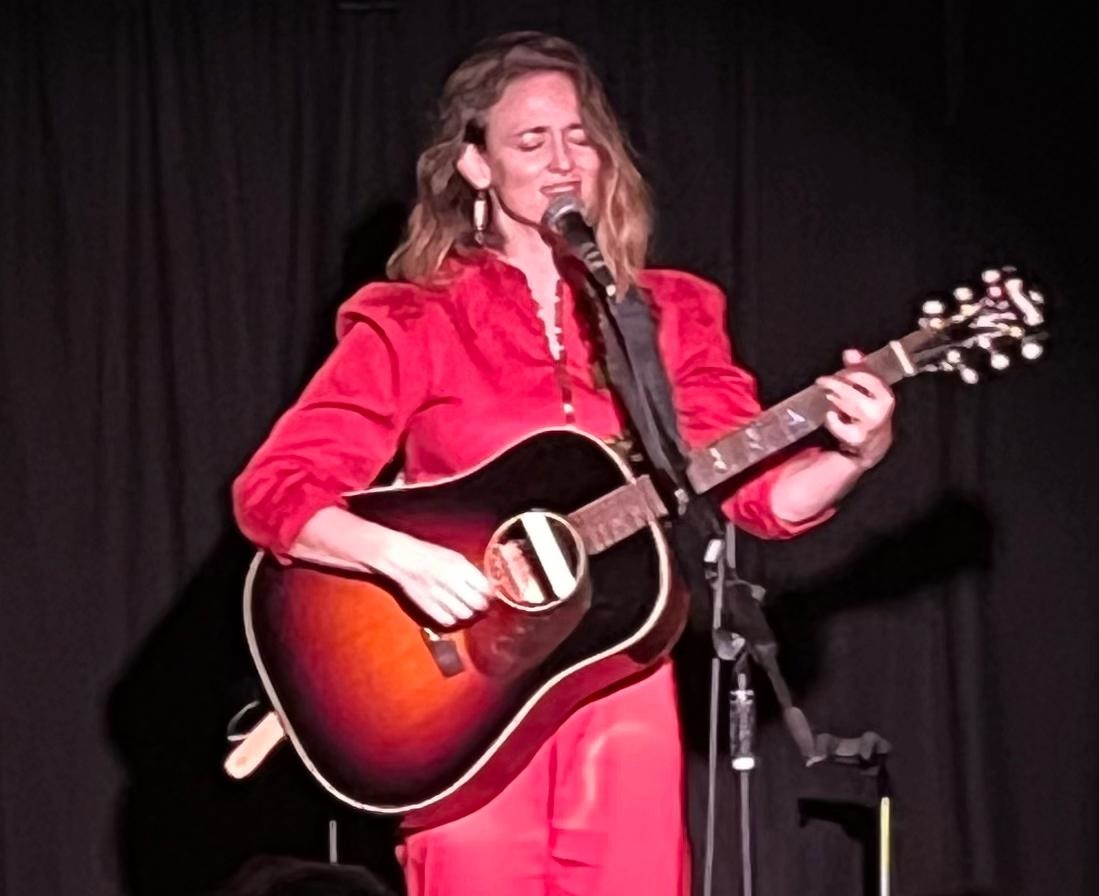
Dawn Landes (vocals, guitar) @ Komedia (Studio), Brighton, 8 September 2024
by John Earls. Photo (c) John Earls
Dawn Landes’ The Liberated Woman’s Songbook is a remarkable album and project. It is Landes’ re-imagining of the book of the same title, originally published by folk singer, guitar teacher and author Jerry Silverman in 1971.
The night before this performance it was the subject of a major concert at London Barbican’s Milton Hall, where Landes was joined a number of special guests including folk legend Peggy Seeger and poet Jackie Kay.
Tonight it was a central (but by no means exclusive) feature of this solo acoustic set at the much smaller Studio space of Brighton’s Komedia. Telling the stories and highlighting the voices of women through songs spanning over 200 years, this section of the evening had the feel of the best kind of musical history lesson.
Hard is the Fortune of All Womankind, a traditional ballad from 1830, is the earliest of the collection and was deeply affecting, as was The Housewife’s Lament (1866), whose lyrics come from the diary of a woman named Sarah A. Price in Ottawa, Illinois. She had seven children, all of whom died in her lifetime.
Bread and Roses (1912) was one of the songs for which Landes was ably joined by Sylvie Lewis. Along with The Mill Mother’s Lament (1929) – “Let’s stand together workers and have a union here” – and Florence Reece’s Which Side Are You On (1931), it emphasised that many of these songs are not just based on women’s liberation but workers’ and trade union rights also. This was apposite given that the annual meeting of the Trades Union Congress was taking place just up the road (in which I declare an interest as an attendee).
This may all sound rather earnest, but whilst the seriousness of the issues was never diminished, there was plenty of humour throughout the evening. This was helpfully illustrated by this section’s ending with Meredith Tax’s adaptation of the children’s song There was a Young Woman Who Swallowed a Lie (1970). These songs and these women still need to be heard.
This Liberated Woman’s section of the performance was bookended by songs from some of Landes’ other albums. The show opened with Bluebird, from the album of the same name celebrating its 10th anniversary, which set the tone perfectly. From the start it was clear this was going to be intimate, beautiful and ultimately joyous.
Heel Toe was captivating and smoky, Wind and Rain – “Hands up if you’ve had enough” – was fabulous, and there was an absolutely cracking version of Why They Name Whiskey After Men.
Dawn Landes has a gorgeous voice. The singing was clear and expressive, the guitar plucking deft and there were even some sparkling golden boots (“glitter makes things better!”) which were removed at times for some barefoot stomping or appended with tambourine.
All in all one genuinely got the sense that after the excitement of the previous night’s extravaganza this smaller club outing was a back to basics affair. Landes seemed to enjoy it and absolutely held the room.
John Earls is Director of Research at Unite the Union and tweets / updates his ‘X’ content at @john_earls
Published post no.2,296 – Tuesday 10 September 2024



 Arcana.fm