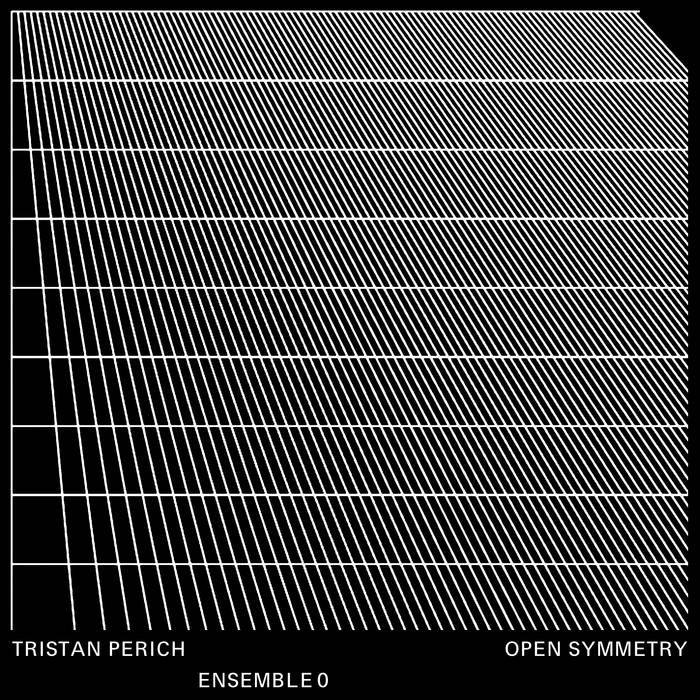
Open Symmetry is the first release on Erased Tapes from New York-based composer Tristan Perich.
As the commentary for the album describes, ‘Open Symmetry pares the ensemble down to just three musicians playing the resonant metal bars of three vibraphone accompanied with a glistening ensemble of 20 speakers, each playing their own separate musical part of the composition.”
Open Symmetry was the result of a meet-up in 2014 between Perich and Ensemble 0‘s Stéphane Garin, who commissioned the piece. Writing for three vibraphone and 1-bit electronics, Perich soon realised it would be a large-scale piece, and the piece occupied him until its premiere in 2019. This is the first recording.
What’s the music like?
Hypnotic is an oft-used word in musical descriptions, but it applies perfectly to the effect this epic piece has on its listener.
Perich’s treble-rich writing creates a rarefied atmosphere, and as the scope of the piece becomes clear there is a sense of assurance, the listener able to kick back and enjoy the piece on two levels.
The first and most immediate level is the short term, and the energetic loops Perich packs together for the vibraphones. Then, as the sections unfold, there is a long-term contentment, the music progressing naturally through each stage without losing any of its momentum.
After a bright introduction, Section 2 is where the pulsing qualities of the music really take hold, before Section 3 opens out beautifully into oscillating figures. Section 4 pulses with warmth and light, initially slow but ultimately powering through. Section 5 becomes like a shower of silvery rain, before Section 6 adopts a more percussive profile of chimes.
A buildup of energy ensues, emphatically released in Section 7 with a thrilling flurry of staccato chords that power to an ecstatic finish.
Does it all work?
It does. Perich writes with impressive conviction and creates vivid colours through motifs that dance in the half light.
Is it recommended?
Yes, enthusiastically. This is a highly impressive achievement, a substantial piece of minimalist music that is both original and effective. Like a long session of bell ringing, Open Symmetry will leave its listeners transfixed.
For fans of… Philip Glass, Steve Reich, Terry Riley
In the last week we heard the sad news of the death of the great Cornish baritone Benjamin Luxon, at the age of 87.
A much-loved singer, Luxon excelled in the opera house and the recital room – not to mention as a soloist in many important recordings of choral and vocal works. The playlist compiled below is packed with English music, with cycles from Vaughan Williams (Songs of Travel) and Stanford (Songs of the Sea).
Luxon took on the title role in the first recording of Benjamin Britten‘s TV opera Owen Wingrave in 1971, an excerpt of which you can also hear below:
You can also hear Benjamin Luxon’s Desert Island Discs on BBC Radio 4
CHERISE, Lucy-Anne Daniels, Marisha Wallace, Lizz Wright, Clarke Peters, BBC Concert Orchestra / Guy Barker
Royal Albert Hall, London Sunday 28 July 2024
reviewed by Richard Whitehouse Pictures (c) Andy Paradise
It has been customary in Proms seasons across the past decade to celebrate figures from those interconnected worlds of jazz, blues and soul. In this context, Sarah Vaughan (1924-90) was a natural choice as, though she rarely featured as a songwriter, her versatility across the musical spectrum meant she had few (if any) equals among her peers and even fewer successors. That tonight’s programme, and its four main singers, could do little more than touch on the relevant stylistic bases was itself tribute to one whose insisting ‘‘I am a singer’’ was not to be gainsaid.
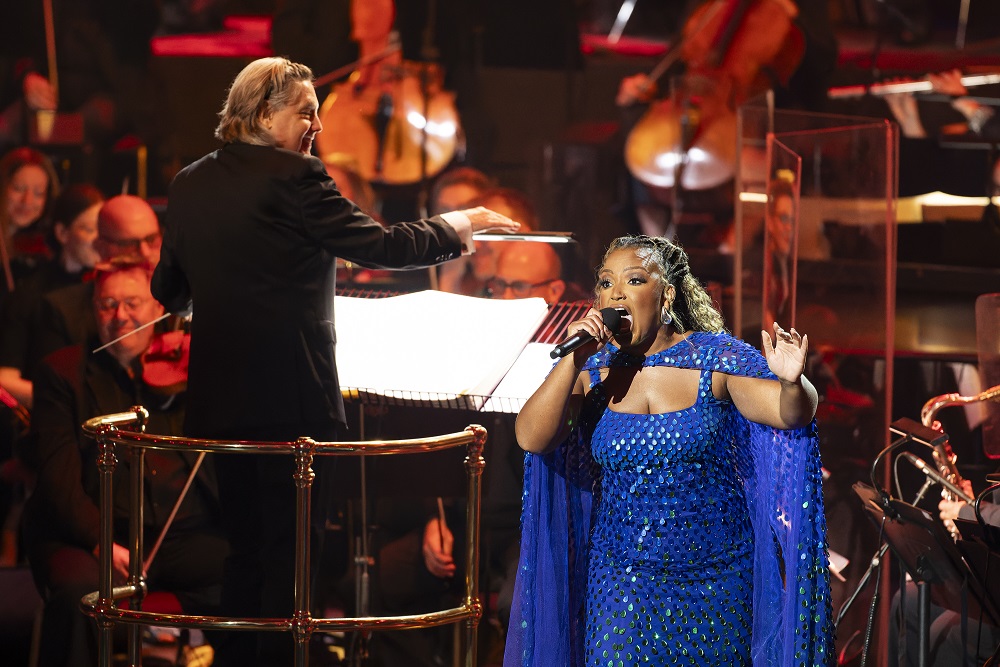
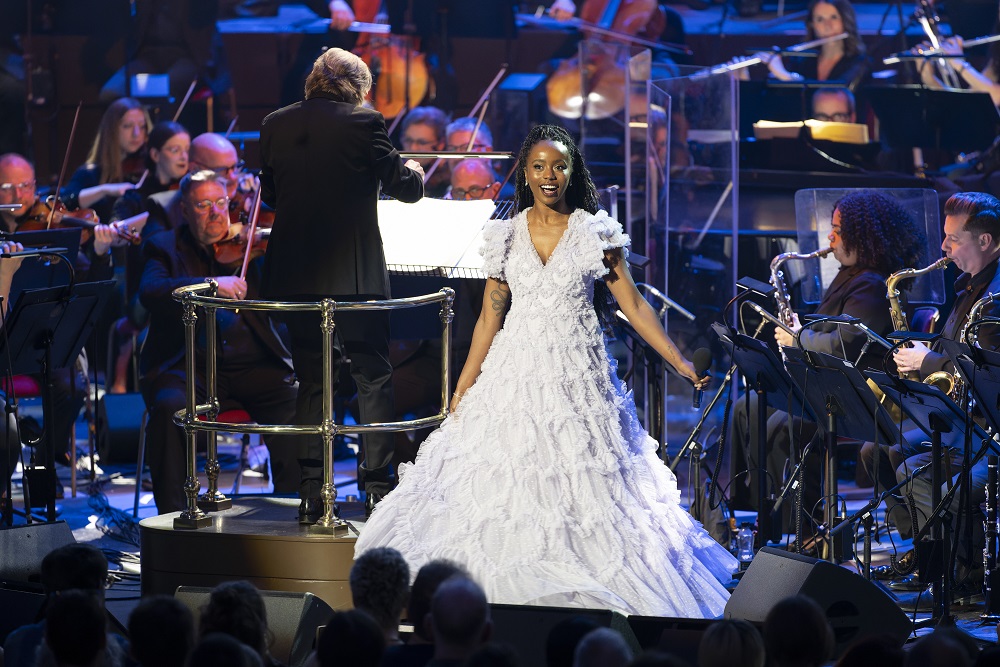
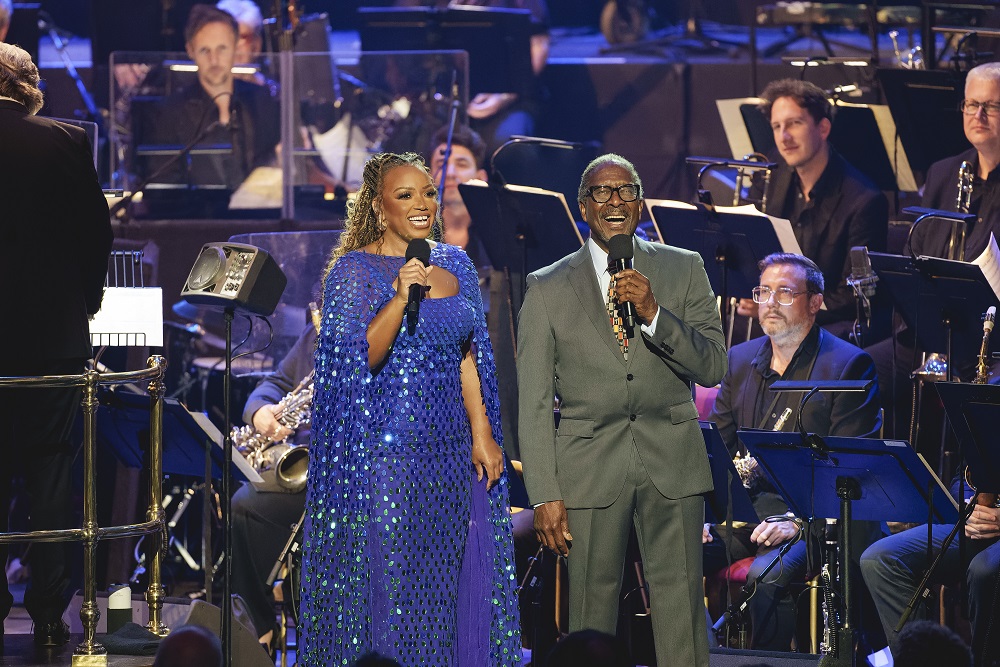
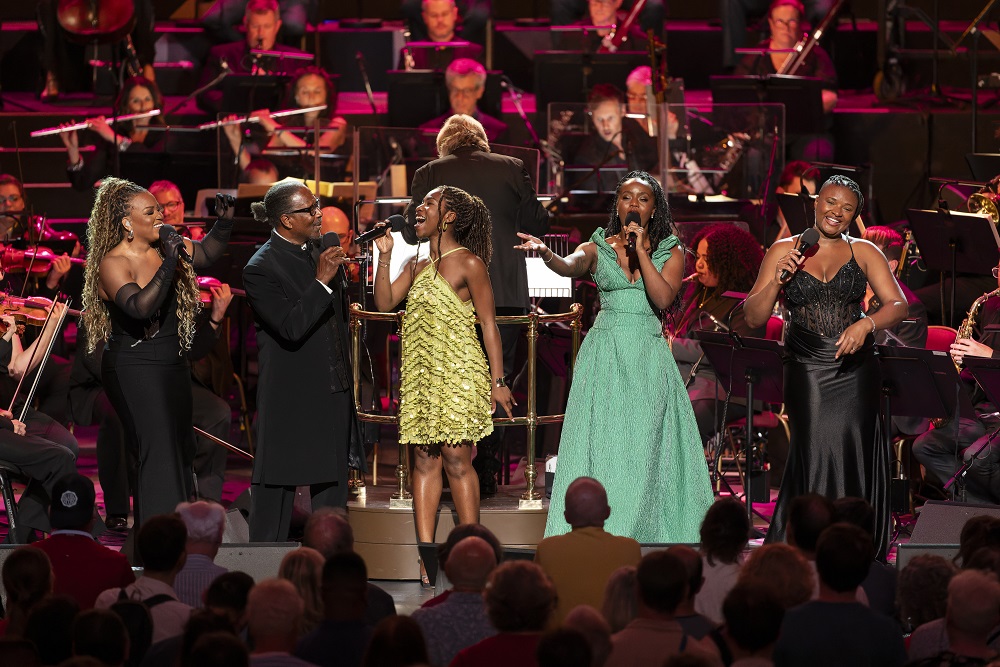
Marisha Wallace (above) pitched straight in with her no-holed-barred reading on I’m Gonna Live Till I Die, complemented by Lucy-Anne Daniels with an appropriately ‘sassy’ Nobody Else but Me then a soulful rendering of A Night in Tunisia (aka Interlude and surprisingly little heard as a vocal item). CHERISE (below) brought no mean pathos to I’ll Wait and Pray then no little wit to the catchy Mean to Me, while Clarke Peters made the most of his spotlight with a dextrous take on I Love the Rhythm in a Riff. Lizz Wright was eloquence itself in Tenderly, and despatched I Hadn’t Anyone Till You with a deft touch, then CHERISE gave a melting rendition of Misty (more affecting for the absence of affectation), but Daniels’s rather ‘by numbers’ scat rather undersold Sassy’s Blues – a pity given this was a rare Vaughan co-write. Wallace returned to round off the first half with a contrasting brace in which My Man, encompassing the wistful and dramatic in equal measure, proved a perfect foil to Great Day whose sheer vocal agility made for an undoubted showstopper with the BBC Concert Orchestra firing on all cylinders.
The orchestra came into its own at the start of the second half, its Bebop Instrumental Medley of standards by Thelonious Monk (‘Round Midnight, Little Rootie Tootie and Pannonica) and Dizzy Gillespie (A Night in Tunisia and Manteca) engaging reminder of the musical environs out of which Vaughan emerged. Daniels then sounded a plaintive tone in Body and Soul, with CHERISE’s insinuating take on Double Rainbow (whistling done to perfection) a reminder of Vaughan’s attraction to Brazilian music in later years. Wallace and Peters were a characterful double-act in Passing Strangers (without banishing memories of Kiki Dee and Scott Walker in their 1968 reading) while CHERISE was raunchiness incarnate in Don’t Be on the Outside, before Wright took the stage for a sequence comprising a moody Black Coffee, sultry Lullaby of Birdland then a confiding If You Could See Me Now which underlined just why this should have become a signature-tune for Vaughan.
Daniels consequently upped the ante with a blithe I Cried for You, ideally complemented by Wallace with her genial take on Just a Little Lovin’. Although tonight was very much a showcase for vocal prowess, most of the items found space for at least one instrumental solo and rightly so, given the roster of ‘names’ in the BBCCO (a pity that woodwind and reeds were omitted from the personnel in the programme). As conductor (and arranger?), Guy Barker set his inimitable seal on proceedings which hopefully brought Sarah Vaughan a younger generation of admirers. All four vocalists (and Peters) returned for a send-off in the guise of an effervescent take on Perdido that assuredly brought the house down.
Prom 13: Sarah Vaughan – If You Could See Me Now. CHERISE
Lucy-Anne Daniels
Marisha Wallace
Lizz Wright
Clarke Peters presenter
BBC Concert Orchestra
Guy Barker conductor
The night’s program was as follows:
Curtis/Hoffman/Kent: I’m Gonna Till I Die Kern: Nobody Else but Me Gillespie: Interlude (A Night in Tunisia) Treadwell/Valentine: I’ll Wait and Pray Ahlert: Men to Me Eckstine: I Love the Rhythm in a Riff Gross: Tenderly Noble: I hadn’t Anyone Till You Garner: Misty Vaughan/Jones: Sassy’s Blues Yvain: My Man Youmans: Great Day Monk/Gillespie: Bebop Instrumental Medley Green: Body and Soul Jobim: Double Rainbow Mitchell/Applebaum/Mann: Passing Strangers Kelly/Watts/Wyche: Don’t Be on the Outside Burke: Black Coffee Shearing: Lullaby of Birdland Dameron: If You See Me Now Arnhelm/Lyman: I Cried for You Mann/Weil: Just a Little Lovin’ Martínez: Perdido
Matthew Bourne returns to first principles, with his first solo piano album since the 2017 release Isotach.
The press release reveals that there are, however, some restrictions around the recording of the album, “born from an off-hand comment by one of Matthew Bourne’s confidants. His instruction, “Do not delete,” provided Bourne with a commission of sorts, an ideal restriction to work within. Everything on the album was given a chance to shine in the studio, to be worked on amongst the freedom of that no deletion diktat – new inspirations now lie beside deep-mined remembrances. Cello and Dulcitone have been added sparingly for colour, but this is Bourne playing for his own enjoyment. Intimate. Reserved even. The real Matthew Bourne?”
What’s the music like?
There is a stillness about Matthew Bourne’s playing on this album that proves to be rather moving. Every note is carefully considered and weighted, and delivered in a conversational manner that makes the listener feel they are the only person in the room with him.
The titles give this away too, personal reflections like To Francesca, Dissemble (for Brian Irvine), Only When It Is (In Memoriam Bill Kinghorn) and Dedicated To You, Because You Were Listening (In Memoriam Keith Tippett) The first of these uses rich cello and crystalline Dulcitone beautifully to complement its lightly questioning phrases. The Bill Kinghorn and Keith Tippett tributes are stately, the latter with a mournful, tolling motif that gathers power before subsiding to near silence.
By contrast The Mirror And Its Fragments has an eerie undertone, with low cello again in the mix.
Does it all work?
It does – being a completely unforced way of making music. The emphasis is on communication of feelings and meanings more than anything else, with the result that the ‘less is more’ approach winds hands down.
Is it recommended?
It is. While Matthew Bourne’s exploits on the big screen should be encouraged, and his more experimental workings with keyboards and other instrumental groups, it is great to hear him go back to where it all began. With new insights, this is a piano-led album to savour.
For fans of… Yann Tiersen, Dustin O’Halloran, Zbigniew Preiser
Britten Gloriana – Symphonic Suite Op.53a (1953) Frances-Hoad Cello Concerto ‘Earth, Sea, Air’ (2022) [Proms Premiere] Elgar Symphony no.2 in E flat major Op.63 (1909-11)
Laura van der Heijden (cello), BBC Scottish Symphony Orchestra / Ryan Wigglesworth
Royal Albert Hall, London Friday 26 July 2024
reviewed by Richard Whitehouse
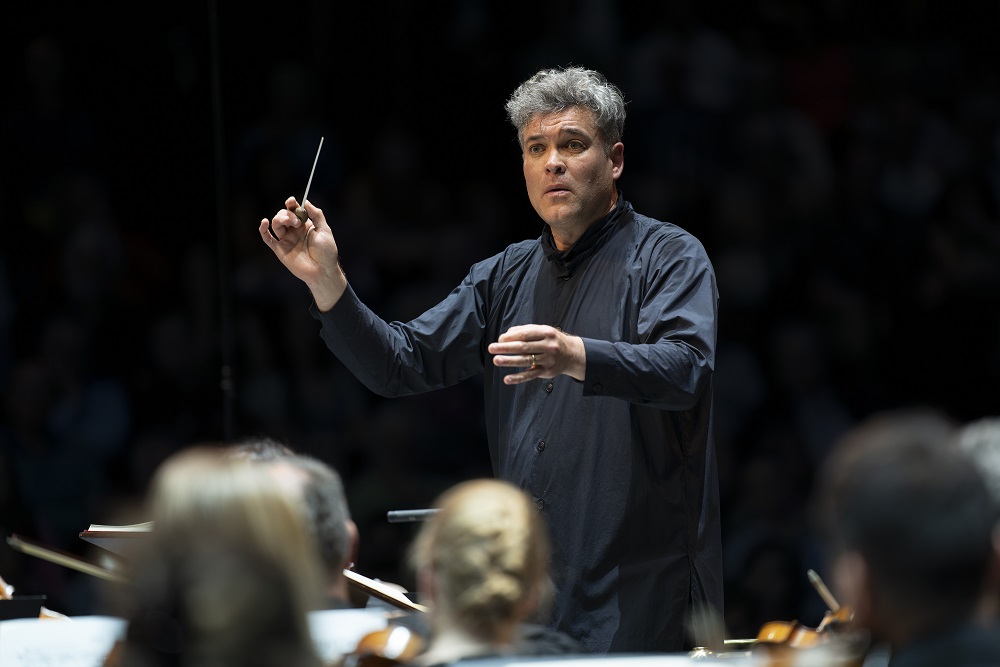
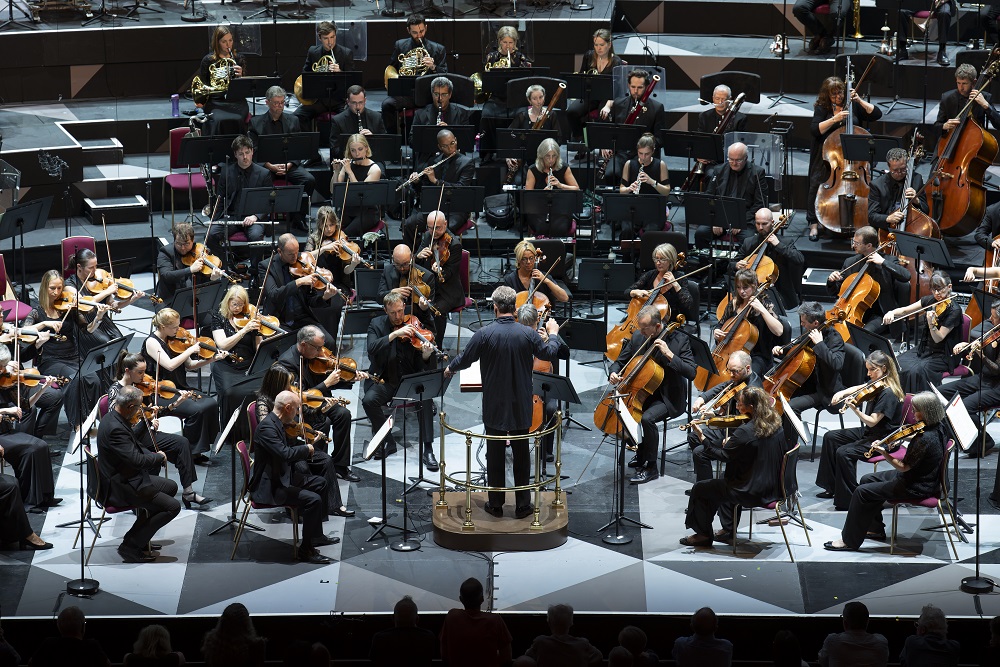
He might not be the only composer-conductor of his generation, but Ryan Wigglesworth has rapidly established himself among the best – as this concert with the BBC Scottish Symphony Orchestra, whose chief conductor he has been over these past two seasons, amply confirmed.
Other than Peter Grimes, the coolly received Gloriana was his only opera from which Britten extracted a concert suite. The vaunting syncopation of Tournament then wrenching fatalism of Gloriana moritura make for a telling framework, with this account at its most perceptive in the wistful poise of the Lute Song – the oboe being an eloquent replacement for the tenor thanks to Stella McCracken – then the evocative sequence of Courtly Dances where Britten effortlessly bridges the historical and the aesthetic divide between the eras of two Elizabeths.
Next a first Proms hearing (just over a year after its Glasgow premiere) for the Cello Concerto by Cheryl Frances-Hoad. Drawing inspiration from recent research into diverse aspects of the natural world, the three continuous movements provide an arresting vantage on an outwardly traditional form. Hence the trajectory of swifts in flight, carbon-absorbing algae over oceanic expanses and gravitational force of volcanic activity each influencing the musical content of a rhythmically impulsive Allegro, harmonically diaphanous Larghetto and melodically soaring Presto giocoso; the whole afforded unity through its composer’s motivic resourcefulness and the engaging commitment of Laura van der Heijden (above) in her realizing of its solo part. She then responded to deserved applause with a limpid reading of Pablo Casals’ The Song of the Birds.
Elgar is a composer evidently close to Wigglesworth’s heart and this evening’s account of his Second Symphony did not disappoint. Launched a little too circumspectly, the initial Allegro duly found a persuasive balance between bounding energy and that musing uncertainty to the fore in the otherworldly processional near its centre. Its overall extroversion was countered by the Larghetto – circumstantial association with the death of Edward VII having tempted many into a funereal pacing but not Wigglesworth, whose handling of its cumulative halves brought sustained emotional intensity framed by the stark lamentation with which it begins and ends.
One of Elgar’s most formally subtle and expressively audacious movements, the scherzo had the requisite impetuousness and nonchalance, thrown into relief by the mechanistic violence towards its core and unnerving energy at its close. Moderate in tempo and not overly majestic in outlook the finale might have been thought anti-climactic, but Wigglesworth’s keen sense of its long-term unfolding emerged in the searching ambivalence of its development and the understated grandeur of a peroration which did not require reinforcing with an organ pedal. Those closing pages could have yielded even greater pathos, but their suffused fatalism was wholly in accord with the conductor’s conception of this movement, as of the work overall.
Just over a year before, Wigglesworth presided over an inspirational account in Birmingham of The Dream of Gerontius. Tonight’s performance of the Second Symphony might not have been quite its equal, but it more than confirmed him as an Elgar interpreter of genuine stature.




 Arcana.fm